AIME 180-Minute Practice: Block Timing That Matches Real Exam Pressure

The AIME rewards sustained reasoning over speed, and the best way to prepare is to practice under conditions that mirror the real exam's 180-minute pressure. A proven block-timing strategy divides the test into four difficulty-based segments: about 30 minutes for the opening five problems, 60 minutes for the middle four, 60 minutes for the next three, and 45 to 135 minutes for the final three problems, depending on their individual difficulty. This structure, drawn from Hanlin's teaching observations (WeChat article, November 4, 2026), helps students build the stamina and decision-making habits needed for a strong score.

Why Block Timing Matters for AIME

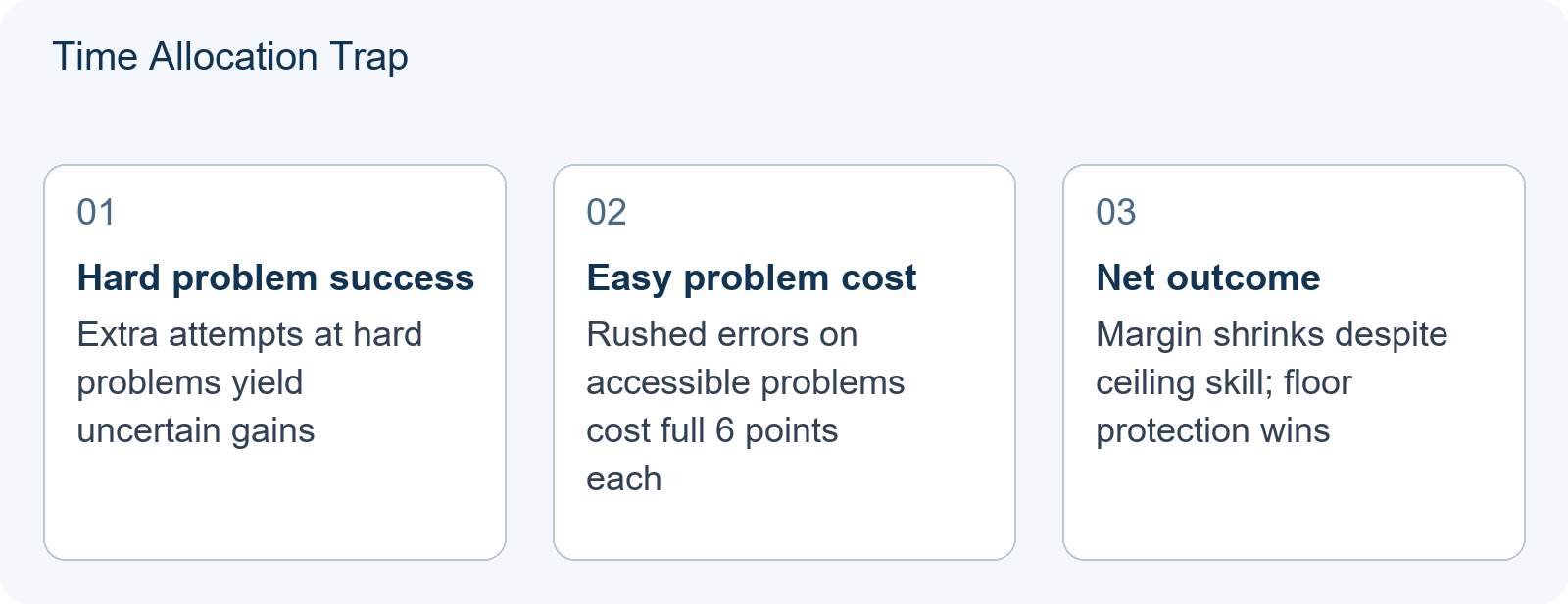
Unlike the AMC, where speed and pattern recognition dominate, the AIME demands deep, uninterrupted thought. Each answer is an integer from 0 to 999, and partial credit does not exist. A single careless error on an early problem can cost as much as a failed attempt at a late problem. The block-timing method protects against both risks: it ensures you secure points on accessible problems while preserving energy for harder ones.

The core insight from Hanlin's AIME teaching experience is that problems cluster by difficulty and time requirement. Treating the exam as a uniform sprint leads to rushed errors on early problems and premature abandonment of late problems that yield to patience.

The Four-Block Framework

Below is the recommended time allocation, with problem ranges mapped to approximate AMC 12 difficulty equivalents and per-problem time budgets.

Block AIME Problems AMC 12 Equivalent Time Budget Per-Problem Average
1 Q1–Q5 Q15–Q18 ~30 minutes ~6 minutes
2 Q6–Q9 Q18–Q21 ~60 minutes ~15 minutes
3 Q10–Q12 Q21–Q23 ~60 minutes
~20 minutes 4 Q13–Q15 Q24–Q25 45–135 minutes

Note that the total for all four blocks ranges from 195 to 285 minutes. Because the exam is only 180 minutes, successful students must reallocate time from earlier blocks when those problems yield quickly, or accept that not every problem can receive full attention. The table above represents target investments, not fixed entitlements.
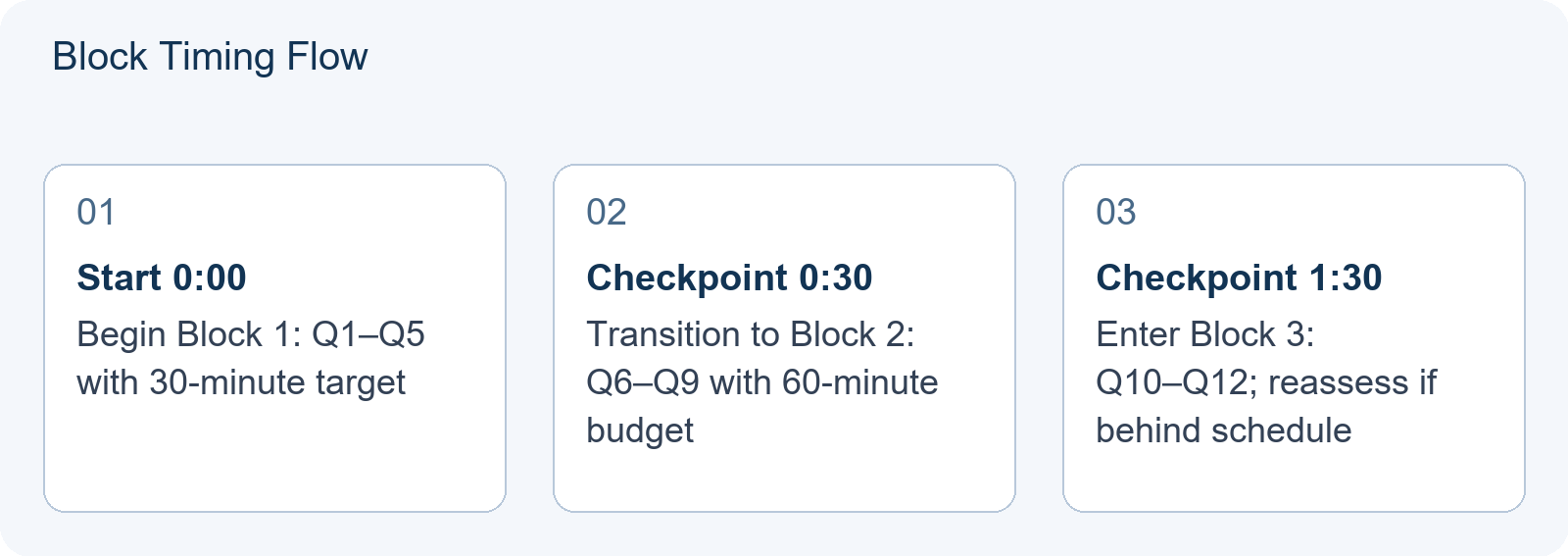
Block Timing Flow

Block 1: Secure the Foundation (Q1–Q5, ~30 Minutes)

The first five problems correspond roughly to AMC 12 problems 15 through 18 in difficulty. They test core competency in algebra, geometry, counting, and number theory without requiring advanced techniques. The goal is near-perfect accuracy with minimal time expenditure.

Teaching illustration: Consider a problem asking for the sum of all positive integers n ≤ 100 such that n² + 3n + 2 is divisible by 5. A student using block timing would recognize this as a modular arithmetic pattern: n² + 3n + 2 ≡ (n+1)(n+2) ≡ 0 (mod 5), so n ≡ 3 or 4 (mod 5). The count is 20 + 20 = 40, and the sum is computed via arithmetic series. This should take under 5 minutes, preserving mental energy.

If a Block 1 problem resists quick solution, mark it and move on. The cost of a 6-minute struggle here is 20% of your early-problem budget.

Block 2: Build Momentum (Q6–Q9, ~60 Minutes)

Problems six through nine introduce more complex structures: systems with symmetric substitutions, geometric configurations requiring auxiliary constructions, or counting problems with multiple constraints. The per-problem average rises to about 15 minutes, but individual problems may vary.

This block is where AIME Combinatorics: Build a State Table Before Writing a Recurrence and AIME Number Theory: Choose Euler or CRT With a Divisibility Ladder become valuable. Students should have these techniques automated enough that choosing the right tool is instinctive, not deliberative.

The 60-minute budget assumes two problems at 10 minutes, one at 15, and one at 25. If you find yourself exceeding 20 minutes on any single problem here, flag it for potential return and invest in Block 3 confidence.

Block 3: Deep Work (Q10–Q12, ~60 Minutes)

Problems ten through twelve represent a significant difficulty escalation, comparable to AMC 12 problems 21 through 23. These problems often require synthesizing multiple techniques or sustaining a long chain of deductions. The 20-minute per-problem average acknowledges that some solutions require extensive computation or careful case analysis.

According to Hanlin's teaching observations (November 4, 2026), this is also where knowledge of advanced trigonometric identities, Newton sums, and recursive methods pays dividends. Students who have systematically prepared find that algebra and geometry problems in this block offer more reliable paths to completion than combinatorics problems, which can have hidden complexity.

Block 4: The Final Push (Q13–Q15, 45–135 Minutes)

The last three problems are the most variable in time requirement. The source explicitly notes that each averages 15 to 45 minutes, meaning the total investment for this block alone can range from 45 to 135 minutes. This is not a typo or exaggeration; it reflects genuine variance in problem difficulty and individual student preparation.

Given the 180-minute exam constraint, students aiming for scores of 10 or below should treat Q13–Q15 as opportunities for selective depth rather than mandatory completion. The path to 8+ points runs through mastery of Q1–Q10, not through heroic stands at Q15.

For students targeting USA/JMO qualification or similar distinctions, the strategy shifts: secure Q1–Q10 efficiently to create a time surplus, then allocate that surplus to the problem in this block that best matches your strengths. A geometry specialist might invest 40 minutes in Q13 while accepting minimal time for Q14–Q15, whereas a combinatorics specialist makes the opposite choice.

Implementing the Practice Schedule

To train with this framework, use past AIME papers under strict 180-minute conditions. Record your actual time spent per problem and compare against the block targets. Over multiple practice exams, patterns emerge: perhaps you consistently overspend in Block 2 due to hesitation between methods, or you rush Block 4 and abandon viable approaches.

Weekly practice structure:

  • Day 1: Full 180-minute timed practice with fresh problems. Record block times.
  • Day 2: Review errors without time pressure. Identify whether each error was conceptual (did not know method), procedural (knew method but executed poorly), or strategic (spent too long on wrong problem).
  • Day 3: Targeted skill work on the weakest block from Day 1's practice.
  • Day 4: Second full 180-minute practice, ideally with problems from a different year to reduce familiarity effects.
  • Day 5: Light review and mental preparation; avoid new material.

Reallocation and Review Strategy

Because the block totals exceed 180 minutes, effective time management requires dynamic reallocation. The source emphasizes that students who score 8 or above typically complete Q1–Q10 in about 90 minutes, leaving 90 minutes for the remaining problems and review.

This 90-minute surplus is where the final three problems receive their funding. A student who solves Q1–Q10 in 80 minutes has potentially 100 minutes for Q11–Q15, but a student who needs 110 minutes for Q1–Q10 has only 70 minutes remaining and must be more selective.

Review time should focus on:

  • Arithmetic verification in Block 1 answers (quick wins, high return)
  • Checking that answers are integers between 0 and 999 (format errors are disqualifying)
  • Re-examining problems where you have a partial solution but recorded no final answer

When to Adjust the Framework

This block structure is a teaching tool, not an official MAA rule. Individual variation is expected. Students with exceptional speed but occasional carelessness might reduce Block 1 to 20 minutes and increase review time. Students who find middle problems particularly challenging might accept a 70-minute Block 2 and correspondingly tighten Block 3.

The essential discipline is honest measurement. Without timing data from practice exams, adjustments are guesswork. With data, you build a personalized pacing plan grounded in your actual performance distribution.

Connecting Preparation to Competition Format

For the 2027 season, AIME qualification in the US and Canada requires AMC 10 scores of at least 100 or AMC 12 scores of at least 85, per MAA announcement (August 26, 2026). Testing dates are February 5 and 6, 2027. These specifics apply to the US and Canada; other regions may have different administrative arrangements.

Students preparing outside the US and Canada should verify their local AIME format, timing, and any regional administrative differences with their competition manager.

Summary: Your 180-Minute Practice Plan

Priority Action Target Outcome
1 Master Q1–Q5 with near-perfect accuracy under 30 minutes 5 points secured, minimal energy expended
2 Develop reliable methods for Q6–Q9, especially algebra and geometry 4 additional points, building to 9 total
3 Strategically select Q10–Q12 based on personal strength 1–2 more points, reaching 10+ threshold
4 Allocate remaining time to Q13–Q15 selectively 0–3 points depending on problem match and time surplus
5 Reserve 10–15 minutes for targeted review Eliminate careless errors, confirm answer format

The block-timing method transforms an overwhelming 180-minute endurance test into a series of manageable intervals with clear decision points. Practice it consistently, measure your results, and adjust to your own pattern of strength and speed.

Diagnosing Your Own Block-Timing Leaks

Knowing the framework is different from executing it. The most common failure pattern is not that students spend too long on hard problems, but that they lose track of which block they are in and let a single problem consume the budget of an entire segment. A practical diagnostic, drawn from Hanlin's teaching observations (WeChat article, November 4, 2026), is to treat every practice exam as a data-collection exercise rather than a score-maximization exercise.

After each timed practice, record four numbers: the actual minutes spent on each block, the number of problems fully solved in each block, and the number of problems where you recorded an answer but later found an error. Most students discover that their leakage is concentrated in one of two places. Either Block 2 expands to 80 minutes because of hesitation between methods, or Block 4 collapses to 10 minutes because earlier blocks ran over and panic set in.

Teaching illustration: A student consistently scores 6 points on practice exams despite solving 10 problems correctly in untimed conditions. Her timing data reveals 45 minutes on Block 1, 75 minutes on Block 2, 40 minutes on Block 3, and 20 minutes on Block 4. The leak is in Block 1: she is verifying answers three times and re-reading problems for hidden complexity that does not exist. The correction is a hard 30-minute alarm and a forced move to Block 2 regardless of remaining uncertainty. After three practices with this constraint, her Block 1 accuracy remains unchanged at 4 out of 5, but her Block 2 completion rises from 2 to 4 problems, lifting her score to 9.

The concrete next task is to run this diagnostic on your next two practice exams before modifying any other part of your preparation. Without this measurement, block timing remains a theoretical preference rather than a trained habit.

General event background is available at Event background.
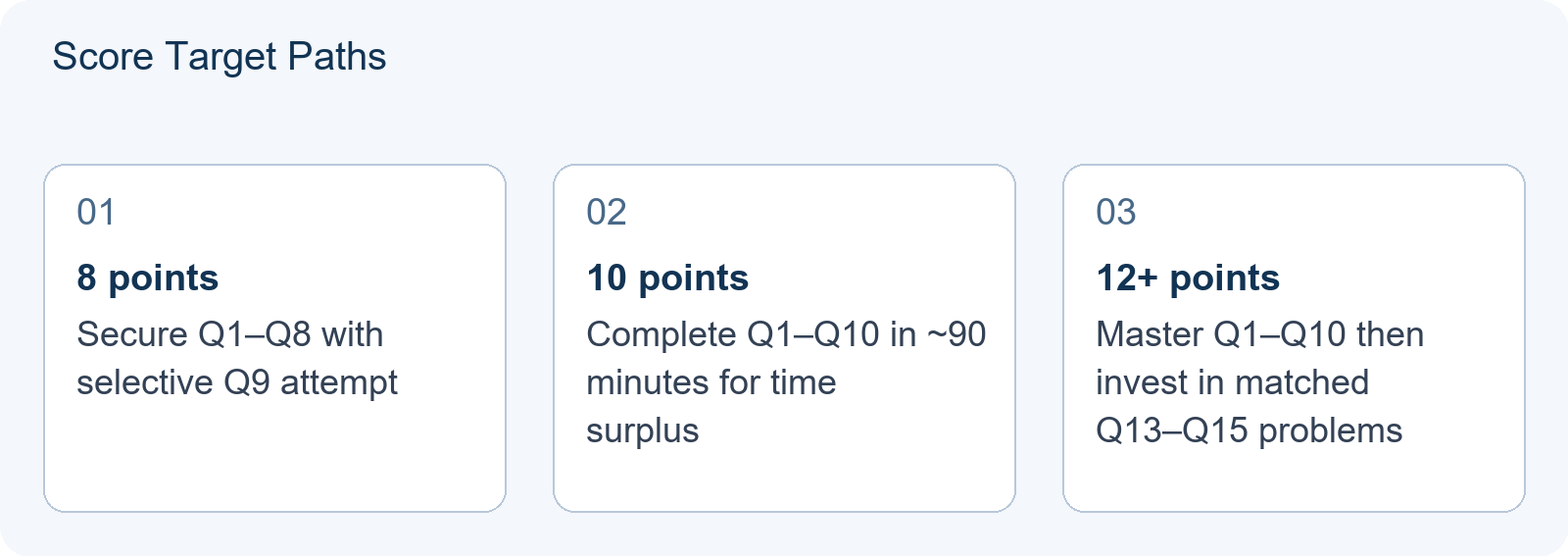
Score Target Paths

Frequently Asked Questions

What if I can't finish Q1-Q5 in 30 minutes?

This signals a gap in foundational skills or excessive caution. Practice untimed first to build method familiarity, then reintroduce time pressure gradually. If a problem resists quick solution after 2-3 minutes, mark your best approach and move on—you can return if time permits.

How does the 180-minute limit work with block totals exceeding 180 minutes?

The block times represent investment targets, not simultaneous requirements. You reallocate time from faster blocks to slower ones. Completing Q1-Q10 in 90 minutes leaves 90 minutes for the remaining problems, which matches the source guidance for 8+ scores.

Should I attempt every problem or focus on my strongest blocks?

For most students, a full attempt at Q1-Q10 with selective investment in Q11-Q15 maximizes expected score. Only students consistently solving Q1-Q12 in practice should plan mandatory attempts at Q13-Q15. The final three problems average 15-45 minutes each—time that must come from earlier efficiency.
AIME Fixed Cutoff Targets: How Much Above 100 or 85 Is Actually Safe

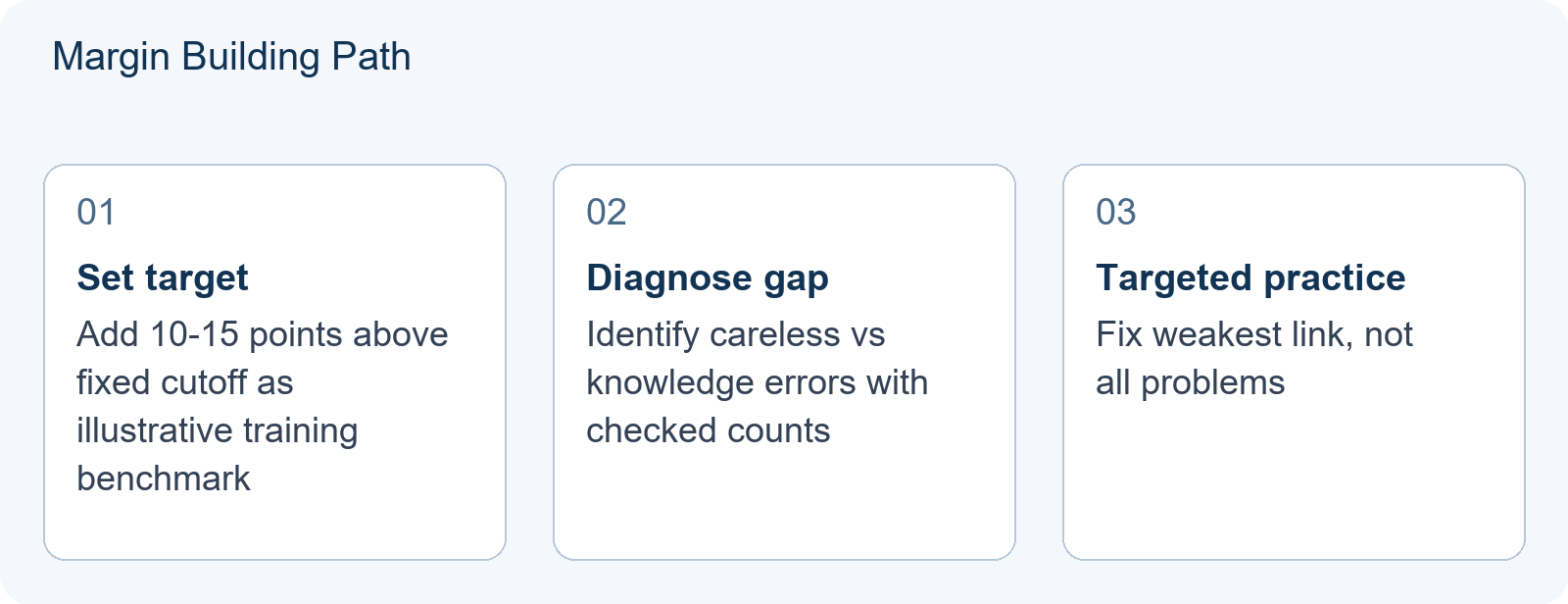
For the 2027 season, AIME qualification uses fixed cutoffs for the first time: AMC 10 at 100 points and AMC 12 at 85 points (MAA, August 26, 2026; Hanlin Courses, November 4, 2026). If you are asking how far above these numbers you need to score for reliable qualification, the short answer is that no single margin guarantees safety. Your personal buffer should reflect the stability of your practice scores, not a universal rule.

Why the Fixed Cutoff Changes the Calculation

Before 2027, AIME cutoffs fluctuated year to year based on overall performance distributions. Students aimed to exceed recent historical lines, which typically landed between 90–105 for AMC 10 and 80–95 for AMC 12 depending on paper difficulty. The new fixed system removes that uncertainty. You now know the exact threshold before sitting the exam.

This clarity, however, creates a different risk. With a known target, students may fixate on scraping past 100 or 85 rather than building robust competence. A student who scores 102 on AMC 10 under ideal conditions but drops to 98 under pressure has no margin for error. The fixed cutoff does not care about your potential—it cares about your actual score on test day.

What Determines a "Safe" Margin

Coaching experience suggests three factors shape how much above the fixed cutoff you should aim:

Factor Lower buffer sufficient Higher buffer advised
Score consistency Practice scores vary ±3 points Practice scores vary ±10+ points
Time pressure handling Rarely leave questions blank Often rush final problems
Calculation error rate 1 or fewer errors per test 2+ careless errors common

A student whose AMC 10 practice scores cluster tightly around 110–115 with minimal careless errors can treat 100 as genuinely secure. Another whose scores swing from 95 to 115 depending on paper alignment needs a higher average target to absorb bad days.

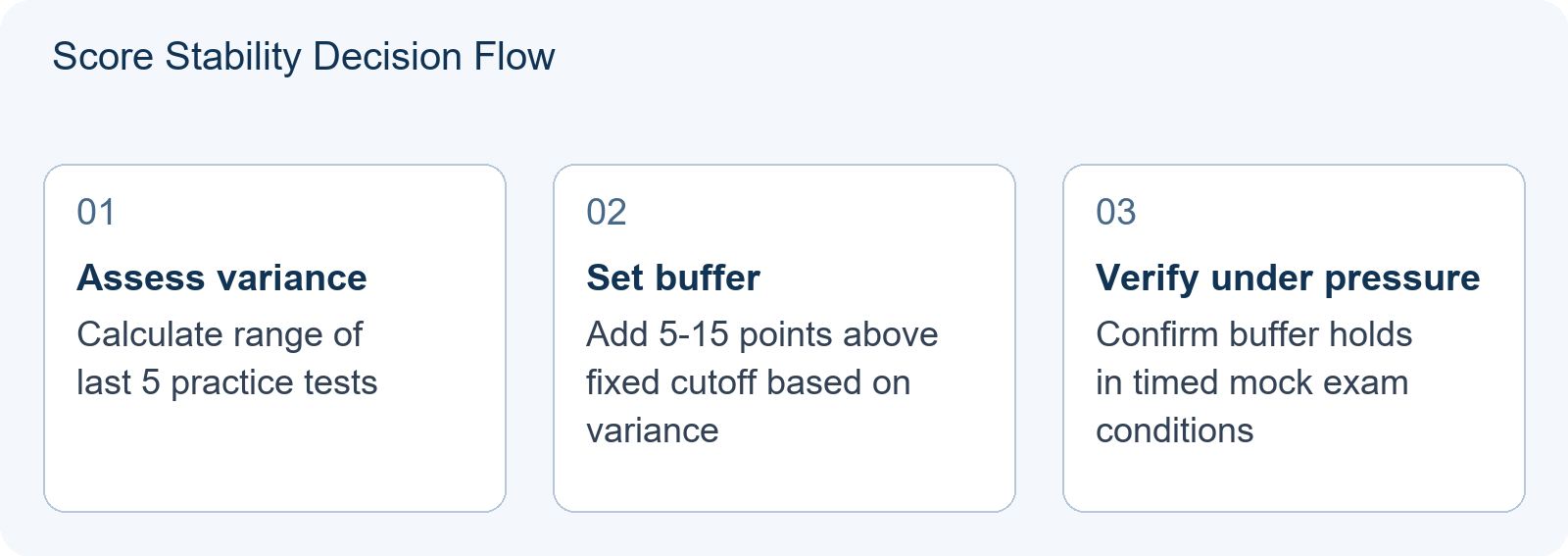
Score Stability Decision Flow

Teaching Illustration: Estimating Your Personal Cutoff

Consider two hypothetical students preparing for AMC 10, both with the same 105 average on recent practice papers:

  • Student A scored 108, 106, 104, 107, 105 on five timed tests. Their range is narrow (4 points), and they tend to lose marks only on genuine knowledge gaps, not errors. A target of 102–105 on exam day is reasonably safe.
  • Student B scored 115, 98, 112, 93, 107 on the same papers. Their average is identical, but the range is 22 points. Two of those scores fall below the 100 cutoff. Student B should aim to push their average to 110+ and specifically address what caused the 93 and 98 performances before considering themselves secure.

This example illustrates why average score alone misleads. The distribution around that average determines your risk.

AMC 12: The Lower Cutoff, Different Dynamics

The AMC 12 fixed cutoff of 85 sits proportionally lower relative to total points (150) than AMC 10's 100. This reflects the exam's increased difficulty and steeper score compression at the top. However, the same principle applies: your safety margin depends on score stability, not the cutoff value itself.

AMC 12 students often face a particular trap. Because 85 seems modest compared to 100, they may underestimate the precision required. In practice, AMC 12 problems 15–20 demand more sustained reasoning than their AMC 10 analogues. Consider a student who solves 13 problems correctly, misses 2, and leaves 10 blank: the score is 13×6 + 2×0 + 10×1.5 = 78 + 15 = 93. If the same student attempts 15 problems with 2 errors and leaves nothing blank: the score is 13×6 + 2×0 + 10×0 = 78—well below cutoff. The margin for error is thinner than raw numbers suggest because each wrong answer costs 6 points of potential score and forfeits the 1.5-point blank return.

Building Score Stability: Practical Steps

Based on Hanlin's teaching observations (November 4, 2026), these practices improve score consistency:

1. Error logging. Record every mistake from practice tests for two weeks. Categorize as: knowledge gap, method selection error, calculation slip, or time pressure artifact. Calculation slips and time pressure artifacts are the fastest to fix and most damaging to cutoff safety.

2. Controlled timed practice. Alternate full timed tests with "pressure-free" untimed solves of the same problems. If your untimed score exceeds timed by more than 15 points, anxiety or pacing—not knowledge—caps your performance. Address this with AIME Mock Review: Separate Setup Errors From Execution Errors.

3. Strategic skipping. On AMC, a blank returns 1.5 points; a wrong answer returns 0. If you cannot solve a problem in twice your average time per question, the expected value of guessing is negative unless you have eliminated at least two options. Students hovering near cutoff should master this decision rule.

From AMC Qualification to AIME Performance

Qualifying for AIME is not the end goal for most competitive students. The AIME itself uses a 15-question, 3-hour format with integer answers from 0 to 999. Its problems 1–5 correspond roughly to AMC 12 problems 15–18 in difficulty, while problems 13–15 reach well beyond (Hanlin Courses, November 4, 2026). Note: the source text contains 'Math Olymiad' [sic] for Math Olympiad.

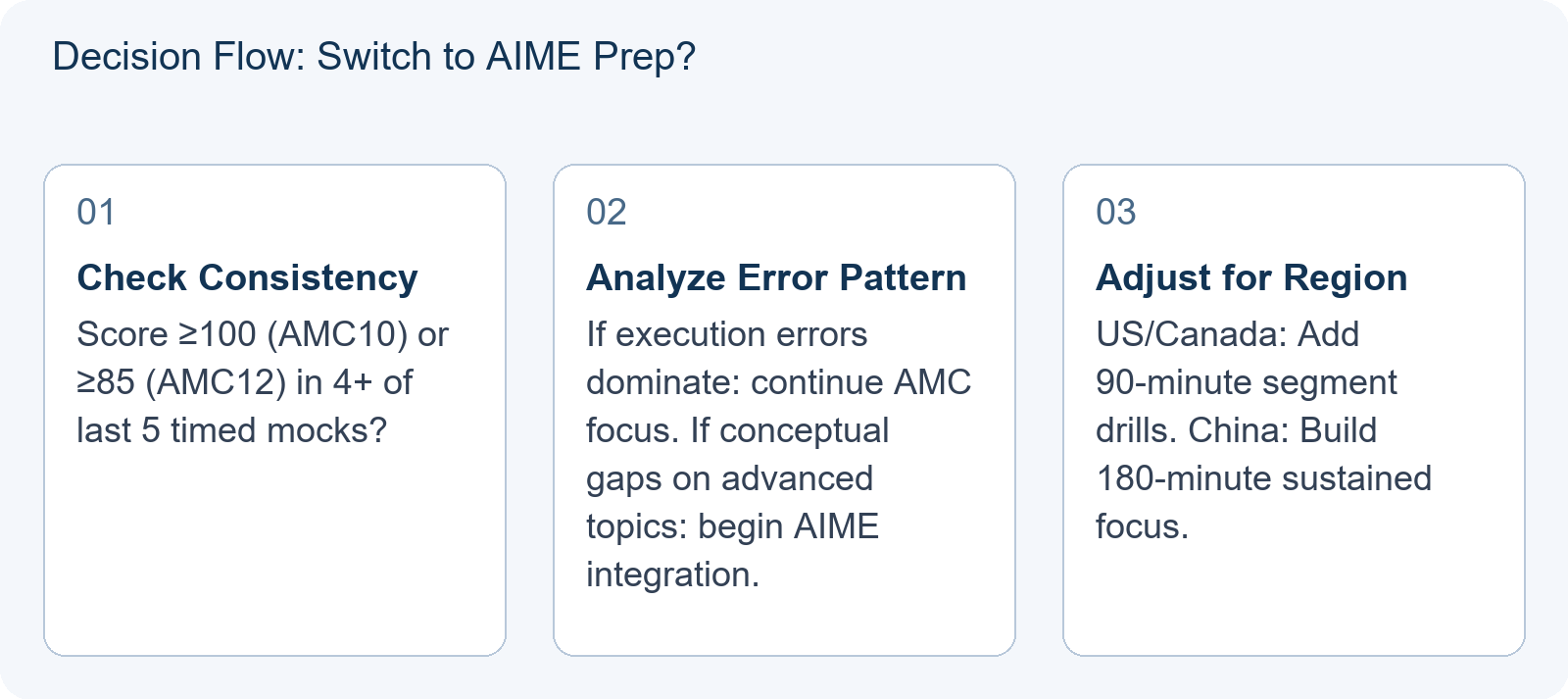
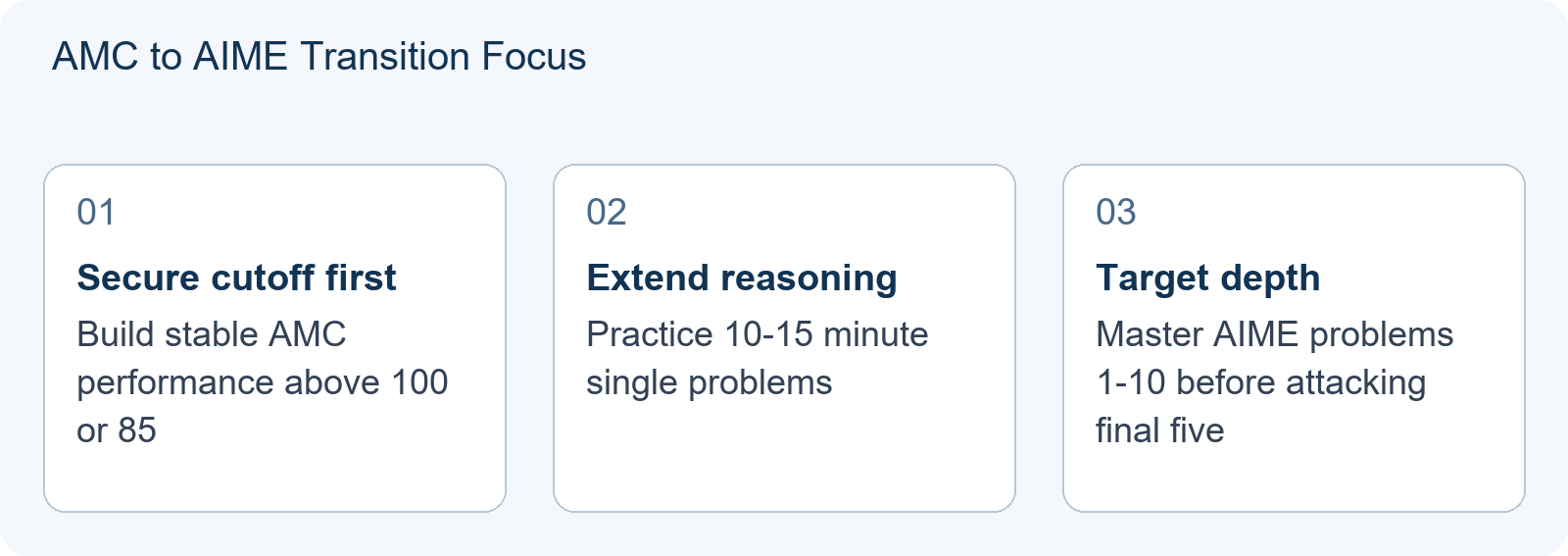
Students who barely clear the AMC cutoff with unstable scores often struggle with AIME's demand for sustained concentration. The skills that build cutoff safety—consistent execution, error reduction, reliable pacing—directly transfer. AIME Preparation After AMC: When to Switch From Speed to Sustained Reasoning requires this foundation.

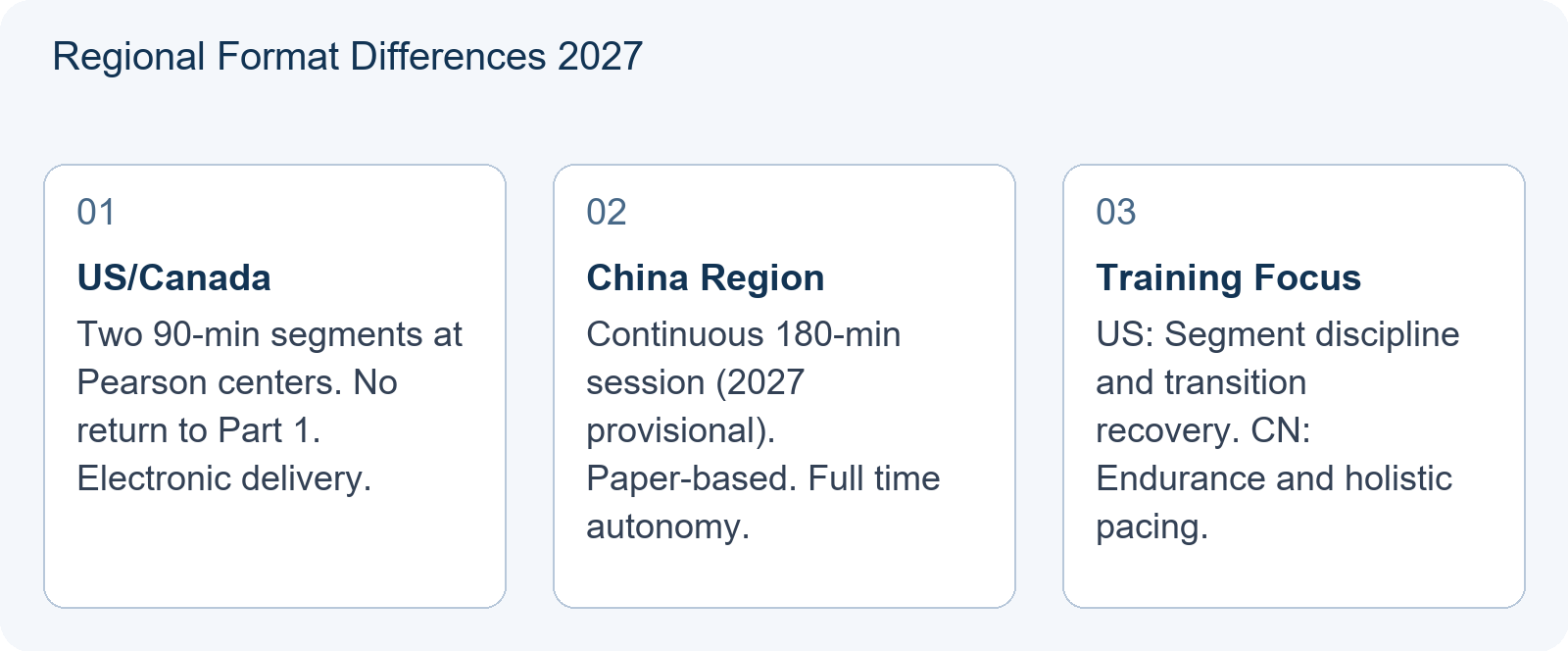
Regional Format Differences for 2027

Your preparation timeline depends on your testing region. Note that the US and Canada schedule differs from China:

Feature US and Canada China (International Program)
Exam dates February 5 and 6, 2027 To be confirmed by local organizer
Session structure Two separate testing dates 180 minutes continuous
Navigation Single session per date; cannot combine Free movement among all problems
Key preparation focus Consistent performance across both dates Flexible pacing and problem ordering

China-region students retain full control over their 180 minutes, which rewards strategic problem ordering. The US and Canada have February 5 and 6 as testing dates per MAA announcement; students should verify with their testing center whether they select one date or are assigned. AIME Pacing Practice: Prepare for Your Region's 2027 Format.

Interpreting Your Practice Scores: A Diagnostic Teaching Illustration

The earlier teaching illustration compared two students with identical 105 averages but very different score distributions. Here is how to apply that framework to your own data, what conclusions are valid, and what to do next.

Step 1: Gather your last five timed practice tests. Use only full-length exams under competition conditions—75 minutes, no interruptions, no checking answers afterward before scoring. Untimed or partial tests distort the diagnostic.

Step 2: Compute three numbers. Let your scores be s1,s2,s3,s4,s5 in any order.

  • Mean: s¯=(s1+s2+s3+s4+s5)/5
  • Minimum: smin=min(s1,…,s5)
  • Range: R=max(s1,…,s5)−smin

Step 3: Apply the diagnostic rules.

Condition Interpretation Recommended target above fixed cutoff
s¯≥110 and R≤8 Stable high performance Current level is safe; shift to AIME prep
s¯≥110 and R>15 High ceiling, unstable floor Aim for s¯+5; diagnose low outliers
100≤s¯<110 and smin≥100 Reliably above cutoff Maintain; reduce variance before raising average
100≤s¯<110 and smin<100 Average masks real risk Aim for s¯+8 to s¯+12; this is Student B's situation
s¯<100 Below cutoff on average Do not target AIME margin yet; rebuild AMC fundamentals

Step 4: Work the explicit diagnostic. Suppose your five AMC 10 practice scores are 97, 103, 99, 108, and 113. Then s¯=104, smin=97, and R=16. You fall in the fourth row: your average exceeds 100, but you have already scored below the fixed cutoff during practice. The 113 is encouraging but irrelevant to qualification safety—you do not get to choose which test day to count. Your valid inference is that you are not yet stable enough for 100 to be reliable.

Step 5: The concrete next practice task. For the next two weeks, do not take any more full timed tests. Instead, after each practice problem you attempt during normal study, record:

  • Whether you solved it correctly under time pressure
  • If wrong, whether you had the method but made an error (execution), or never found the method (setup)

After ten sessions, compute your execution error rate: execution errors divided by total problems attempted. If this exceeds 15%, your volatility is fixable through slower careful work, not more knowledge. Return to full timed tests only when your execution error rate drops below 10% for two consecutive sessions. This directly addresses the instability that caused your 97 and 99, not the ceiling that produced your 113.

Practical Exercise: The Two-Week Stability Drill

Coaches at Hanlin (November 4, 2026) recommend a focused two-week protocol for students whose practice scores fluctuate around the cutoff. The goal is not to learn new material but to identify and eliminate sources of score variance.

Week one: alternate days between timed and untimed solving. On timed days, work only problems 1 through 20 of any AMC 12 or problems 1 through 15 of any AMC 10 under standard time limits. Record every error without looking at the answer key first. On untimed days, revisit the same problems you missed. If you solve them correctly when time pressure is removed, the issue is execution under pressure, not knowledge. Log whether each error was a setup failure (never found the method) or execution failure (had the method but made a slip).

Week two: apply targeted fixes. For execution errors, practice writing out each step of arithmetic or algebraic manipulation explicitly, even when it feels slow. Many students who skip steps to save time actually lose time by hunting for arithmetic mistakes later. For setup errors, study the problem's structural features without solving it: what topic does it belong to, what theorems typically apply, and where the likely trap lies. This builds pattern recognition without requiring full computation.

After this two-week block, take one full timed test. Compare your score variance to the previous two weeks. If your range has narrowed, you have a reproducible method for stability. If not, the issue may be foundational gaps rather than pressure, and you should shift from margin-building to core skill review before returning to timed practice.

General event background is available at Event background.

AMC to AIME Transition Focus

Frequently Asked Questions

What exactly are the 2027 AIME fixed cutoff scores?

For the 2027 season, AIME qualification requires AMC 10 score of at least 100 or AMC 12 score of at least 85. These are fixed thresholds announced by MAA on August 26, 2026.

How much above the cutoff should I aim to score?

Aim for a buffer based on your score stability, not a fixed number. Students with narrow score ranges (±3 points) may need only 5 points above cutoff. Those with volatile performance should target 10–15 points above to absorb bad days.

Does China use the same AIME format as the US and Canada in 2027?

No. China-region students take a single 180-minute continuous exam with free navigation among all problems. The US and Canada have February 5 and 6, 2027 as testing dates; the specific session structure depends on the testing center, and students should verify with their local organizer.

AIME Readiness Diagnostic: From AMC Speed to Sustained Problem Solving

The gap between AMC success and AIME competence is not merely a matter of harder problems. It is a fundamental shift from rapid recognition to sustained written reasoning. Many students who breeze through AMC questions by pattern-matching find themselves frozen when an AIME problem demands fifteen minutes of concentrated deduction. This article offers a practical diagnostic framework to identify where your reasoning breaks down and how to rebuild it for the longer, more demanding AIME format.

Recognizing the Speed-to-Stamina Transition Point

The AMC rewards quick identification of familiar structures. Most problems are designed to be solved in under two minutes, and the highest scorers often finish with time to spare. AIME problems, by contrast, are engineered for depth. A common observation notes that AIME questions 1 through 5 roughly correspond to AMC 12 questions 15 through 18 in difficulty, yet they demand written justification rather than multiple-choice elimination. This means a student who comfortably scores 120 on the AMC may still struggle to complete five AIME problems in the allotted time.

The transition point manifests differently for each student. Some find themselves racing through the first few AIME problems only to stall on calculation-heavy steps. Others over-invest time in early problems, leaving insufficient energy for the middle tier where strategic choices matter most. The diagnostic task is to locate your personal breakpoint: the problem number at which your current habits shift from productive to counterproductive.

Teaching illustration: Consider the case of a student we will call M. After qualifying for AIME with a 112 on the AMC 10, M spent the first practice session attempting to solve problems as quickly as possible. M completed three problems in the first hour but made arithmetic errors on two of them and had no meaningful progress on problems 4 through 6. The diagnostic revealed that M's AMC-trained pace was actively harmful; the solution was not more speed but deliberate slowing and structured verification.

Building a Personal Diagnostic Protocol

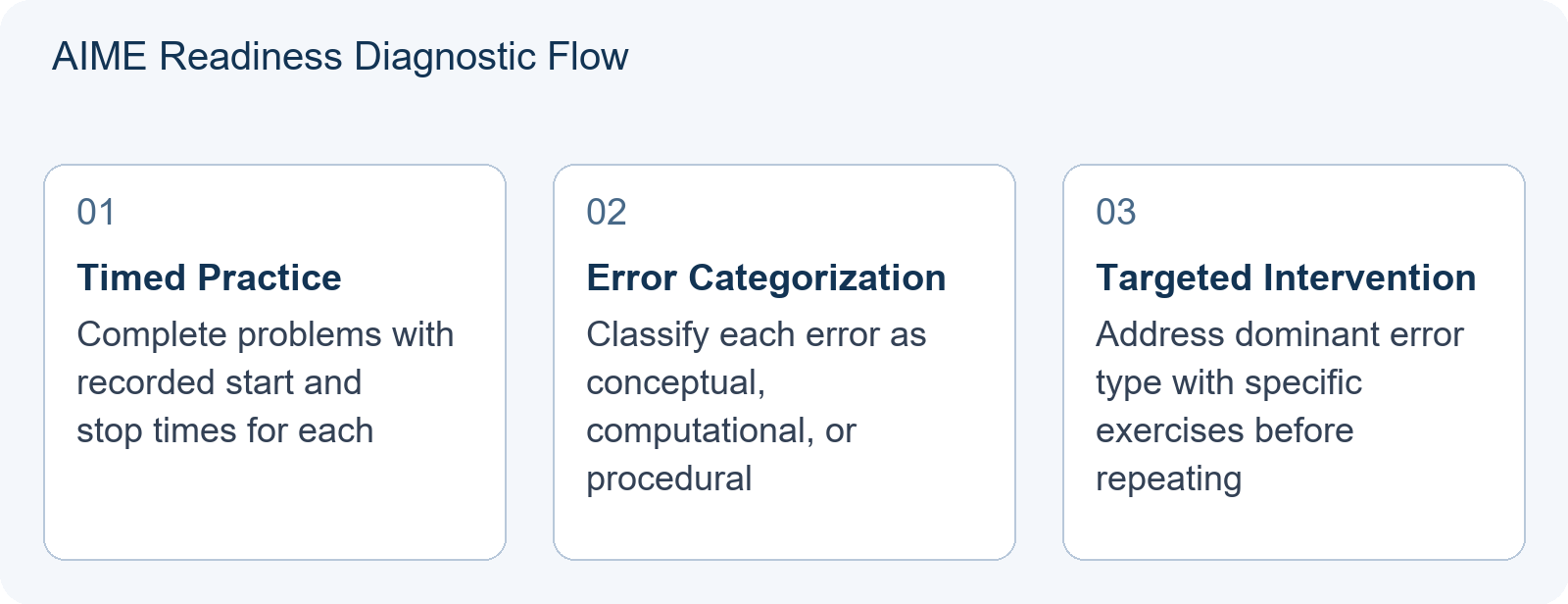
A useful AIME Readiness Diagnostic must measure more than problem count. It should capture where your time goes, where your errors cluster, and how your confidence aligns with actual performance. The protocol begins with a timed practice session using problems from past competitions, but with a twist: you must record your start and stop time for each problem, mark your confidence level before checking answers, and categorize every error as conceptual, computational, or procedural.

Conceptual errors indicate missing knowledge or misapplied theorems. Computational errors are arithmetic or algebraic slips despite correct approach. Procedural errors occur when you abandon a viable path or fail to complete a solution strategy. Over multiple sessions, patterns emerge. A student with frequent conceptual errors in number theory knows to prioritize Euler's theorem and the Chinese Remainder Theorem. One with computational errors needs verification rituals. Procedural errors suggest the need for more explicit planning before writing.

The Hanlin teaching team emphasizes that this diagnostic should be repeated every two weeks during preparation, with results tracked in a simple spreadsheet. The goal is not to maximize any single score but to watch the error distribution shift. When computational errors decline and procedural errors become the dominant category, you are approaching AIME readiness. When conceptual errors persist in specific topics, targeted study is indicated before further full-length practice.

AIME Readiness Diagnostic Flow

Allocating Time With the Three-Zone Model

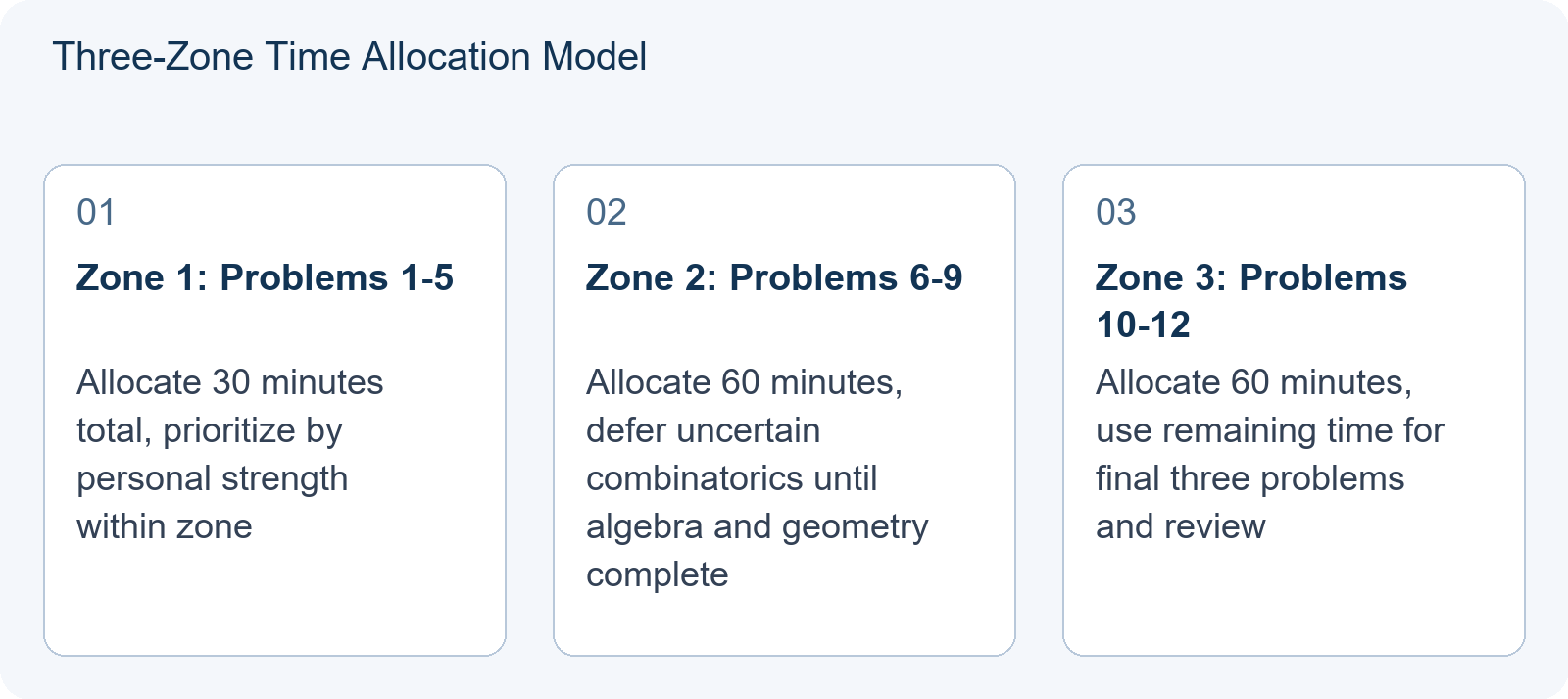
Effective AIME pacing rejects uniform time distribution. The three-zone model, derived from the Hanlin difficulty mapping, assigns 30 minutes to problems 1 through 5, 60 minutes to problems 6 through 9, and 60 minutes to problems 10 through 12, with remaining time for the final three problems and review. This reflects the empirical observation that securing eight correct answers typically requires solid execution in the first two zones rather than partial progress across all fifteen problems.

The model is prescriptive but not rigid. Within each zone, you should sequence problems by personal strength rather than numerical order. If combinatorics consistently consumes disproportionate time with uncertain outcomes, defer those problems within a zone until the algebra and geometry questions are addressed. The Hanlin analysis notes that algebra and geometry together comprise approximately ten of the 15 problems, with number theory and combinatorics splitting the remainder in various ratios.

Teaching illustration: For a hypothetical student, implementing the three-zone model meant initially skipping problem 7, a combinatorics question, in favor of problem 8, a geometry problem involving trigonometric relationships. This sequencing choice allowed the student to accumulate correct answers more efficiently and build momentum. The diagnostic insight was that time allocation had previously been dictated by problem order rather than strategic assessment of expected return on time investment.

Developing Written Reasoning Stamina

AMC preparation often emphasizes mental calculation and answer selection. AIME demands the opposite: extended written chains of reasoning without intermediate feedback. The shift is analogous to training for a sprint versus a middle-distance race. Muscles used for explosive speed must be reconditioned for sustained output, and the same applies to cognitive processes.

Building stamina requires graduated exposure. Begin with single problems that take 10 to 15 minutes, working fully through the writing process without interruption. Progress to pairs of problems in 25 minutes, then triples in 40 minutes. Only after several weeks should you attempt full 15-problem sessions. The Hanlin recommendation of daily mock examinations in the final week is effective precisely because it assumes this base has already been built; premature full-length practice risks reinforcing bad habits under fatigue.

The writing itself matters. AIME solutions are graded on correctness, not elegance, but clear organization reduces error rates. A suggested template includes: restate given conditions, identify the target quantity, note the key theorem or technique to be applied, execute calculations in sequence, and verify boundary conditions. This structure added perhaps 30 seconds per problem but dramatically reduced the rate of abandoned partial solutions and unnoticed algebraic sign errors.

Mastering the Core Algebra and Geometry Toolkit

The Hanlin analysis identifies algebra and geometry as the backbone of AIME preparation, typically accounting for ten or more problems per examination. Within algebra, particular attention should go to trigonometric identities beyond the basic set, including auxiliary angle formulas and sum-to-product transformations. These appear in symmetric triangle conditions and periodic function analysis that AMC 12 rarely explores in depth.

Geometry preparation must emphasize computational tools over classical theorem memorization. While Menelaus, Ceva, and Ptolemy have their place, a common observation is that modern AIME geometry problems are generally solvable with basic properties plus heavy application of trigonometry, coordinate geometry, and complex numbers. The critical skill is identifying which computational framework simplifies a given configuration. A hypothetical student initially attempted synthetic approaches to every geometry problem, often stalling; after diagnostic review, the student learned to assess within 60 seconds whether coordinate or trigonometric methods offered cleaner access.

For algebra specifically, Newton sum techniques and functional equations appear with modest frequency but high payoff when recognized. The preparation strategy is not to master the most general forms but to recognize the characteristic patterns: symmetric polynomial relationships, recursive coefficient structures, and substitution opportunities that reduce unfamiliar equations to standard forms.

Navigating Number Theory at the Advanced Boundary

Number theory problems on the AIME, particularly from question 11 onward, regularly invoke Euler's theorem and the Chinese Remainder Theorem in ways that AMC 10 and 12 only hint at. The diagnostic question here is whether you can state these theorems precisely, identify their preconditions, and execute the multi-step constructions they require.

Euler's theorem states that for coprime integers a and n, a raised to the power of phi(n) is congruent to 1 modulo n, where phi(n) is Euler's totient function. The AIME application typically requires computing phi(n) for composite moduli, verifying the coprimality condition, and then using the resulting exponent reduction to solve a congruence. The Chinese Remainder Theorem requires solving a system of congruences with pairwise coprime moduli by constructing a solution through linear combinations. Both theorems demand comfort with modular arithmetic manipulation that goes beyond the AMC level.

Teaching illustration: A hypothetical student's diagnostic revealed conceptual weakness in applying these theorems to composite moduli. The targeted response was a sequence of exercises: first verifying Euler's theorem for small cases, then applying it to reduce large exponents, then combining with the Chinese Remainder Theorem for problems with multiple modulus conditions. This progression, maintained over two weeks, transformed number theory from a feared category to a reliable source of points in the middle and upper zones.

Approaching Combinatorics With Recursive Structure

AIME combinatorics diverges from AMC practice primarily in its emphasis on recursive methods and advanced combinatorial identities. Vandermonde's identity and related convolution formulas appear with sufficient regularity to warrant deliberate study. The diagnostic challenge is recognizing when a counting problem admits recursive decomposition rather than direct enumeration.

The state table technique, referenced in validated materials, provides a concrete framework. Before writing a recurrence, explicitly enumerate the states that describe partial configurations, identify transitions between states, and verify boundary conditions. This discipline prevents the common error of writing recurrences that miscount initial conditions or double-count intermediate configurations. For path-counting problems on grids or graphs, the state might encode current position and a constraint history; for coloring problems, it might track the pattern of the last few elements.

Teaching illustration: A hypothetical student applied this method to a practice problem involving counting sequences with local constraints. The initial attempt used direct multiplication and yielded an incorrect answer. After constructing an explicit state table with three states representing the relevant history, the recurrence emerged cleanly, and the boundary conditions were verifiable by inspection. The diagnostic lesson was that combinatorics errors were largely procedural: rushing to algebra before establishing structural clarity.

Implementing Verification and Review Rituals

The AIME answer format, a three-digit integer from 0 to 999, offers no partial credit and no opportunity to learn from multiple-choice distractors. Verification is therefore not a luxury but a necessity. The Hanlin guidance emphasizes checking both the mathematical reasoning and the final transcription, with particular attention to extraneous roots in algebraic problems and off-by-one errors in combinatorial counting.

A practical verification ritual has three components. First, after completing a solution, pause and articulate the answer in words: what does this number represent in the problem context? This semantic check catches many computational errors. Second, verify boundary cases explicitly. If a formula was derived for general n, does it hold for the smallest stated case? Third, recompute critical steps by an alternative method. If a geometry problem was solved with coordinates, check key lengths with the law of cosines; if a recurrence was solved by characteristic equation, verify the first few terms by direct computation.

Teaching illustration: For a hypothetical student, implementing these rituals initially felt time-consuming, but the diagnostic data showed a reduction in incorrect answers from 40 percent to under 15 percent. The time invested in verification was more than recovered by eliminating the need to revisit problems during review time. In the final preparation phase, practice scores stabilized in the 8 to 10 range, a significant improvement from the initial 3 to 4, and the diagnostic protocol had served its purpose of identifying and addressing the specific barriers between AMC competence and AIME readiness.

General event background is available at Event background.

Three-Zone Time Allocation Model

Frequently Asked Questions

How early should I begin AIME preparation after completing the AMC?

Begin immediately after the AMC, regardless of whether you have received official confirmation of qualification. A common observation emphasizes that waiting until results are announced leaves insufficient time to develop the sustained reasoning skills AIME requires. Start with diagnostic practice to identify your transition point from AMC speed to AIME stamina.

What is the most common mistake students make when transitioning from AMC to AIME?

The most common mistake is maintaining AMC pacing habits. Students who attempt to solve AIME problems in two to three minutes typically make careless errors or abandon viable approaches prematurely. The diagnostic protocol specifically targets this by forcing timed recording and error categorization to break the speed habit.

How should I balance topic study versus full-length practice?

Spend the majority of preparation time on targeted topic study and graduated stamina building. Full-length practice becomes dominant only in the final two weeks. A common recommendation of daily mock examinations in the last week assumes a foundation already built; premature full-length practice reinforces errors under fatigue rather than correcting them.

AIME Combinatorics: Build a State Table Before Writing a Recurrence

For 2027 AIME combinatorics preparation, build the state table before writing a recurrence. Name the ending classes that control the next legal move, list their transitions, hand-check small cases, and only then trust the algebra. This matters when a counting condition depends on the last symbol, the last two symbols, or an asymmetric restriction rather than on a single total.

Why the state table comes before the recurrence

A recurrence is a compressed description of transitions between states. If the state is wrong, the recurrence can look neat and still count the wrong objects. A common failure is to assume every valid string of length n has the same number of legal extensions. That is true only when the restriction is symmetric with respect to the next symbol. Many AIME-style counting conditions are not symmetric: whether a 1 may be appended can depend on whether the current string already ends in 1.

The order should be: name the states, write the legal moves between states, compute the first few values by hand, and only then solve or iterate the recurrence. This is also the discipline behind the period-detection method in the related AIME Recurrence Relations: Find the Period Before Expanding Long Sequences: a recurrence must be correctly specified before its long-term behavior means anything. The state table is the specification.

MAA’s public invitational-competitions page lists the 2027 AIME as 15 integer-answer questions with answers 0–999; the final count must collapse to one integer, but the counting logic must be valid first.

A complete teaching illustration: length-6 binary strings

Teaching illustration (original, not an official contest problem): Count the length-6 binary strings that contain no two consecutive 1s. A binary string uses only 0 and 1; “no consecutive 1s” means the substring 11 never appears.

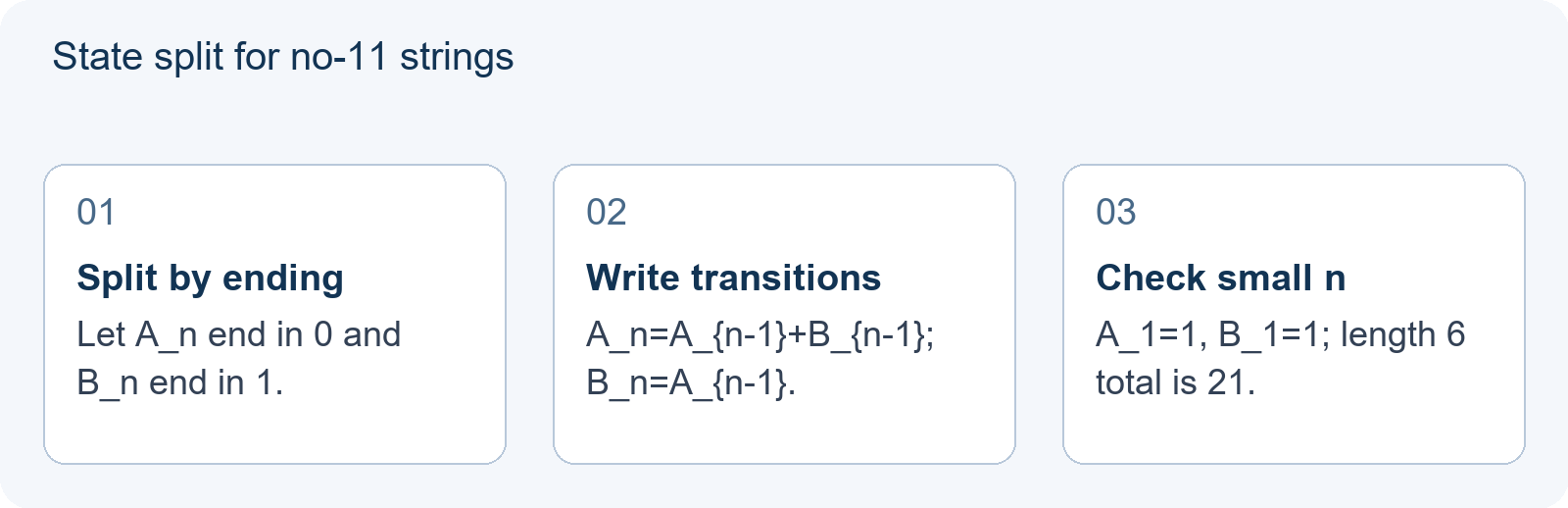
Do not start with a recurrence. Start with the last symbol, because that is what controls whether appending another 1 is legal. Let An be the number of valid length-n strings ending in 0, and let Bn be the number of valid length-n strings ending in 1.

  • To form a valid length-n string ending in 0, append 0 to any valid length-(n−1) string. So An = An−1 + Bn−1.
  • To form a valid length-n string ending in 1, the previous string must end in 0. So Bn = An−1.
  • The initial values are A1 = 1, from the string 0, and B1 = 1, from the string 1.
n An: ends in 0 Bn: ends in 1 Total valid strings
1 1 1 2
2 2 1 3
3 3 2 5
4 5 3 8
5 8 5 13
6 13 8 21

The length-6 count is 21. The hand checks support the table: length 1 gives 0 and 1; length 2 gives 00, 01, and 10; length 3 has five valid strings, including 010 and 101, while 011 and 110 are excluded.

State split for no-11 strings

What a failed one-state attempt looks like

A solver who writes “each string has two possible next symbols, so Tn+1 = 2Tn” has skipped the state question. From length 1, T1 = 2. The false recurrence gives T2 = 4, but the actual valid length-2 strings are 00, 01, and 10. The missing fourth candidate, 11, is illegal because the first 1 cannot be extended by another 1.

The error is not arithmetic. The error is that “valid string” is not a sufficient state when the next allowed symbol depends on the final symbol. The transition from a string ending in 0 is different from the transition from a string ending in 1. Once those two states are separated, the overcount disappears.

This is why a recurrence that happens to produce the right numbers for one or two cases is not proof. A Fibonacci-like formula may fit a few values and still fail later if the state model is incomplete. Checking n = 1, 2, and 3 by hand is not cosmetic; it tests whether the transition rules match the actual objects.

The four-column diagnostic table

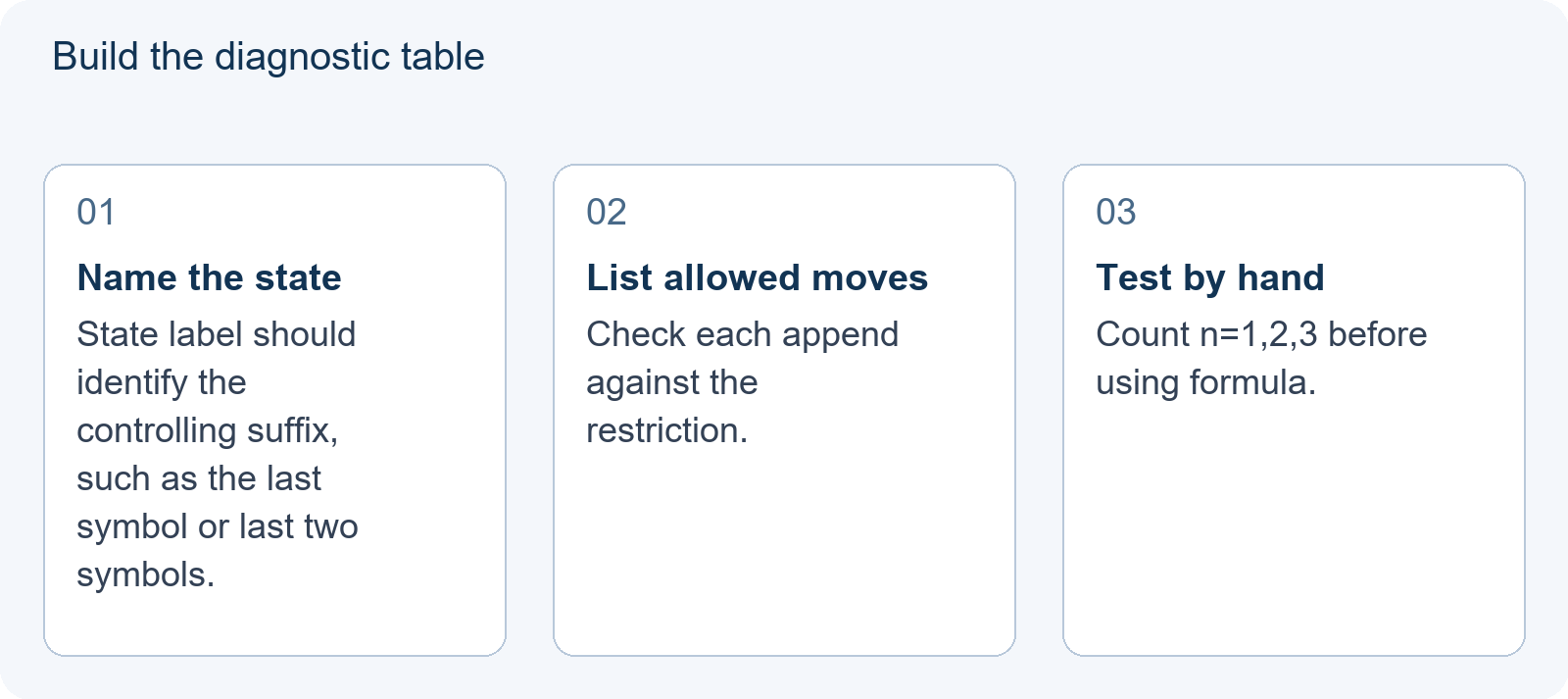
Before writing algebra, fill a table with four columns. The table is deliberately small; its purpose is to expose hidden assumptions.

State name Meaning Allowed transition Count
S0 Valid strings ending in 0 Append 0 or append 1; both remain valid An
S1 Valid strings ending in 1 Append 0 only; appending 1 would create 11 Bn

The “Allowed transition” column is where most errors become visible. If the entry says “append 0 or 1” for every state, the restriction has been ignored. If the entry depends on more than the last symbol, such as a rule forbidding 101, the table needs states that remember the last two symbols or an equivalent automaton state.

The “Count” column must be defined before it is used. An and Bn are not interchangeable totals; they are counts of different ending classes. The final answer is A6 + B6, not A6 or B6 alone.

Three warning signs that your state is incomplete

1. The condition is asymmetric. If appending one symbol is sometimes legal and sometimes not, a single state is probably too coarse. The no-11 condition is the simplest example: a 1 is legal after 0 but not after 1.

2. The next choice depends on more than one previous item. If the rule forbids a pattern of length three, such as 101, knowing only the last symbol is not enough. You need a state that records the relevant suffix, or you need to redefine the states so the forbidden pattern can be detected.

3. You are splitting by an ending pattern but forgetting to add the classes back. State counts are usually components of a total. Students sometimes compute the number ending in 0 and report it as the answer, or add a state twice because two labels describe overlapping sets. The state definitions must be disjoint and exhaustive for the objects being counted. This is the same counting discipline discussed in the AIME Inclusion-Exclusion: Count Overlaps Without Overcounting and the AIME Counting With Symmetry: When Dividing by the Number of Rotations Fails: before dividing, adding, or applying a formula, define the sets precisely.

How this fits AIME combinatorics preparation

A Hanlin Course WeChat article, “2027 AIME Qualification Moves to Fixed Cutoffs: Preparation Planning and a High-Energy Trial Class” (2026-11-04), reports the Hanlin teaching team’s judgment that AIME combinatorics calls for recursive methods and advanced combinatorial identities such as Vandermonde, and recommends targeted practice. That is a coaching analysis, not an official syllabus. Its practical value is that recursion and identities are not replacements for state design; they are tools applied after the counted objects and transitions are defined.

A separate Hanlin Course WeChat note, “Important Notice: Domestic AIME Mathematics Exam Arrangements Confirmed,” recommends classified AIME past-paper practice for students who already have AMC/AIME preparation and are targeting an AIME score of 8–10, with targeted work in number theory and combinatorics because the note describes those modules as common weak areas for Chinese students. That is a preparation recommendation, not a rule about what every AIME will contain. For combinatorics, classified practice is most useful when each attempt is annotated with the state definition, the transition rule, and the first place the count stopped matching a hand check.

The 2027 MAA invitational-competitions page is the current official reference for the AIME’s integer-answer format; this article does not infer regional booking routes or selection rules from it. The technique here is independent of any one paper: it is a way to make a counting attempt auditable.

A 20-minute practice protocol

Use one small counting problem, not a full timed set, and work in this order:

  • Minutes 0–4: Write the object definition. State the alphabet, the length, and the forbidden pattern in your own words. Do not begin with a recurrence.
  • Minutes 4–8: Name states by the information that controls the next move. For the no-11 example, the controlling information is the last symbol. For a longer forbidden pattern, choose the shortest suffix that determines legality.
  • Minutes 8–12: Fill the four-column table. Write each allowed transition and the count symbol it feeds. If a transition is not allowed, say why in words.
  • Minutes 12–16: Hand-count n = 1, 2, and 3. Compare with the table. If they disagree, fix the state or transition before doing algebra.
  • Minutes 16–20: Write the recurrence and compute one more value. Then check whether the recurrence’s structure matches the table’s transitions. Do not trust a formula that has not survived the small cases.

This protocol is deliberately slower than pattern-matching at the start. Its advantage is that it localizes failure. When an answer is wrong, you can ask whether the error began in the state definition, the transition rule, the initial conditions, or the arithmetic. That diagnosis is more useful than redoing the whole problem from the top.

Preparing for a course-fit or diagnostic conversation

If you are considering a diagnostic session or a combinatorics course, bring one counting attempt rather than a list of topics. Include your state table, your first three hand-checked values, and a note on where the transition stopped matching the actual objects. A coach can then distinguish a state-definition problem from a recurrence-execution problem. That is more actionable than a general request for “harder combinatorics.”

Ask for classified practice only if you can name the error type you need to fix: missing ending state, invalid transition, wrong initial condition, or overcount when adding classes. Not every student needs the same drill. The state-table habit is the common foundation; the next step depends on which column of the table broke.

General event background is available at Event background.

Build the diagnostic table

Frequently Asked Questions

Is a state table necessary if I already know a Fibonacci-like recurrence?

Not always necessary, but it justifies when the recurrence applies. For no consecutive 1s, the table splits strings by their last symbol and produces the correct transitions. If the restriction is asymmetric, a one-state recurrence is usually unsafe.

Does this article use real AIME problems?

No. The length-6 binary-string problem is an original teaching illustration, not an official contest problem. It is designed to show state definition, transition checking, and initial conditions; use authorized past papers for actual AIME practice.

What should I bring to an AIME combinatorics diagnostic?

Bring one timed or untimed counting attempt, including your state table, your first three hand-checked values, and a note on where the count stopped matching. That lets a coach identify whether the error is in state definition, transition, initial conditions, or arithmetic.

AIME Geometry Construction: Practice Without a Compass or Ruler in 2027

For the 2027 AIME at a Pearson Professional Center, a compass and ruler are not part of the allowed kit. The IMA note 2026–27 AMC 10/12 Policy Changes and AIME Reform: Authoritative Compilation (Organizing Committee + MAA Official Dual Source), dated 27 August 2026, states that Pearson candidates may not bring any materials, including a compass and ruler. The center issues a laminated graph-paper booklet and a fine-tip pen, with reissue available. The practical answer for AIME geometry construction is therefore to practise on graph paper with a fine-tip pen, treat every diagram as a labelled reasoning aid rather than a measuring instrument, and rehearse the two 90-minute segments separately.

What the 2027 rule changes for construction

The note describes a different examination environment from an ordinary classroom contest. AIME geometry construction cannot rely on bringing personal drawing tools, and it cannot rely on returning to an earlier segment after the midpoint. The table below separates supplied facts from their practice implications.

Item What the 27 August 2026 IMA note states Practice implication
Personal materials Pearson candidates may not bring any materials, including a compass and ruler. Do not train as if personal geometry tools will be available. Simulate the issued format.
Issued materials The center issues a laminated graph-paper booklet and a fine-tip pen; reissue is available. Use graph paper and a fine-tip pen in practice; keep the drawing simple and labelled.
Timing Two 90-minute segments: questions 1–8 first, then questions 9–15. No return to segment one; a mid-segment exit voids that segment. Build a segment break into practice. Write diagram facts before the break, but do not plan on carrying notes forward.
Answering The examination is electronic, with answers entered on screen. Do not let a paper sketch become the final answer record. Transfer the integer answer deliberately.

The note also places AIME 2027 in a single 5–6 February 2027 window, with each candidate sitting once. There is no AIME I/II retake to plan around. For the wider scheduling change, see AIME 2027 Single Exam: Plan Without an AIME I/II Retake.

Where the Pearson rule stops

The tool rule above belongs to the Pearson-administered route described in the note. It should not be pasted onto every AIME candidate. The note's China-organizer information says China uses concentrated test centers and describes the China and US AIME papers as relatively independent. China entrants follow China organizer arrangements, not the Pearson materials process. International entrants outside the Pearson-described route should follow their International Group Leader.

This distinction matters for practice. A student preparing for a Pearson center should rehearse with graph paper and pen because personal compass and ruler use is not permitted there. A student preparing through a different route should first confirm that route's materials instructions with the relevant organizer. Do not assume that a rule written for one administration applies to another.

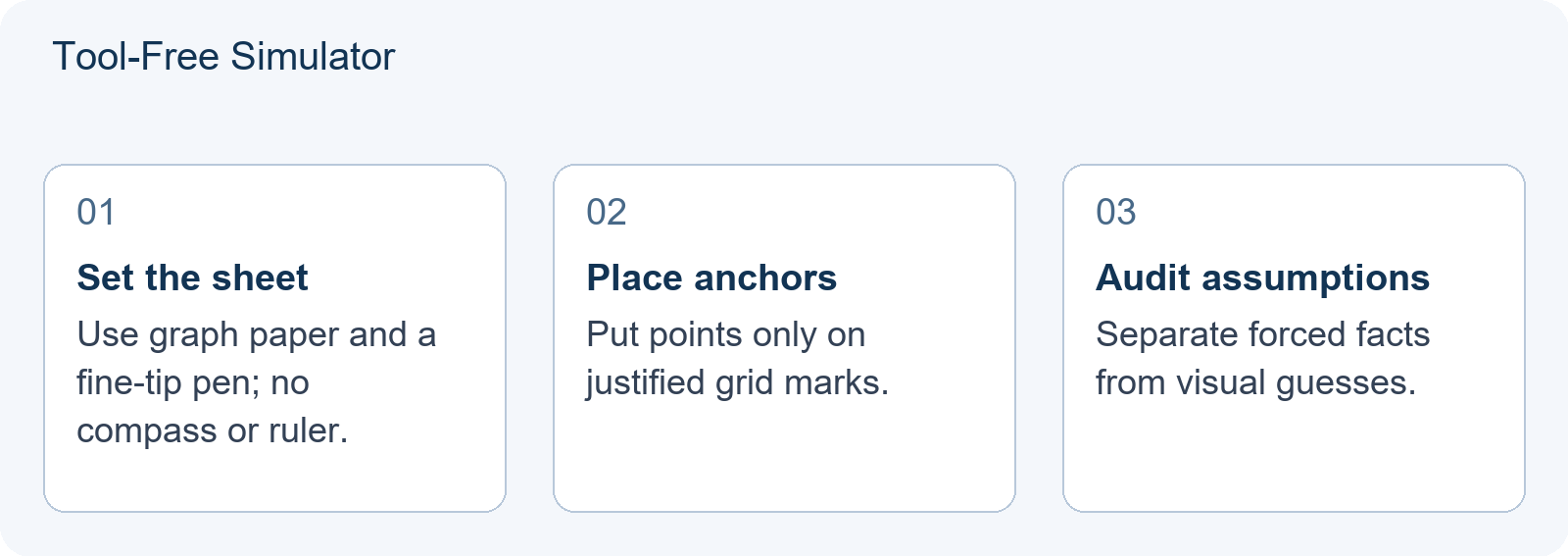
Tool-Free Simulator

The graph-paper simulation drill

A useful AIME geometry construction routine has three parts: simulate the surface, force the labels, and audit the assumptions. The goal is not to produce a beautiful drawing. The goal is to make the diagram carry only relations that the problem statement or a calculation justifies.

1. Simulate the issued surface

Use plain graph paper and a fine-tip pen. Do not begin with a compass, ruler, or a pre-drawn figure that silently supplies lengths and right angles. Mark a small coordinate frame in the corner of the practice page. This frame is not part of the real test; it is a training device that makes grid counts explicit and prevents the eye from doing arithmetic that the pen has not recorded.

2. Place only justified anchors

Put key points on grid intersections only when the problem's conditions allow a coordinate choice. If a practice problem gives a triangle with side lengths 6, 4, and 5, for example, do not place all three vertices on convenient intersections merely because the sketch looks neat. Choose coordinates that match the given lengths, or work without coordinates and label only the stated lengths. A grid is a bookkeeping tool, not a licence to round a length into a prettier one.

3. Separate forced facts from visual guesses

After sketching, write two short lists beside the figure: forced and looks like. A forced fact might be that D lies on AB or that CD is vertical because C and D have the same x-coordinate. A visual guess might be that CD looks perpendicular to AB or that D looks like the midpoint. Only the first list may enter a calculation. This habit is the core of tool-free AIME geometry construction: the diagram organises reasoning, but it does not become evidence.

Teaching illustration: one auxiliary line, one audit

Teaching illustration, not an AIME problem and not official scoring guidance. Suppose a practice prompt gives coordinates A=(0,0), B=(6,0), and C=(2,4). On graph paper, mark A and B six grid units apart, then mark C two units right and four units up. Add D=(2,0), the vertical projection of C onto AB. Because AB is horizontal and CD is vertical, angle CDB is 90°. The grid counts give AD=2, DB=4, and CD=4. Hence CB = √(4²+4²) = 4√2, and AC = √(2²+4²) = 2√5. The area is ½ × AB × CD = ½ × 6 × 4 = 12. No compass or ruler is needed, because every used relation comes from coordinates or a stated right angle.

Now contrast that with one possible slip. A student might place D at the midpoint (3,0) because the sketch looks central. Then CD = √((3−2)²+(0−4)²) = √17, and angle CDB is not 90°: the vectors from D are (−1,4) and (3,0), whose dot product is −3, not zero. The midpoint is not the foot. The drawing looked plausible, but the label D is the foot was never forced. This is exactly the kind of error that a neat grid sketch can hide. The audit list catches it before the calculation begins.

The same audit applies to auxiliary lines. If you add a line from a vertex to the opposite side, label the new point and state why it is there: midpoint, foot of an altitude, intersection with a parallel, or a point defined by a given ratio. If the only reason is that the line makes the diagram easier to look at, the line is not yet a construction. It is a guess. A useful auxiliary line should create a right triangle, a similar triangle, a cyclic quadrilateral, or a coordinate relation that connects known quantities to the target.

This is also where the article AIME Geometry Ratios: Choose an Auxiliary Line Before Chasing Lengths covers the adjacent question of which line to add when ordinary drawing tools are available. The present problem is narrower: how to build and check the diagram when compass and ruler are unavailable and only the center-issued graph-paper format is simulated.

Segment-one and segment-two construction protocol

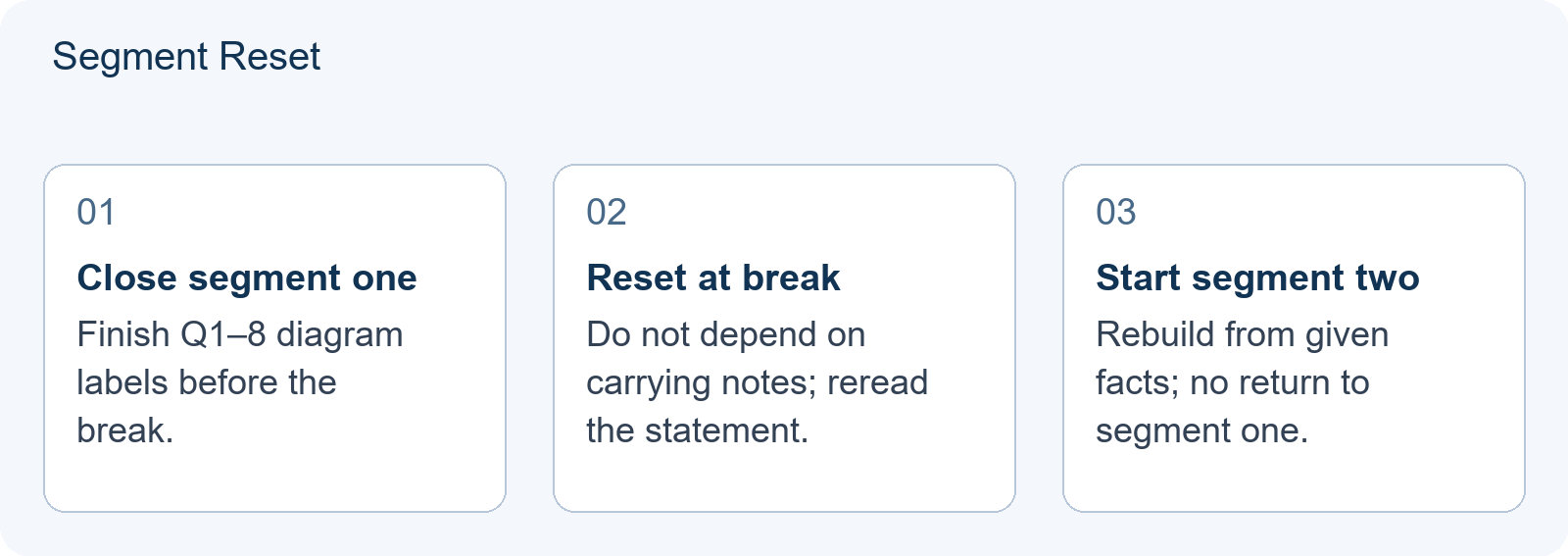
The two-segment structure changes how a candidate should manage diagrams. In segment one, questions 1–8 come first. In segment two, questions 9–15 follow, and there is no return to segment one. A mid-segment exit voids that segment. A candidate therefore cannot plan to solve an early construction problem during the second segment.

A practical training device is to give every construction problem a short diagram passport before moving on. The passport records four things: the coordinates or labelled lengths, the auxiliary line and its justification, the target quantity, and any unresolved doubt. In practice, this takes only a few lines and prevents a neat but ambiguous sketch from becoming a memory trap. The passport is a training discipline, not an assumption about exam scratch-paper retention: the supplied note does not say that notes can be carried across the break. The safe exam plan is not to depend on carrying them.

At the break, reset mentally. In segment two, rebuild only from the problem statement and the facts you can write in the new segment. Do not rely on crossed-segment note access. Do not assume that a line which looked parallel in segment one was parallel. Do not assume that a point which looked central was a midpoint. For broader pacing practice across regional formats, see AIME Pacing Practice: Prepare for Your Region's 2027 Format.

Traps that survive a neat sketch

  • Trusting the grid too much. A point on a grid intersection is exact only if the coordinates are justified. A clean intersection can make an unforced midpoint or right angle look real.
  • Importing remembered figures. A recalled diagram from a past paper is not the current problem's figure. Redraw from the stated conditions, not from memory.
  • Redrawing instead of labelling. If the first sketch is messy, do not spend minutes producing a prettier one. Add one clear auxiliary line and write the forced relations beside it.
  • Letting the sketch replace the algebra. A grid can suggest that two lengths are equal, but only a calculation or a stated condition proves it. The answer must still be derived and checked.
  • Forgetting the electronic answer. The sketch is not the answer sheet. After the calculation, transfer the integer answer deliberately and check the allowed range.

A useful diagnostic is to take one tool-free geometry sketch you have already drawn and mark every label as F for forced or G for guess. If any labels are G, the diagram is doing too much work. Replace the guessed labels with stated conditions or remove them.

Preparing a consultation with one tool-free sketch

For a preparation consultation, bring one graph-paper geometry sketch made with a fine-tip pen and no compass or ruler. Include the original conditions, the auxiliary line you added, the target quantity, and your F/G audit. The point is not to show a polished drawing. The point is to expose where the diagram stopped supporting the reasoning and started supplying assumptions.

A productive discussion can then focus on three questions: Did the auxiliary line create a forced relation, or only a visual one? Did the labels survive a segment reset? Would a simpler line or a coordinate check have reached the answer with less redrawing? This is a Hanlin preparation perspective on tool-constrained AIME geometry construction, not a claim about any candidate's score or invitation outcome.

General event background is available at Event background.

Segment Reset

Frequently Asked Questions

Can I bring a compass and ruler to the AIME 2027 at a Pearson center?

No, for Pearson centers. The 27 August 2026 IMA note states that Pearson candidates may not bring any materials, including a compass and ruler. The center issues a laminated graph-paper booklet and a fine-tip pen, with reissue available. China entrants follow China organizer arrangements, so do not transfer the Pearson materials rule to a China test center.

Is graph paper enough for AIME geometry construction?

It is enough as a reasoning aid, not as a measuring instrument. Practise placing justified points, labelling forced lengths and angles, and writing an F/G audit. A neat grid sketch can still contain unforced assumptions, so every relation used in a calculation should come from the problem statement or a checkable coordinate fact.

How should I practise the two 90-minute AIME segments?

Simulate questions 1–8 in the first 90-minute segment and questions 9–15 in the second, with no return to segment one. In practice, finish each diagram with forced labels before moving on because segment two cannot revisit segment one. Do not assume issued scratch notes can be carried across the break; follow the center procedure, and at the start of segment two rebuild from the problem statement.

AIME Trigonometry: Reduce Symmetric Triangle Conditions With One Identity

Direct answer. For 2027 AIME preparation, when a triangle problem gives A+B+C=pi and a symmetric trigonometric expression in all three angles, first test whether the expression is unchanged by every permutation of A, B, C. If it is, pair two angles with sum-to-product, use A+B=pi-C, and convert the remaining terms to half-angles. The central reduction is cos A + cos B + cos C = 1 + 4 sin(A/2) sin(B/2) sin(C/2). Do not begin by assigning convenient angle values; that discards the constraint that makes the problem solvable. This is a Hanlin preparation discussion, not official MAA scoring guidance.

Hanlin's 4 November 2026 AIME preparation article, “2027 AIME Qualification Moves to Fixed Score Lines: Preparation Planning and a High-Energy Trial Class” (WeChat public account Hanlin Courses), observes that AIME algebra extends AMC12 with advanced trigonometric identities—auxiliary-angle, sum-to-product, and product-to-sum—and that symmetric expressions in the three angles of a triangle are part of that AIME algebra scope. The same article says trigonometric, coordinate, and complex-number computation drives difficulty in higher-numbered AIME geometry questions. That is the teaching problem this article addresses: choosing the first transformation without losing the angle-sum condition.

Why symmetric triangle trigonometry is different from polynomial symmetry

In polynomial problems, symmetry usually means that coefficients or roots can be permuted without changing the expression. Root relations then let you replace elementary symmetric sums by Vieta values. Triangle trigonometry has a different constraint: the variables are angles, and the relation is angular, A+B+C=pi, not a polynomial equation in independent roots. A symmetric expression such as cos A + cos B + cos C is not helped by solving for A, B, C. It is helped by turning the angular sum into a product of half-angle sines. For the polynomial-root counterpart, see AIME Vieta's Formulas: Find Symmetric Expressions Without Solving Every Root; the present method is different because the constraint is A+B+C=pi.

A second difference is the domain. Every angle of a nondegenerate triangle satisfies 0<A,B,C<pi, so each half-angle lies in (0,pi/2). Sines and cosines are positive there, which makes product bounds and equality conditions usable. If you copy a triangle identity into a problem where the three angles do not sum to pi, the identity is simply false. The domain is part of the method, not an afterthought.

The diagnostic: is the expression genuinely symmetric?

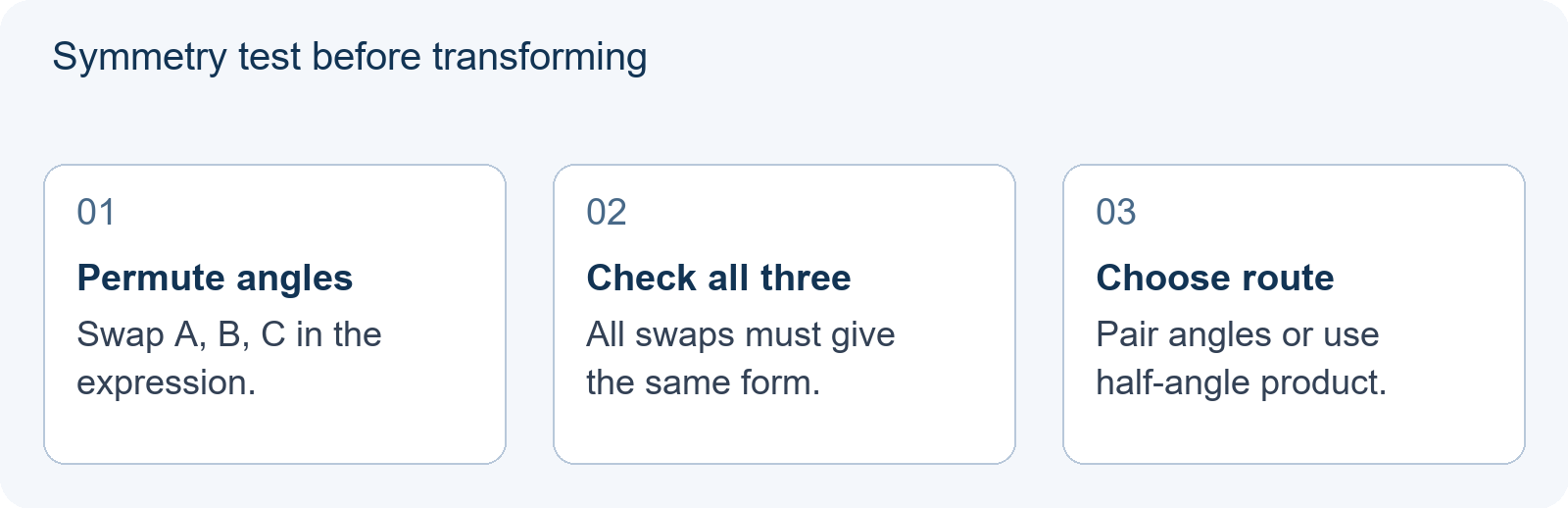
Before transforming, write the expression and test all swaps. If swapping A and B, or B and C, changes the expression, it is not fully symmetric. For example, under A+B+C=pi, the expression cos A + 2 cos B + 3 cos C is not symmetric because swapping A and B changes the coefficients attached to the angles. Pairing cos A + cos B may still be a legal algebraic step, but you cannot conclude that all three angles behave alike or that equality forces A=B=C.

A genuine three-angle symmetric expression must use all three angles in a permutation-invariant way. Simple examples are cos A + cos B + cos C, sin^2 A + sin^2 B + sin^2 C, and products such as sin(A/2) sin(B/2) sin(C/2). A one-angle expression such as 3 cos A + 4 sin A is not a three-angle symmetric problem; it is an auxiliary-angle problem hiding inside a triangle. The auxiliary-angle form R cos(A-phi) compresses one angle combination, but applying it blindly to a symmetric three-angle expression usually destroys the symmetry you need.

Transformation Use it when What it preserves Typical failure
Pair two angles with sum-to-product You see cos A + cos B or sin A + sin B Uses A+B=pi-C explicitly Forgetting the C/2 conversion and losing the constraint
Half-angle product The expression is symmetric in all three angles Turns the sum condition into a product or bound Treating half-angle sines as independent variables
Auxiliary angle One angle dominates, as in a cos theta + b sin theta Compresses one variable combination Applying it to all three angles and breaking symmetry

Symmetry test before transforming

The identity that carries the angle-sum constraint

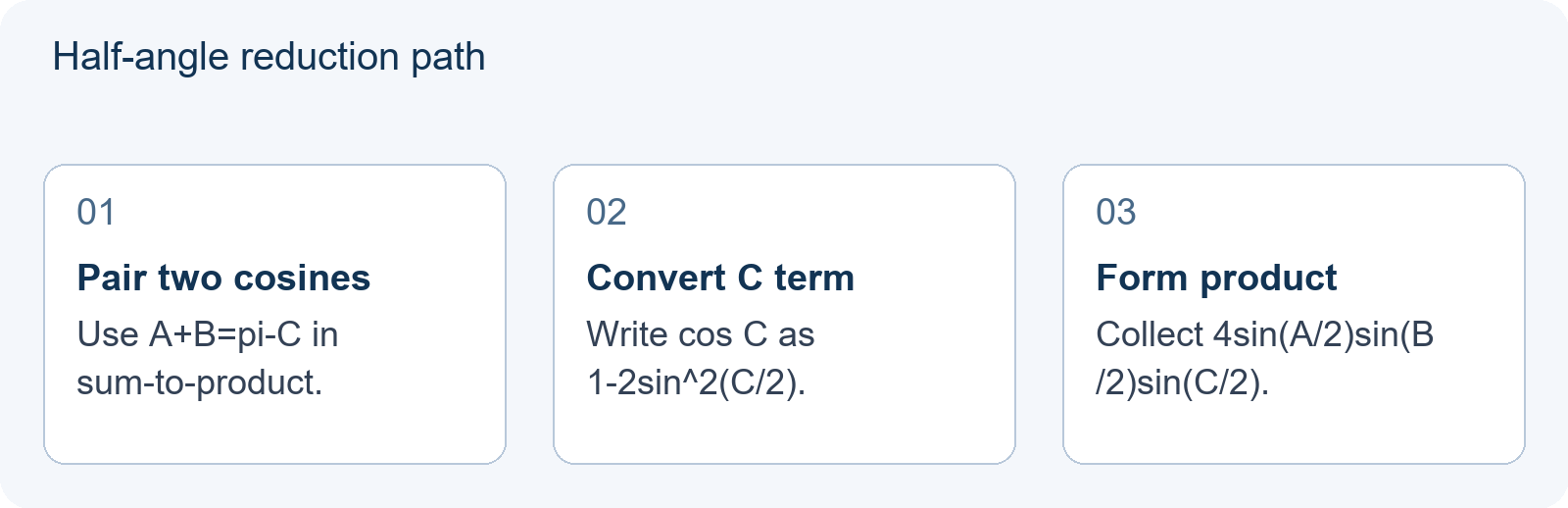
Start with the pair cos A + cos B. Since A+B=pi-C,

cos A + cos B = 2 cos((A+B)/2) cos((A-B)/2) = 2 sin(C/2) cos((A-B)/2).

Add cos C = 1 - 2 sin^2(C/2). Then

cos A + cos B + cos C = 1 + 2 sin(C/2)[cos((A-B)/2) - sin(C/2)].

Because sin(C/2)=cos((A+B)/2), the bracket is cos((A-B)/2) - cos((A+B)/2). The identity cos u - cos v = -2 sin((u+v)/2) sin((u-v)/2) gives

cos((A-B)/2) - cos((A+B)/2) = 2 sin(A/2) sin(B/2).

Multiplying by the outside factor 2 sin(C/2) yields

cos A + cos B + cos C = 1 + 4 sin(A/2) sin(B/2) sin(C/2).

This is the reduction to remember. It is valid exactly when A+B+C=pi and the angles form a nondegenerate triangle. The right side is visibly positive, so the left side is greater than 1 for every nondegenerate triangle. That simple domain check already rules out impossible conditions such as cos A + cos B + cos C = 1.

A fully worked teaching illustration (not a contest problem)

Teaching illustration. Suppose A, B, C are angles of a nondegenerate triangle, so A+B+C=pi and 0<A,B,C<pi. Suppose also that cos A + cos B + cos C = 3/2. Determine the triangle's angle structure.

Apply the identity: 1 + 4 sin(A/2) sin(B/2) sin(C/2) = 3/2, so

sin(A/2) sin(B/2) sin(C/2) = 1/8.

Let x=A/2, y=B/2, z=C/2. Then x+y+z=pi/2 and x,y,z lie in (0,pi/2). The function log(sin t) is concave on this interval, so Jensen's inequality gives

log(sin x)+log(sin y)+log(sin z) <= 3 log(sin((x+y+z)/3)) = 3 log(sin(pi/6)) = 3 log(1/2).

Exponentiating, sin x sin y sin z <= 1/8. The condition reaches equality. Equality in Jensen forces x=y=z=pi/6, hence A=B=C=pi/3. So the symmetric condition forces the equilateral triangle. The key is not the numerical answer equilateral by itself; it is that the identity turned a sum of cosines into a product whose maximum is controlled by the angle-sum constraint.

What changes when the expression is not symmetric

If the expression has unequal coefficients or treats one angle differently, do not force the half-angle product identity as a conclusion about all three angles. For example, with A+B+C=pi, the expression E=cos A + 2 cos B + 3 cos C is not permutation-invariant. You may still pair cos A + cos B and express C in terms of A and B, but the result will generally depend on the difference A-B. That is a signal that the problem is asking for a range, a relation, or a one-variable reduction, not an equilateral conclusion.

Similarly, a condition such as 3 cos A + 4 sin A = 2 is a one-angle auxiliary-angle problem. Rewrite it as 5 cos(A-phi)=2 for an appropriate phi, then use the triangle domain to restrict A. The mistake is to treat this as a symmetric three-angle condition merely because A appears inside a triangle. Symmetry is a property of the whole expression, not a mood created by the word triangle.

Common traps that invalidate an otherwise good method

  • Using a triangle identity outside A+B+C=pi. The half-angle product identity is not a general identity for arbitrary angles.
  • Losing the domain 0<A,B,C<pi. Half-angles are in (0,pi/2), so their sines are positive. If a derived product is zero or negative, the condition is impossible for a nondegenerate triangle.
  • Assuming every symmetric-looking expression becomes one variable. A sum of cosines can reduce to a product, but a sum with unequal coefficients usually retains a difference term.
  • Confusing equality of a product with equality of angles without checking the equality case. Jensen or AM-GM equality conditions must be stated and must lie inside the valid domain.

These traps matter because AIME geometry can reward trigonometric computation in higher-numbered questions. Hanlin's 4 November 2026 article makes the same teaching point: trigonometric fluency is not decorative; it is part of the computational toolkit for difficult AIME geometry. For a geometry-specific decision aid, see AIME Geometry Ratios: Choose an Auxiliary Line Before Chasing Lengths.

A three-step routine for AIME trigonometry practice

Use this routine before expanding anything. First, write the domain and the constraint: A+B+C=pi, 0<A,B,C<pi. Second, test symmetry by swapping two angles at a time; if any swap changes the expression, record that it is not fully symmetric. Third, choose the transformation: pair two angles if a sum-to-product is visible, use the half-angle product if the expression is symmetric in all three, and use an auxiliary angle only when one angle combination is genuinely isolated.

A short self-diagnostic: with A+B+C=pi, decide whether cos A + 2 cos B + 3 cos C is symmetric. It is not, because swapping A and B changes the expression. Decide whether cos(A-B)+cos(B-C)+cos(C-A) is symmetric. It is, because any permutation only reorders the three cosine terms. If you can make these two classifications quickly, you are less likely to apply the equilateral conclusion where it does not belong.

The 2027 AIME format change does not change the mathematics of this reduction, but it does change pacing decisions. The trigonometric reduction should be practised as a short, reliable first move, not as a long derivation during the exam.

Preparing a useful question for a consultation

A useful preparation review starts with one written attempt rather than a folder of unsorted problems. Mark the line where you chose a transformation: Did you pair angles, use an auxiliary angle, or expand? State whether you checked symmetry and whether you checked the triangle domain. That lets a teacher diagnose whether the bottleneck is identity choice, algebraic execution, or domain checking. A useful question is specific: “I paired cos A + cos B but did not know whether to convert C to C/2 or keep C,” not “Please explain AIME trigonometry.” This is preparation advice, not a promise that any particular checklist is a Hanlin service.

For the broader shift from AMC speed to AIME sustained reasoning, see AIME Preparation After AMC: When to Switch From Speed to Sustained Reasoning. Keep the trigonometric identity separate from procedural rules: qualification thresholds and exam logistics are set by the relevant authorities, while the reduction above is a mathematical method you can verify line by line.

General event background is available at Event background.

Half-angle reduction path

Frequently Asked Questions

When should I use sum-to-product in AIME trigonometry?

Use sum-to-product when two angles appear as cos A + cos B or sin A + sin B and the triangle condition A+B+C=pi lets you replace A+B with pi-C. It is a first move in a symmetric three-angle expression because it exposes half-angles and keeps the constraint visible.

Does cos A + cos B + cos C = 3/2 always force an equilateral triangle?

For a nondegenerate triangle with A+B+C=pi, yes. The identity gives sin(A/2)sin(B/2)sin(C/2)=1/8, and the maximum of that product under A/2+B/2+C/2=pi/2 is 1/8, attained only at A=B=C=pi/3. Outside that triangle domain, the conclusion does not apply.

What if the trigonometric expression is not fully symmetric?

Do not force the equilateral conclusion. Test swaps of the angles; unequal coefficients or a singled-out angle mean the expression is not permutation-invariant. You may still pair two terms or use an auxiliary angle, but the remaining difference or one-angle dependence must be handled explicitly.

AIME 2027 Single Exam: Plan Without an AIME I/II Retake

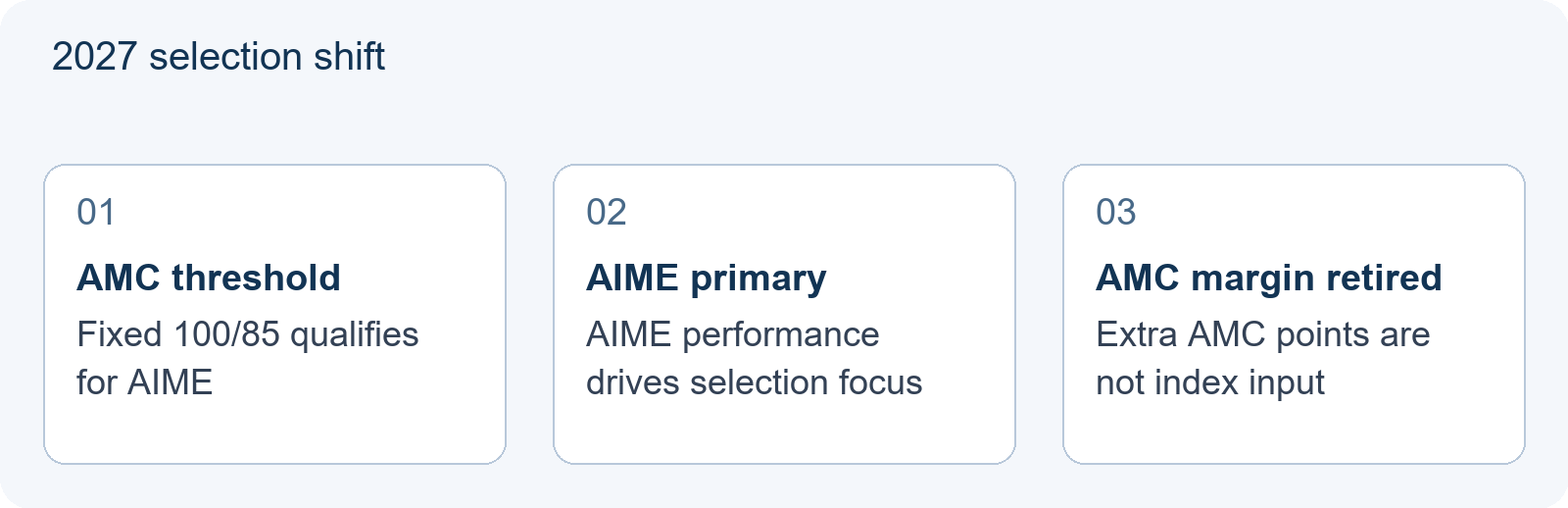
For the AIME 2027 single exam, the practical answer is simple: plan for one attempt. MAA information verified on 26 August 2026 discontinues AIME I and AIME II and replaces them with a single AIME window on 5–6 February 2027. Qualification for that single exam uses fixed thresholds: AMC 10 at least 100 and AMC 12 at least 85. A student who is waiting for a second sitting to serve as a backup is planning for a format that no longer exists.

The change matters most for students who have heard that AIME I and AIME II are two chances. They are not, for 2027. The Hanlin WeChat article 'Note for Students Aiming for AIME: 2027 Qualification Thresholds Fixed, China Arrangements Clarified, AIME Test-Site Booking Opens!', published 10 October 2026, reports that China’s 2027 AIME remains 15 questions in one 180-minute continuous session, while US/Canada uses two 90-minute segments. Both regions face a single-exam risk, but the risk appears at different points in the clock. The preparation question is no longer 'How do I use the first AIME to prepare for the second?' It is 'What must be reliable before the only sitting?'

What Changed for AIME 2027?

The older AIME I/II structure encouraged a two-sitting mental model: one sitting could act as a warm-up or diagnostic, and the other could be treated as the real attempt. That model should be retired. The table below contrasts assumptions families may still carry with the 2027 single-exam reality.

Assumption to check 2027 single-exam reality Planning consequence
'AIME I can be a warm-up; AIME II is the real attempt.' AIME I/II are discontinued; there is one window on 5–6 February 2027. Score every full timed set before review and treat it as the only sitting.
'A strong AMC score can cushion a weaker AIME.' For USAMO/USAJMO selection, AIME scores are primary; AMC scores no longer count. If the goal extends beyond qualification, AIME accuracy is not a secondary margin.
'I can repair a bad start later.' China: one 180-minute continuous session with self-directed time. US/Canada: 90 minutes for 8 questions, then 90 minutes for 7; no return to segment one. China rehearses return-to-blank decisions; US/Canada rehearses first-segment accuracy.

The fixed thresholds also change the qualification target. Instead of asking whether this year’s cutoff might move, a student can ask whether practice scores sit reliably above AMC 10 100 or AMC 12 85. The fixed line makes the target more legible. It does not create another AIME sitting. A margin-building view is useful alongside this planning question, but the core point remains the single attempt.

Why the Retake Assumption Is Risky

Under a two-sitting model, a student could tell themselves that the first AIME produced information and the second would apply it. For 2027, the first sitting is final. That is especially consequential for students aiming at USAMO or USAJMO, because the verified 2027 rules make AIME scores primary and retire the older AMC-plus-AIME index. A student cannot assume that a strong AMC result will offset a weaker AIME result.

The risk is not only emotional. It changes how practice is designed. A practice set followed by unlimited review is a learning tool, but it is not a simulation of the single exam. If a student always allows a second attempt at the same set, they may never rehearse the decisions that matter most: when to leave a question blank, when to check an answer, and when to stop chasing a hard problem because the recoverable points are elsewhere. The single-exam plan should make those decisions boring and repeatable.

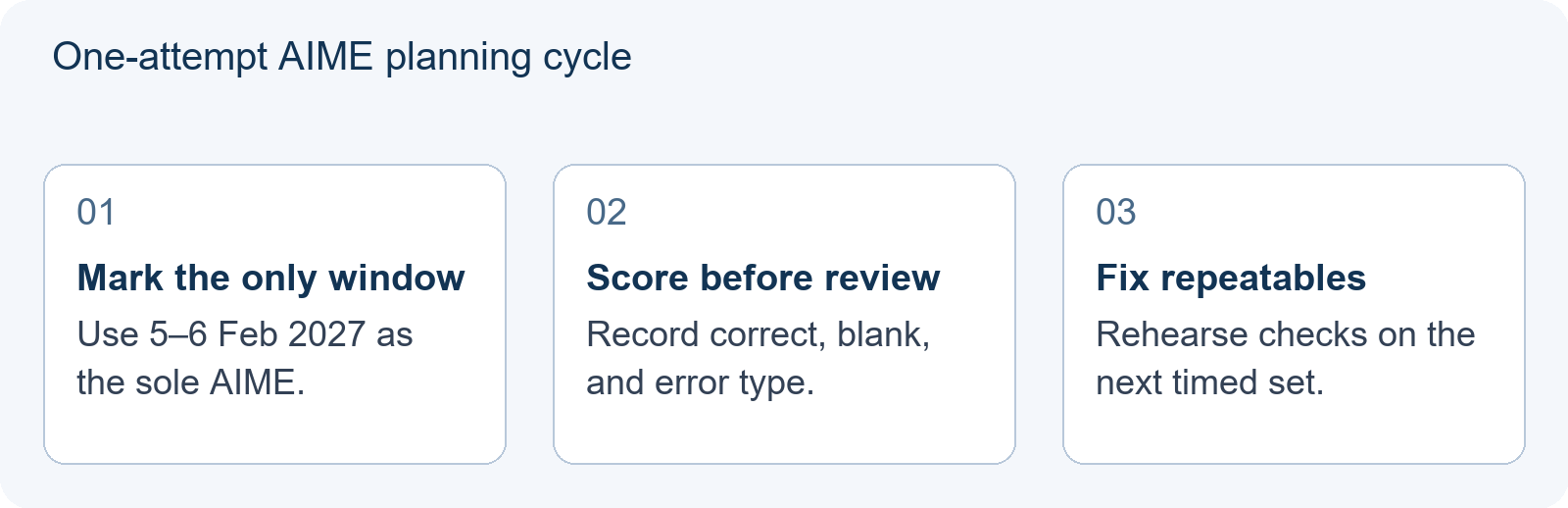
One-attempt AIME planning cycle

One-Attempt Preparation Priorities

A one-attempt plan does not require a completely different curriculum. It requires a different order of reliability. The following priorities are a suggested preparation framework, not a claim that every student needs the same schedule.

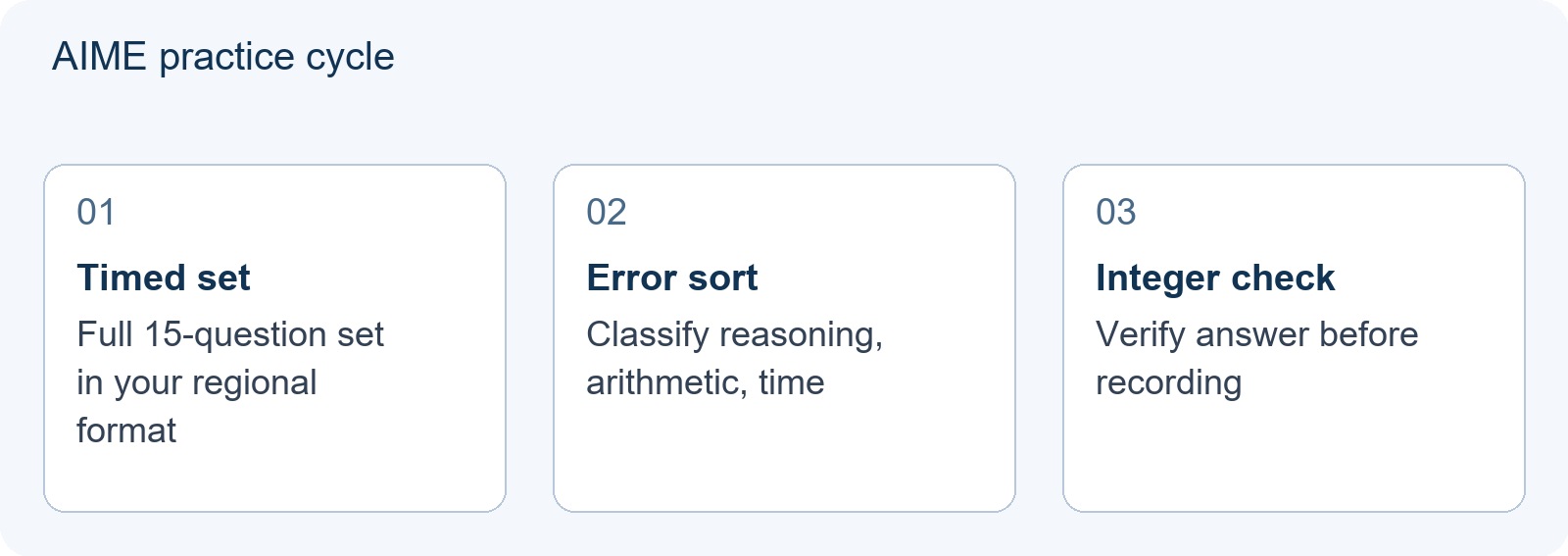
  • Front-load answer verification. For integer-answer questions, the final check should be a fixed step, not an optional habit. Domain conditions, sign errors, and 'solved for the wrong quantity' mistakes can turn a correct method into an incorrect entry.
  • Rehearse the full regional clock. China’s 180-minute continuous session rewards time allocation and return-to-blank decisions. US/Canada’s two 90-minute segments reward first-segment accuracy because the first eight answers cannot be revisited after the second segment begins. Use AIME Pacing Practice: Prepare for Your Region's 2027 Format to match practice to the correct format.
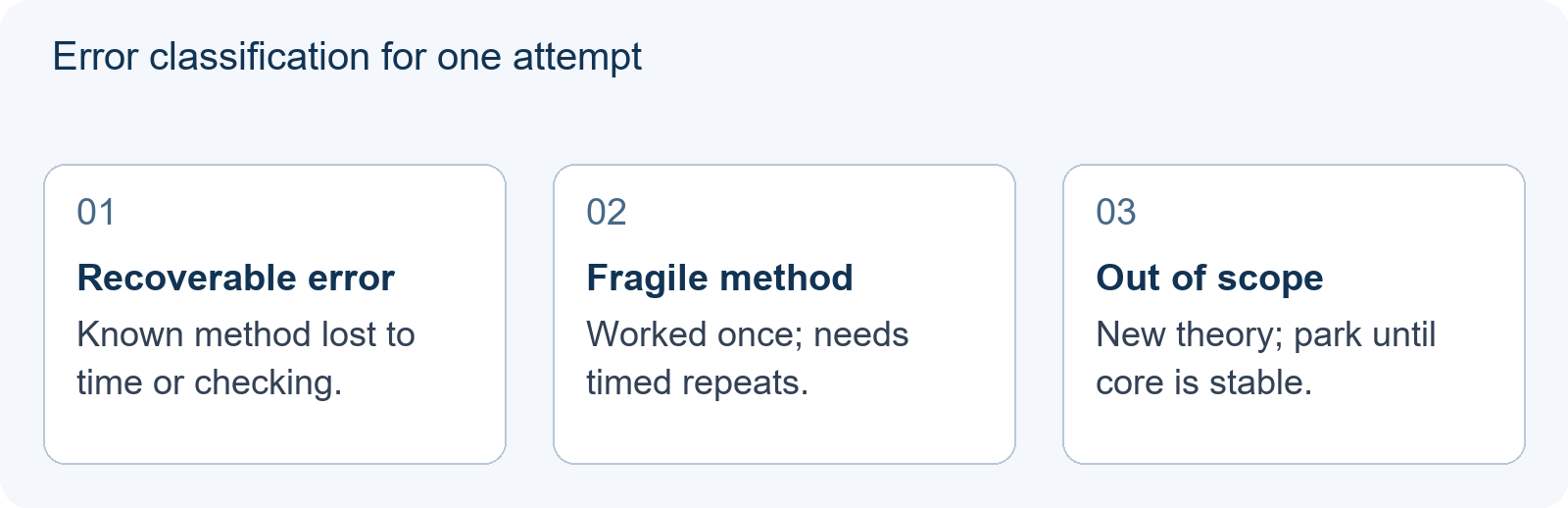
  • Classify errors by recoverability. A recoverable error uses a method the student already knows but loses to time pressure, a sign slip, or a missed check. A fragile method worked once but has not survived timed repeats. An out-of-scope item needs new theory and should not displace core accuracy too early.
  • Keep a blank log. For every skipped question, record whether the student recognized the method, ran out of time, or never had a viable entry point. Blank logs are more useful than a raw score because they show whether the next practice block should build speed, checking, or new content.
  • Use a no-retake practice rule. Finish a timed set, record the verified correct count, and only then review. The review can be generous; the first pass should not be.

Teaching Illustration: One Check Can Change the Recorded Answer

Teaching illustration, not an actual AIME problem or official scoring guidance. Solve sqrt(x + 6) = x. Because the right side equals a principal square root, x must be at least 0. Squaring both sides gives x + 6 = x^2, so x^2 − x − 6 = 0, or (x − 3)(x + 2) = 0. The candidates are 3 and −2. Checking x = 3 gives sqrt(9) = 3, which is valid. Checking x = −2 gives sqrt(4) = 2, while the right side is −2, so the candidate is rejected. The verified answer is 3.

This is a simple error, but it is exactly the kind that a single-exam plan must make non-repeatable. The student did not lack the algebra. They lacked a final verification step. In a one-attempt environment, a 20-second check is not extra caution; it is part of the answer.

Teaching Illustration: A 15-Question Score Audit

Teaching illustration using hypothetical counts, not a real student record. Suppose a student completes a 15-question timed set under one-attempt conditions and records the following audit.

Question band In-exam action Verified correct Review finding
1–6 Answered 6 No change
7–9 Left blank 0 Q7 and Q8 use known methods; Q9 needs a new idea
10–12 Answered 2 One sign error
13–15 Answered 0 No recoverable method found in review

The verified correct count is 8. If Q7, Q8, and the sign-error question are recoverable, the arithmetic ceiling is 11, because 6 + 2 + 2 + 1 = 11. That does not mean the student will score 11; it means the next practice block should not be aimed only at three harder topics. Two blanks were known-method questions, and one error was a checkable sign slip. A sensible next timed set might require the student to revisit Q7 and Q8 before spending time on Q13–15, then add a final sign check on Q10–12. The audit changes the practice target from 'more problems' to 'recoverable points under the clock.'

China and US/Canada: Same Single Exam, Different Failure Points

China’s 2027 AIME remains 15 questions in one 180-minute continuous session, according to the Hanlin Course article dated 10 October 2026. Students can allocate the whole block, skip a question, and return to it. The main single-exam risk is poor time allocation: a student may spend too long on a hard question and fail to return to a blank that was already within reach. Practice should therefore include an explicit return rule, such as 'after two minutes without a path, mark and move,' followed by a planned return window.

US/Canada uses two 90-minute segments: 8 questions, then 7. After entering the second segment, a student cannot return to modify the first eight answers. The main risk is first-segment accuracy and the handoff. A student who is slow to settle in the first eight questions has no late repair. Practice should simulate the handoff, not just the total 180 minutes. Readers outside China and North America should follow their International Group Leader’s instructions; the Pearson process should not be transferred to China. For China-specific age, format, and single-exam differences, see AIME China 2027: Age, Format, and Single-Exam Differences.

Preparing a Course-Fit or Resource Request

Before asking Hanlin for AIME preparation planning, build a one-page attempt profile. This is a preparation aid, not a promise that Hanlin offers a named checklist or a particular service. Include the date of each recent timed set, the regional format used, the verified correct count, the number of blanks, and a short error log separated into recoverable, fragile, and out-of-scope categories. Add the student’s target: qualification, a specific score band, or USAMO/USAJMO preparation. Do not include real student names if the log is shared.

A concrete profile makes the conversation more useful than a vague request for 'AIME preparation.' It also protects against the old retake assumption: if the practice record still contains second attempts at the same set, the profile will show it. The goal is to replace that habit with a single-attempt review cycle that matches the 2027 format. For a score-band perspective, the site’s AIME: 7 Points is the Watershed, 10 Points is the Stepping Stone can help frame target-setting without implying a guaranteed outcome.

The single-exam plan in one sentence: make the ordinary questions reliable, verify before recording, rehearse the region’s clock, and review every timed set as if there is no second sitting. That is the practical meaning of AIME 2027 without an AIME I/II retake.

General event background is available at Event background.

Error classification for one attempt

Frequently Asked Questions

Is there an AIME II in 2027?

No. The 2027 cycle replaces AIME I/II with one AIME window on 5–6 February 2027. Plan for one attempt.

Can a student choose between AIME I and AIME II in 2027?

No such choice exists for 2027 because AIME I/II are discontinued. The relevant choice is preparation quality and regional format, not an exam sitting.

Does a lower AIME score allow another attempt?

No. There is no second 2027 AIME sitting under the single-exam change; a lower score is not a retake trigger. Use practice sets to rehearse one-attempt decisions before the official window.

AIME 2027 USAMO/USAJMO Selection: Why AMC Scores No Longer Count

This AIME 2027 USAMO/USAJMO selection guide answers the practical question first: for 2027, a strong AMC 10 or AMC 12 score still can earn AIME qualification at the fixed thresholds — AMC 10 at least 100 and AMC 12 at least 85. It no longer does the second job many families assumed it did. MAA guidance verified for this report on 26 August 2026 says USAMO/USAJMO selection is based primarily on AIME scores; AMC scores no longer count because the AMC + 20 x AIME index is retired. The practical answer is therefore: qualify through AMC, then compete for USAMO/USAJMO through AIME performance. An AMC margin above the threshold is not protection inside the selection index.

What changed: qualification is not selection

AIME qualification and USAMO/USAJMO selection are separate gates. The first gate is now fixed for 2027: students on AMC 10 at or above 100, or AMC 12 at or above 85, meet the stated qualification threshold, subject to the applicable eligibility rules. That fixed line replaces the percentage-based cutoff logic many families remember. Qualification still matters, but it is a doorway, not the selection ranking.

The second gate is the selection process that follows AIME. Under the retired index, a student's AMC score and AIME score were combined in a way that could let a high AMC score compensate for a lower AIME score. That arithmetic is gone. MAA guidance verified on 26 August 2026 states that USAMO/USAJMO selection is based primarily on AIME scores and that AMC scores no longer count. The AIME also becomes a single opportunity in 2027, with AIME I/II discontinued in favour of one 5-6 February 2027 window. One strong AIME performance now carries more planning weight than it did when families could think in terms of an AMC cushion.

A worked contrast: why a 20-point AMC margin stops protecting you

The following is a teaching illustration, not an actual contest result, an official cutoff, or a prediction of selection. It uses simple numbers to show why the old index changed the planning question.

Hypothetical student AMC 12 score AIME score Retired index arithmetic 2027 planning reading
Student A 120 5 120 + 20 x 5 = 220 The AIME score is the selection focus
Student B 100 8 100 + 20 x 8 = 260 The AIME score is the selection focus

Both hypothetical students clear the fixed AMC 12 threshold of at least 85. Under the retired index arithmetic, Student B's AIME advantage more than offsets Student A's 20-point AMC lead. Under the 2027 rule described by MAA, the AMC lead is not part of that selection index at all. Student B's AIME 8 does not guarantee selection, and Student A is not mathematically eliminated by this illustration. The point is narrower and more useful: the comparison no longer begins with Student A's AMC margin. It begins with AIME performance.

2027 selection shift

Who is affected — and who is not

The change matters most to students who have already qualified for AIME and are aiming at USAMO/USAJMO. Those students need to stop treating AMC preparation as a reserve score that can be spent later. Once the fixed threshold is cleared, additional AMC points may still be a personal achievement or a useful confidence signal, but they are not the selection currency described in the 2027 rule.

Students still below the fixed thresholds are in a different position. Their immediate task is qualification, not USAMO/USAJMO selection planning. A student who is not yet stable above AMC 10 100 or AMC 12 85 should not abandon AMC fundamentals for AIME material too early. The relevant decision aid is AIME Qualification Targets: Build a Reliable Margin Above the AMC Cutoff. For students who have cleared the line, the useful question becomes whether their AIME work is stable enough for a single-opportunity exam.

China and US/Canada candidates also need to separate qualification rules from administration rules. The AIME is a single opportunity in 2027, but the sitting format differs by region. Hanlin's 10 October 2026 report, translated as 'Attention, students preparing for AIME: 2027 qualification thresholds are fixed, China arrangements are clarified, and AIME test-site booking opens!', says China retains a 180-minute continuous session, while US/Canada candidates use two 90-minute segments of 8 and 7 questions. International entrants follow their International Group Leader; the Pearson self-scheduling process should not be applied to China. The China-specific format is summarised in AIME China 2027: Age, Format, and Single-Exam Differences.

Preparation priority: from cutoff margin to AIME stability

AMC and AIME reward different behaviours. AMC is a 25-question, 75-minute selection paper where speed, triage and clean short solutions matter. AIME is a 15-question integer-answer paper where a student must sustain reasoning across longer derivations. The 2027 selection change makes that difference strategic, not merely stylistic. A student who has qualified should move the centre of preparation from 'Can I push my AMC score higher?' to 'Can I produce reliable AIME accuracy under one sitting?'

That shift does not mean ignoring AMC entirely. It means changing what is optimised. Extra AMC speed drills may still help a student who is close to the qualification threshold. For a qualified USAMO/USAJMO aspirant, the higher-value work is multi-step derivation, checking whether an answer is an integer that satisfies every condition, and reviewing errors by cause rather than by topic label alone. The adjacent preparation question is covered in AIME Preparation After AMC: When to Switch From Speed to Sustained Reasoning. Score bands are a separate question; no score band should be read as a 2027 selection cutoff.

Decision table: audit your current plan

Old planning assumption 2027 planning question What to practise What to stop optimising
'My AMC margin protects my USAMO/USAJMO path.' Can I produce stable AIME accuracy in one opportunity? Longer derivations, integer-answer verification, timed recovery Chasing extra AMC points after the fixed threshold is secure
'AIME qualification is the finish line.' Have I separated qualification from selection? Full AIME sets under the correct regional format Treating qualification as if it were a selection ranking
'AIME I/II gives me a second chance.' How do I manage a single AIME sitting? Pacing, skip-and-return discipline, error checks Planning around a retake that no longer exists in 2027

The first row is the central change. A family may still be proud of a high AMC score, and a student may still benefit from AMC work as general training. But the selection index no longer uses AMC scores, so a plan that spends November and December trying to enlarge an already sufficient AMC margin is solving last season's problem. The second row guards against a different mistake: qualification is necessary but not the same as selection. The third row matters because the single AIME opportunity raises the cost of poor pacing and unreviewed errors, without creating a new official cutoff formula.

A practice design that matches the new selection logic

A practical weekly cycle has three parts. First, a timed AIME set using the student's actual regional format: 180 continuous minutes in China, or the two-segment 8 + 7 structure for US/Canada candidates. Second, an error sort into three boxes: reasoning gap, arithmetic or sign slip, and time or decision error. Third, an integer-answer verification pass in which the student checks the answer against the original conditions rather than only against the last line of algebra.

Teaching illustration only: suppose a practice equation produces candidates 12 and -3. The negative value cannot be the recorded integer answer, so the student must decide whether it is an extraneous root, a domain restriction, or a sign error in the derivation. The lesson is not the particular equation; it is the habit of verifying before recording. AIME preparation should build that habit under time pressure, because the 2027 selection logic rewards the student who can produce a correct integer answer repeatedly, not the student who merely recognises a familiar AMC shortcut.

Single-opportunity planning, without inventing a cutoff

The move to one AIME opportunity changes risk management. A student cannot assume that a bad first attempt will be followed by a second AIME I/II sitting. That makes full-run pacing, scratch-work discipline and recovery after a difficult problem more important. For US/Canada candidates, the two 90-minute segments also mean that segment-one choices cannot be revisited in segment two; students should practise that constraint rather than assuming a single continuous paper. For China candidates, the 180-minute continuous session allows self-directed time allocation, but it also removes the external break that might otherwise reset concentration.

What this article does not do is publish an unofficial USAMO/USAJMO cutoff formula. The verified 2027 rule says selection is based primarily on AIME scores and that AMC scores no longer count. It does not follow that every AIME score above some invented number guarantees selection, and it does not follow that every AIME score below some invented number eliminates a student. Families should reject any table that presents such numbers as official without a current MAA source. The safe planning conclusion is narrower: AMC gets the student to AIME; AIME performance is the primary selection input to prepare for.

How to prepare for a course-fit or resource review

A useful preparation conversation should start with evidence, not a sales promise. Bring a recent timed AIME set completed under the correct regional format, a short error log that separates reasoning from arithmetic and pacing, the student's current AMC threshold status, and a clear target: qualification, a stronger AIME score band, or USAMO/USAJMO selection preparation. Ask whether the review distinguishes those goals, because a student still chasing AMC 10 100 or AMC 12 85 needs different work from a qualified student who is already training for a single AIME sitting.

Ask also how integer-answer verification and full-paper pacing will be reviewed, and whether the plan uses the student's actual format rather than a generic 15-question set. A good review should be able to explain why a particular drill is assigned and what error pattern it addresses. It should not promise a selection outcome, invent a cutoff, or treat a high AMC score as a reserve that can be spent in the AIME index. The qualification and format articles linked above answer different questions; this article is specifically about the 2027 selection shift after AIME qualification.

General event background is available at Event background.

AIME practice cycle

Frequently Asked Questions

Does a high AMC score still help with USAMO/USAJMO selection in 2027?

A high AMC score can still help a student meet the fixed AIME qualification threshold: AMC 10 at least 100 or AMC 12 at least 85. It does not contribute to the USAMO/USAJMO selection index described for 2027, because AMC scores no longer count and the AMC + 20 x AIME index is retired. Selection is based primarily on AIME scores.

Does AIME qualification alone imply USAMO/USAJMO eligibility?

No. AIME qualification is a separate step from USAMO/USAJMO selection. A student must qualify for AIME, but selection is based primarily on AIME performance under the 2027 rule. This article does not publish an unofficial USAMO/USAJMO cutoff or imply that any particular AIME score guarantees selection.

How should China and US/Canada candidates prepare differently for the 2027 AIME?

Both should prepare for stable AIME accuracy under a single opportunity, but the sitting format differs. Hanlin's 10 October 2026 report says China retains a 180-minute continuous session, while US/Canada candidates use two 90-minute segments of 8 and 7 questions. International entrants should follow their International Group Leader, and the Pearson process should not be applied to China.

AIME Preparation After AMC: When to Switch From Speed to Sustained Reasoning

The question of when to switch from speed to sustained reasoning in AIME preparation after AMC is no longer a matter of guessing cutoff percentages. For the 2027 season, the Mathematical Association of America (MAA) has established fixed qualification thresholds: a score of at least100 on AMC 10 or85 on AMC 12 meets the score requirement, provided other criteria are met. This structural change simplifies the goal but complicates the strategy. Students often ask whether they should begin AIME-specific training immediately upon hitting these scores or wait until after the November AMC exams. The answer depends less on the calendar date and more on the student's consistency in achieving these fixed benchmarks under timed conditions.

The New Fixed Thresholds and Their Strategic Implications

Previously, AIME qualification relied on percentile rankings, which fluctuated based on the strength of the applicant pool each year. This created uncertainty: a student might score well but fail to qualify due to high competition, or vice versa. According to MAA official rules verified in October 2026, the shift to absolute scores (100/85) removes this ambiguity. However, it introduces a new challenge: stability. A student who occasionally clears100 on AMC 10 practice tests may not consistently achieve this result under exam pressure. Analysis of preparation patterns suggests that the primary risk for students near the threshold is variance, not lack of knowledge. Therefore, the decision to switch to AIME-style sustained reasoning should be triggered by demonstrated consistency, not just a single passing score.

Distinguishing US/Canada Format Changes from China Region Rules

A critical distinction exists between the US/Canada and international regions regarding the 2027 AIME format. In the US and Canada, the exam will be administered electronically at Pearson Professional Centers, split into two 90-minute segments with no return to the first half. For China region participants in 2027, the format has not yet adopted the 90+90 minute structure; according to the October 10 operator report, the current arrangement follows a continuous session with full autonomy over time allocation. This difference fundamentally alters the "switch" moment. US/Canada students must train for segmented focus and strict time-boxing earlier, as the inability to revisit questions changes the cognitive load. Chinese students, however, can continue practicing holistic time management and strategic skipping, meaning their transition to deep reasoning can be more gradual, focusing on problem-solving depth rather than rigid segment adherence. Note that the China format is provisional for 2027 and subject to future policy updates.

Decision Flow: Switch to AIME Prep?

Teaching Illustration: The Consistency Diagnostic

[Teaching illustration: invented example for pedagogical purposes]

To determine if a student is ready to switch to AIME preparation, consider this diagnostic framework. Suppose a student takes five recent AMC 10 past papers under timed conditions and scores: 96, 102, 97.5, 105, and 99. The sum is 499.5, giving a mean of 99.9. Exactly two scores meet or exceed 100 (102 and 105), while three fall below (96, 97.5, and 99). Despite averaging close to 100, this student fails three out of five attempts to reach the fixed threshold. The errors are primarily calculation slips in the middle range (questions 11-20). In this scenario, switching to AIME problems is premature. The bottleneck is not conceptual depth but execution reliability. AIME problems require sustained attention; if a student cannot maintain accuracy over 75 minutes on AMC, they will likely struggle with the endurance required for AIME. The correct next step is targeted error analysis on AMC mid-range questions, not advanced AIME topics.

Contrasting Case: When Depth Becomes the Priority

[Teaching illustration: invented example for pedagogical purposes]

Contrast this with a student whose scores are consistently 115+ on AMC 10. They have mastered speed and basic accuracy. If this student continues only doing AMC drills, they face diminishing returns. Their errors now occur on questions 21-25, which involve complex combinatorics or number theory—topics that overlap significantly with early AIME problems. Here, the switch is overdue. This student should begin integrating AIME-style problems that require multi-step logical chains. Unlike AMC, where elimination strategies often work, AIME requires deriving an integer answer from scratch. Students who delay this switch often hit a "wall" in February, realizing too late that their AMC speed does not translate to AIME derivation skills.

The Role of Endurance Training in the Transition

Sustained reasoning differs from speed solving in cognitive stamina. AMC 10/12 allows for rapid pattern recognition and heuristic shortcuts. AIME demands rigorous proof-like thinking, even though formal proofs are not written. For students preparing for the China region's current 180-minute continuous exam, building this endurance is crucial. Many students burn out mentally before the final hour. The transition phase should include "long-form" practice sessions where students solve 3-4 difficult problems without time pressure, focusing entirely on clarity of logic and checking steps. This contrasts with the US/Canada segmented model, where endurance is tested within tighter 90-minute windows. Regardless of region, the ability to hold complex variables in working memory for extended periods is the key skill developed during this switch.

Diagnostic Application: Analyzing Error Types

Families can use a simple error-type analysis to decide the timing of the switch. Categorize mistakes from recent AMC mock tests into three buckets: 1) Knowledge Gaps (didn't know the theorem), 2) Execution Errors (calculation/slip), and 3) Strategy Errors (spent too long on easy questions). If Bucket 2 dominates, stay in AMC mode. If Bucket 1 involves advanced topics like modular arithmetic or complex geometry, switch to AIME prep. If Bucket 3 is high, work on pacing. This diagnostic prevents the common mistake of jumping to hard problems while still making basic errors. It ensures that the "switch" is data-driven, aligning with the fixed threshold reality where marginal gains come from eliminating specific weaknesses.

Practical Next Steps and Regional Considerations

When consulting with educators about AIME preparation, bring concrete data. Instead of asking "Is my child good enough?", present consistency diagnostic results. Ask specifically about regional format differences: "How do we adjust our study plan for the continuous session format versus the segmented US format?" Request feedback on whether current practice materials reflect the difficulty jump from AMC Q20 to AIME Q1. Understanding that AIME answers are integers from 0-999 helps frame the need for precise calculation skills. This approach moves the conversation from vague anxiety to targeted strategy, leveraging the new fixed-score environment to create a clear roadmap for success.

For students in China, the current format preserves flexibility in time allocation, so training should emphasize sustained concentration rather than segment-specific pacing. For US/Canada students, early adaptation to the 90-minute segment boundary is essential. Both groups should note that the fixed thresholds mean qualification is now a transparent target—but reaching it consistently remains the prerequisite for productive AIME preparation.

Related reading: For a deeper look at polynomial techniques common in early AIME problems, see AIME Polynomial Remainders: Solving Without Expanding Every Term. Students transitioning from AMC should also review AMC Math Competition: A Guide to AIME Qualification and Preparation for qualification mechanics, and AIME: 7 Points is the Watershed, 10 Points is the Stepping Stone for score-targeted strategy.

Applying the Consistency Diagnostic to Real-World Preparation Timelines

The teaching illustration above demonstrates that a mean score of 99.9 on AMC 10 practice tests does not guarantee qualification, as only two out of five attempts met the fixed threshold of 100. This discrepancy highlights a critical gap in student preparation: the failure to distinguish between average performance and reliable execution under pressure. For students aiming for AIME, this distinction dictates the immediate next steps in their study plan.

[Teaching illustration: invented example for pedagogical purposes]

Consider a hypothetical student who has completed three full AMC 10 mock exams in October 2026 with scores of 96, 102, and 97.5. The sum is 295.5, yielding a mean of 98.5. Here, one score exceeds the threshold, but two fall below it. If this student begins solving AIME problems immediately, they risk reinforcing bad habits. AIME questions require multi-step derivations where a single arithmetic error invalidates the entire solution. If the student’s primary weakness is calculation slips in the mid-range (questions 11–20), attempting AIME problems will likely result in frustration rather than skill acquisition. The correct strategic move is to pause advanced topic study and focus exclusively on error analysis from these three mocks. Identify whether the losses were due to knowledge gaps or execution errors. If execution dominates, drill timed accuracy on AMC-style problems until at least four out of five consecutive attempts exceed 100.

Conversely, examine a student with scores of112.5,118.5,and115.5. The mean is115.5, and all three attempts comfortably clear the 100-point bar. This consistency indicates mastery of speed and basic accuracy. Continuing to drill AMC papers offers diminishing returns. Their errors now likely occur on questions 21–25, involving complex combinatorics or number theory—topics that overlap significantly with early AIME problems. For this student, switching to sustained reasoning is overdue. They should begin integrating AIME-style problems that require deriving an integer answer from scratch without multiple-choice elimination strategies. Delaying this switch often leads to a "wall" in February, when students realize their AMC speed does not translate to AIME derivation skills.

This diagnostic approach prevents the common mistake of jumping to hard problems while still making basic errors. It ensures that the transition to AIME preparation is data-driven, aligning with the new fixed-score environment where marginal gains come from eliminating specific weaknesses. Students near the threshold must prioritize stability over novelty. Only when consistency is demonstrated should the focus shift to depth. This methodical progression respects the cognitive demands of both competitions and maximizes the probability of qualifying for AIME in the 2027 season.

Regional Format Differences 2027

Frequently Asked Questions

Does the fixed AIME cutoff mean I can stop worrying about percentile rankings?

Yes, for qualification purposes. You only need to meet the absolute score (100 for AMC 10, 85 for AMC 12). However, strong AMC performance builds the foundational skills that translate to higher AIME scores, which are now the primary factor for USAMO/USA(J)MO selection starting in 2027. Aiming above the minimum remains advisable for skill development, not for direct selection advantage.

What is the minimum age for AIME participation in my region?

For the US/Canada region, MAA rules state that participants must be aged 13 or older for 2027. International participants follow their respective country's policies through their International Group Leader. China region participants should verify current age requirements with their local organizer, as regional policies may differ from the US/Canada standard. Do not generalize the US/Canada minimum age 13 to China.

Should I buy AIME prep books before taking the AMC exam?

It depends on your current level. If you consistently exceed the AMC qualification thresholds, starting AIME prep early is beneficial. If you are borderline, focus on mastering AMC content first to ensure qualification, then switch to AIME materials after the November exam. Coaching judgment, not rigid rules, should guide this decision.

AIME Qualification Targets: Build a Reliable Margin Above the AMC Cutoff

Starting with the 2026–27 competition cycle, AIME qualification no longer depends on fluctuating percentage cutoffs. The MAA has set fixed thresholds: 100 points on AMC10 and 85 points on AMC12 (MAA AIME official rules, checked October 12 2026). For students and families researching preparation strategy, this change removes uncertainty about "where the line will fall"—but it replaces that uncertainty with a different question: how much above the fixed cutoff should you aim to score in practice, so that the official result feels secure rather than lucky?

Important distinction: these are official qualification thresholds, not guarantees. Meeting the score requirement is necessary but not sufficient; eligibility also depends on age and other criteria. For US/Canada test takers at Pearson centers, students must be 13 years or older as of the 2027 AIME date, with no exceptions (MAA AIME official rules, checked October 12 2026). International participants, including China-region students, follow their regional International Group Leader policies; the age condition and other eligibility rules may differ. This article focuses on building practice margin above the cutoff score, which is separate from verifying full eligibility.

Why a "Reliable Margin" Matters More Than the Minimum

A score at or above the relevant threshold meets the score component of eligibility. However, competition conditions differ from practice. Time pressure, problem-order effects, and the occasional misread can each cost points. A practice score at the threshold leaves no numerical margin for variation on a later paper. The goal should be to reach a level where the official cutoff feels like a floor, not a ceiling.

The fixed cutoff also changes the preparation dynamic. Under the old percentage system, a student might hope for an easy test that affects the cutoff. With a fixed score, the number is known in advance, which makes preparation more transparent. Under a percentile-based system, an easier paper can raise the score needed to reach the same percentile. That is different from the fixed threshold used in this cycle. The only variable left is your own performance.

Worked Teaching Case: Building an Illustrative Training Target

Let us examine a concrete scenario with checked arithmetic. Suppose a student is preparing for AMC10 and wants to qualify for AIME. The fixed cutoff is 100. The student sets an illustrative training target of 115 points in practice conditions—this is a personal benchmark, not an official safe margin or guarantee.

Step 1: Understand the scoring reality. AMC10 awards 6 points for a correct answer, 1.5 points for a blank, and 0 for an incorrect answer. With 25 questions in 75 minutes, the maximum is 150 points.

Step 2: Establish a baseline with verified counts. Consider a student who attempts 20 problems, leaving 5 blank, with 17 correct and 3 wrong. The score is: 17 × 6 + 5 × 1.5 + 3 × 0 = 102 + 7.5 = 109.5. This clears the 100 cutoff but illustrates how a student can be above minimum yet still short of a comfortable margin.

Step 3: Show improvement path with same attempt count. Suppose this student improves accuracy without increasing attempts: 19 correct, 1 wrong, 5 blank (still 20 attempted, 5 blank). The score becomes: 19 × 6 + 5 × 1.5 + 1 × 0 = 114 + 7.5 = 121.5. The gain is 121.5 − 109.5 = 12 points—from fixing just two errors. The problem counts verify: 19 + 1 + 5 = 25.

This case illustrates a general principle: for students near the cutoff, accuracy on accessible problems often yields more margin than attempts at harder problems.

Margin Building Path

Contrasting Case: Where Chasing Hard Problems Fails

Consider a different student with the same 115 illustrative target but a different profile: strong theoretical knowledge but slow execution. This student can solve problems 20–25 correctly when given unlimited time but rushes through early problems.

In practice, this student attempts 22 problems: 17 correct, 5 wrong, 3 blank. Using the checked calculation: 17 × 6 + 3 × 1.5 + 5 × 0 = 102 + 4.5 = 106.5 (not 105 as rough estimation might suggest). This clears the cutoff with only 6.5 points of margin—insufficient comfort for test-day variation.

The superficially similar approach of "attempt many problems" fails here because the student's time allocation is inverted. The two additional attempts beyond our first case came at the cost of two more errors. If those two problems had been left blank instead, the student would have earned 2 × 1.5 = 3 points; by getting them wrong, they earned 0. The hard-problem success did not compensate for this loss.

This contrast highlights that margin-building is not primarily about ceiling performance. It is about floor protection: ensuring that the problems you know how to do become points you actually earn.

Diagnostic: Where Is Your Margin Right Now?

To apply this framework, use a recent timed AMC practice test under realistic conditions. Record:

  • Problems correct, blank, and incorrect
  • Which problems were "careless errors" versus "did not know how to solve"
  • Time spent on each problem (estimate if not tracked)

Calculate your score and categorize your errors. Then ask:

If I eliminated all careless errors while keeping everything else constant, what would my score be? This is your "clean execution" ceiling. If this exceeds your illustrative target (e.g., 115 for AMC10), your priority is process discipline, not new content.

If I had unlimited time, what would my score be? This measures knowledge versus execution. A large gap between unlimited-time and actual score indicates speed or time-management issues. A small gap indicates knowledge gaps.

How many problems did I attempt in the first 30 minutes versus the final 45? Front-loading attempts often leads to rushed errors. A more even pace, with time reserved for checking, typically improves accuracy.

Complete answers to these three questions give you a specific preparation direction. Generic advice like "do more practice tests" is less useful than targeted work on your identified gap.

What the Diagnostic Means for Next Steps

Suppose your diagnostic reveals a gap between your clean-execution ceiling and your illustrative target. The specific feedback that addresses this depends on the error pattern:

Pattern: Careless errors concentrated in problems 1–15. Feedback needed: structured checking protocol, not harder problems. One approach is the "two-pass" method: first pass completes problems with confidence; second pass reviews flagged items. Another is explicit estimation—does the answer make sense?—before finalizing.

Pattern: Time runs out with unattempted problems you could solve. Feedback needed: timed practice with strict problem-allocation budgets. For AMC10, a rough guide is 2 minutes per problem for 1–10, 3 minutes for 11–20, and remaining time for 21–25. Adjust based on your personal speed.

Pattern: Knowledge gaps in specific content areas. Feedback needed: targeted topic review, not more full tests. Common AMC10/12 topics include counting and probability, number theory, and geometric configurations. Identifying which topics cost you points allows efficient study.

Use the final practice period to address the errors your own records reveal. Students who have built reliable margin through consistent practice perform more predictably than those who peak on occasional strong showings.

China-Specific Preparation Context

For students in China, the 2026–27 season has additional considerations. The AMC10/12 A and B exams remain available, with dates of November 6 and November 14, 2026; Hanlin's October 24, 2026 report gives the B registration deadline as November 3. China-region students take the exam offline at authorized test centers, not online. The AIME itself, if qualified, is also administered offline in China with a continuous 180-minute format—unlike the US/Canada split-session structure (Hanlin operator report, October 10, 2026).

This matters for margin-building because the test-day environment differs. Students should practice under conditions that match their actual administration: paper test, continuous time, and the specific materials allowed. The US/Canada AIME format of split 90-minute sessions with no return to earlier problems does not apply to China-region test takers, so preparation should not emphasize that constraint.

Students in China register through the International Group Leader system; MAA lists distinct public-school and private-school IGLs for China (MAA International 2026–27 participation). The private-school listing connects to ASDAN China. This registration pathway is separate from US/Canada direct registration and should be planned in advance.

Connecting to Broader Preparation Resources

For students seeking to understand the full progression from AMC to AIME and beyond, several related articles provide complementary coverage. The AMC10 to AIME Qualification Guide: Cutoff Scores, Exam Dates & Prep Strategies offers overview information on cutoff scores, exam dates, and general preparation strategies. For students earlier in their competition journey, the From AMC8 to AIME: The Ultimate Math Competition Progression Path describes how foundational competition experience builds toward qualification. Those interested in how AIME performance specifically influences advanced opportunities can consult AIME Competition Score Weight Adjustment: How to Prepare for 2026.

These resources address adjacent questions; this article's specific contribution is the worked methodology for building and verifying a reliable margin above the fixed cutoff.

Preparing for Consultation: What to Bring

If you are considering structured preparation support, having the following information ready makes consultation more productive:

  • Your most recent timed AMC practice score, with problem-level breakdown if available
  • Your target competition date (A or B exam, or both)
  • Your current grade level and math coursework, to assess foundational readiness
  • Specific topics or problem types where you consistently lose points

This preparation allows a focused discussion about whether your gap is primarily knowledge-based, execution-based, or strategic—and what specific practice structure would address it.

Time Allocation Trap

Frequently Asked Questions

Is 100 on AMC10 or 85 on AMC12 enough to guarantee AIME qualification?

These are the fixed minimum qualifying scores set by MAA for the 2026-27 cycle. However, 'guarantee' depends on meeting all eligibility criteria. For US/Canada test takers, this includes a minimum age of 13; international participants follow regional IGL policies with potentially different requirements. For test-day security, you should aim to consistently score above these thresholds in practice to account for performance variation. Practice targets are illustrative benchmarks, not official safe margins.

How does the China-region AIME format differ from US/Canada?

China-region AIME remains a continuous 180-minute offline exam according to the October 10, 2026 operator report. The US/Canada format splits into two 90-minute sessions with no return to earlier problems. China students should practice continuous-time conditions, not the split-session structure. International participants follow their regional International Group Leader policies.

Should I focus on solving harder problems or reducing errors on easier ones?

For building margin above the cutoff, reducing errors on problems you already know how to solve typically yields more reliable point gains than attempting harder problems. The worked case in this article shows how improving two wrong answers to correct ones—keeping the same attempt count—gains 12 points without requiring new knowledge or additional attempts.

Online Consultation
Online Consultation