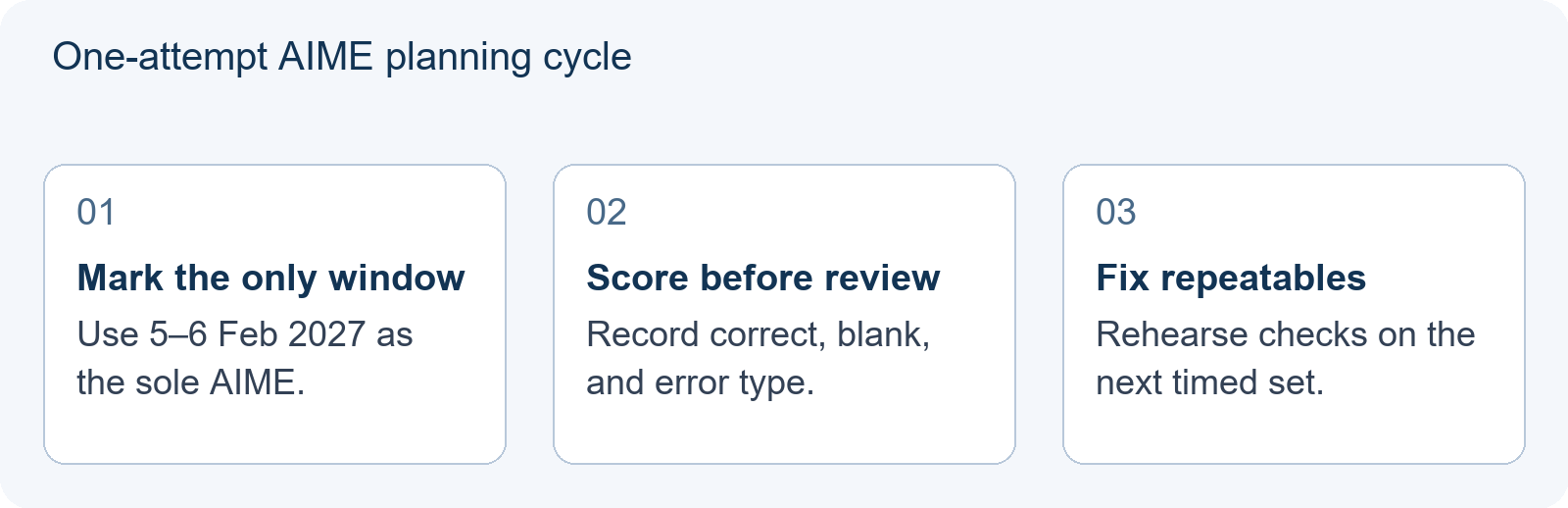
An AIME mock review should turn each miss into a next action, not stop at the raw score. For the 2027 cycle, the MAA describes a 15-question, integer-answer AIME with a single attempt, so a completed mock is diagnostic evidence. Review it in three passes: setup, execution and knowledge. Then choose the next drill from the dominant error category. This is a Hanlin preparation perspective, not official scoring guidance.
Why a raw score cannot choose your next drill
Two hypothetical students can both score 6/15 and need opposite plans. Student A loses three questions by misreading a condition, answering the complement, or recording an unscaled variable. Student B understood those questions but loses three marks to sign slips, a modular inverse error and a final answer outside 0-999. If both respond by taking another mock, Student A practises the same setup weakness, while Student B rehearses the same final-check omission. The score is identical; the repair is not.
Hanlin course WeChat, 2027 AIME fixed cutoff and prep planning (4 November 2026), says the teaching team recommends sufficient daily mock tests in the final week to find weak or forgotten knowledge and to practise time allocation and competition mindset. Hanlin course WeChat, AMC10/12 mock test free open (9 October 2026), describes mock diagnostics that identify weak modules and generate an advantage/disadvantage report and an error book. For an AIME mock, adapt that principle carefully: the artifact you need is a classified error log, not only a score report. If your question is still whether to move from AMC speed to sustained reasoning, see AIME Preparation After AMC: When to Switch From Speed to Sustained Reasoning; this article begins after one mock is finished.
Define setup, execution and knowledge without overlap
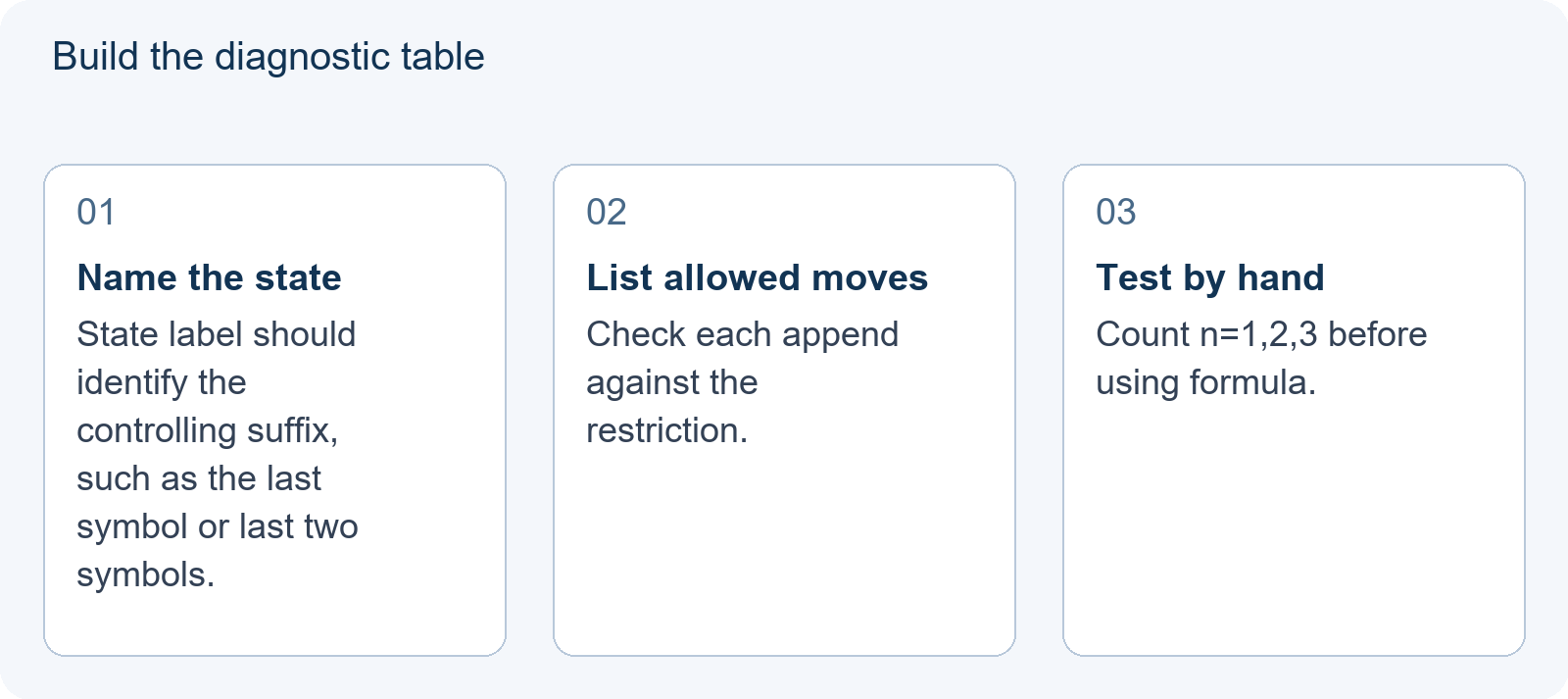
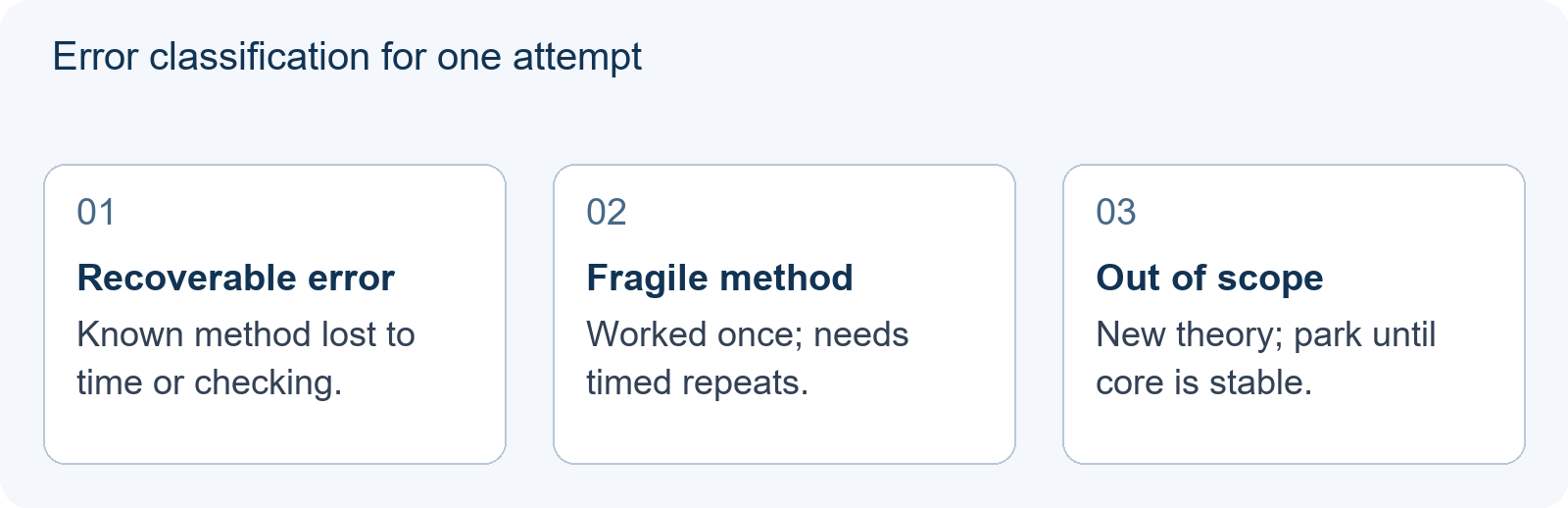
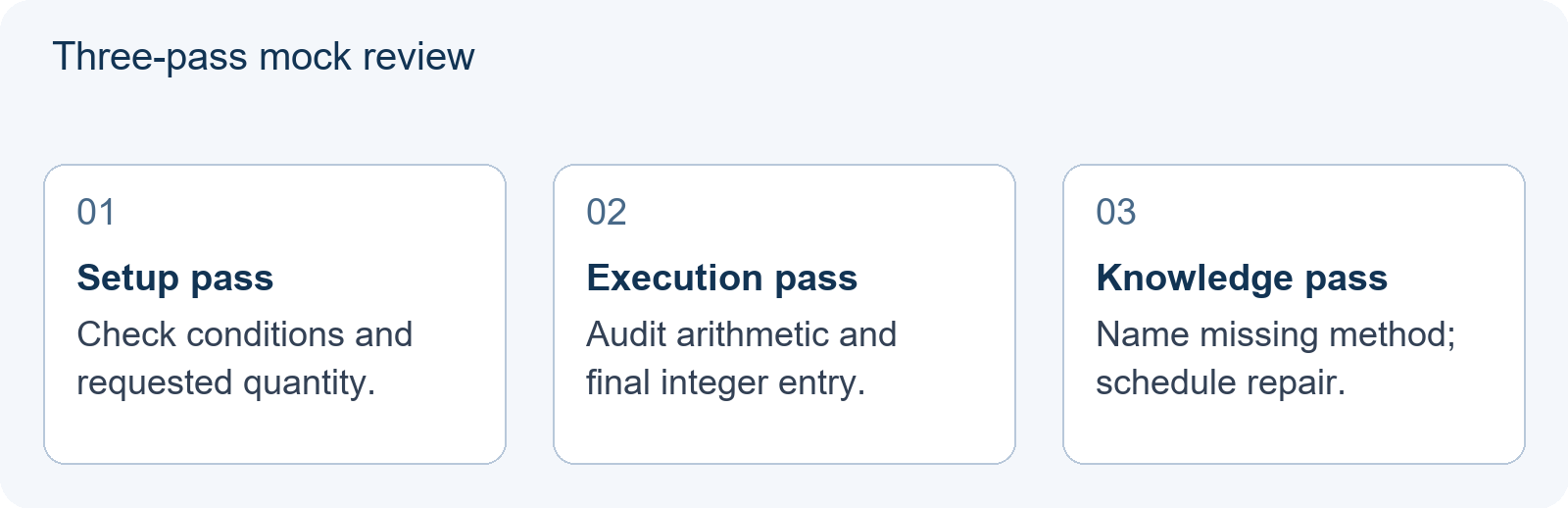
Use operational definitions. Setup is what you did before the first line of algebra: reading conditions, defining variables, choosing the requested quantity, tracking units and constraints. Execution is what happened after a correct plan: algebra, arithmetic, modular reduction, sign control and final entry. Knowledge is the missing theorem, method or recognition pattern that prevented a credible plan.
| Category | Typical evidence | Question to ask |
|---|---|---|
| Setup | Wrong variable, dropped condition, answered complement, missed scale | Would a correct restatement have prevented the miss? |
| Execution | Correct plan, wrong sign, arithmetic slip, bad final integer | Did the plan survive the first line? |
| Knowledge | No usable method, theorem not known, pattern not recognised | Could the student start without a hint? |
When a miss could fit two categories, assign the earliest category that would have prevented it. A forgotten theorem is knowledge; a correct theorem applied with a wrong inverse is execution; a correct method used on the wrong quantity is setup.
An original teaching example, not an AIME problem
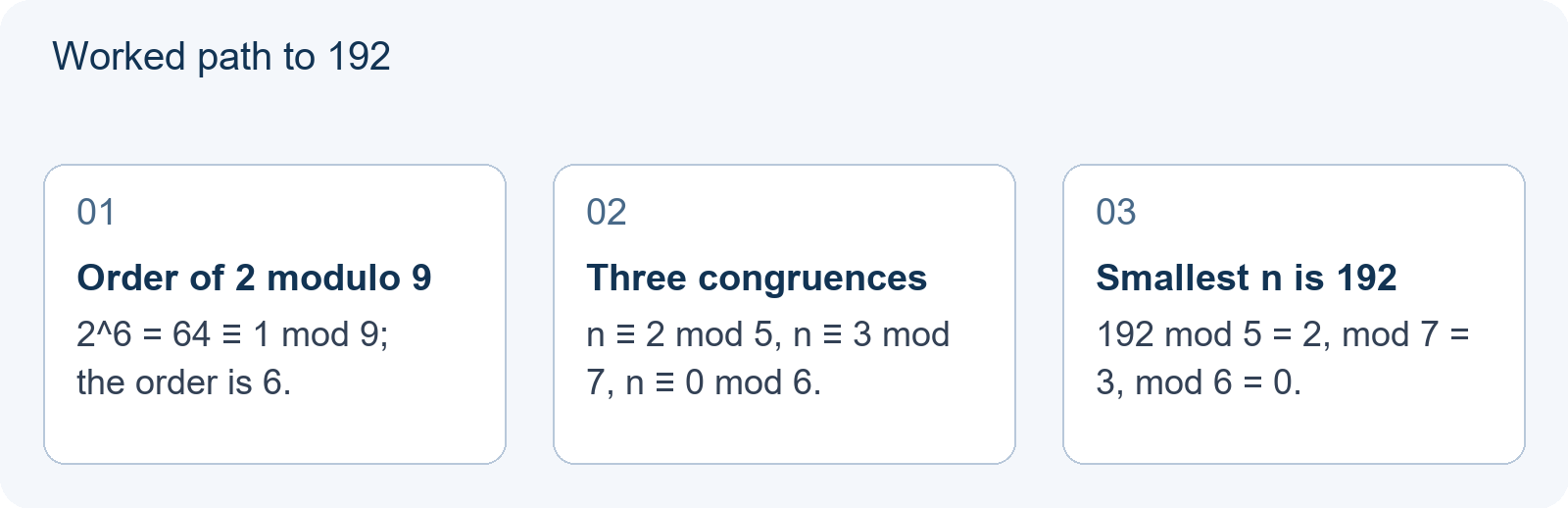
Suppose an exercise asks for the least positive integer n such that n leaves remainder 5 when divided by 8 and remainder 2 when divided by 9. This is a complete teaching example, not an official prompt. A correct setup writes n = 8a + 5 = 9b + 2 and records the word least. Solving gives a = 3 mod 9, so n = 29 is the least positive solution; all solutions differ by 72. If a student never notes least and answers 101, classify setup. If the student has already recorded the word least in setup and writes the general solution 29 + 72k, then selects k = 1 and records 101, classify the final selection as execution, not knowledge.
A labelled hypothetical 15-question diagnostic
The following is a teaching illustration, not real contest data and not a Hanlin score report. Assume six correct answers and nine misses. The point is the classification habit, not the invented question content.
| Miss | Review evidence | Category | Next action |
|---|---|---|---|
| Q3 | Changed a strict inequality to equality and dropped an endpoint | Setup | Rewrite every inequality before solving |
| Q5 | Solved for the complement but recorded it as the requested count | Setup | Box the requested quantity in the final sentence |
| Q7 | Defined a variable in thousands, then recorded the variable value | Setup | Add a unit and scale check |
| Q9 | Correct plan; sign slip when moving terms | Execution | Audit signed arithmetic line by line |
| Q10 | Correct congruence; modular inverse off by one | Execution | Verify inverse by multiplication |
| Q11 | Computed a value outside 0-999 without rechecking the requested integer | Execution | Add a final range and quantity check |
| Q13 | No usable recurrence method | Knowledge | Targeted recurrence block before another mock |
| Q14 | Did not know the needed trigonometric identity | Knowledge | Identity mini-set, then retry a fresh item |
| Q15 | Counting recursion not recognised | Knowledge | Repair the topic before a full timed set |
This hypothetical student has three setup, three execution and three knowledge misses. The next week should not be evenly split three ways. Pick the category that cost the most recoverable marks first, then keep the other repairs small.
Pass one: setup review
Review with a blank sheet. Read the original wording and underline every condition: positive, integer, distinct, increasing, nonnegative, least, greatest, or a stated range. Then write the requested quantity in your own words before looking at your solution. Compare that restatement with the first two lines you wrote in the mock. The comparison exposes setup errors: you optimised the wrong quantity, lost a boundary, or used a variable without defining its scale.
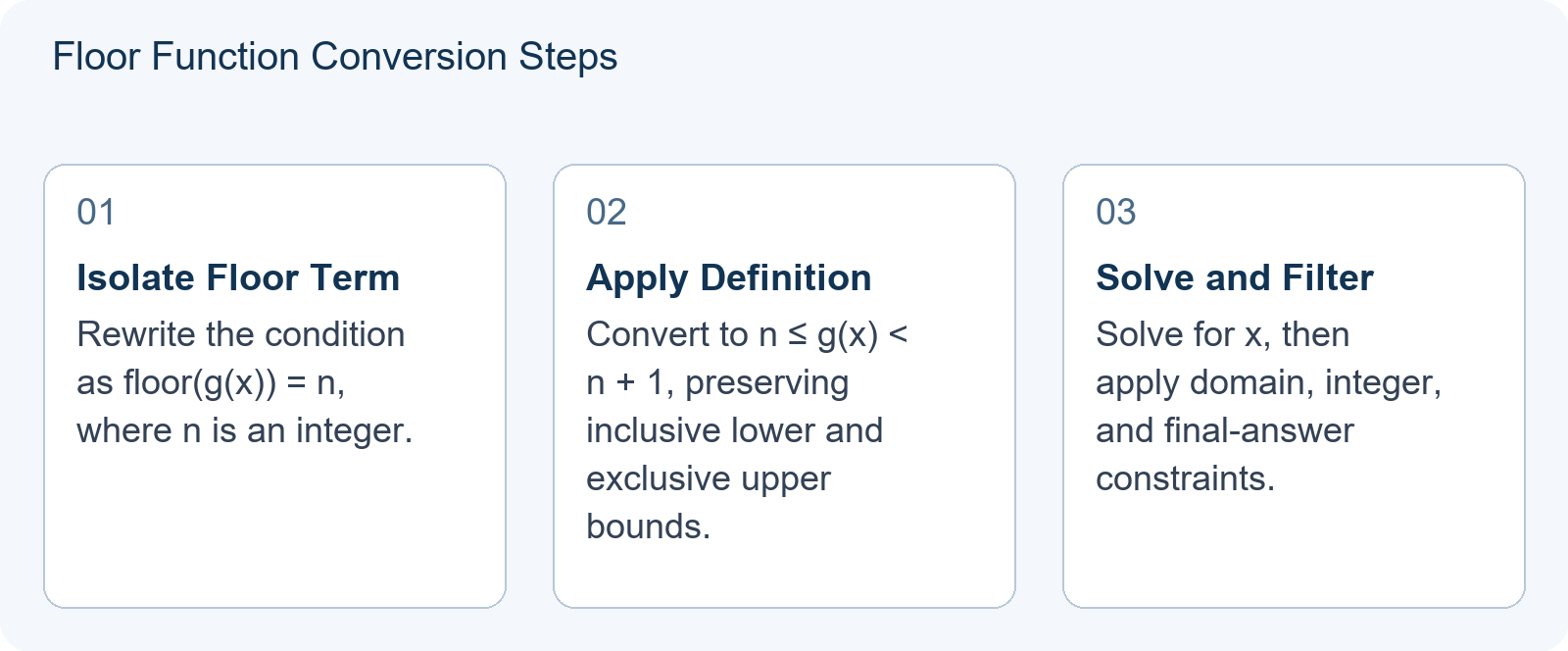
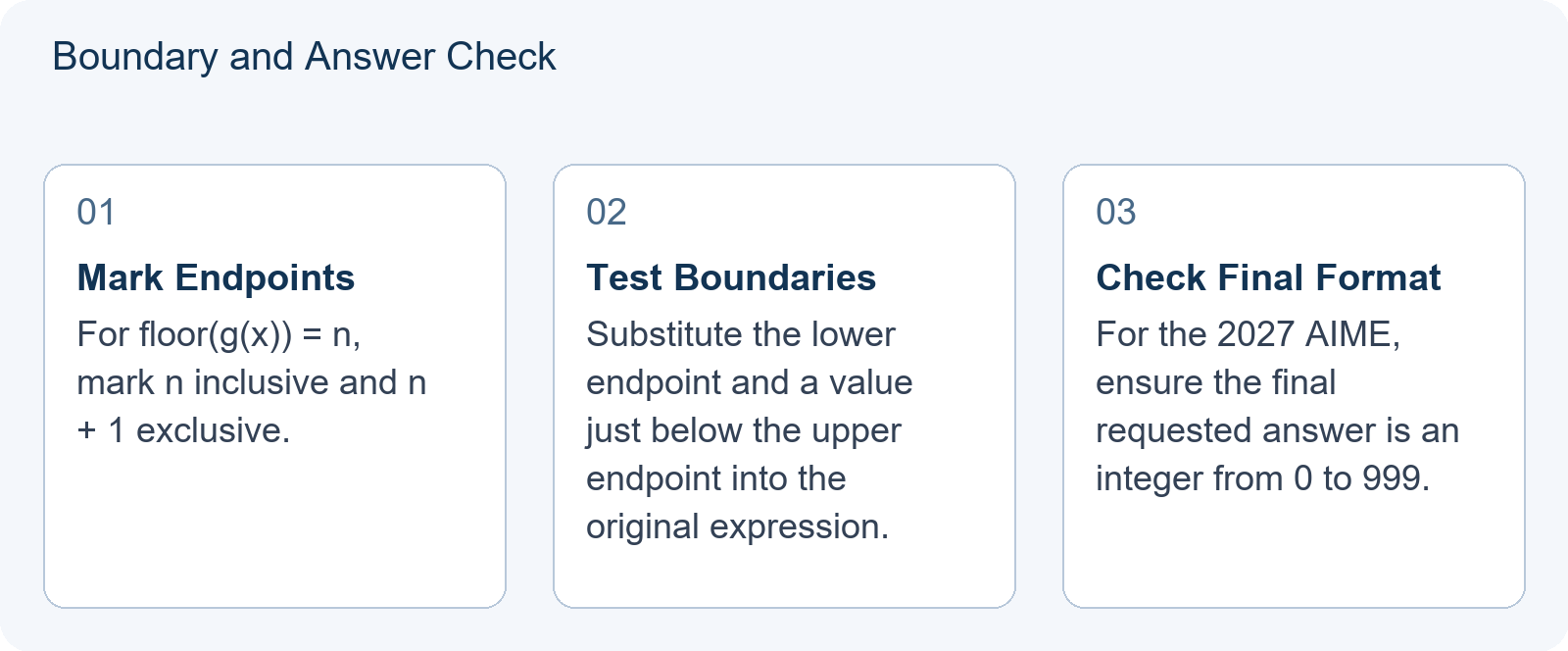
For the 2027 format, the first 90-minute section cannot be revisited, so do not award yourself a return visit during review. If you left a setup ambiguity unresolved in the mock, note it as a real cost. A setup drill is short: take five fresh conditions, rewrite each as an equation or inequality, name the requested quantity and state the admissible range. Do not solve yet. The goal is to make condition-reading automatic before more full mocks.
Pass two: execution review
Execution review starts only after the plan is judged correct. Re-solve from the first equation, but this time mark every arithmetic or algebraic transition. Check signs, distribution, cancellation and modular inverses. Then check the last three lines: did you answer the requested quantity, and is the final integer in the required range? The MAA page (2027 rules) states answers are integers from 0 to 999, so a final value outside that range is a signal to re-read the question, not a value to submit.
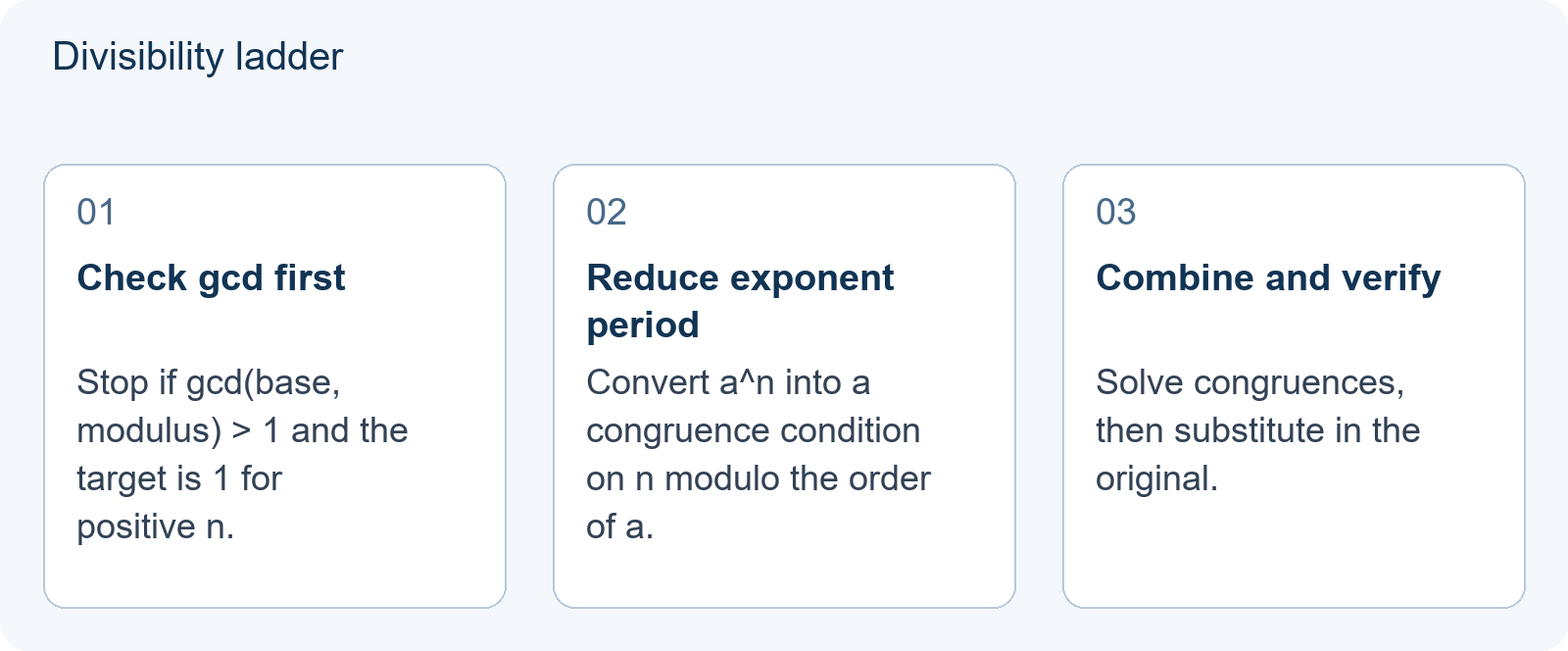
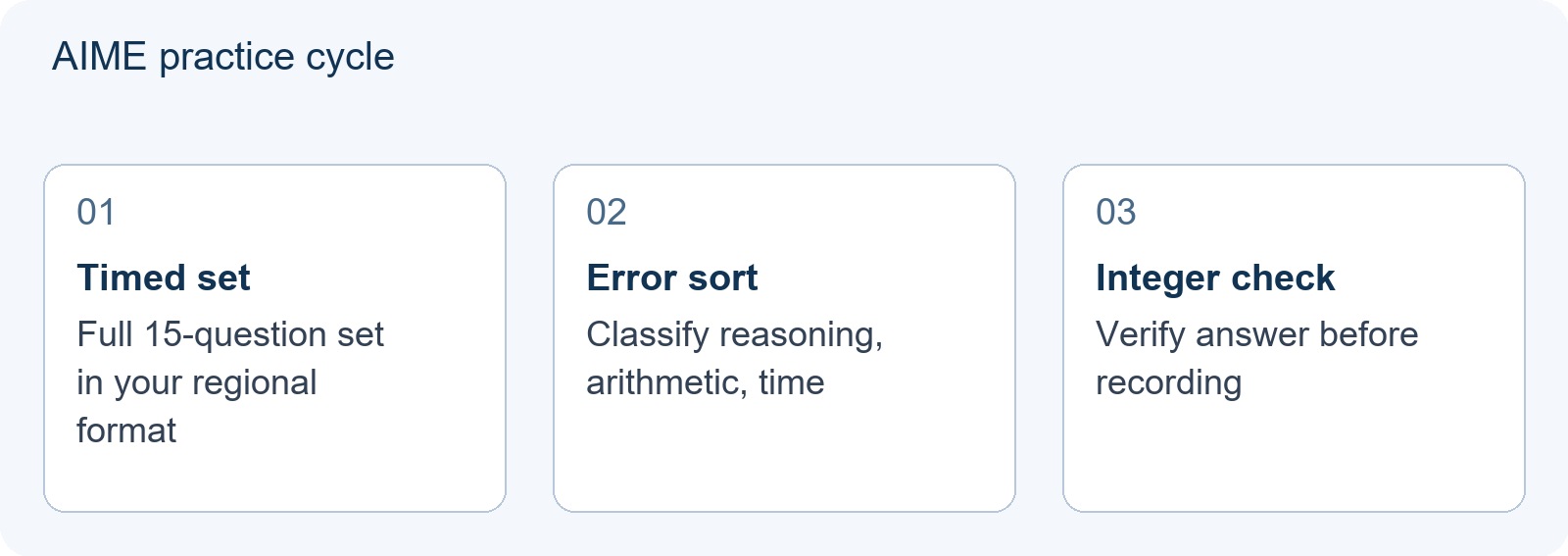
A practical repair is a 90-second final check, not a vague instruction to be careful. The check has a fixed order: re-read the final sentence, verify units and scale, recompute the last arithmetic step, confirm the answer range, and only then record. For related checking habits, see AIME Answer Checking: Catching Extraneous Roots Before Recording an Integer. If execution errors dominate, keep the topic level stable and add this check before adding more mock volume.
Pass three: knowledge review
Knowledge review asks a blunt question: could you have started without a hint? If not, name the missing object precisely. Not 'number theory is weak', but 'I did not recognise a linear recurrence that could be reduced by a characteristic equation', or 'I did not know the identity needed to collapse a symmetric triangle expression'. Precise naming prevents a vague topic block from becoming re-reading.
Hanlin's 4 November 2026 teaching note treats final-week mocks as a way to find weak or forgotten knowledge; that is a coaching judgment, not a claim that mocks replace study. Use the mock to identify the gap, then schedule a short targeted block: one worked example, two guided items, then one fresh item without notes. If the fresh item still fails at setup, the gap remains knowledge; if the setup is clear but the ending fails, move the repair to execution.
Decision rules for the next week
| Dominant category | Next seven days | Evidence to re-check |
|---|---|---|
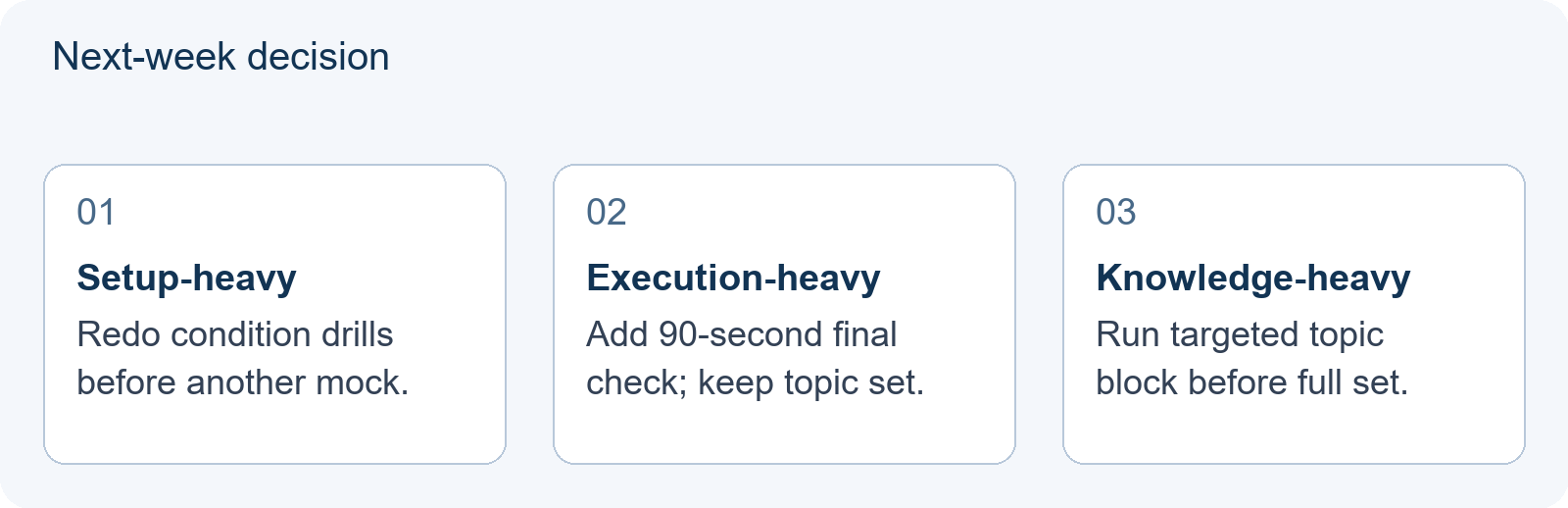
| Setup-heavy | Condition and requested-quantity drills before another full mock | You can restate the goal before solving |
| Execution-heavy | Keep topic level; add a fixed 90-second final check | Errors move into the check, not the plan |
| Knowledge-heavy | One focused topic block before the next full set | A fresh item starts without a hint |
| Mixed | One dominant repair plus one secondary repair only | The error log changes category, not just score |
Use one weekly cycle: one mock, one classified review, one targeted repair set, then a short timed re-check. Do not take a second full mock merely because the first score felt low. The re-check should be shorter than a full mock and should test the repaired category under time pressure. If the same category repeats, review whether the repair was too broad and narrow it to one observable behaviour.
Rehearse the single 2027 sitting, then prepare a useful review conversation
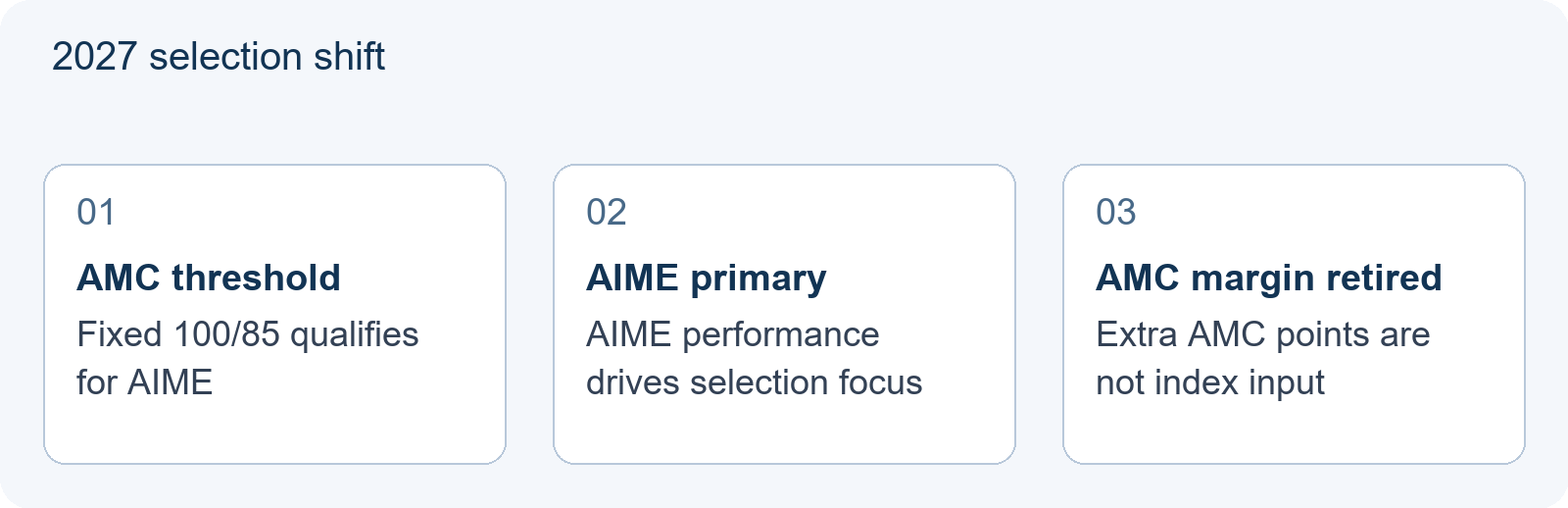
The MAA Invitational Competitions page (2027 rules, accessed 16 November 2026) states that AIME has 15 integer-answer questions with answers 0-999, in two 90-minute sections of 8 and 7 questions; the first section cannot be revisited. It also states a Pearson testing window of 5-6 February 2027, a single window and one attempt, with AIME I/II discontinued. The source page is linked here: MAA Invitational Competitions. Because the 2027 setting removes a retake, a mock should rehearse the same no-return conditions, not only the score. For pacing practice around that change, see AIME Pacing Practice: Prepare for Your Region's 2027 Format. Hanlin is independent of the MAA, which sets AIME rules.
If you discuss a completed mock with a teacher or coach, prepare a compact evidence file: one completed mock or section, the original answer sheet, scratch work showing your setup and final line, and a three-column log with question number, category and one-line evidence. Add timing notes only if you actually recorded them. Bring one focused question, such as whether the next two weeks should prioritise setup drills, execution checks or a topic block. This preparation list is a decision aid, not a claim that every item is a separate service. A teacher can then respond to the evidence rather than to a raw score alone.
Frequently Asked Questions
What is the first step after scoring an AIME mock?
Classify each miss as setup, execution or knowledge before choosing another mock. For the 2027 cycle, the MAA describes one attempt, so the review should produce next actions, not just a score.
How many categories should an AIME error log use?
Use three categories: setup, execution and knowledge. If a miss could fit two, assign the earliest category that would have prevented it, then write one next action for that category.
Should I take another full mock right after a low score?
Not usually. If setup-heavy, do condition drills first. If execution-heavy, add a fixed final check. If knowledge-heavy, repair one topic before a full set. Then use a short timed re-check.