AIME Inclusion-Exclusion: Count Overlaps Without Overcounting

Direct answer. AIME inclusion-exclusion is the technique for counting objects that satisfy at least one of several conditions when the conditions overlap. Adding the individual counts is wrong because an object satisfying two conditions is counted twice, and one satisfying three is counted three times. For three conditions A, B and C, the corrected count is |A ∪ B ∪ C| = |A| + |B| + |C| − (|A ∩ B| + |A ∩ C| + |B ∩ C|) + |A ∩ B ∩ C|. On the standard illustration of integers 1 to 100 divisible by 2, 3 or 5, this gives 50 + 33 + 20 − 16 − 10 − 6 + 3 = 74. MAA's published 2027 AIME description lists 15 integer-answer questions with answers 0–999, and regional administrations differ in timing and delivery, so confirm the format through your own registration channel rather than assuming the US/Canada arrangement applies to you.

Why adding the individual counts fails

Suppose a student writes down three sets: A = multiples of 2 up to 100, B = multiples of 3, C = multiples of 5. The individual counts are 50, 33 and 20. Adding them gives 103 — more than the 100 integers that exist in the range. A count larger than the population is always a defect, not a rounding issue. The cause is that 6 is in both A and B, so it was counted twice; 30 is in all three, so it was counted three times.

On a timed AIME this kind of error is expensive because it does not look wrong in the middle of a solution. The sum 103 looks like a plausible three-digit entry, and it only collapses when it is checked against the range. Building the check into the method, rather than saving it for the end, is what makes the technique reliable.

The sign ladder: add singles, subtract pairs, add the triple

The reason the formula has its particular shape is easy to verify region by region.

  • If an object satisfies exactly one condition, it is counted once in the singles, never in a pair, never in the triple: net contribution 1.
  • If it satisfies exactly two conditions, it is counted twice in the singles and once in a pair: net contribution 2 − 1 = 1.
  • If it satisfies all three, it is counted three times in the singles, three times across the pairs, and once in the triple: net contribution 3 − 3 + 1 = 1.

Every element therefore contributes exactly 1 to the expression, which is exactly what a union count requires. The same reasoning extends to four or more sets, where the signs alternate +, −, +, − at successive overlap levels.
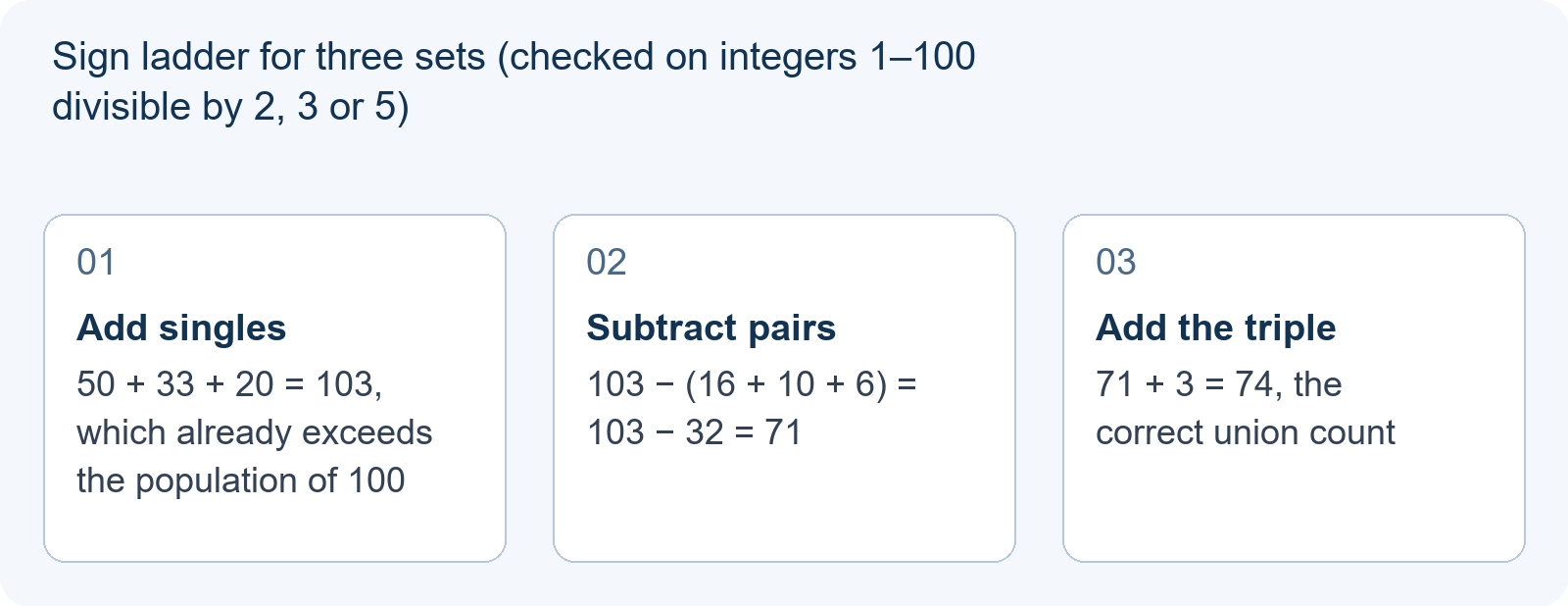
Sign ladder for three sets (checked on integers 1–100 divisible by 2, 3 or 5)

Step-by-step teaching illustration (a teaching example, not an official contest problem)

Count the integers from 1 to 100 inclusive that are divisible by at least one of 2, 3 or 5. This is a deliberately transparent illustration of the mechanics; it is not a released AIME problem.

Step 1 — single counts. |A| = floor(100/2) = 50; |B| = floor(100/3) = 33; |C| = floor(100/5) = 20.

Step 2 — pairwise intersections. An integer lies in A ∩ B when it is divisible by both 2 and 3, that is, by lcm(2,3) = 6. So |A ∩ B| = floor(100/6) = 16. Similarly |A ∩ C| = floor(100/10) = 10 and |B ∩ C| = floor(100/15) = 6.

Step 3 — triple intersection. Divisibility by all three means divisibility by lcm(2,3,5) = 30, so |A ∩ B ∩ C| = floor(100/30) = 3.

Step 4 — apply the ladder.

Term Value How it was obtained
Singles 50 + 33 + 20 = 103 floor(100/2), floor(100/3), floor(100/5)
Pairs (subtracted) 16 + 10 + 6 = 32 floor(100/6), floor(100/10), floor(100/15)
Triple (added) 3 floor(100/30)
Union 103 − 32 + 3 = 74 Add singles, subtract pairs, add triple

The answer is 74. Notice that the intermediate 103 was never the answer; it was a staging value that the later subtractions corrected.

Reading the same diagram three ways

The same setup answers several different questions, which makes overlap structures a productive practice target.

  • At least one condition: 74, as computed above.
  • Exactly one condition: compute each exclusive region. Multiples of 2 only = 50 − 16 − 10 + 3 = 27; multiples of 3 only = 33 − 16 − 6 + 3 = 14; multiples of 5 only = 20 − 10 − 6 + 3 = 7. Total 27 + 14 + 7 = 48. The shortcut expression 103 − 2(32) + 3(3) = 103 − 64 + 9 = 48 confirms it.
  • At least two conditions: the pairwise sum 32 counts an element of exactly two conditions once and an element of all three conditions three times, so subtract two copies of the triple: 32 − 2(3) = 26. Note that this group of 26 includes the 3 elements that satisfy all three conditions. Therefore, the number of elements satisfying exactly two conditions is 26 − 3 = 23.
  • None of the conditions: 100 − 74 = 26.

These regions give a free correctness test. Using disjoint categories (exactly one, exactly two, all three, none): 48 + 23 + 3 + 26 = 100, covering every integer in the range exactly once.

A second illustration where the LCM choice decides the answer

Now count integers from 1 to 120 divisible by 4, 6 or 10. Singles: floor(120/4) = 30, floor(120/6) = 20, floor(120/10) = 12. Pairs use the least common multiples: lcm(4,6) = 12 gives 10; lcm(4,10) = 20 gives 6; lcm(6,10) = 30 gives 4. The triple uses lcm(4,6,10) = 60, giving 2. So the union is 30 + 20 + 12 − (10 + 6 + 4) + 2 = 62 − 20 + 2 = 44.

The instructive part is the pair lcm(4,6) = 12. Substituting 24, a common product rather than the least common multiple, would give floor(120/24) = 5 instead of 10. Because this term is subtracted, underestimating the intersection size leads to subtracting too little. The incorrect calculation would be 62 − (5 + 6 + 4) + 2 = 62 − 15 + 2 = 49. Thus, the error causes the final count to increase from 44 to 49. LCM errors do not announce themselves; they simply shift the result. Writing the lcm beside each intersection before doing any arithmetic is the cheapest defence.

'At least one' versus 'exactly one': the comparison that prevents lost points

Phrase in the question What it counts Correct treatment
At least one The union |A ∪ B ∪ C| Add singles, subtract pairs, add the triple (74 in the first illustration)
Exactly one Elements in one set and no other Build each exclusive region |A| − |A ∩ B| − |A ∩ C| + |A ∩ B ∩ C| and sum them (48 in the first illustration)
At least two Elements in two or three sets Add the pairwise intersections, then subtract twice the triple intersection (26 in the first illustration)

A common point of confusion arises when students compute the union correctly but submit it for an 'exactly one' question, or vice versa. The two numbers are different, and the gap between 74 and 48 is exactly the set of integers that satisfy two or three of the conditions. Distinguishing whether the question asks for the total coverage (union) or specific exclusive zones is critical for accuracy.

Venn diagrams as a twenty-second check

You will rarely have time to fill in every Venn region during the exam, but a rough three-circle sketch still pays. Label the pairwise and triple regions first, since those are where the sign errors occur, and leave the exclusive regions blank. If the question says 'exactly one', you should see immediately that three separate blank regions are being requested, not the whole outline.

Overcounting has other disguises as well. Rotational arrangements, for example, are overcounted by a symmetry factor rather than by an overlap level, and the correction is not the inclusion-exclusion ladder; that distinct trap is treated in our note on AIME Counting With Symmetry: When Dividing by the Number of Rotations Fails. Being able to name which kind of overcounting you face is half the diagnosis.

Diagnostic routine after you reach an answer

  • Population test: is the count no larger than the number of objects in the stated range? 74 out of 100 passes; 103 does not.
  • Sign test: did you add the triple back after subtracting the pairs? The pattern is +, −, +, never +, −, −.
  • Region-sum test: do the exclusive, exactly-two, triple and none regions add to the population? 48 + 23 + 3 + 26 = 100 leaves no integer unaccounted for.
  • Divisor test: is every intersection divisor a genuine least common multiple? Pair intersections use lcm of the two divisors; the triple uses lcm of all three.

Each check takes seconds and each one catches a different error class. Overlap counting rewards a student who finishes with two independent routes to the same integer, not one confident route.

Wording that signals overlap counting

Certain phrases should trigger the ladder almost automatically: 'divisible by', 'is a multiple of', 'contains at least one of', 'satisfies either … or …', and any request phrased as 'how many … have at least one property'. The complementary phrases 'exactly one' and 'none' should trigger the region-building variant instead. When overlap counting appears alongside residue conditions, it is worth reviewing the residue technique separately; our note on AIME Modular Arithmetic: Recover an Integer From Two Remainders covers the congruence side of such problems.

How to practise this before your sitting

Six to eight well-chosen overlap problems are worth more than forty undifferentiated counting exercises. Work in this order: two-set warm-ups until the subtraction is automatic; three-set divisibility problems until the triple term is never forgotten; then 'exactly one' and 'at least two' variants of the same setup, so that the different target phrases are felt as different questions. Time a small set at exam pace, and keep a written record of which region you miscounted, not just which problem you missed.

Hanlin's own course note for 2027 AIME preparation, 'Important Notice: Domestic AIME Arrangements Confirmed' (Hanlin Courses WeChat account, retrieved 26 October 2026), treats number theory and combinatorics as the usual weak modules for Chinese students targeting 8–10 points. That is a coaching judgment drawn from teaching experience, not an official MAA rule or a published statistic, and it should be read as a study-priority suggestion rather than a prediction about any individual. Students who want to close that gap tend to benefit from bringing one or two worked overlap attempts, including the wrong version, to any consultation so the error can be located at the region level.

For the wider context around structure, difficulty spread and preparation sequencing, see our AIME Competition Guide: Scoring Changes, Difficulty Breakdown, and Prep Strategies.

General event background is available at Event background.
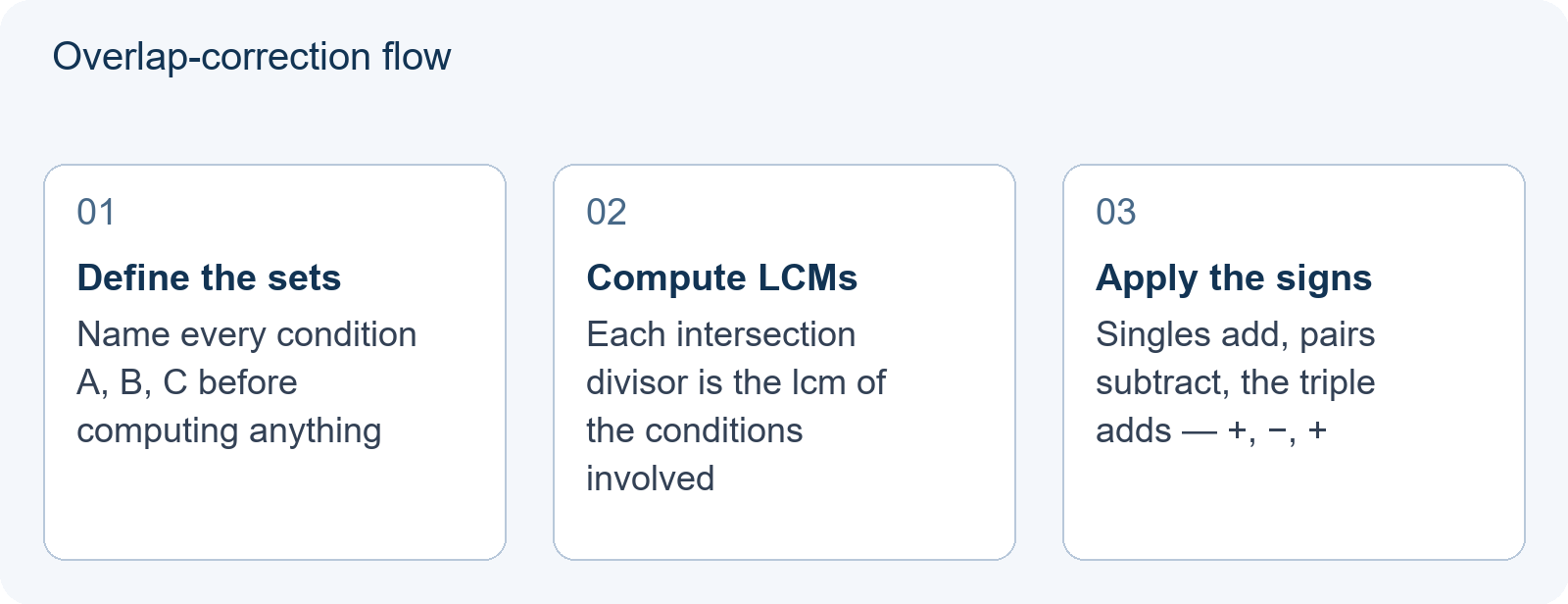
Overlap-correction flow

Frequently Asked Questions

Is inclusion-exclusion always necessary for small ranges?

No. If the whole population is small enough that you can list every element and mark the conditions by hand, direct enumeration is often safer, because the listing itself is the check. The ladder becomes the better choice once the range or the number of conditions makes complete listing impractical, which is the normal situation on the AIME. Either way, keep the population test: any count above the size of the range is wrong.

How do I handle 'exactly one' conditions?

Do not submit the union count. Build each exclusive region separately using |A| − |A ∩ B| − |A ∩ C| + |A ∩ B ∩ C| and add the three regions; in the 1-to-100 illustration that is 27 + 14 + 7 = 48. The equivalent shortcut is 103 − 2(32) + 3(3) = 48. Use whichever form you can reproduce under time pressure.

Which errors should I guard against in these problems?

Two errors to guard against are an incorrect least common multiple for an intersection, such as using 24 instead of 12 for lcm(4,6), and forgetting to add the triple intersection back after subtracting the pairwise intersections. Check each intersection divisor explicitly, and treat the region-sum test as a consistency check only when the regions are built from the actual set memberships rather than from the same mistaken intersection figures.
AIME China 2027: Age, Format, and Single-Exam Differences

Direct Answer: What Applies to AIME China 2027?

If your search question is "does the new AIME age rule or computer format apply to China in 2027?", the short answer is no on both counts. According to Hanlin's operator report Important Notice: Domestic AIME Math Exam Arrangements Confirmed! (WeChat public account "Hanlin Curriculum", published October 2026), the China region maintains its original rules with no minimum age threshold and continues to use a 180-minute continuous paper-based exam. The US/Canada region, by contrast, introduces a minimum age of 13 and moves to a two-part computer-based administration.

This distinction matters because reform headlines travel faster than regional policy. The MAA Invitational Competitions page, checked 26 October 2026, states that international AMC participants follow their country's IGL (International Governing Body) policy. That language is exactly why a US/Canada administrative change is not automatically a China change, and why younger Chinese students should not assume ineligibility before checking their region's rules.

Why the Confusion? What the US/Canada Region Actually Changed

The 2026-2027 season brought structural changes to the AMC and AIME series in the US/Canada region. The MAA page checked 26 October 2026 lists the following:

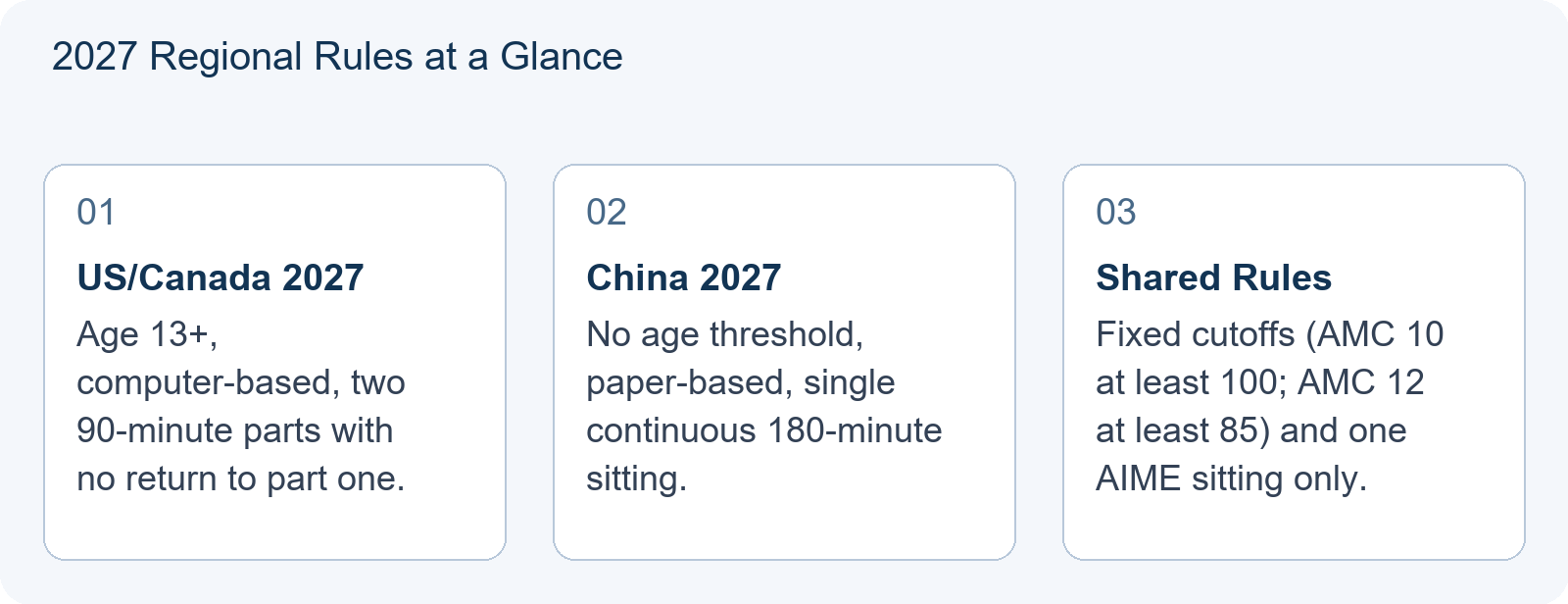
  • Minimum age of 13. In the US/Canada region, students under 13 are ineligible for AIME even if they meet the AMC score cutoff.
  • Computer-based administration at Pearson centers, with the English test delivered February 5-6, 2027.
  • Two-part structure. First 90-minute part contains 8 questions; after a short break, the second 90-minute part contains the remaining 7. Once a student moves to part two, they cannot return to edit part one.
  • Unified fixed cutoffs. AMC 10 at least 100, or AMC 12 at least 85, with other eligibility requirements.

Those details are US/Canada administration facts. Because international AMC participants follow their own country's IGL policy, treating them as global AIME rules would mislead China-region families. For comparison, the same MAA update notes that USAMO/USAJMO selection in 2027 is primarily AIME-based, with the AMC score no longer counted and the old AMC-plus-AIME index abolished.

2027 Regional Rules at a Glance

AIME China 2027 vs. US/Canada: Comparison Table

The table below summarizes the differences reported for 2027, using the Hanlin October 2026 operator report for China-region facts and the MAA page checked 26 October 2026 for US/Canada facts.

Feature US/Canada 2027 China 2027
Age eligibility Minimum age 13 required. No age threshold; original rules maintained.
Delivery mode Computer-based at Pearson centers. Offline paper exam.
Duration and structure Two 90-minute parts: 8 questions, break, 7 questions. No back-tracking to part one. One continuous 180-minute sitting; entire paper available for review in the same window.
Question count and answer form 15 integer-answer questions, answers 0-999. 15 integer-answer questions, answers 0-999.
AMC qualification cutoffs AMC 10 at least 100, or AMC 12 at least 85 (with other eligibility requirements). AMC 10 at least 100, or AMC 12 at least 85, matching the US figure as a fixed line rather than a percentage.
Number of AIME sittings Single AIME only. AIME I / AIME II split and the makeup path are removed for the 2027 season.

Read this table as a decision aid, not as a summary of everything in the AIME rulebook. It shows that for a Chinese student, the operational variables actually under their control in 2027 are paper-format endurance, single-sitting accuracy, and AMC score margin above the fixed cutoff — not the Pearson interface or the age-13 line.

Younger Chinese Students: Eligibility Without the US/Canada Age Cap

Parents of Grade 6 or Grade 7 students often ask whether the US/Canada age-13 rule blocks their child. Per the Hanlin October 2026 report, the China region keeps its original rules and has no age threshold, so a qualified AMC 10 or AMC 12 performer is not disqualified by age in the China stream for 2027.

Eligibility is not the same as readiness, however. The China-region format asks the candidate to hold focus across 180 continuous minutes, handwrite the entire solution path, and verify integer answers without a computer interface to catch input mistakes. If you are the parent of a young qualifier, the useful planning question is not "is my child old enough?" but "can my child sustain 180 minutes of focused reasoning after a full school day?" That is a practice question, and it is answered by timed paper mocks, not by age documents.

Single-Exam Reality: Planning for One AIME Sitting

A second change is not regional at all: 2027 ends the AIME I / AIME II split and the associated makeup path. Per the Hanlin October 2026 report, qualifying candidates receive one AIME opportunity in the season, with no second sitting to absorb an off day.

The practical implication is narrower than it first appears. What disappears is optional recovery, not optional strategy. A student who prepared to use AIME I as a low-stakes rehearsal and AIME II as the real attempt loses that sequence. In 2027, the same student needs a single plan that is calibrated for the paper they will actually see on 7 February 2027 (China region, 13:00-16:00, per the Hanlin report).

For China-region papers, that removal of a second sitting argues for tighter answer-checking inside the same 180 minutes. Because the entire paper stays accessible, the last 15-25 minutes can be reserved for verifying arithmetic and integer-range constraints (0-999) rather than racing through unattempted items. For a broader discussion of when study should shift from AMC speed to AIME sustained reasoning, see AIME Preparation After AMC: When to Switch From Speed to Sustained Reasoning.

Format Stability: Why 180-Minute Paper Practice Still Fits China

A common consequence of reading US/Canada reform coverage is that a Chinese student starts gaming, in training, for an artificial two-part structure. Per the Hanlin October 2026 report, the China region stays on the continuous 180-minute paper model for 2027; the note also indicates that from 2028 the China region is expected to align with the two-part offline computer-based style. That expectation does not change the 2027 simulation you should be running this season.

Coaching guidance for the 2027 China paper format typically includes:

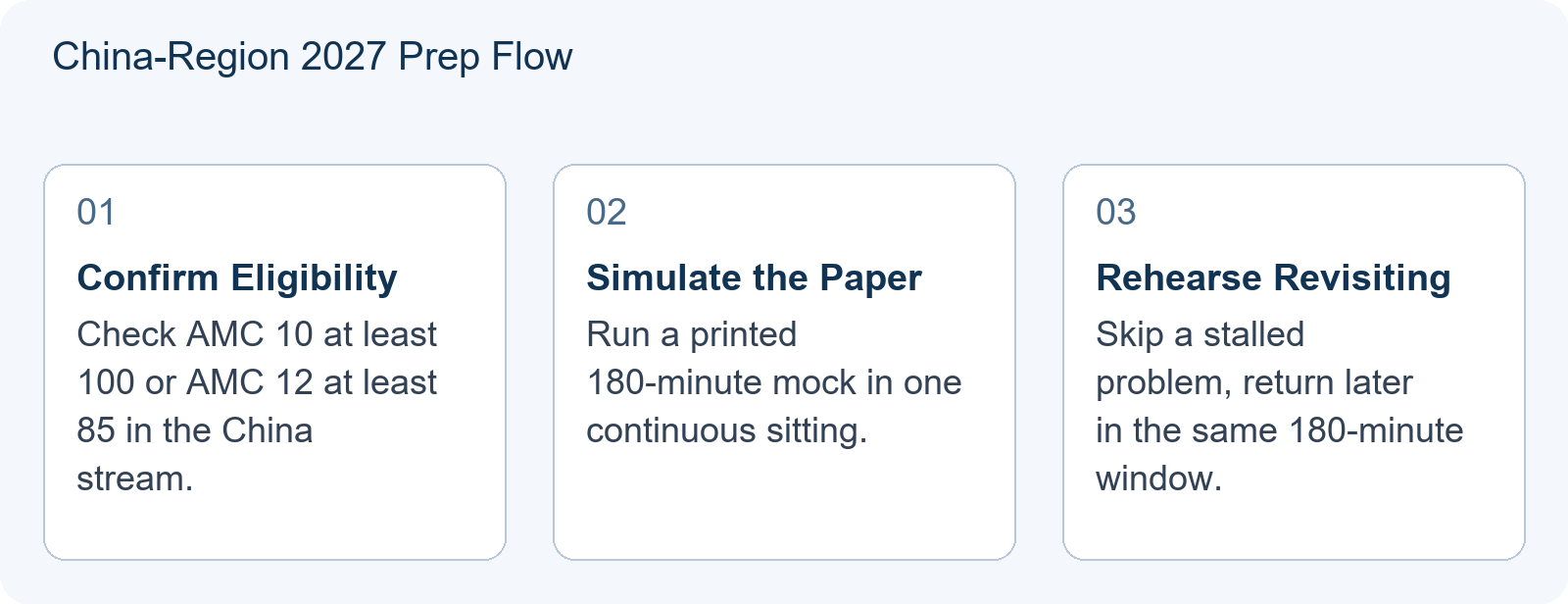
  1. Full-length paper simulations. Run printed 180-minute mocks rather than short digital sessions, so timing instinct and scratch-paper habits are trained under the real constraint.
  2. Answer-verification habit. Build a routine of plugging results back into the original condition and checking that the integer lies within 0-999 before recording it.
  3. Revisit discipline. Practice skipping a stalled problem and returning to it later within the same 180-minute window, since the China paper does not lock a first-pass answer.

These are proposals for training, not claims about how any specific student performed. They follow directly from the format facts in the operator report.

Worked Teaching Illustration: A 180-Minute Time Frame

The following is an illustrative planning exercise, not a past contest problem and not a predicted AIME paper. Suppose a China-region candidate sets two goals for a 180-minute paper: attempt 12 of the 15 problems with full effort, and reserve 25 minutes at the end for verification of the answers already recorded.

  • Time for active solving: 180 - 25 = 155 minutes.
  • Average budget per attempted problem: 155 / 12 ≈ 12.9 minutes, so a working plan of roughly 12-13 minutes per attempted problem.
  • If the candidate wants a safety buffer of 30 minutes instead of 25: (180 - 30) / 12 = 150 / 12 = 12.5 minutes per attempted problem.

Notice that the average is not a per-problem rule; earlier problems in the paper are typically faster, so the real plan front-loads the clock and leaves more room for the attempted items near the back. If you are calibrating against AIME qualification scores instead of time, see AIME Qualification Targets: Build a Reliable Margin Above the AMC Cutoff.

USA(J)MO Pathway: Separate Eligibility Policy

Families aiming at USAMO or USAJMO should treat the pathway separately from AIME eligibility. The MAA page checked 26 October 2026 states that USAMO/USAJMO selection in 2027 is primarily based on AIME scores, with the AMC score no longer counted and the old AMC-plus-AIME index abolished.

USAMO/USAJMO participation is governed by separate eligibility policies, so readers interested in that pathway should consult the official MAA eligibility guidelines directly. This article's scope is the AIME China-region format comparison. For broader context on how regional formats shape preparation generally, see AIME Pacing Practice: Prepare for Your Region's 2027 Format.

Bringing Your Region Questions to an Authorized Test Center

If you plan to speak with an authorized AMC/AIME test center such as the one described in the Hanlin October 2026 report, come with questions that fit the 2027 rule picture rather than generic preparation questions. Useful items to have ready:

  • Your recent AMC 10 or AMC 12 score, so the center can assess margin above the fixed 100 / 85 line.
  • Confirmation that your registration is being handled in the China-region stream, not the US/Canada stream.
  • The format you will sit: continuous 180-minute paper exam, not a two-part computer test.
  • Which practice resources target paper-based endurance and integer-answer verification.
  • Your goal, whether that is AIME qualification, a high AIME score, or a longer mathematical progression.

The aim of these questions is to make sure a study plan matches the rules that apply to your confirmed region, rather than rules that appear in a global news summary.

General event background is available at Event background.

China-Region 2027 Prep Flow

Frequently Asked Questions

Is there an age limit for AIME China 2027?

No. The Hanlin October 2026 report describes the China region as keeping its original rules with no minimum age threshold, in contrast to the US/Canada region where a minimum age of 13 applies to AIME 2027.

Will Chinese students take the 2027 AIME on a computer?

For the 2027 season, no. The Hanlin report describes the China region remaining on a 180-minute continuous paper-based exam. The two-part computer-based administration is a US/Canada change. The same report indicates China may move to a comparable two-part offline computer format from 2028, which is planning context for later seasons rather than for 2027.

How does USAMO/USAJMO selection relate to AIME 2027?

USAMO/USAJMO selection in 2027 is primarily based on AIME scores, according to the MAA page checked 26 October 2026. USAMO/USAJMO participation is governed by separate eligibility policies, so students aiming for USAMO/USAJMO should consult the official MAA eligibility guidelines directly.

AIME Polynomial Remainders: Solving Without Expanding Every Term

For many students preparing for the American Invitational Mathematics Examination (AIME), polynomial remainders present a specific cognitive trap. The instinct is often to perform long division or expand terms fully, which consumes valuable time and increases the likelihood of arithmetic errors. However, the core skill required is not computational endurance but strategic simplification using the Remainder Theorem and modular arithmetic concepts. This article develops a systematic approach to solving polynomial remainder problems without expanding every term, providing concrete teaching illustrations and diagnostic guidance.

The Core Principle: Why Expansion Fails

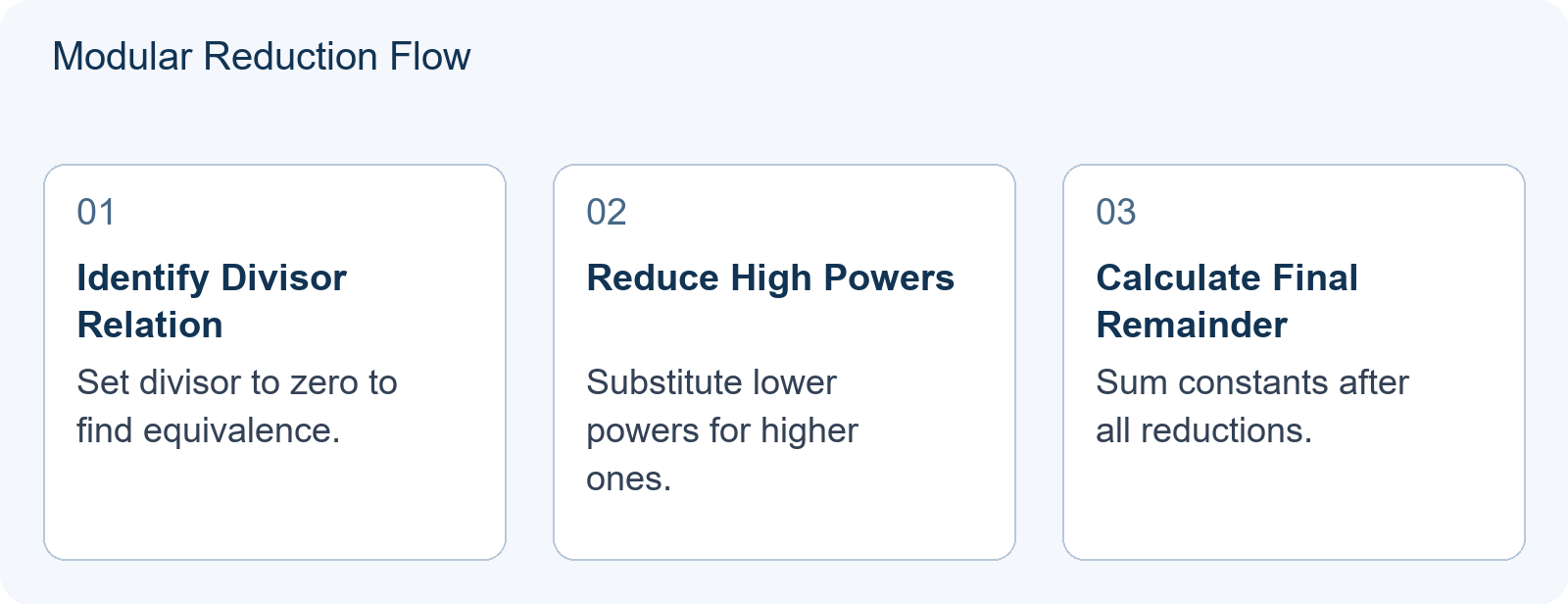
The Remainder Theorem states that if a polynomial P(x) is divided by (x - c), the remainder is P(c). When the divisor is more complex, such as (ax² + bx + c), direct application requires finding roots or using undetermined coefficients. In AIME contexts, divisors are often chosen so that their roots are irrational or complex, making direct substitution messy. The key insight is to treat the polynomial equation modulo the divisor. If we know that x² ≡ k (mod x² - k), we can reduce high powers of x systematically without expanding the entire expression.

This modular perspective transforms a division problem into a substitution problem. Rather than asking "what is the quotient?" we ask "what is x equivalent to?" The answer allows us to collapse exponents rapidly. This method is particularly powerful because AIME problems frequently feature polynomials of degree 8 or higher divided by simple quadratics—precisely the structure where brute-force long division would waste five to ten minutes.

Teaching Illustration 1: Strategic Reduction

Consider a teaching illustration where you need the remainder when P(x) = x¹⁰ + 5x⁸ + 2 is divided by Q(x) = x² - 3. Instead of dividing term by term, observe that x² ≡ 3 (mod x² - 3). Therefore, x¹⁰ = (x²)⁵ ≡ 3⁵ = 243. Similarly, x⁸ = (x²)⁴ ≡ 3⁴ = 81. Substituting these back into P(x), the remainder is 243 + 5(81) + 2 = 243 + 405 + 2 = 650. This method takes seconds compared to minutes spent on long division.

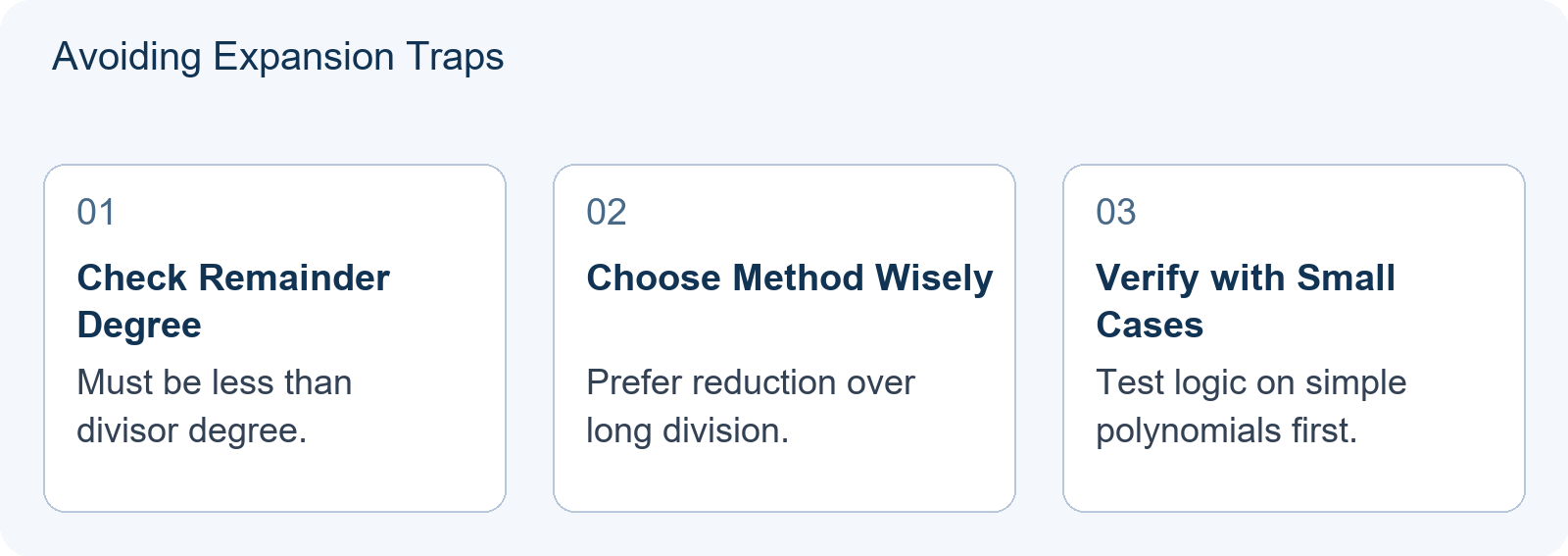
The critical verification step is confirming that the remainder's degree is less than the divisor's degree. Here, the remainder 650 is a constant (degree 0), which is less than degree 2, so the answer is complete. Students who attempt long division would arrive at the same constant but through far more error-prone arithmetic.

Teaching Illustration 2: Where Assumptions Fail

A common mistake occurs when students assume they can simply plug in values without verifying the degree of the remainder. Suppose P(x) is divided by D(x) = x² + x + 1. The remainder must be linear, say R(x) = ax + b. Students might try to find a and b by evaluating P(ω) where ω is a complex root. While valid, this requires handling complex numbers carefully. A safer, purely algebraic approach involves reducing powers of x using x² ≡ -x - 1. For example, x³ = x·x² ≡ x(-x-1) = -x² - x ≡ -(-x-1) - x = 1. Recognizing that x³ ≡ 1 allows rapid reduction of any power xⁿ based on n mod 3.

If a student fails to identify this cyclic pattern, they may attempt unnecessary complex substitutions, leading to calculation errors. The modular approach here reveals structure: since x³ ≡ 1, the powers of x cycle with period 3. For any polynomial, we can reduce exponents modulo 3, then express the result as a linear combination of 1 and x, which gives the remainder directly.

Diagnostic Table: Common Errors vs. Efficient Methods

Error Type Description Correct Approach
Brute Force Division Performing full polynomial long division. Use modular reduction (xᵏ ≡ r).
Ignoring Remainder Degree Assuming remainder is constant for quadratic divisors. Remainder degree < Divisor degree (linear for quadratic).
Complex Root Misuse Making arithmetic errors with i or ω. Stick to real-coefficient reduction rules.

Modular Reduction Flow

Building Systematic Skill: A Targeted Practice Sequence

To build this skill, start with divisors of the form x² - k, where the reduction is immediate: x² ≡ k. Practice reducing xⁿ for n up to 12. Then move to x² + x + 1 or x² - x + 1 where cyclic patterns emerge—here, x³ ≡ 1 or similar identities appear. Finally, tackle general quadratics requiring systems of equations for coefficients a and b. This progression mirrors the difficulty curve seen in competition contexts.

Each stage demands verification: after finding a remainder, multiply the quotient (if known) by the divisor and add the remainder—check that you recover the original polynomial. This sanity check catches sign errors and coefficient mistakes instantly.

For broader context on eligibility and preparation strategies, refer to our AIME: 7 Points is the Watershed, 10 Points is the Stepping Stone. Understanding the structural changes in the exam format, such as the shift to computer-based testing, helps contextualize why speed and accuracy in algebraic manipulation are critical. Additional background on qualification pathways appears in AMC Math Competition: A Guide to AIME Qualification and Preparation.

Demonstrating Competence

A learner should be able to take any polynomial up to degree 10 and divide it by a monic quadratic within two minutes, showing clear steps of power reduction rather than division algorithms. This aligns with the emphasis on foundational algebra skills highlighted in our From AMC8 to AIME: The Ultimate Math Competition Progression Path. Mastery means recognizing the divisor's structure instantly and selecting the appropriate reduction path without hesitation.

Avoiding Expansion Traps

Frequently Asked Questions

Can I always use the Remainder Theorem directly?

Only for linear divisors like (x-c). For quadratics, you must use modular reduction or set up a system for the linear remainder ax+b.

Is complex number substitution faster?

It can be, but it risks arithmetic errors. Algebraic reduction using x² relations is often safer and quicker for integer coefficients.

How does this apply to the new AIME format?

The new format emphasizes speed and accuracy. Mastering reduction techniques saves time compared to manual long division.

AIME Counting With Symmetry: When Dividing by the Number of Rotations Fails

Many AIME preparation students encounter counting problems where symmetry seems to invite a quick shortcut: identify rotational symmetry, then divide the total count by the number of rotations. This article addresses the specific failure mode in the title—when and why this division fails—through two original teaching illustrations. For broader context on AIME eligibility and the 2026-27 competition changes, see our AIME: 7 Points is the Watershed, 10 Points is the Stepping Stone.

The Tempting Shortcut and Its Limits

The intuition behind "divide by the number of rotations" comes from Burnside's lemma or basic orbit-counting: if a figure has n-fold rotational symmetry, one might expect each distinct configuration to appear n times in an unconstrained count. But this only holds under strict conditions that AIME problems often violate. The two cases below show a valid application and a common misapplication.

Case 1: Where Division Works (Teaching Illustration)

Setup: Count the number of distinct necklaces of 6 beads, using 2 red and 4 blue beads, where rotations are considered identical but reflections are distinguished.

Unconstrained count: Choose positions for the 2 red beads: C(6,2) = 15.

Symmetry analysis: The cyclic group C₆ acts on these 15 configurations. For a configuration to have stabilizer larger than the identity, the pattern must repeat with period dividing 6. With exactly 2 red beads, the only possible non-trivial stabilizer would require period 2 (3 copies of a 2-bead pattern) or period 3 (2 copies of a 3-bead pattern). Period 3 is impossible: it requires 3 red beads (one per block) or 0 red beads, not 2. Period 2 requires opposite beads to match, which is possible.

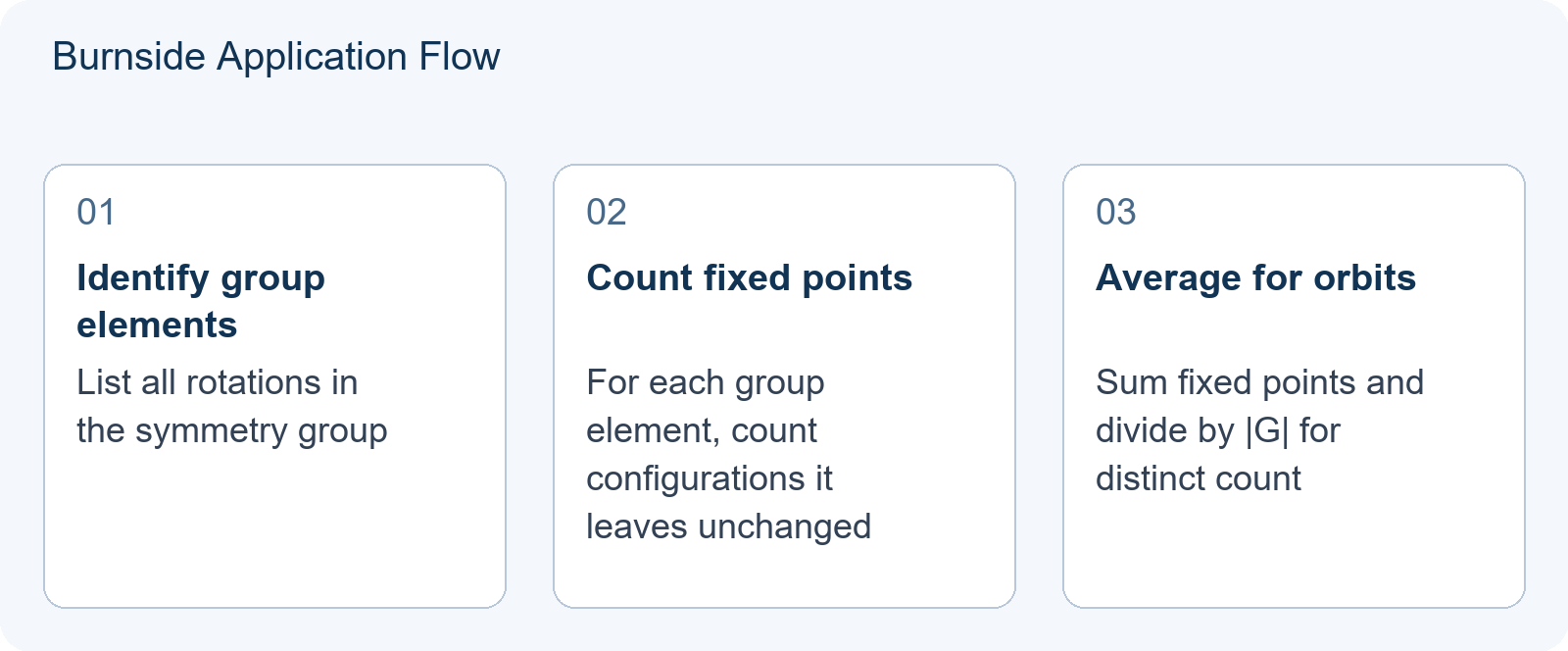
Correct approach (Burnside's lemma):

  • Identity (1 element): fixes all 15 configurations
  • Rotation by 60° and 300° (2 elements, order 6): fix only uniform colorings; impossible with 2 red, 4 blue. Fix 0 each.
  • Rotation by 120° and 240° (2 elements, order 3): require three matching positions; impossible with 2 red. Fix 0 each.
  • Rotation by 180° (1 element, order 2): requires opposite beads to match. With 2 red, 4 blue, choose which of the 3 opposite pairs is red-red: 3 configurations fixed.

Distinct necklaces = (15 + 0 + 0 + 0 + 0 + 3)/6 = 18/6 = 3.

Why naive division fails: 15/6 = 2.5 is not an integer, immediately signaling error. Even if it were integer, the correct answer 3 ≠ 2.5. The non-trivial stabilizer from the 180° rotation (3 configurations with opposite reds) makes uniform orbit size impossible.

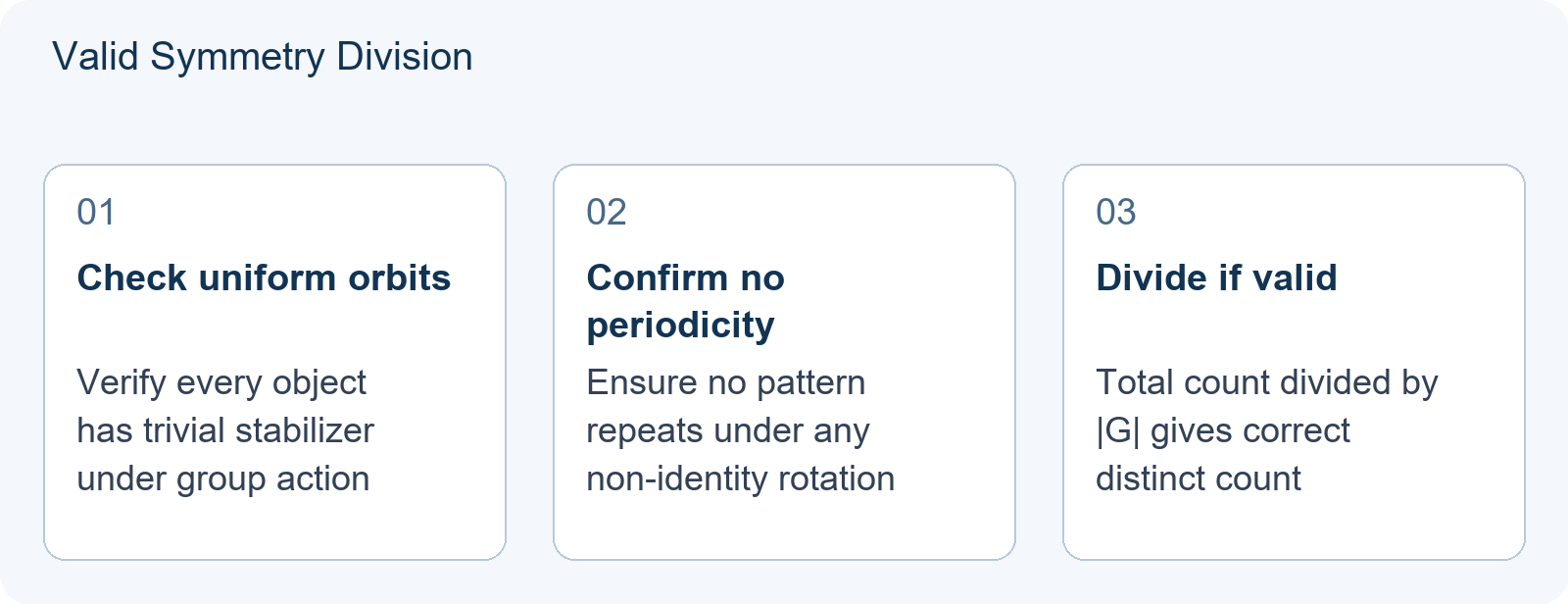
Valid Symmetry Division

Case 2: Where Division Fails Disastrously (Teaching Illustration)

Setup: Count distinct colorings of a regular hexagon's vertices with 3 colors (R, G, B), where two colorings are equivalent if one rotates to the other.

Naive approach: Total colorings = 3⁶ = 729. Hexagon has 6 rotations. "Answer": 729/6 = 121.5—not even an integer, immediate red flag.

Why division fails: Different colorings have different stabilizer sizes. The monochromatic colorings (all R, all G, all B) have stabilizer size 6, not 1. Many patterns with repeating subpatterns (like RGRGRG) have stabilizer size 2 or 3. The orbits are not uniform in size.

Correct approach (Burnside):

  • Identity (1): fixes all 3⁶ = 729
  • Rotation by 60° and 300° (2 elements): fix colorings with all vertices same color, so 3 each
  • Rotation by 120° and 240° (2 elements): fix colorings with period 3, so 3² = 9 each
  • Rotation by 180° (1 element): fixes colorings with opposite vertices equal, so 3³ = 27

Distinct colorings = (729 + 2·3 + 2·9 + 27)/6 = (729 + 6 + 18 + 27)/6 = 780/6 = 130.

The naive 121.5 is wrong by nearly 7%; in other problems, the error can be larger.

Diagnostic: When Can You Divide?

Condition Safe to divide? Typical AIME context
All orbits have same size |G| Yes Rare; requires no non-identity symmetry in any configuration
Some orbits smaller (non-trivial stabilizers) No Most symmetry counting problems
Counting orbits of group action on labeled objects Use Burnside Necklaces, colorings, arrangements
"Up to rotation" with constraints on counts Use Burnside Bead colorings with fixed color frequencies

The Key Decision Rule

Before dividing by |G|, ask: Does every configuration I'm counting have trivial stabilizer? If any configuration could repeat under a non-identity rotation—same colors in a periodic pattern, identical objects arranged symmetrically, etc.—then division is invalid. Burnside's lemma is the reliable tool.

Building the Skill for AIME

AIME counting problems with symmetry typically appear in the 7-12 range, where careful case analysis separates correct from incorrect answers. The specific skill to demonstrate: given a symmetry condition, identify the group action, compute fixed points for each symmetry, and apply the orbit-counting formula.

For practice sequencing and broader preparation strategies, refer to our AMC Math Competition: A Guide to AIME Qualification and Preparation. Students ready for advanced topics may also consult From AMC8 to AIME: The Ultimate Math Competition Progression Path for additional challenge areas.

Preparing for Consultation

If you're working through symmetry counting and considering structured support, prepare these items for productive discussion:

  • Specific problems where your answer differed from the solution—note whether you used division or Burnside
  • Your current comfort with cycle notation and group actions
  • Whether you're targeting AIME qualification (AMC 10/12 performance) or AIME score improvement (USAJMO/USAMO trajectory)

Understanding the 2026-27 AIME format changes—including the two-part 90-minute structure and computer-based delivery—also informs how to time your practice sessions. The mathematical content, however, remains consistent with past years.

Burnside Application Flow

Frequently Asked Questions

Why does 729/6 not work for hexagon colorings?

Because different colorings have different stabilizer sizes. Monochromatic colorings are fixed by all 6 rotations, not just the identity. Burnside's lemma accounts for this by averaging fixed points across all group elements.

Can I every just divide by the number of rotations?

Only when every configuration has trivial stabilizer—meaning no configuration has any rotational symmetry. This is rare in competition problems; verify by checking if any periodic pattern is possible under the given constraints.

How does the 2026-27 AIME format affect symmetry problem preparation?

The mathematical content remains unchanged. The two-part timing structure means you should practice sustaining focus for 90-minute blocks, but the counting techniques—including Burnside's lemma—are the same as in prior years.

AIME Answer Checking: Catching Extraneous Roots Before Recording an Integer

The American Invitational Mathematics Examination (AIME) requires answers to be integers between 0 and 999. While many students focus on solving complex equations or combinatorial structures, a frequent source of lost points is failing to verify that the derived solution actually satisfies the original problem's constraints. This article addresses the specific preparation need of AIME Answer Checking, focusing on catching extraneous roots and domain violations before recording an integer.

Why Verification Matters in AIME

In standard multiple-choice competitions like AMC 10/12, incorrect intermediate steps might still lead to a plausible distractor. In AIME, however, there are no choices. If you solve an equation algebraically but fail to check for extraneous roots introduced by squaring both sides, or if you miss a geometric constraint that renders a solution impossible, you will record an invalid number. The recent reforms announced by MAA for the 2027 AIME emphasize rigorous testing conditions, including electronic entry and strict time limits. This makes efficient, reliable verification habits even more critical, as there is less opportunity for casual re-reading during the exam.

Teaching Illustration 1: The Squaring Trap

The following is an original teaching illustration, not an official past problem.

Consider a problem asking for the sum of all real values of x satisfying x+5=x−1. A common student approach is to square both sides immediately:

  • x+5=(x−1)2
  • x+5=x2−2x+1
  • x2−3x−4=0
  • (x−4)(x+1)=0

This yields potential solutions x=4 and x=−1. If the student simply sums these (4+(−1)=3), they arrive at an incorrect answer. Why? Because squaring can introduce extraneous roots. We must check each candidate against the original equation:

  • For x=4: 4+5=9=3, and 4−1=3. This works.
  • For x=−1: −1+5=4=2, but −1−1=−2. Since 2≠−2, this root is extraneous.

The correct sum is just 4. Without this verification step, the answer would be wrong. Notice also that the extraneous root x=−1 makes the right-hand side negative while the left-hand side (a square root) must be non-negative—a structural clue that could catch the error even faster.

Teaching Illustration 2: Geometry Constraints and the Acute Triangle

The following is an original teaching illustration, not an official past problem.

Imagine a problem involving a triangle with side lengths a=5, b=6, and variable side c, where the triangle must be acute. The question asks for the maximum integer value of c. Using the law of cosines, c2=a2+b2−2abcosC, a student might derive that for an acute triangle, all angles must be less than 90°. This requires three conditions:

  • a2+b2>c2 → 25+36=61>c2, so c<61≈7.81
  • a2+c2>b2 → 25+c2>36, so c2>11, meaning c>11≈3.32
  • b2+c2>a2 → 36+c2>25, automatically satisfied for positive c

A hurried student might approximate 61≈8 and incorrectly assume c can equal 8. However, checking the condition strictly: 82=64, which is not less than 61 (64>61), meaning the triangle would be obtuse, not acute. The valid maximum integer is c=7, since 72=49<61. This illustrates how rounding errors or loose bounds can lead to recording an invalid geometric configuration.

Diagnostic Table for Common Errors

Error Type Cause Verification Strategy
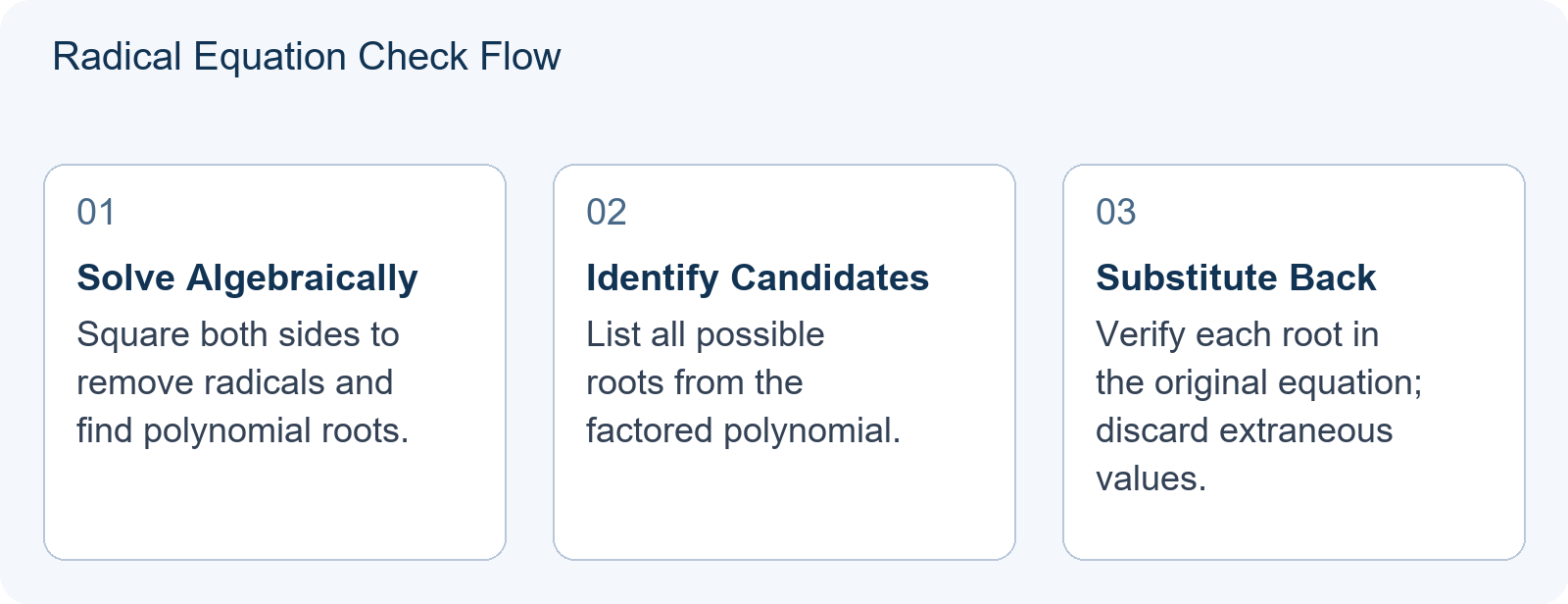
Extraneous Roots Squaring both sides of radical equations. Substitute back into original equation; check signs match.
Domain Violation Logarithms of non-positive numbers; division by zero. Check argument positivity and denominator non-zero status.
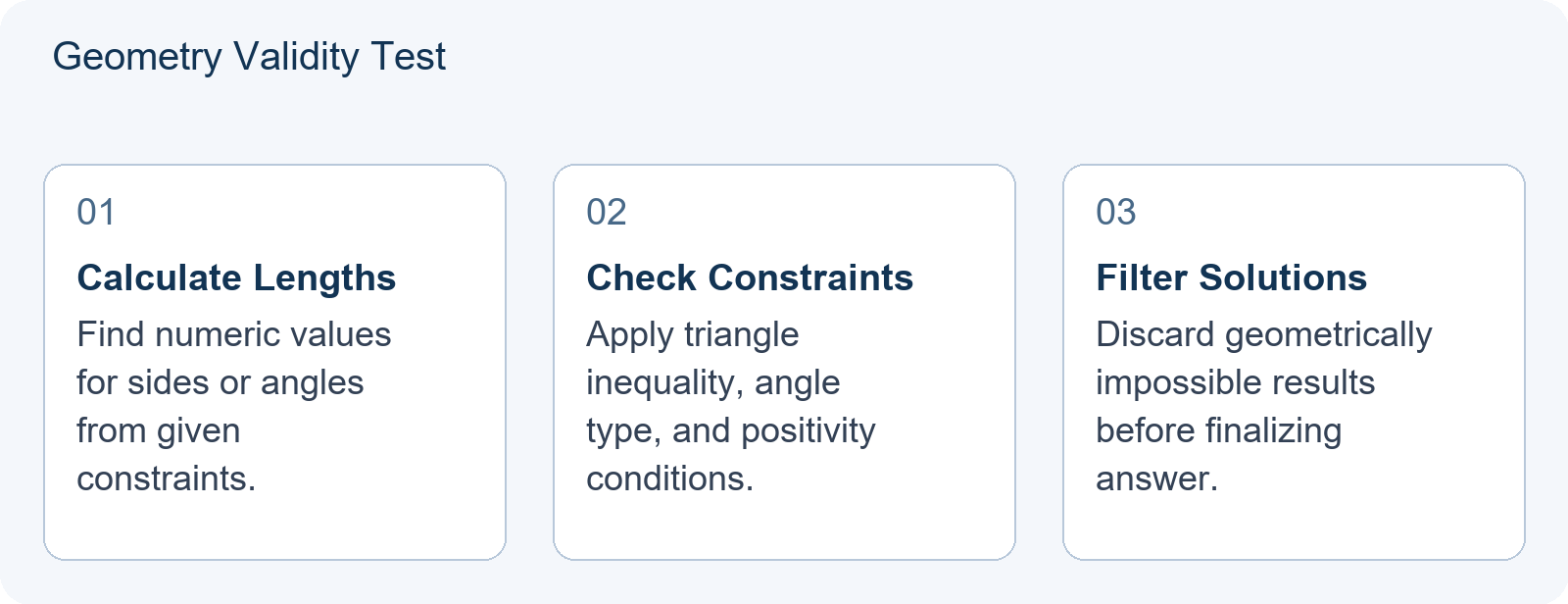
Geometric Impossibility Triangle inequality failure; negative lengths; wrong angle type. Verify all sides satisfy triangle inequalities and specific type constraints.
Integer Constraint Miss Answer is not an integer or outside 0-999. Re-examine derivation; round appropriately only if specified; ensure bounds.

Radical Equation Check Flow

Targeted Practice Sequence

To build this skill, do not just solve problems; practice the "stop-and-check" routine. For every AIME-style problem you attempt, explicitly write down the verification step before calculating the final integer. Start with simple radical equations, then move to systems of equations where substitution might introduce false solutions, and finally tackle geometry problems with multiple cases.

Begin with ten minutes daily on problems specifically designed to hide extraneous roots. When you find a candidate solution, pause and ask: "Does this make both sides of the original equation equal?" and "Does this violate any domain restriction I haven't checked?" This deliberate pause becomes automatic with repetition, and it prevents the costly error of recording an integer that algebra alone falsely suggested.

For broader context on qualification rules and scoring changes, refer to our How to Qualify for the AIME: AMC10 Cutoff Scores, Awards, and Difficulty. To understand how these skills fit into the new 2027 format, see AMC Math Competition: A Guide to AIME Qualification and Preparation. For specific resource recommendations, visit From AMC8 to AIME: The Ultimate Math Competition Progression Path.

Demonstrating Competence

A learner should be able to demonstrate this skill by consistently identifying why a particular algebraic solution is invalid due to domain restrictions or extraneous roots within 30 seconds of finding it. This speed is crucial when managing the two 90-minute segments of the upcoming computer-based AIME format, where efficient answer checking preserves time for harder problems.

Geometry Validity Test

Frequently Asked Questions

Does AIME allow partial credit for showing work?

No, AIME scores are based solely on the correctness of the final integer answer entered. Showing work does not earn points, so accurate verification is essential.

What happens if my calculated answer is not an integer?

You must re-evaluate your method. AIME answers are always integers between 0 and 999. Non-integers indicate a calculation error or misinterpretation of the question.

Are calculators allowed for checking answers?

No, calculators are not permitted in AIME. You must use mental arithmetic or scratch paper provided at the test center to verify solutions.

Online Consultation
Online Consultation