
Direct Answer: What Applies to AIME China 2027?
If your search question is "does the new AIME age rule or computer format apply to China in 2027?", the short answer is no on both counts. According to Hanlin's operator report Important Notice: Domestic AIME Math Exam Arrangements Confirmed! (WeChat public account "Hanlin Curriculum", published October 2026), the China region maintains its original rules with no minimum age threshold and continues to use a 180-minute continuous paper-based exam. The US/Canada region, by contrast, introduces a minimum age of 13 and moves to a two-part computer-based administration.
This distinction matters because reform headlines travel faster than regional policy. The MAA Invitational Competitions page, checked 26 October 2026, states that international AMC participants follow their country's IGL (International Governing Body) policy. That language is exactly why a US/Canada administrative change is not automatically a China change, and why younger Chinese students should not assume ineligibility before checking their region's rules.
Why the Confusion? What the US/Canada Region Actually Changed
The 2026-2027 season brought structural changes to the AMC and AIME series in the US/Canada region. The MAA page checked 26 October 2026 lists the following:
- Minimum age of 13. In the US/Canada region, students under 13 are ineligible for AIME even if they meet the AMC score cutoff.
- Computer-based administration at Pearson centers, with the English test delivered February 5-6, 2027.
- Two-part structure. First 90-minute part contains 8 questions; after a short break, the second 90-minute part contains the remaining 7. Once a student moves to part two, they cannot return to edit part one.
- Unified fixed cutoffs. AMC 10 at least 100, or AMC 12 at least 85, with other eligibility requirements.
Those details are US/Canada administration facts. Because international AMC participants follow their own country's IGL policy, treating them as global AIME rules would mislead China-region families. For comparison, the same MAA update notes that USAMO/USAJMO selection in 2027 is primarily AIME-based, with the AMC score no longer counted and the old AMC-plus-AIME index abolished.
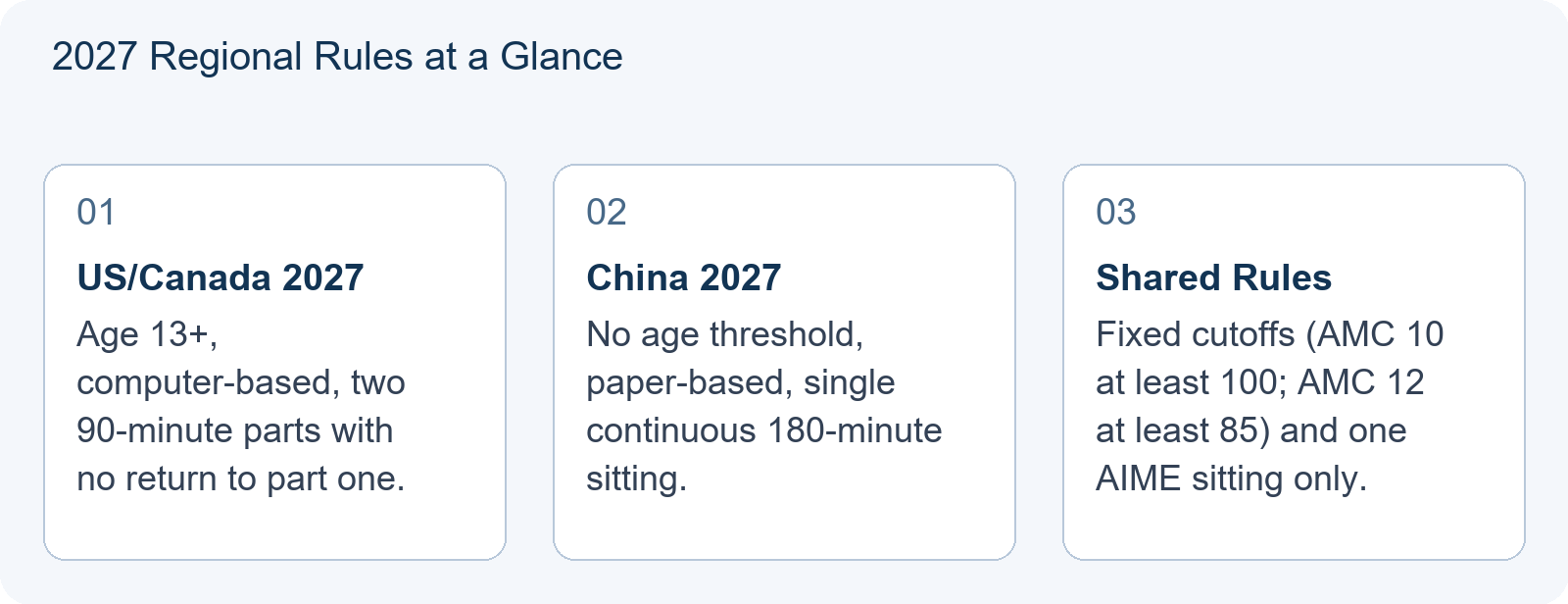
AIME China 2027 vs. US/Canada: Comparison Table
The table below summarizes the differences reported for 2027, using the Hanlin October 2026 operator report for China-region facts and the MAA page checked 26 October 2026 for US/Canada facts.
| Feature | US/Canada 2027 | China 2027 |
|---|---|---|
| Age eligibility | Minimum age 13 required. | No age threshold; original rules maintained. |
| Delivery mode | Computer-based at Pearson centers. | Offline paper exam. |
| Duration and structure | Two 90-minute parts: 8 questions, break, 7 questions. No back-tracking to part one. | One continuous 180-minute sitting; entire paper available for review in the same window. |
| Question count and answer form | 15 integer-answer questions, answers 0-999. | 15 integer-answer questions, answers 0-999. |
| AMC qualification cutoffs | AMC 10 at least 100, or AMC 12 at least 85 (with other eligibility requirements). | AMC 10 at least 100, or AMC 12 at least 85, matching the US figure as a fixed line rather than a percentage. |
| Number of AIME sittings | Single AIME only. AIME I / AIME II split and the makeup path are removed for the 2027 season. | |
Read this table as a decision aid, not as a summary of everything in the AIME rulebook. It shows that for a Chinese student, the operational variables actually under their control in 2027 are paper-format endurance, single-sitting accuracy, and AMC score margin above the fixed cutoff — not the Pearson interface or the age-13 line.
Younger Chinese Students: Eligibility Without the US/Canada Age Cap
Parents of Grade 6 or Grade 7 students often ask whether the US/Canada age-13 rule blocks their child. Per the Hanlin October 2026 report, the China region keeps its original rules and has no age threshold, so a qualified AMC 10 or AMC 12 performer is not disqualified by age in the China stream for 2027.
Eligibility is not the same as readiness, however. The China-region format asks the candidate to hold focus across 180 continuous minutes, handwrite the entire solution path, and verify integer answers without a computer interface to catch input mistakes. If you are the parent of a young qualifier, the useful planning question is not "is my child old enough?" but "can my child sustain 180 minutes of focused reasoning after a full school day?" That is a practice question, and it is answered by timed paper mocks, not by age documents.
Single-Exam Reality: Planning for One AIME Sitting
A second change is not regional at all: 2027 ends the AIME I / AIME II split and the associated makeup path. Per the Hanlin October 2026 report, qualifying candidates receive one AIME opportunity in the season, with no second sitting to absorb an off day.
The practical implication is narrower than it first appears. What disappears is optional recovery, not optional strategy. A student who prepared to use AIME I as a low-stakes rehearsal and AIME II as the real attempt loses that sequence. In 2027, the same student needs a single plan that is calibrated for the paper they will actually see on 7 February 2027 (China region, 13:00-16:00, per the Hanlin report).
For China-region papers, that removal of a second sitting argues for tighter answer-checking inside the same 180 minutes. Because the entire paper stays accessible, the last 15-25 minutes can be reserved for verifying arithmetic and integer-range constraints (0-999) rather than racing through unattempted items. For a broader discussion of when study should shift from AMC speed to AIME sustained reasoning, see AIME Preparation After AMC: When to Switch From Speed to Sustained Reasoning.
Format Stability: Why 180-Minute Paper Practice Still Fits China
A common consequence of reading US/Canada reform coverage is that a Chinese student starts gaming, in training, for an artificial two-part structure. Per the Hanlin October 2026 report, the China region stays on the continuous 180-minute paper model for 2027; the note also indicates that from 2028 the China region is expected to align with the two-part offline computer-based style. That expectation does not change the 2027 simulation you should be running this season.
Coaching guidance for the 2027 China paper format typically includes:
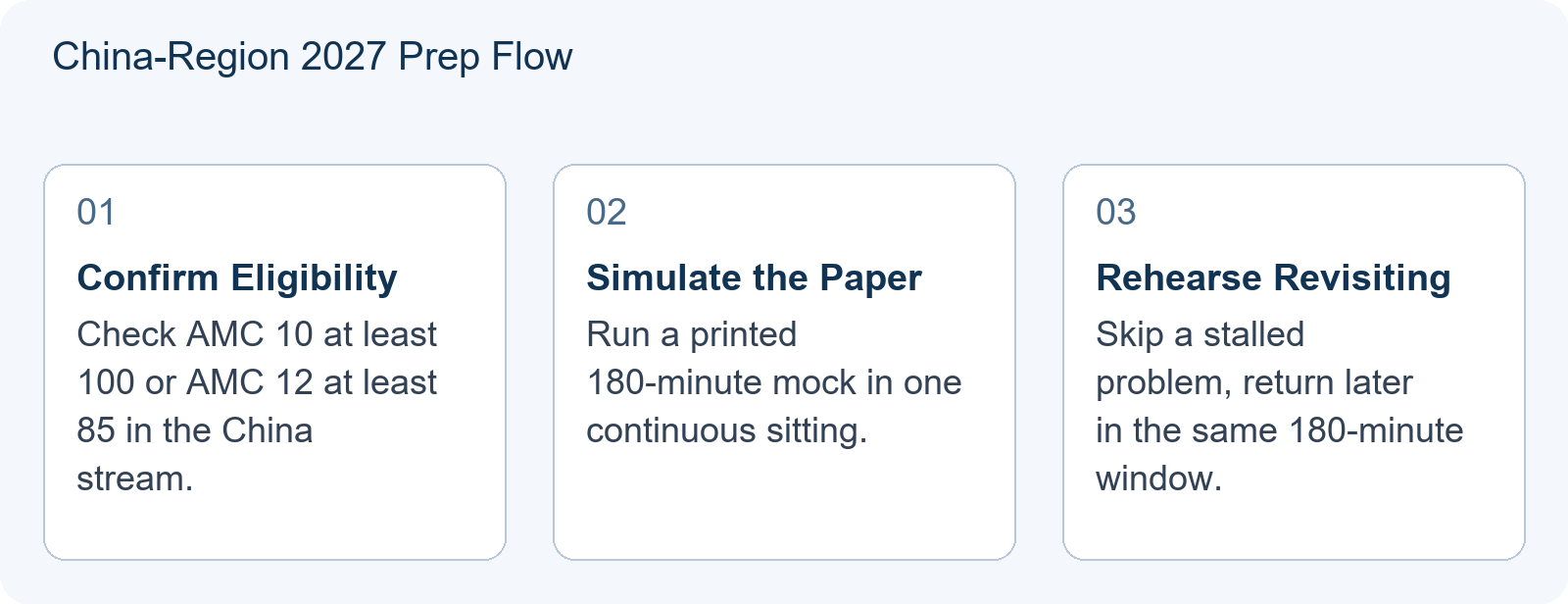
- Full-length paper simulations. Run printed 180-minute mocks rather than short digital sessions, so timing instinct and scratch-paper habits are trained under the real constraint.
- Answer-verification habit. Build a routine of plugging results back into the original condition and checking that the integer lies within 0-999 before recording it.
- Revisit discipline. Practice skipping a stalled problem and returning to it later within the same 180-minute window, since the China paper does not lock a first-pass answer.
These are proposals for training, not claims about how any specific student performed. They follow directly from the format facts in the operator report.
Worked Teaching Illustration: A 180-Minute Time Frame
The following is an illustrative planning exercise, not a past contest problem and not a predicted AIME paper. Suppose a China-region candidate sets two goals for a 180-minute paper: attempt 12 of the 15 problems with full effort, and reserve 25 minutes at the end for verification of the answers already recorded.
- Time for active solving: 180 - 25 = 155 minutes.
- Average budget per attempted problem: 155 / 12 ≈ 12.9 minutes, so a working plan of roughly 12-13 minutes per attempted problem.
- If the candidate wants a safety buffer of 30 minutes instead of 25: (180 - 30) / 12 = 150 / 12 = 12.5 minutes per attempted problem.
Notice that the average is not a per-problem rule; earlier problems in the paper are typically faster, so the real plan front-loads the clock and leaves more room for the attempted items near the back. If you are calibrating against AIME qualification scores instead of time, see AIME Qualification Targets: Build a Reliable Margin Above the AMC Cutoff.
USA(J)MO Pathway: Separate Eligibility Policy
Families aiming at USAMO or USAJMO should treat the pathway separately from AIME eligibility. The MAA page checked 26 October 2026 states that USAMO/USAJMO selection in 2027 is primarily based on AIME scores, with the AMC score no longer counted and the old AMC-plus-AIME index abolished.
USAMO/USAJMO participation is governed by separate eligibility policies, so readers interested in that pathway should consult the official MAA eligibility guidelines directly. This article's scope is the AIME China-region format comparison. For broader context on how regional formats shape preparation generally, see AIME Pacing Practice: Prepare for Your Region's 2027 Format.
Bringing Your Region Questions to an Authorized Test Center
If you plan to speak with an authorized AMC/AIME test center such as the one described in the Hanlin October 2026 report, come with questions that fit the 2027 rule picture rather than generic preparation questions. Useful items to have ready:
- Your recent AMC 10 or AMC 12 score, so the center can assess margin above the fixed 100 / 85 line.
- Confirmation that your registration is being handled in the China-region stream, not the US/Canada stream.
- The format you will sit: continuous 180-minute paper exam, not a two-part computer test.
- Which practice resources target paper-based endurance and integer-answer verification.
- Your goal, whether that is AIME qualification, a high AIME score, or a longer mathematical progression.
The aim of these questions is to make sure a study plan matches the rules that apply to your confirmed region, rather than rules that appear in a global news summary.
General event background is available at Event background.
Frequently Asked Questions
Is there an age limit for AIME China 2027?
No. The Hanlin October 2026 report describes the China region as keeping its original rules with no minimum age threshold, in contrast to the US/Canada region where a minimum age of 13 applies to AIME 2027.
Will Chinese students take the 2027 AIME on a computer?
For the 2027 season, no. The Hanlin report describes the China region remaining on a 180-minute continuous paper-based exam. The two-part computer-based administration is a US/Canada change. The same report indicates China may move to a comparable two-part offline computer format from 2028, which is planning context for later seasons rather than for 2027.
How does USAMO/USAJMO selection relate to AIME 2027?
USAMO/USAJMO selection in 2027 is primarily based on AIME scores, according to the MAA page checked 26 October 2026. USAMO/USAJMO participation is governed by separate eligibility policies, so students aiming for USAMO/USAJMO should consult the official MAA eligibility guidelines directly.