
Preparing for the American Invitational Mathematics Examination (AIME) requires more than just solving difficult problems; it demands precise time management matched to your region's specific format. As we look toward the 2027 competition cycle, a critical distinction emerges between the United States/Canada region and China. The US/Canada region adopts a new split-block format, while China retains its continuous 180-minute structure according to operator reports dated October 10, 2026. This article clarifies the specific format changes, explains why the pacing strategies diverge, and provides concrete practice methods for each region.
US/Canada 2027: Two 90-Minute Blocks With Comparable Difficulty
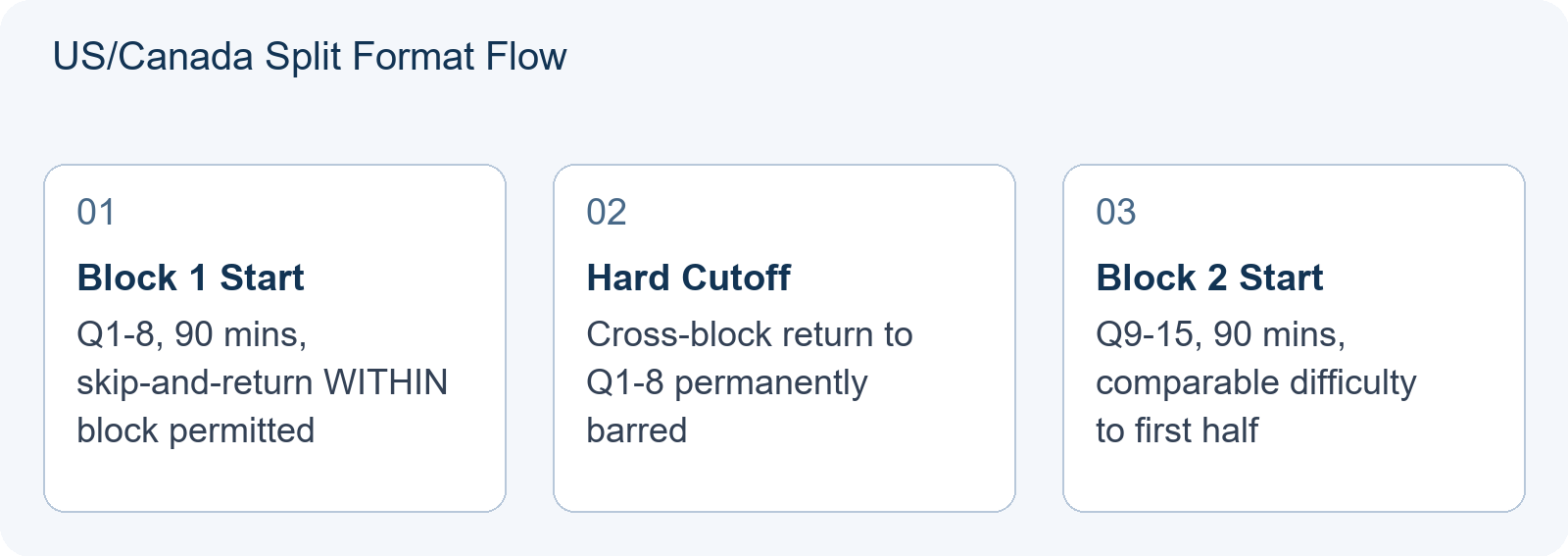
For students competing in the United States and Canada, the 2027 AIME introduces a structural overhaul verified by MAA official rules checked October 12, 2026. The exam is administered at Pearson Professional Centers in two distinct 90-minute parts with a short break between them. The first part contains questions 1–8; the second part contains questions 9–15. The critical constraint: once the second 90-minute block begins, students cannot return to questions 1–8. However, students MAY skip questions and return to them within the same 90-minute half. This within-half flexibility is essential to proper pacing strategy.
Importantly, MAA confirms the two halves have comparable difficulty—not the traditional pattern of early easy and late hard. This means students should not assume questions 1–8 are uniformly simple or that questions 9–15 are uniformly harder. The comparable-difficulty design rewards consistent performance across both blocks rather than front-loaded security.
Why the Split Format Changes Strategic Decisions
In the historical continuous format, a student stuck on question 4 could abandon it, progress through questions 5–10, and return to question 4 later with fresh perspective. The new US/Canada format preserves this flexibility WITHIN each 90-minute block but removes it ACROSS blocks. Time spent on questions 1–8 is permanently subtracted from questions 9–15, but time spent on question 3 can still be reallocated to question 7 if both fall within the same block.
The arithmetic bears examination: 90 minutes divided by 7 questions (second block) yields approximately 12.86 minutes per question, which is LARGER—not smaller—than the 12 minutes per question available across the full 180 minutes for 15 questions. The second block offers more time per question than the average, not less, though this must be weighed against the comparable difficulty of the problems.
Worked Teaching Illustration: Within-Half Return Strategy
Consider a student working through Block 1 (questions 1–8) with the following time expenditures: Q1 takes 10 minutes, Q2 takes 15 minutes, Q3 takes 10 minutes, Q4 takes 12 minutes, Q5 takes 15 minutes, Q6 takes 20 minutes. The cumulative time is 82 minutes. The student has 8 minutes remaining in Block 1 and CAN use this time to retry Q4, which had been skipped after initial difficulty. This within-half return is explicitly permitted and strategically valuable.
Contrast this with the same student in Block 2: if she spends 82 minutes on questions 9–13, the remaining 8 minutes cannot be redirected to Q4 from Block 1. The cross-block barrier is absolute.
China 2027: Continuous 180 Minutes, Full Self-Allocation
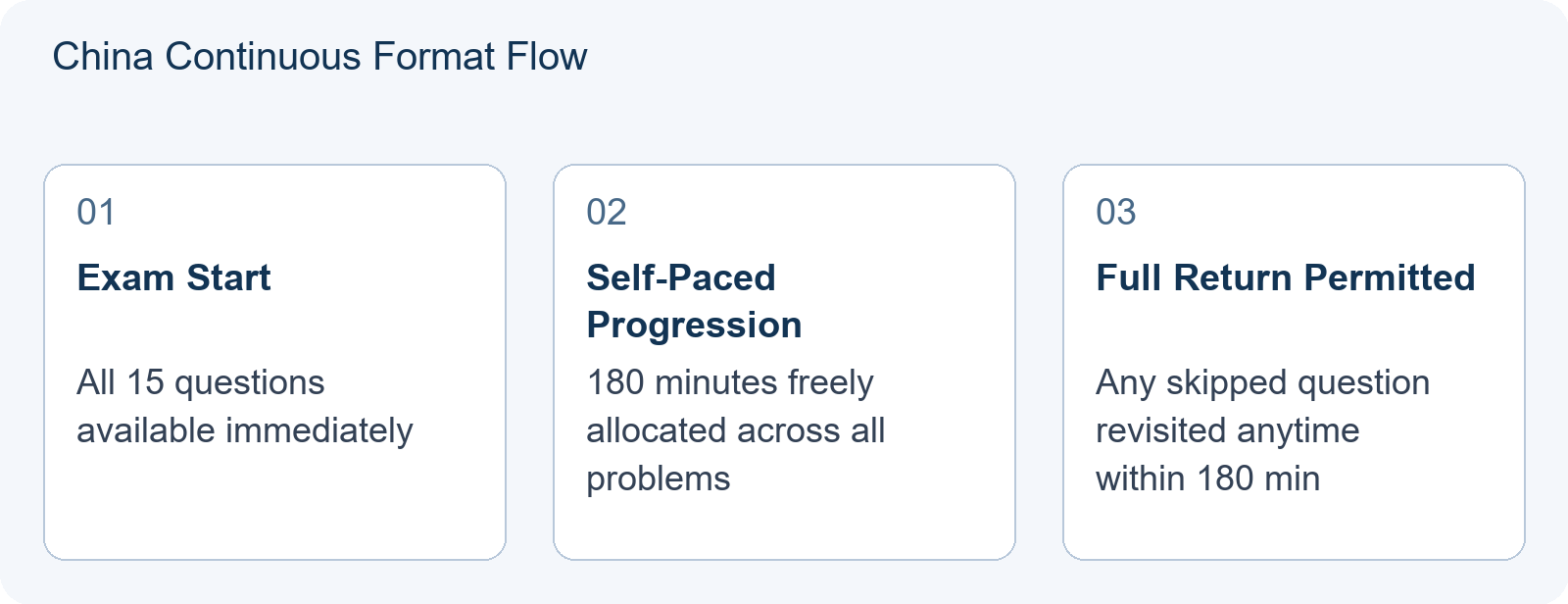
China's AIME implementation follows a different structure. According to operator reports dated October 10, 2026, Chinese candidates continue with a continuous 180-minute session for all 15 questions. Students retain full autonomy to allocate time across the entire exam and may return to skipped questions at any point. This is the confirmed format for the Chinese region, though it is not a MAA global guarantee—other regions may have different arrangements.
Implications for China Preparation
China students should not train for the 90+90 split. The relevant skills are three-hour stamina, strategic skipping with planned returns across the full exam, and dynamic time reallocation. A student who masters the US/Canada split-block drill would be underprepared for China's format, having trained to treat questions 1–8 as a closed chapter. Conversely, a China-trained student attempting the US/Canada format without adjustment would face difficulty at the 90-minute hard cutoff between blocks.
Teaching Illustration: Same Student, Different Formats
Consider a student with typical per-question times on a past AIME: Q1–3 at 5 minutes each; Q4–6 at 10 minutes each; Q7–8 at 15 minutes each; Q9–10 at 20 minutes each; Q11–15 attempted only if time permits.
Scenario A: China Continuous Format
The student spends 15 minutes on Q1–3, then 30 minutes on Q4–6 (total 45 minutes). Q7 takes 15 minutes (60 minutes elapsed). Q8 takes 15 minutes (75 minutes). She has completed Q1–8 in 75 minutes, leaving 105 minutes for Q9–15. She attempts Q9 (20 minutes, 95 total), skips Q10 after 10 minutes of no progress, proceeds to Q11 (20 minutes, 125 total), returns to Q10 with 55 minutes remaining, and solves it with 25 minutes of additional work. She then attempts Q12 with 30 minutes left. Total completed: Q1–11. The cross-exam return to Q10 was decisive.
Scenario B: US/Canada Split Format (Same Student)
Block 1: Q1–3 (15 minutes), Q4–6 (30 minutes, total 45), Q7 (15 minutes, 60), Q8 (15 minutes, 75). She has 15 minutes remaining in Block 1. She uses 10 minutes to verify Q5, catches a calculation error, and corrects it. With 5 minutes left, she cannot productively start another problem, so she briefly reviews Q6. Block 1 ends with Q1–8 completed and verified.
Block 2: Q9 (20 minutes), Q10 (abandoned after 15 minutes of no progress), Q11 (20 minutes, 55 total), leaving 35 minutes for Q12–15. She attempts Q12 but makes no progress in 20 minutes, abandons it, and spends remaining time on Q13 with partial success. Total completed: Q1–9, Q11, partial Q13. The Q10 abandonment was correct given the block constraint; the Q12 attempt consumed time that could not be redirected to earlier questions.
Key Difference
In Scenario A, the return to Q10 added a completed problem. In Scenario B, the block boundary prevented this, and the student instead made progress on Q13. The continuous format rewarded persistence across the full exam; the split format rewarded securing early points and accepting strategic abandonment within each block. The optimal strategy is not merely "go faster"—it is "decide earlier within each bounded window."
Contrasting Case: When Old Paper Splits Mislead Preparation
A student preparing for US/Canada 2027 finds a 2015 AIME and splits it Q1–8 versus Q9–15 as a mock Block 1 and Block 2. However, older AIME papers may not reflect the new comparable-difficulty design. The 2015 paper might have genuinely easier problems in positions 1–8, leading the student to expect Block 1 to be comfortable. On the actual 2027 exam, with comparable difficulty across halves, Block 1 problems 6–8 may require Block 2-level effort. The student, unprepared for this, exhausts 90 minutes on only six problems and enters Block 2 with depleted confidence. The teaching illustration: do not assume old paper position numbers predict 2027 half difficulty. Use full timed blocks without pre-splitting by difficulty.
Diagnostic Application: Identify Your Regional Pacing Profile
Perform this timed diagnostic using any past AIME paper. For US/Canada candidates: set a hard 90-minute timer for Q1–8. You MAY skip and return within this window. Stop at 90 minutes. Reset for Q9–15. Record: (a) questions attempted per block, (b) questions completed per block, (c) time of first abandonment decision, (d) whether within-half returns were productive. For China candidates: run a continuous 180-minute session. Record cumulative time at each question's completion, note all skips and returns, and identify whether returns were productive.
Interpreting Your Results
If you are US/Canada-bound and your first abandonment occurs after minute 80 of Block 1, you are deciding too late. Target: abandon any problem consuming more than 12 minutes without clear progress, preserving time for within-half returns. If you are China-bound and your cumulative time on Q1–8 exceeds 90 minutes, you are front-loading and risking a rushed endgame. Target: complete Q1–8 in 75–85 minutes to preserve flexibility for returns across the full exam.
Next Steps: Region-Specific Practice Adjustments
For US/Canada students, incorporate "hard-stop" drills weekly: solve 8 questions from varied positions in a past paper in 90 minutes with within-half skip-and-return permitted, practicing early abandonment and return. For China students, take full 3-hour continuous tests biweekly, deliberately practicing skip-and-return sequences across the entire exam. Both groups should track accuracy rates separately for questions 1–5, 6–10, and 11–15 to identify where time investment yields the highest marginal return.
For further technique development, see our guides on AIME Polynomial Remainders: Solving Without Expanding Every Term and AIME Counting With Symmetry: When Dividing by the Number of Rotations Fails. For qualification context, refer to AMC Math Competition: A Guide to AIME Qualification and Preparation.
Practical Drill: The "Two-Pass" Block Strategy for US/Canada Candidates
The most common pacing failure in the new 90-minute split format is not running out of time, but spending it inefficiently on problems that yield no partial credit. AIME answers are integers from 0 to 999; there is no partial credit for work shown. Therefore, a student who spends 15 minutes attempting a problem and fails to produce an integer answer has gained zero points, whereas a student who spends 3 minutes verifying a solved problem secures those points. To address this, we introduce a structured "Two-Pass" drill specifically designed for the US/Canada 2027 format.
Step 1: The Rapid Scan (Minutes 0–15)
In your next practice session for Block 1 (Questions 1–8), do not start solving Question 1 immediately. Instead, spend the first 15 minutes reading all eight questions. Your goal is not to solve them, but to categorize each as "Confident," "Possible," or "Unknown." Mark these categories mentally or on your scratch paper. This initial investment prevents the trap of getting stuck on a difficult early question while easier later questions remain untouched. For example, if you identify Q6 as "Confident" but Q2 as "Unknown," you can prioritize Q6 after finishing Q1, ensuring you secure points from solvable problems before tackling harder ones.
Step 2: The Confident Pass (Minutes 15–45)
Solve only the questions marked "Confident." Aim to complete these within 30 minutes. If you finish early, use the remaining time to review your answers for calculation errors. This phase builds momentum and secures a baseline score. In a typical scenario, a strong student might find 4–5 questions in Block 1 to be "Confident." Completing these quickly frees up significant mental bandwidth for the more challenging "Possible" questions.
Step 3: The Strategic Return (Minutes 45–90)
Now, tackle the "Possible" questions. You have 45 minutes left. If you get stuck on one for more than 10 minutes without progress, abandon it and move to the next. Crucially, remember that you can return to skipped questions within this same block. Use the final 10 minutes to make a second attempt at any abandoned "Possible" questions with fresh perspective. This structured approach ensures that time is allocated based on expected point yield rather than question number order.
Diagnostic Check
After completing this drill, analyze your timing log. Did you spend more than 15 minutes on any single question during the "Confident Pass"? If so, your self-assessment was inaccurate—practice identifying true confidence levels. Did you leave any "Confident" questions unsolved? If yes, your scan phase was too rushed. Adjust your next drill by extending the scan to 20 minutes if necessary. This iterative refinement helps calibrate your internal clock to the 90-minute constraint, transforming abstract time management into concrete, measurable habits.
Conclusion
The 2027 AIME presents divergent pacing challenges. US/Canada candidates face a split format with comparable-difficulty halves that demands rapid decision-making, strategic within-half returns, and early security without assuming front-loaded ease. China candidates retain continuous 180-minute flexibility but must build three-hour stamina and disciplined self-regulation. Neither format is inherently easier—the challenge is alignment between preparation and reality. Verify your regional format with your local organizing body, then train specifically for that structure. Generic AIME practice without regional format awareness risks preventable timing errors.
Frequently Asked Questions
Does the 90+90 minute split apply to China AIME 2027?
No. The 90+90 split is confirmed for US/Canada Pearson centers only. According to operator reports dated October 10, 2026, China's 2027 AIME uses a continuous 180-minute format with full time self-allocation. This is not a MAA global guarantee for all regions.
Can I return to questions from the first half during the second half in US/Canada format?
No. The cross-block return is permanently barred once Block 2 begins. However, within each 90-minute half, you MAY skip questions and return to them. For example, if you spend 82 minutes on questions 1-6, you have 8 minutes remaining to retry question 4 within Block 1.
What is the fixed AIME qualifying threshold for 2027?
MAA lists minimum AMC10/AMC12 thresholds of100/85 for this cycle, subject to all other applicable eligibility conditions. The minimum age13 requirement is specified for US/Canada Pearson administration; international participants should confirm their regional IGL requirements.