
The American Invitational Mathematics Examination (AIME) requires answers to be integers between 0 and 999. While many students focus on solving complex equations or combinatorial structures, a frequent source of lost points is failing to verify that the derived solution actually satisfies the original problem's constraints. This article addresses the specific preparation need of AIME Answer Checking, focusing on catching extraneous roots and domain violations before recording an integer.
Why Verification Matters in AIME
In standard multiple-choice competitions like AMC 10/12, incorrect intermediate steps might still lead to a plausible distractor. In AIME, however, there are no choices. If you solve an equation algebraically but fail to check for extraneous roots introduced by squaring both sides, or if you miss a geometric constraint that renders a solution impossible, you will record an invalid number. The recent reforms announced by MAA for the 2027 AIME emphasize rigorous testing conditions, including electronic entry and strict time limits. This makes efficient, reliable verification habits even more critical, as there is less opportunity for casual re-reading during the exam.
Teaching Illustration 1: The Squaring Trap
The following is an original teaching illustration, not an official past problem.
Consider a problem asking for the sum of all real values of satisfying . A common student approach is to square both sides immediately:
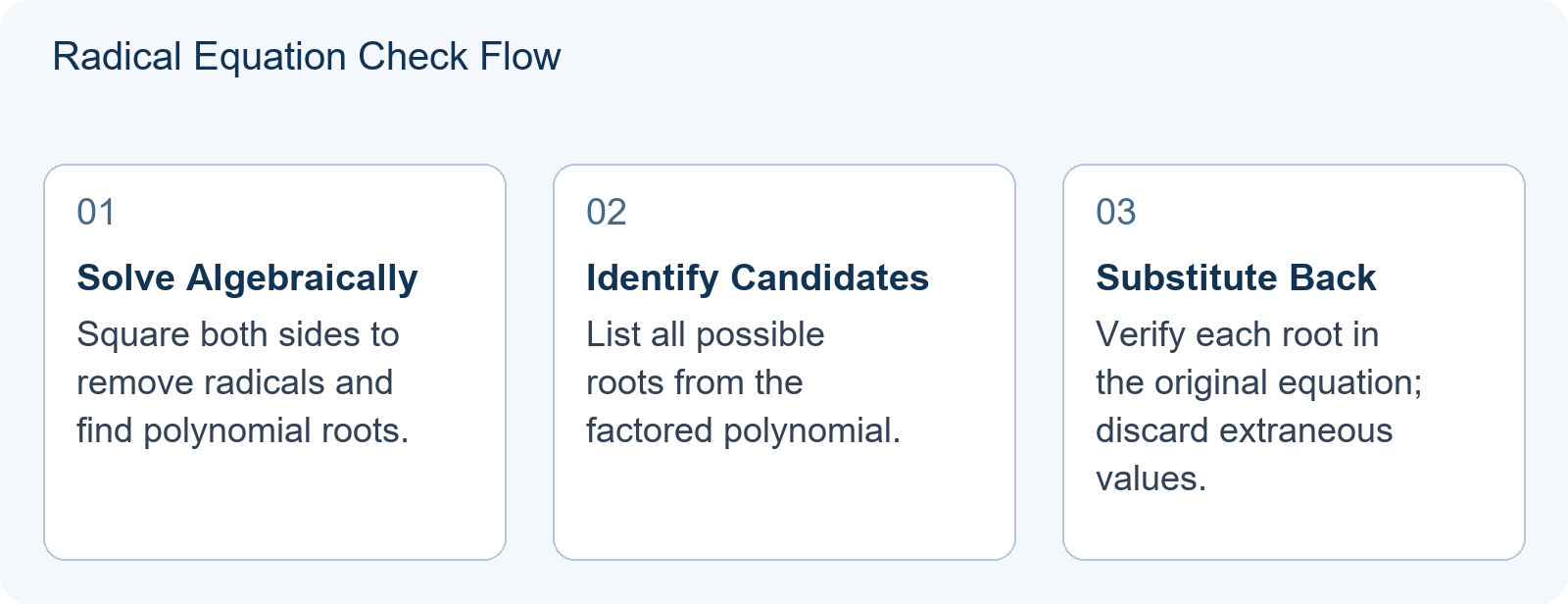
This yields potential solutions and . If the student simply sums these (), they arrive at an incorrect answer. Why? Because squaring can introduce extraneous roots. We must check each candidate against the original equation:
- For : , and . This works.
- For : , but . Since , this root is extraneous.
The correct sum is just 4. Without this verification step, the answer would be wrong. Notice also that the extraneous root makes the right-hand side negative while the left-hand side (a square root) must be non-negative—a structural clue that could catch the error even faster.
Teaching Illustration 2: Geometry Constraints and the Acute Triangle
The following is an original teaching illustration, not an official past problem.
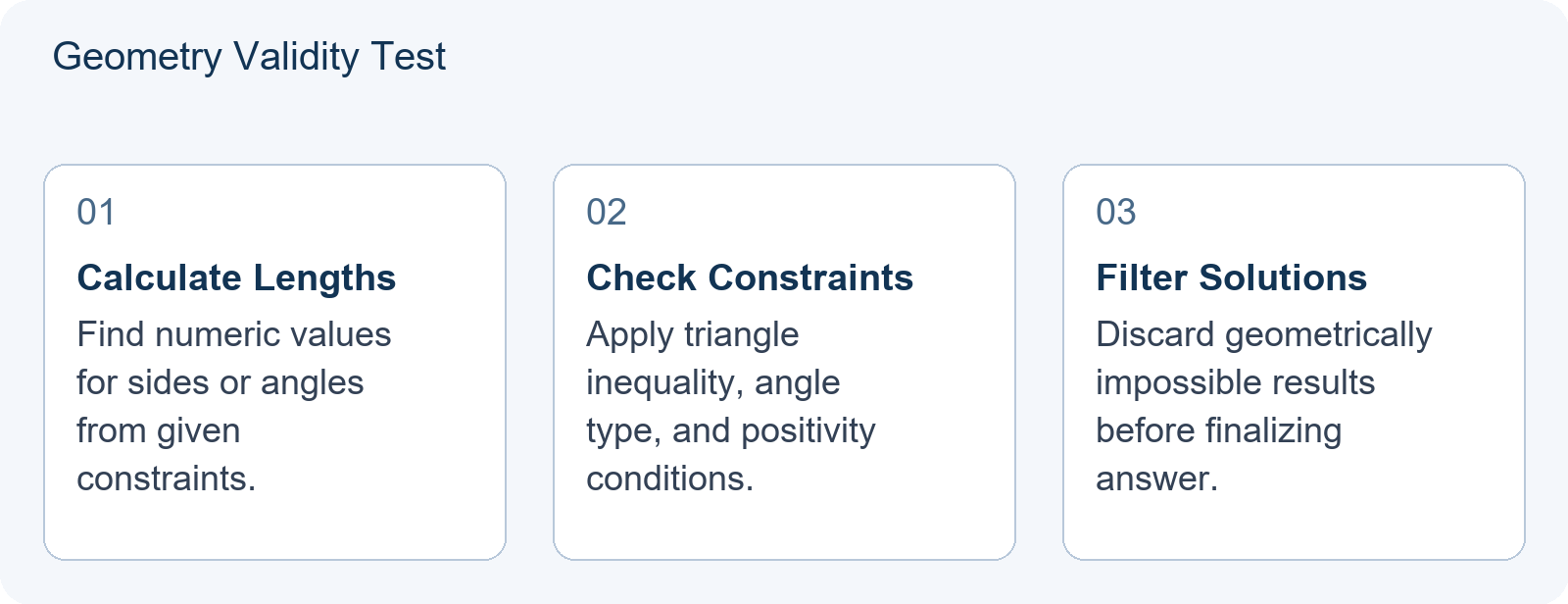
Imagine a problem involving a triangle with side lengths , , and variable side , where the triangle must be acute. The question asks for the maximum integer value of . Using the law of cosines, , a student might derive that for an acute triangle, all angles must be less than . This requires three conditions:
- → , so
- → , so , meaning
- → , automatically satisfied for positive
A hurried student might approximate and incorrectly assume can equal 8. However, checking the condition strictly: , which is not less than 61 (), meaning the triangle would be obtuse, not acute. The valid maximum integer is , since . This illustrates how rounding errors or loose bounds can lead to recording an invalid geometric configuration.
Diagnostic Table for Common Errors
| Error Type | Cause | Verification Strategy |
|---|---|---|
| Extraneous Roots | Squaring both sides of radical equations. | Substitute back into original equation; check signs match. |
| Domain Violation | Logarithms of non-positive numbers; division by zero. | Check argument positivity and denominator non-zero status. |
| Geometric Impossibility | Triangle inequality failure; negative lengths; wrong angle type. | Verify all sides satisfy triangle inequalities and specific type constraints. |
| Integer Constraint Miss | Answer is not an integer or outside 0-999. | Re-examine derivation; round appropriately only if specified; ensure bounds. |
Targeted Practice Sequence
To build this skill, do not just solve problems; practice the "stop-and-check" routine. For every AIME-style problem you attempt, explicitly write down the verification step before calculating the final integer. Start with simple radical equations, then move to systems of equations where substitution might introduce false solutions, and finally tackle geometry problems with multiple cases.
Begin with ten minutes daily on problems specifically designed to hide extraneous roots. When you find a candidate solution, pause and ask: "Does this make both sides of the original equation equal?" and "Does this violate any domain restriction I haven't checked?" This deliberate pause becomes automatic with repetition, and it prevents the costly error of recording an integer that algebra alone falsely suggested.
For broader context on qualification rules and scoring changes, refer to our How to Qualify for the AIME: AMC10 Cutoff Scores, Awards, and Difficulty. To understand how these skills fit into the new 2027 format, see AMC Math Competition: A Guide to AIME Qualification and Preparation. For specific resource recommendations, visit From AMC8 to AIME: The Ultimate Math Competition Progression Path.
Demonstrating Competence
A learner should be able to demonstrate this skill by consistently identifying why a particular algebraic solution is invalid due to domain restrictions or extraneous roots within 30 seconds of finding it. This speed is crucial when managing the two 90-minute segments of the upcoming computer-based AIME format, where efficient answer checking preserves time for harder problems.
Frequently Asked Questions
Does AIME allow partial credit for showing work?
No, AIME scores are based solely on the correctness of the final integer answer entered. Showing work does not earn points, so accurate verification is essential.
What happens if my calculated answer is not an integer?
You must re-evaluate your method. AIME answers are always integers between 0 and 999. Non-integers indicate a calculation error or misinterpretation of the question.
Are calculators allowed for checking answers?
No, calculators are not permitted in AIME. You must use mental arithmetic or scratch paper provided at the test center to verify solutions.