
Many AIME preparation students encounter counting problems where symmetry seems to invite a quick shortcut: identify rotational symmetry, then divide the total count by the number of rotations. This article addresses the specific failure mode in the title—when and why this division fails—through two original teaching illustrations. For broader context on AIME eligibility and the 2026-27 competition changes, see our AIME: 7 Points is the Watershed, 10 Points is the Stepping Stone.
The Tempting Shortcut and Its Limits
The intuition behind "divide by the number of rotations" comes from Burnside's lemma or basic orbit-counting: if a figure has n-fold rotational symmetry, one might expect each distinct configuration to appear n times in an unconstrained count. But this only holds under strict conditions that AIME problems often violate. The two cases below show a valid application and a common misapplication.
Case 1: Where Division Works (Teaching Illustration)
Setup: Count the number of distinct necklaces of 6 beads, using 2 red and 4 blue beads, where rotations are considered identical but reflections are distinguished.
Unconstrained count: Choose positions for the 2 red beads: C(6,2) = 15.
Symmetry analysis: The cyclic group C₆ acts on these 15 configurations. For a configuration to have stabilizer larger than the identity, the pattern must repeat with period dividing 6. With exactly 2 red beads, the only possible non-trivial stabilizer would require period 2 (3 copies of a 2-bead pattern) or period 3 (2 copies of a 3-bead pattern). Period 3 is impossible: it requires 3 red beads (one per block) or 0 red beads, not 2. Period 2 requires opposite beads to match, which is possible.
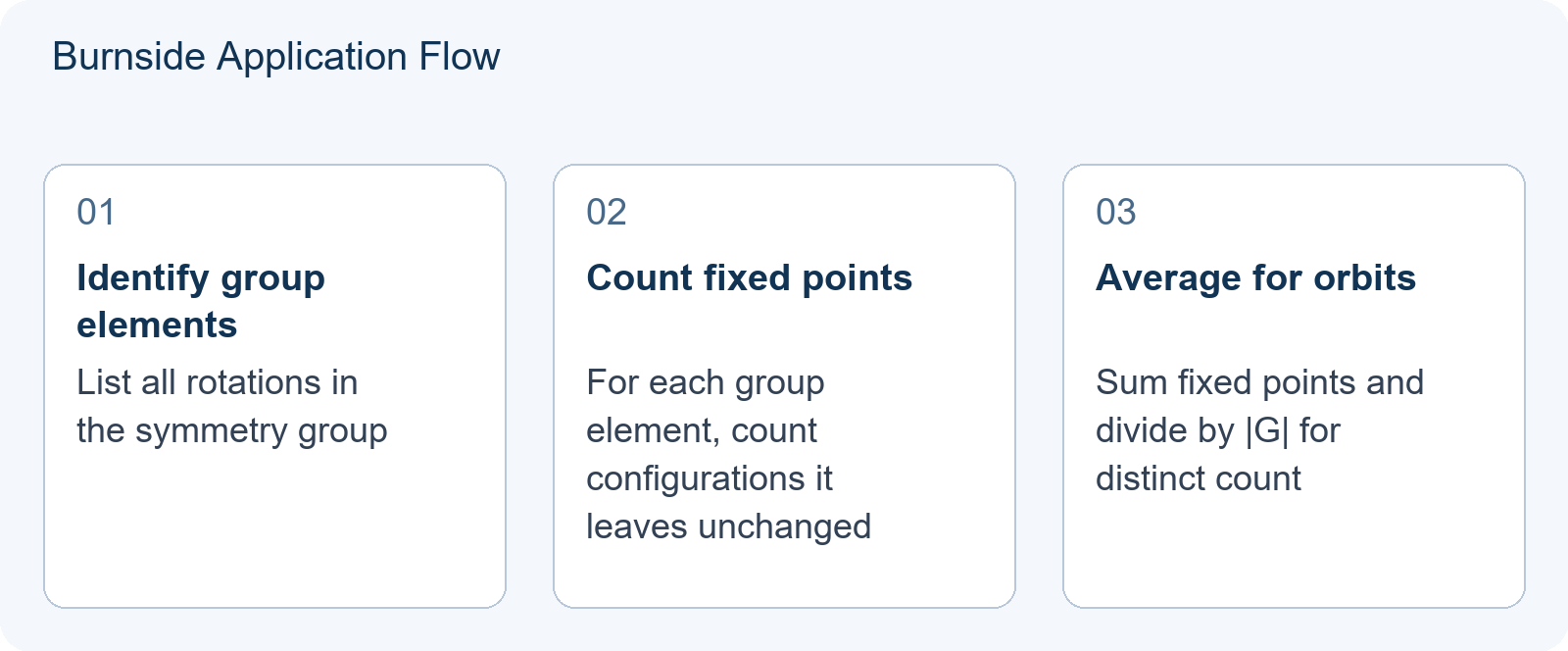
Correct approach (Burnside's lemma):
- Identity (1 element): fixes all 15 configurations
- Rotation by 60° and 300° (2 elements, order 6): fix only uniform colorings; impossible with 2 red, 4 blue. Fix 0 each.
- Rotation by 120° and 240° (2 elements, order 3): require three matching positions; impossible with 2 red. Fix 0 each.
- Rotation by 180° (1 element, order 2): requires opposite beads to match. With 2 red, 4 blue, choose which of the 3 opposite pairs is red-red: 3 configurations fixed.
Distinct necklaces = (15 + 0 + 0 + 0 + 0 + 3)/6 = 18/6 = 3.
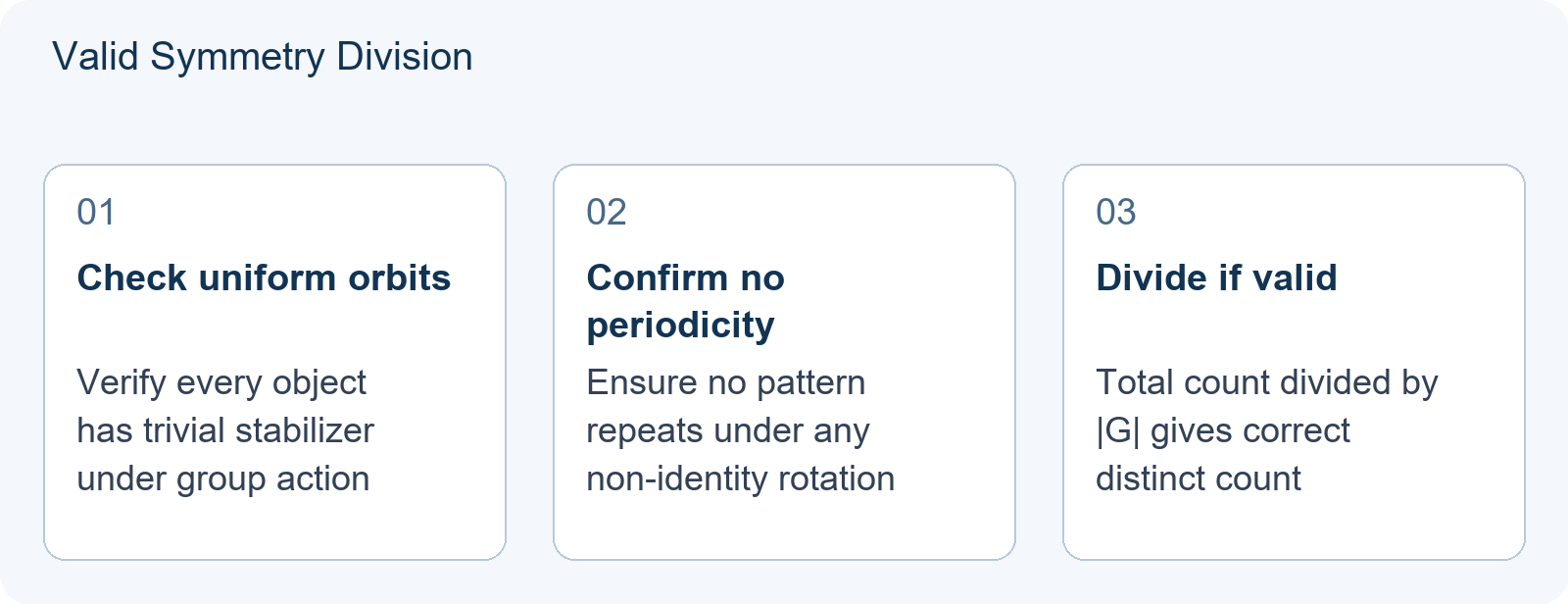
Why naive division fails: 15/6 = 2.5 is not an integer, immediately signaling error. Even if it were integer, the correct answer 3 ≠ 2.5. The non-trivial stabilizer from the 180° rotation (3 configurations with opposite reds) makes uniform orbit size impossible.
Case 2: Where Division Fails Disastrously (Teaching Illustration)
Setup: Count distinct colorings of a regular hexagon's vertices with 3 colors (R, G, B), where two colorings are equivalent if one rotates to the other.
Naive approach: Total colorings = 3⁶ = 729. Hexagon has 6 rotations. "Answer": 729/6 = 121.5—not even an integer, immediate red flag.
Why division fails: Different colorings have different stabilizer sizes. The monochromatic colorings (all R, all G, all B) have stabilizer size 6, not 1. Many patterns with repeating subpatterns (like RGRGRG) have stabilizer size 2 or 3. The orbits are not uniform in size.
Correct approach (Burnside):
- Identity (1): fixes all 3⁶ = 729
- Rotation by 60° and 300° (2 elements): fix colorings with all vertices same color, so 3 each
- Rotation by 120° and 240° (2 elements): fix colorings with period 3, so 3² = 9 each
- Rotation by 180° (1 element): fixes colorings with opposite vertices equal, so 3³ = 27
Distinct colorings = (729 + 2·3 + 2·9 + 27)/6 = (729 + 6 + 18 + 27)/6 = 780/6 = 130.
The naive 121.5 is wrong by nearly 7%; in other problems, the error can be larger.
Diagnostic: When Can You Divide?
| Condition | Safe to divide? | Typical AIME context |
|---|---|---|
| All orbits have same size |G| | Yes | Rare; requires no non-identity symmetry in any configuration |
| Some orbits smaller (non-trivial stabilizers) | No | Most symmetry counting problems |
| Counting orbits of group action on labeled objects | Use Burnside | Necklaces, colorings, arrangements |
| "Up to rotation" with constraints on counts | Use Burnside | Bead colorings with fixed color frequencies |
The Key Decision Rule
Before dividing by |G|, ask: Does every configuration I'm counting have trivial stabilizer? If any configuration could repeat under a non-identity rotation—same colors in a periodic pattern, identical objects arranged symmetrically, etc.—then division is invalid. Burnside's lemma is the reliable tool.
Building the Skill for AIME
AIME counting problems with symmetry typically appear in the 7-12 range, where careful case analysis separates correct from incorrect answers. The specific skill to demonstrate: given a symmetry condition, identify the group action, compute fixed points for each symmetry, and apply the orbit-counting formula.
For practice sequencing and broader preparation strategies, refer to our AMC Math Competition: A Guide to AIME Qualification and Preparation. Students ready for advanced topics may also consult From AMC8 to AIME: The Ultimate Math Competition Progression Path for additional challenge areas.
Preparing for Consultation
If you're working through symmetry counting and considering structured support, prepare these items for productive discussion:
- Specific problems where your answer differed from the solution—note whether you used division or Burnside
- Your current comfort with cycle notation and group actions
- Whether you're targeting AIME qualification (AMC 10/12 performance) or AIME score improvement (USAJMO/USAMO trajectory)
Understanding the 2026-27 AIME format changes—including the two-part 90-minute structure and computer-based delivery—also informs how to time your practice sessions. The mathematical content, however, remains consistent with past years.
Frequently Asked Questions
Why does 729/6 not work for hexagon colorings?
Because different colorings have different stabilizer sizes. Monochromatic colorings are fixed by all 6 rotations, not just the identity. Burnside's lemma accounts for this by averaging fixed points across all group elements.
Can I every just divide by the number of rotations?
Only when every configuration has trivial stabilizer—meaning no configuration has any rotational symmetry. This is rare in competition problems; verify by checking if any periodic pattern is possible under the given constraints.
How does the 2026-27 AIME format affect symmetry problem preparation?
The mathematical content remains unchanged. The two-part timing structure means you should practice sustaining focus for 90-minute blocks, but the counting techniques—including Burnside's lemma—are the same as in prior years.