
For many students preparing for the American Invitational Mathematics Examination (AIME), polynomial remainders present a specific cognitive trap. The instinct is often to perform long division or expand terms fully, which consumes valuable time and increases the likelihood of arithmetic errors. However, the core skill required is not computational endurance but strategic simplification using the Remainder Theorem and modular arithmetic concepts. This article develops a systematic approach to solving polynomial remainder problems without expanding every term, providing concrete teaching illustrations and diagnostic guidance.
The Core Principle: Why Expansion Fails
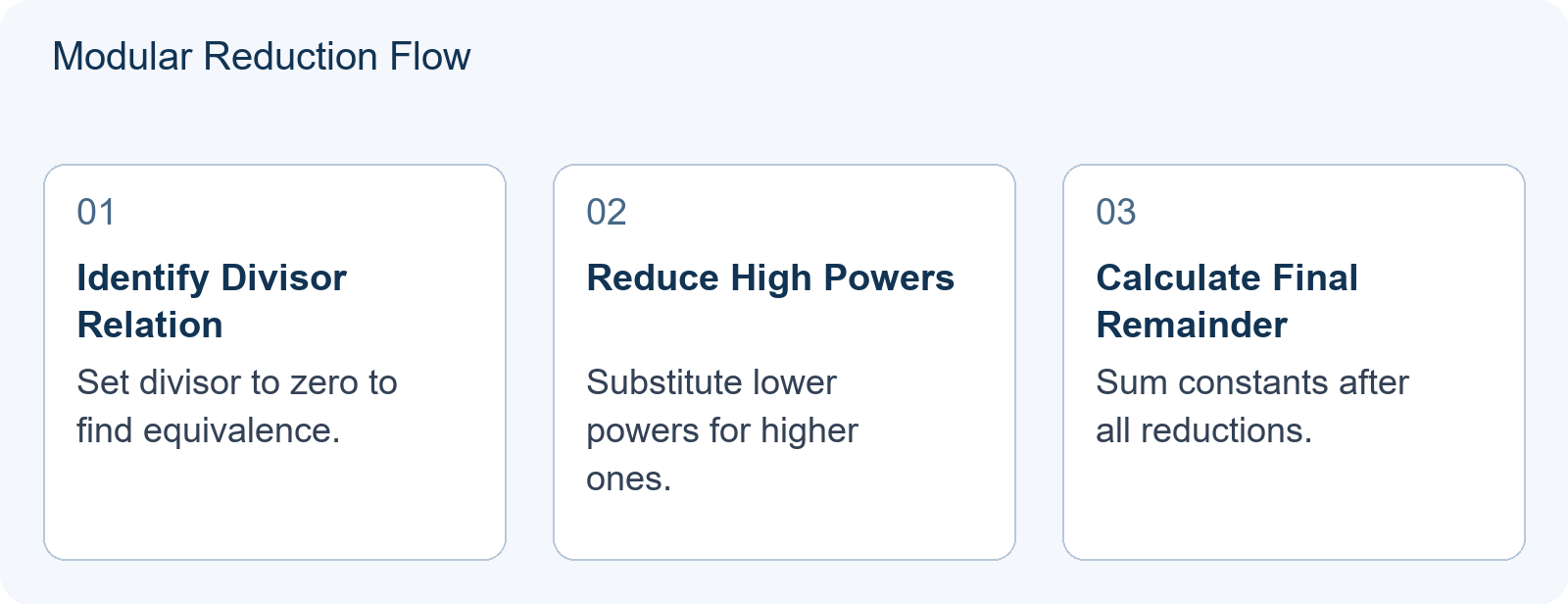
The Remainder Theorem states that if a polynomial P(x) is divided by (x - c), the remainder is P(c). When the divisor is more complex, such as (ax² + bx + c), direct application requires finding roots or using undetermined coefficients. In AIME contexts, divisors are often chosen so that their roots are irrational or complex, making direct substitution messy. The key insight is to treat the polynomial equation modulo the divisor. If we know that x² ≡ k (mod x² - k), we can reduce high powers of x systematically without expanding the entire expression.
This modular perspective transforms a division problem into a substitution problem. Rather than asking "what is the quotient?" we ask "what is x equivalent to?" The answer allows us to collapse exponents rapidly. This method is particularly powerful because AIME problems frequently feature polynomials of degree 8 or higher divided by simple quadratics—precisely the structure where brute-force long division would waste five to ten minutes.
Teaching Illustration 1: Strategic Reduction
Consider a teaching illustration where you need the remainder when P(x) = x¹⁰ + 5x⁸ + 2 is divided by Q(x) = x² - 3. Instead of dividing term by term, observe that x² ≡ 3 (mod x² - 3). Therefore, x¹⁰ = (x²)⁵ ≡ 3⁵ = 243. Similarly, x⁸ = (x²)⁴ ≡ 3⁴ = 81. Substituting these back into P(x), the remainder is 243 + 5(81) + 2 = 243 + 405 + 2 = 650. This method takes seconds compared to minutes spent on long division.
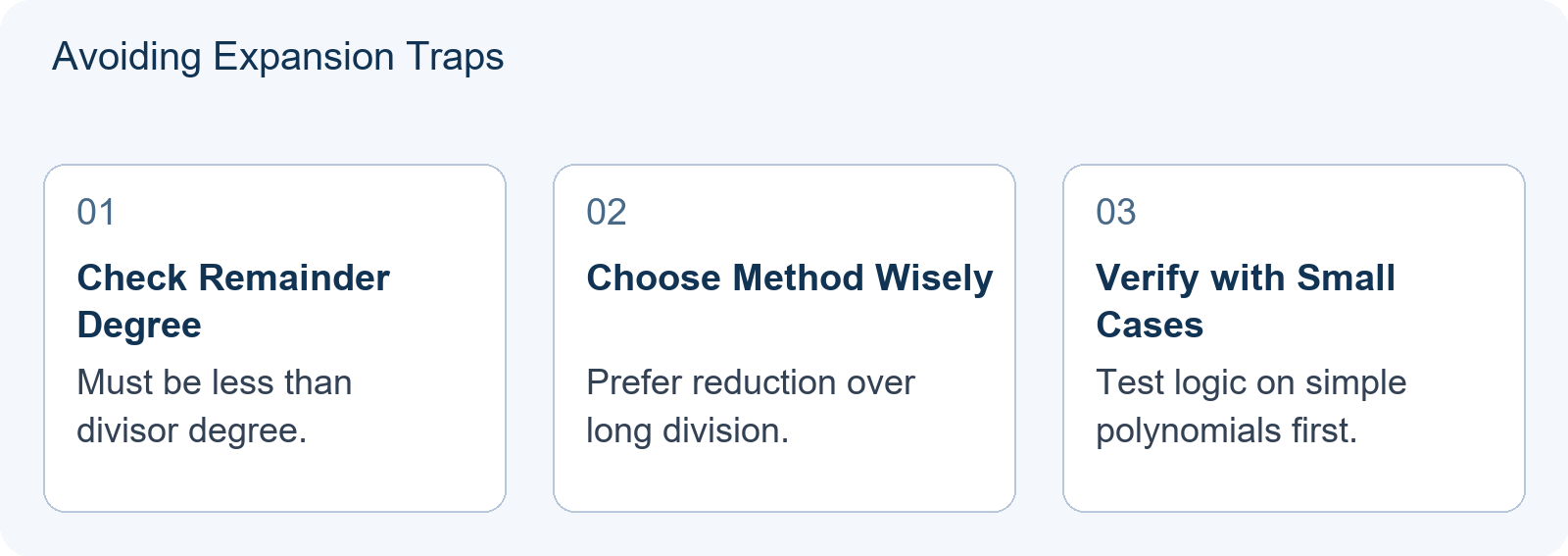
The critical verification step is confirming that the remainder's degree is less than the divisor's degree. Here, the remainder 650 is a constant (degree 0), which is less than degree 2, so the answer is complete. Students who attempt long division would arrive at the same constant but through far more error-prone arithmetic.
Teaching Illustration 2: Where Assumptions Fail
A common mistake occurs when students assume they can simply plug in values without verifying the degree of the remainder. Suppose P(x) is divided by D(x) = x² + x + 1. The remainder must be linear, say R(x) = ax + b. Students might try to find a and b by evaluating P(ω) where ω is a complex root. While valid, this requires handling complex numbers carefully. A safer, purely algebraic approach involves reducing powers of x using x² ≡ -x - 1. For example, x³ = x·x² ≡ x(-x-1) = -x² - x ≡ -(-x-1) - x = 1. Recognizing that x³ ≡ 1 allows rapid reduction of any power xⁿ based on n mod 3.
If a student fails to identify this cyclic pattern, they may attempt unnecessary complex substitutions, leading to calculation errors. The modular approach here reveals structure: since x³ ≡ 1, the powers of x cycle with period 3. For any polynomial, we can reduce exponents modulo 3, then express the result as a linear combination of 1 and x, which gives the remainder directly.
Diagnostic Table: Common Errors vs. Efficient Methods
| Error Type | Description | Correct Approach |
|---|---|---|
| Brute Force Division | Performing full polynomial long division. | Use modular reduction (xᵏ ≡ r). |
| Ignoring Remainder Degree | Assuming remainder is constant for quadratic divisors. | Remainder degree < Divisor degree (linear for quadratic). |
| Complex Root Misuse | Making arithmetic errors with i or ω. | Stick to real-coefficient reduction rules. |
Building Systematic Skill: A Targeted Practice Sequence
To build this skill, start with divisors of the form x² - k, where the reduction is immediate: x² ≡ k. Practice reducing xⁿ for n up to 12. Then move to x² + x + 1 or x² - x + 1 where cyclic patterns emerge—here, x³ ≡ 1 or similar identities appear. Finally, tackle general quadratics requiring systems of equations for coefficients a and b. This progression mirrors the difficulty curve seen in competition contexts.
Each stage demands verification: after finding a remainder, multiply the quotient (if known) by the divisor and add the remainder—check that you recover the original polynomial. This sanity check catches sign errors and coefficient mistakes instantly.
For broader context on eligibility and preparation strategies, refer to our AIME: 7 Points is the Watershed, 10 Points is the Stepping Stone. Understanding the structural changes in the exam format, such as the shift to computer-based testing, helps contextualize why speed and accuracy in algebraic manipulation are critical. Additional background on qualification pathways appears in AMC Math Competition: A Guide to AIME Qualification and Preparation.
Demonstrating Competence
A learner should be able to take any polynomial up to degree 10 and divide it by a monic quadratic within two minutes, showing clear steps of power reduction rather than division algorithms. This aligns with the emphasis on foundational algebra skills highlighted in our From AMC8 to AIME: The Ultimate Math Competition Progression Path. Mastery means recognizing the divisor's structure instantly and selecting the appropriate reduction path without hesitation.
Frequently Asked Questions
Can I always use the Remainder Theorem directly?
Only for linear divisors like (x-c). For quadratics, you must use modular reduction or set up a system for the linear remainder ax+b.
Is complex number substitution faster?
It can be, but it risks arithmetic errors. Algebraic reduction using x² relations is often safer and quicker for integer coefficients.
How does this apply to the new AIME format?
The new format emphasizes speed and accuracy. Mastering reduction techniques saves time compared to manual long division.