For the 2027 season, AIME qualification uses fixed cutoffs for the first time: AMC 10 at 100 points and AMC 12 at 85 points (MAA, August 26, 2026; Hanlin Courses, November 4, 2026). If you are asking how far above these numbers you need to score for reliable qualification, the short answer is that no single margin guarantees safety. Your personal buffer should reflect the stability of your practice scores, not a universal rule.
Why the Fixed Cutoff Changes the Calculation
Before 2027, AIME cutoffs fluctuated year to year based on overall performance distributions. Students aimed to exceed recent historical lines, which typically landed between 90–105 for AMC 10 and 80–95 for AMC 12 depending on paper difficulty. The new fixed system removes that uncertainty. You now know the exact threshold before sitting the exam.
This clarity, however, creates a different risk. With a known target, students may fixate on scraping past 100 or 85 rather than building robust competence. A student who scores 102 on AMC 10 under ideal conditions but drops to 98 under pressure has no margin for error. The fixed cutoff does not care about your potential—it cares about your actual score on test day.
What Determines a "Safe" Margin
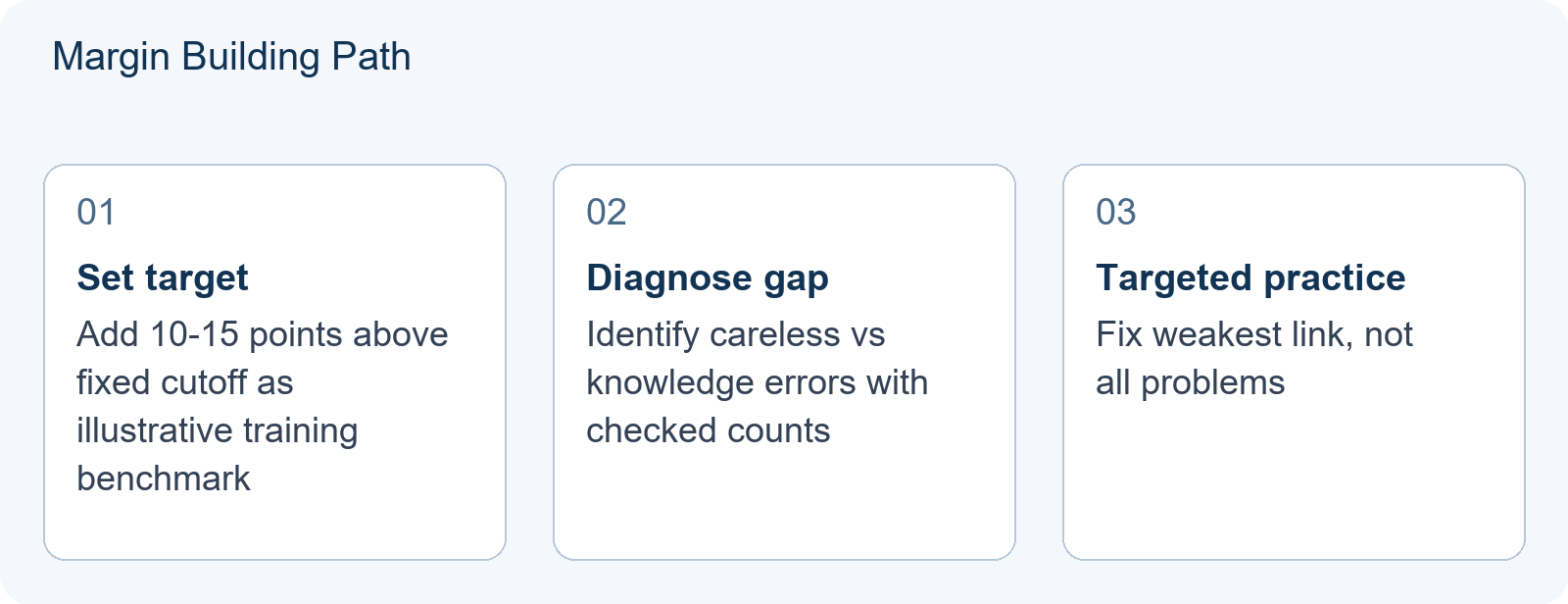
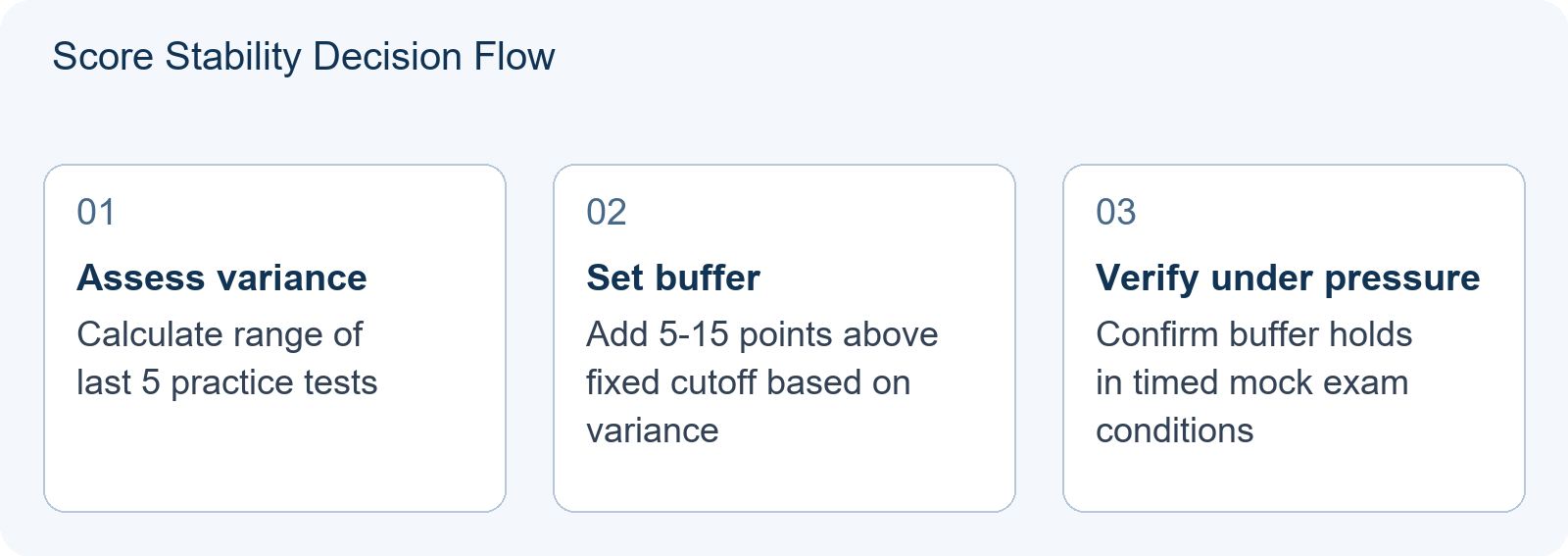
Coaching experience suggests three factors shape how much above the fixed cutoff you should aim:
| Factor | Lower buffer sufficient | Higher buffer advised |
|---|---|---|
| Score consistency | Practice scores vary ±3 points | Practice scores vary ±10+ points |
| Time pressure handling | Rarely leave questions blank | Often rush final problems |
| Calculation error rate | 1 or fewer errors per test | 2+ careless errors common |
A student whose AMC 10 practice scores cluster tightly around 110–115 with minimal careless errors can treat 100 as genuinely secure. Another whose scores swing from 95 to 115 depending on paper alignment needs a higher average target to absorb bad days.
Teaching Illustration: Estimating Your Personal Cutoff
Consider two hypothetical students preparing for AMC 10, both with the same 105 average on recent practice papers:
- Student A scored 108, 106, 104, 107, 105 on five timed tests. Their range is narrow (4 points), and they tend to lose marks only on genuine knowledge gaps, not errors. A target of 102–105 on exam day is reasonably safe.
- Student B scored 115, 98, 112, 93, 107 on the same papers. Their average is identical, but the range is 22 points. Two of those scores fall below the 100 cutoff. Student B should aim to push their average to 110+ and specifically address what caused the 93 and 98 performances before considering themselves secure.
This example illustrates why average score alone misleads. The distribution around that average determines your risk.
AMC 12: The Lower Cutoff, Different Dynamics
The AMC 12 fixed cutoff of 85 sits proportionally lower relative to total points (150) than AMC 10's 100. This reflects the exam's increased difficulty and steeper score compression at the top. However, the same principle applies: your safety margin depends on score stability, not the cutoff value itself.
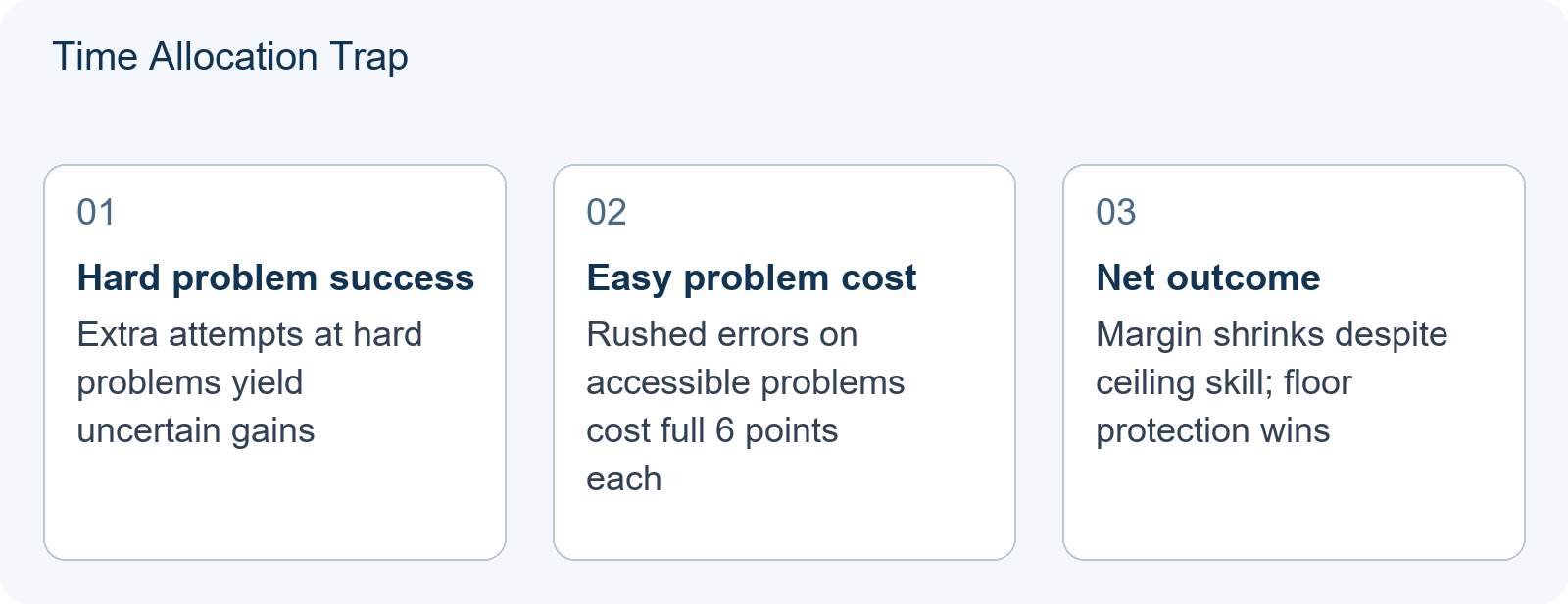
AMC 12 students often face a particular trap. Because 85 seems modest compared to 100, they may underestimate the precision required. In practice, AMC 12 problems 15–20 demand more sustained reasoning than their AMC 10 analogues. Consider a student who solves 13 problems correctly, misses 2, and leaves 10 blank: the score is 13×6 + 2×0 + 10×1.5 = 78 + 15 = 93. If the same student attempts 15 problems with 2 errors and leaves nothing blank: the score is 13×6 + 2×0 + 10×0 = 78—well below cutoff. The margin for error is thinner than raw numbers suggest because each wrong answer costs 6 points of potential score and forfeits the 1.5-point blank return.
Building Score Stability: Practical Steps
Based on Hanlin's teaching observations (November 4, 2026), these practices improve score consistency:
1. Error logging. Record every mistake from practice tests for two weeks. Categorize as: knowledge gap, method selection error, calculation slip, or time pressure artifact. Calculation slips and time pressure artifacts are the fastest to fix and most damaging to cutoff safety.
2. Controlled timed practice. Alternate full timed tests with "pressure-free" untimed solves of the same problems. If your untimed score exceeds timed by more than 15 points, anxiety or pacing—not knowledge—caps your performance. Address this with AIME Mock Review: Separate Setup Errors From Execution Errors.
3. Strategic skipping. On AMC, a blank returns 1.5 points; a wrong answer returns 0. If you cannot solve a problem in twice your average time per question, the expected value of guessing is negative unless you have eliminated at least two options. Students hovering near cutoff should master this decision rule.
From AMC Qualification to AIME Performance
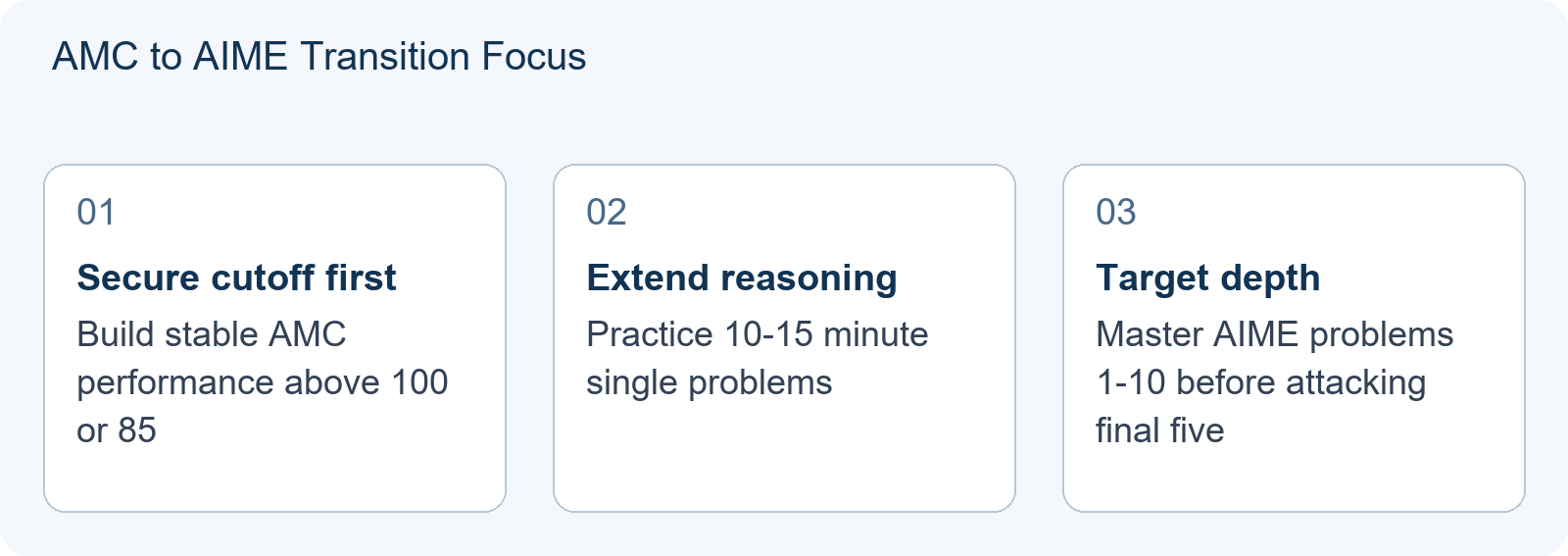
Qualifying for AIME is not the end goal for most competitive students. The AIME itself uses a 15-question, 3-hour format with integer answers from 0 to 999. Its problems 1–5 correspond roughly to AMC 12 problems 15–18 in difficulty, while problems 13–15 reach well beyond (Hanlin Courses, November 4, 2026). Note: the source text contains 'Math Olymiad' [sic] for Math Olympiad.
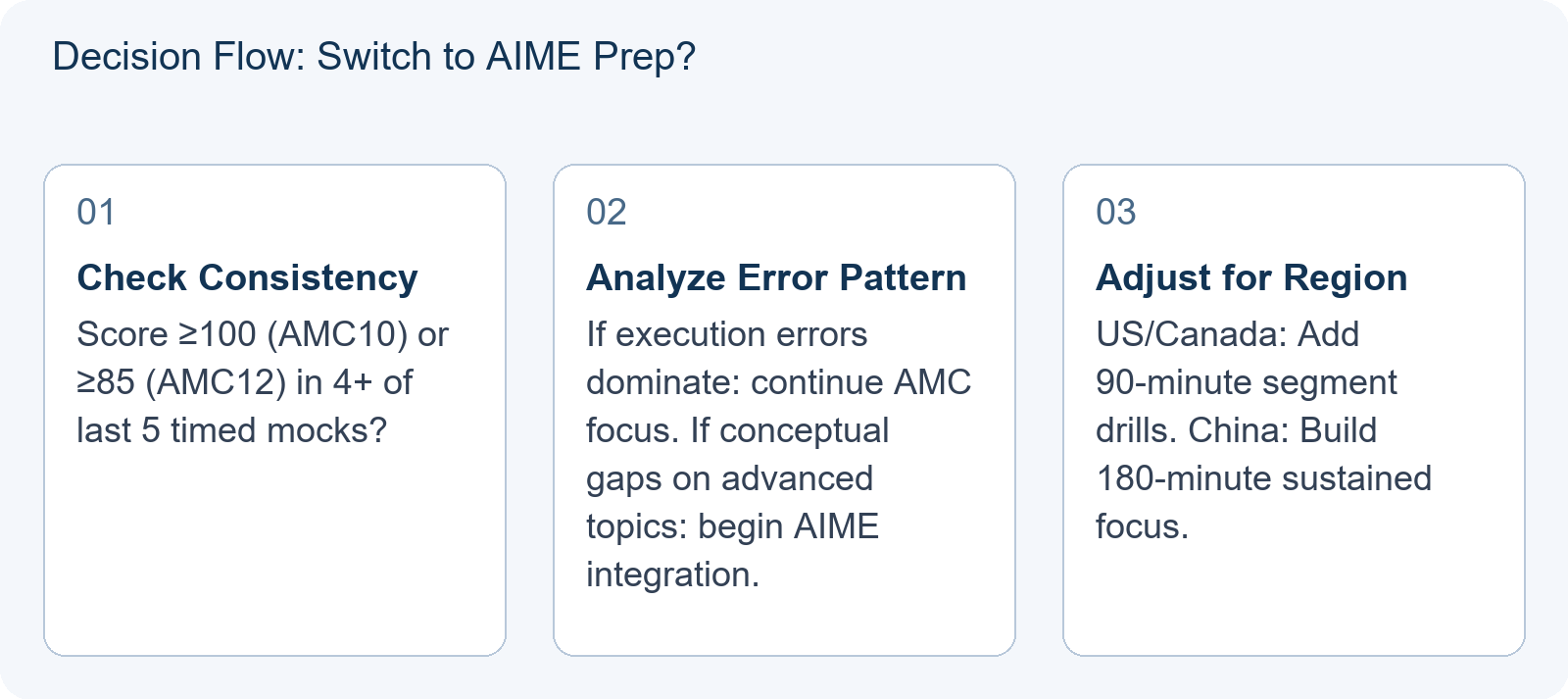
Students who barely clear the AMC cutoff with unstable scores often struggle with AIME's demand for sustained concentration. The skills that build cutoff safety—consistent execution, error reduction, reliable pacing—directly transfer. AIME Preparation After AMC: When to Switch From Speed to Sustained Reasoning requires this foundation.
Regional Format Differences for 2027
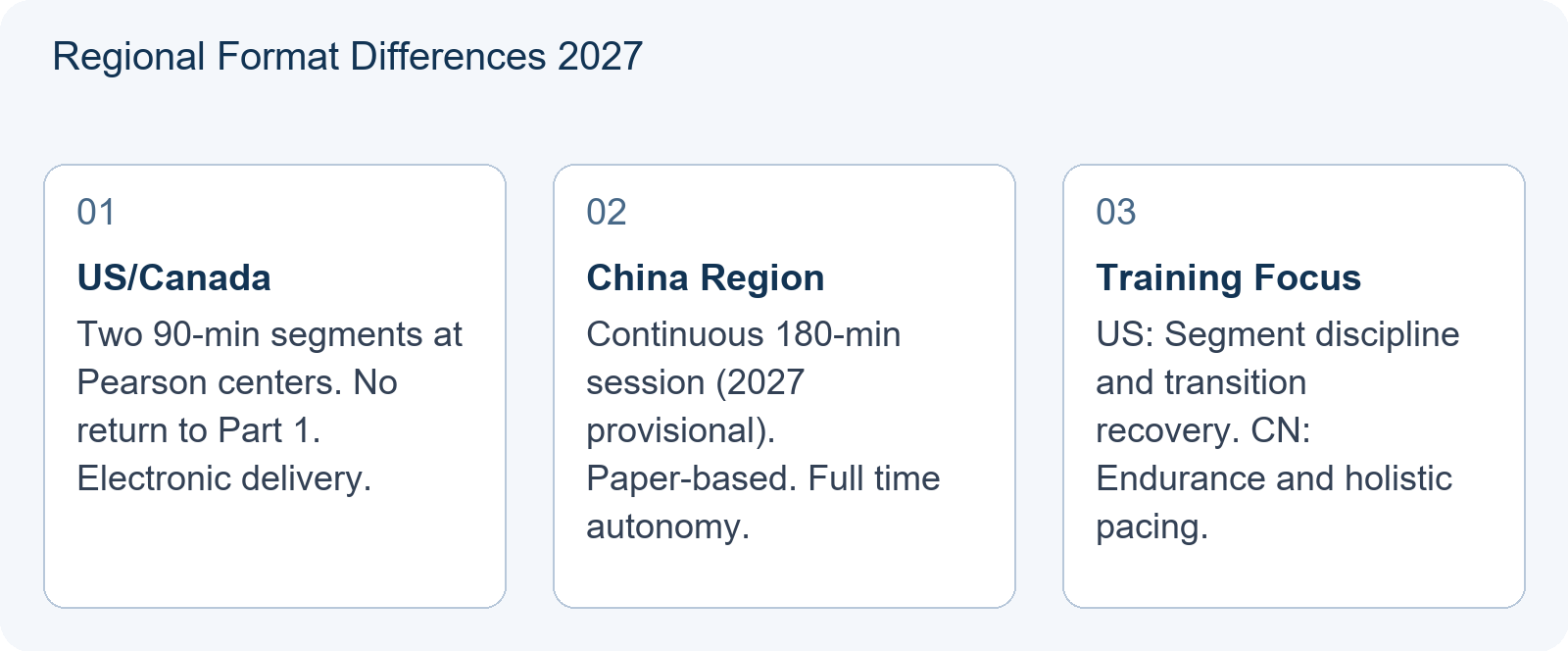
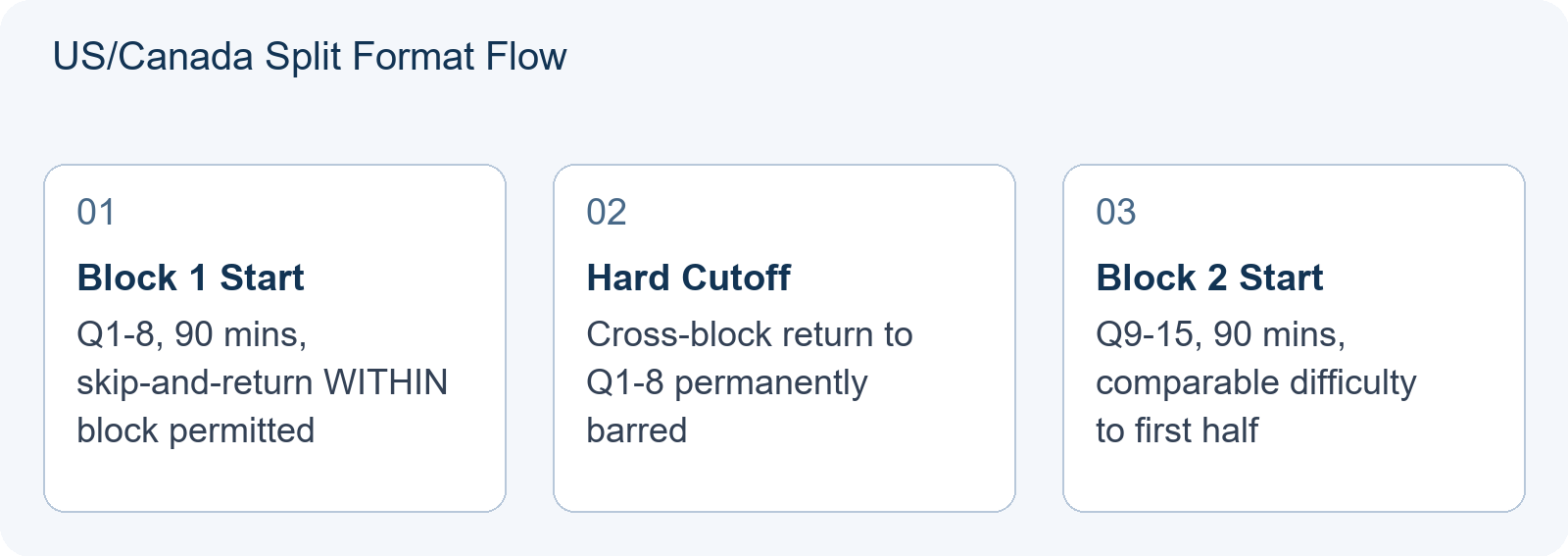
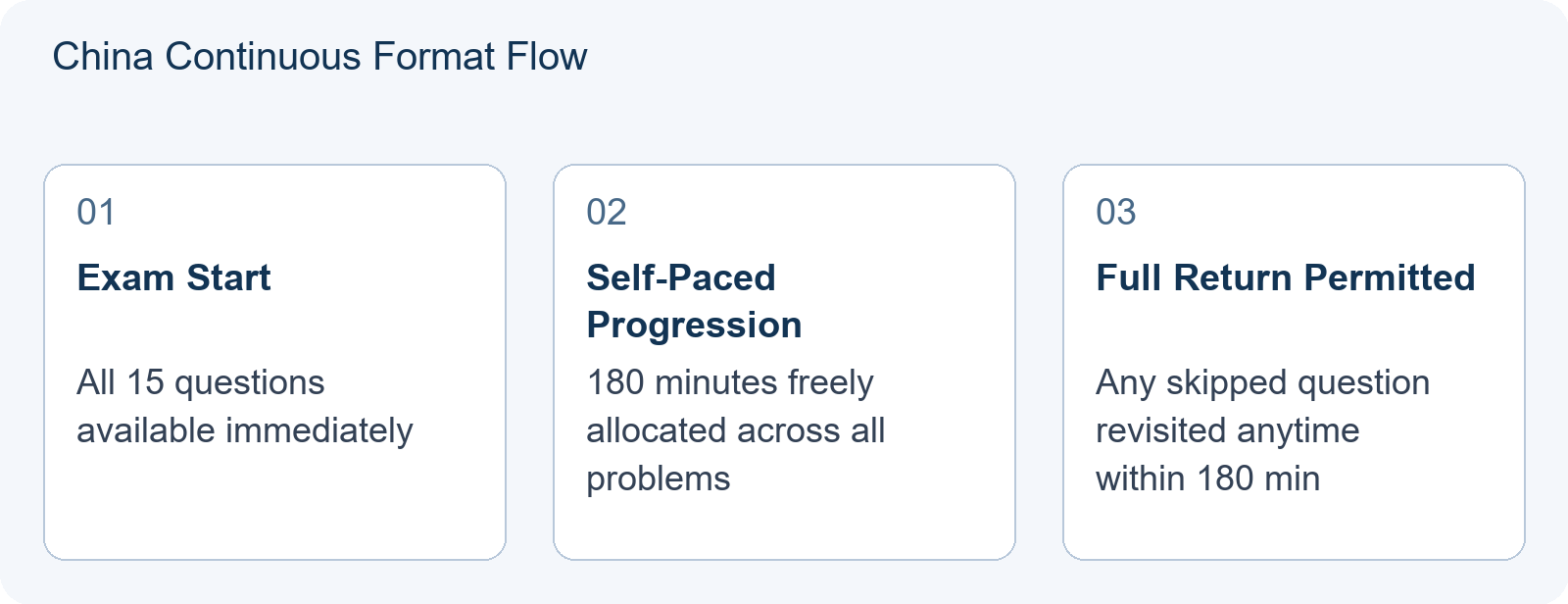
Your preparation timeline depends on your testing region. Note that the US and Canada schedule differs from China:
| Feature | US and Canada | China (International Program) |
|---|---|---|
| Exam dates | February 5 and 6, 2027 | To be confirmed by local organizer |
| Session structure | Two separate testing dates | 180 minutes continuous |
| Navigation | Single session per date; cannot combine | Free movement among all problems |
| Key preparation focus | Consistent performance across both dates | Flexible pacing and problem ordering |
China-region students retain full control over their 180 minutes, which rewards strategic problem ordering. The US and Canada have February 5 and 6 as testing dates per MAA announcement; students should verify with their testing center whether they select one date or are assigned. AIME Pacing Practice: Prepare for Your Region's 2027 Format.
Interpreting Your Practice Scores: A Diagnostic Teaching Illustration
The earlier teaching illustration compared two students with identical 105 averages but very different score distributions. Here is how to apply that framework to your own data, what conclusions are valid, and what to do next.
Step 1: Gather your last five timed practice tests. Use only full-length exams under competition conditions—75 minutes, no interruptions, no checking answers afterward before scoring. Untimed or partial tests distort the diagnostic.
Step 2: Compute three numbers. Let your scores be in any order.
- Mean:
- Minimum:
- Range:
Step 3: Apply the diagnostic rules.
| Condition | Interpretation | Recommended target above fixed cutoff |
|---|---|---|
| and | Stable high performance | Current level is safe; shift to AIME prep |
| and | High ceiling, unstable floor | Aim for ; diagnose low outliers |
| and | Reliably above cutoff | Maintain; reduce variance before raising average |
| and | Average masks real risk | Aim for to ; this is Student B's situation |
| Below cutoff on average | Do not target AIME margin yet; rebuild AMC fundamentals |
Step 4: Work the explicit diagnostic. Suppose your five AMC 10 practice scores are 97, 103, 99, 108, and 113. Then , , and . You fall in the fourth row: your average exceeds 100, but you have already scored below the fixed cutoff during practice. The 113 is encouraging but irrelevant to qualification safety—you do not get to choose which test day to count. Your valid inference is that you are not yet stable enough for 100 to be reliable.
Step 5: The concrete next practice task. For the next two weeks, do not take any more full timed tests. Instead, after each practice problem you attempt during normal study, record:
- Whether you solved it correctly under time pressure
- If wrong, whether you had the method but made an error (execution), or never found the method (setup)
After ten sessions, compute your execution error rate: execution errors divided by total problems attempted. If this exceeds 15%, your volatility is fixable through slower careful work, not more knowledge. Return to full timed tests only when your execution error rate drops below 10% for two consecutive sessions. This directly addresses the instability that caused your 97 and 99, not the ceiling that produced your 113.
Practical Exercise: The Two-Week Stability Drill
Coaches at Hanlin (November 4, 2026) recommend a focused two-week protocol for students whose practice scores fluctuate around the cutoff. The goal is not to learn new material but to identify and eliminate sources of score variance.
Week one: alternate days between timed and untimed solving. On timed days, work only problems 1 through 20 of any AMC 12 or problems 1 through 15 of any AMC 10 under standard time limits. Record every error without looking at the answer key first. On untimed days, revisit the same problems you missed. If you solve them correctly when time pressure is removed, the issue is execution under pressure, not knowledge. Log whether each error was a setup failure (never found the method) or execution failure (had the method but made a slip).
Week two: apply targeted fixes. For execution errors, practice writing out each step of arithmetic or algebraic manipulation explicitly, even when it feels slow. Many students who skip steps to save time actually lose time by hunting for arithmetic mistakes later. For setup errors, study the problem's structural features without solving it: what topic does it belong to, what theorems typically apply, and where the likely trap lies. This builds pattern recognition without requiring full computation.
After this two-week block, take one full timed test. Compare your score variance to the previous two weeks. If your range has narrowed, you have a reproducible method for stability. If not, the issue may be foundational gaps rather than pressure, and you should shift from margin-building to core skill review before returning to timed practice.
General event background is available at Event background.
Frequently Asked Questions
What exactly are the 2027 AIME fixed cutoff scores?
For the 2027 season, AIME qualification requires AMC 10 score of at least 100 or AMC 12 score of at least 85. These are fixed thresholds announced by MAA on August 26, 2026.
How much above the cutoff should I aim to score?
Aim for a buffer based on your score stability, not a fixed number. Students with narrow score ranges (±3 points) may need only 5 points above cutoff. Those with volatile performance should target 10–15 points above to absorb bad days.
Does China use the same AIME format as the US and Canada in 2027?
No. China-region students take a single 180-minute continuous exam with free navigation among all problems. The US and Canada have February 5 and 6, 2027 as testing dates; the specific session structure depends on the testing center, and students should verify with their local organizer.