AIME Fixed Cutoff Targets: How Much Above 100 or 85 Is Actually Safe

For the 2027 season, AIME qualification uses fixed cutoffs for the first time: AMC 10 at 100 points and AMC 12 at 85 points (MAA, August 26, 2026; Hanlin Courses, November 4, 2026). If you are asking how far above these numbers you need to score for reliable qualification, the short answer is that no single margin guarantees safety. Your personal buffer should reflect the stability of your practice scores, not a universal rule.

Why the Fixed Cutoff Changes the Calculation

Before 2027, AIME cutoffs fluctuated year to year based on overall performance distributions. Students aimed to exceed recent historical lines, which typically landed between 90–105 for AMC 10 and 80–95 for AMC 12 depending on paper difficulty. The new fixed system removes that uncertainty. You now know the exact threshold before sitting the exam.

This clarity, however, creates a different risk. With a known target, students may fixate on scraping past 100 or 85 rather than building robust competence. A student who scores 102 on AMC 10 under ideal conditions but drops to 98 under pressure has no margin for error. The fixed cutoff does not care about your potential—it cares about your actual score on test day.

What Determines a "Safe" Margin

Coaching experience suggests three factors shape how much above the fixed cutoff you should aim:

Factor Lower buffer sufficient Higher buffer advised
Score consistency Practice scores vary ±3 points Practice scores vary ±10+ points
Time pressure handling Rarely leave questions blank Often rush final problems
Calculation error rate 1 or fewer errors per test 2+ careless errors common

A student whose AMC 10 practice scores cluster tightly around 110–115 with minimal careless errors can treat 100 as genuinely secure. Another whose scores swing from 95 to 115 depending on paper alignment needs a higher average target to absorb bad days.
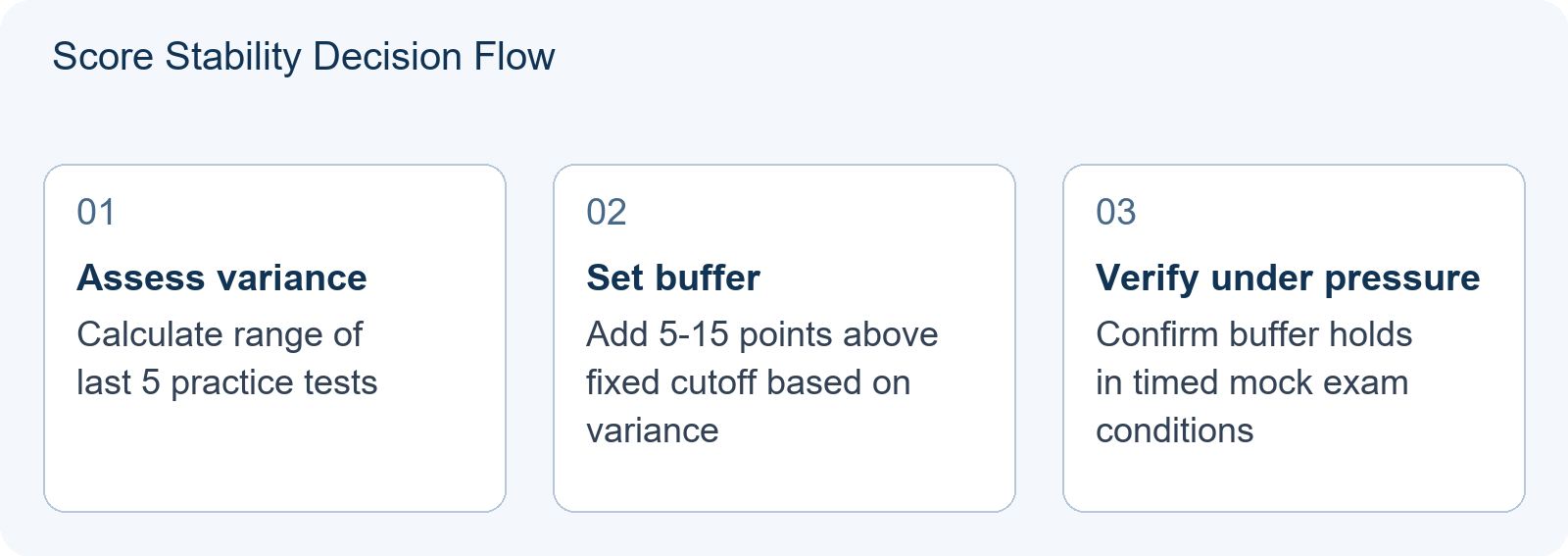
Score Stability Decision Flow

Teaching Illustration: Estimating Your Personal Cutoff

Consider two hypothetical students preparing for AMC 10, both with the same 105 average on recent practice papers:

  • Student A scored 108, 106, 104, 107, 105 on five timed tests. Their range is narrow (4 points), and they tend to lose marks only on genuine knowledge gaps, not errors. A target of 102–105 on exam day is reasonably safe.
  • Student B scored 115, 98, 112, 93, 107 on the same papers. Their average is identical, but the range is 22 points. Two of those scores fall below the 100 cutoff. Student B should aim to push their average to 110+ and specifically address what caused the 93 and 98 performances before considering themselves secure.

This example illustrates why average score alone misleads. The distribution around that average determines your risk.

AMC 12: The Lower Cutoff, Different Dynamics

The AMC 12 fixed cutoff of 85 sits proportionally lower relative to total points (150) than AMC 10's 100. This reflects the exam's increased difficulty and steeper score compression at the top. However, the same principle applies: your safety margin depends on score stability, not the cutoff value itself.

AMC 12 students often face a particular trap. Because 85 seems modest compared to 100, they may underestimate the precision required. In practice, AMC 12 problems 15–20 demand more sustained reasoning than their AMC 10 analogues. Consider a student who solves 13 problems correctly, misses 2, and leaves 10 blank: the score is 13×6 + 2×0 + 10×1.5 = 78 + 15 = 93. If the same student attempts 15 problems with 2 errors and leaves nothing blank: the score is 13×6 + 2×0 + 10×0 = 78—well below cutoff. The margin for error is thinner than raw numbers suggest because each wrong answer costs 6 points of potential score and forfeits the 1.5-point blank return.

Building Score Stability: Practical Steps

Based on Hanlin's teaching observations (November 4, 2026), these practices improve score consistency:

1. Error logging. Record every mistake from practice tests for two weeks. Categorize as: knowledge gap, method selection error, calculation slip, or time pressure artifact. Calculation slips and time pressure artifacts are the fastest to fix and most damaging to cutoff safety.

2. Controlled timed practice. Alternate full timed tests with "pressure-free" untimed solves of the same problems. If your untimed score exceeds timed by more than 15 points, anxiety or pacing—not knowledge—caps your performance. Address this with AIME Mock Review: Separate Setup Errors From Execution Errors.

3. Strategic skipping. On AMC, a blank returns 1.5 points; a wrong answer returns 0. If you cannot solve a problem in twice your average time per question, the expected value of guessing is negative unless you have eliminated at least two options. Students hovering near cutoff should master this decision rule.

From AMC Qualification to AIME Performance

Qualifying for AIME is not the end goal for most competitive students. The AIME itself uses a 15-question, 3-hour format with integer answers from 0 to 999. Its problems 1–5 correspond roughly to AMC 12 problems 15–18 in difficulty, while problems 13–15 reach well beyond (Hanlin Courses, November 4, 2026). Note: the source text contains 'Math Olymiad' [sic] for Math Olympiad.

Students who barely clear the AMC cutoff with unstable scores often struggle with AIME's demand for sustained concentration. The skills that build cutoff safety—consistent execution, error reduction, reliable pacing—directly transfer. AIME Preparation After AMC: When to Switch From Speed to Sustained Reasoning requires this foundation.

Regional Format Differences for 2027

Your preparation timeline depends on your testing region. Note that the US and Canada schedule differs from China:

Feature US and Canada China (International Program)
Exam dates February 5 and 6, 2027 To be confirmed by local organizer
Session structure Two separate testing dates 180 minutes continuous
Navigation Single session per date; cannot combine Free movement among all problems
Key preparation focus Consistent performance across both dates Flexible pacing and problem ordering

China-region students retain full control over their 180 minutes, which rewards strategic problem ordering. The US and Canada have February 5 and 6 as testing dates per MAA announcement; students should verify with their testing center whether they select one date or are assigned. AIME Pacing Practice: Prepare for Your Region's 2027 Format.

Interpreting Your Practice Scores: A Diagnostic Teaching Illustration

The earlier teaching illustration compared two students with identical 105 averages but very different score distributions. Here is how to apply that framework to your own data, what conclusions are valid, and what to do next.

Step 1: Gather your last five timed practice tests. Use only full-length exams under competition conditions—75 minutes, no interruptions, no checking answers afterward before scoring. Untimed or partial tests distort the diagnostic.

Step 2: Compute three numbers. Let your scores be s1,s2,s3,s4,s5 in any order.

  • Mean: s¯=(s1+s2+s3+s4+s5)/5
  • Minimum: smin=min(s1,…,s5)
  • Range: R=max(s1,…,s5)−smin

Step 3: Apply the diagnostic rules.

Condition Interpretation Recommended target above fixed cutoff
s¯≥110 and R≤8 Stable high performance Current level is safe; shift to AIME prep
s¯≥110 and R>15 High ceiling, unstable floor Aim for s¯+5; diagnose low outliers
100≤s¯<110 and smin≥100 Reliably above cutoff Maintain; reduce variance before raising average
100≤s¯<110 and smin<100 Average masks real risk Aim for s¯+8 to s¯+12; this is Student B's situation
s¯<100 Below cutoff on average Do not target AIME margin yet; rebuild AMC fundamentals

Step 4: Work the explicit diagnostic. Suppose your five AMC 10 practice scores are 97, 103, 99, 108, and 113. Then s¯=104, smin=97, and R=16. You fall in the fourth row: your average exceeds 100, but you have already scored below the fixed cutoff during practice. The 113 is encouraging but irrelevant to qualification safety—you do not get to choose which test day to count. Your valid inference is that you are not yet stable enough for 100 to be reliable.

Step 5: The concrete next practice task. For the next two weeks, do not take any more full timed tests. Instead, after each practice problem you attempt during normal study, record:

  • Whether you solved it correctly under time pressure
  • If wrong, whether you had the method but made an error (execution), or never found the method (setup)

After ten sessions, compute your execution error rate: execution errors divided by total problems attempted. If this exceeds 15%, your volatility is fixable through slower careful work, not more knowledge. Return to full timed tests only when your execution error rate drops below 10% for two consecutive sessions. This directly addresses the instability that caused your 97 and 99, not the ceiling that produced your 113.

Practical Exercise: The Two-Week Stability Drill

Coaches at Hanlin (November 4, 2026) recommend a focused two-week protocol for students whose practice scores fluctuate around the cutoff. The goal is not to learn new material but to identify and eliminate sources of score variance.

Week one: alternate days between timed and untimed solving. On timed days, work only problems 1 through 20 of any AMC 12 or problems 1 through 15 of any AMC 10 under standard time limits. Record every error without looking at the answer key first. On untimed days, revisit the same problems you missed. If you solve them correctly when time pressure is removed, the issue is execution under pressure, not knowledge. Log whether each error was a setup failure (never found the method) or execution failure (had the method but made a slip).

Week two: apply targeted fixes. For execution errors, practice writing out each step of arithmetic or algebraic manipulation explicitly, even when it feels slow. Many students who skip steps to save time actually lose time by hunting for arithmetic mistakes later. For setup errors, study the problem's structural features without solving it: what topic does it belong to, what theorems typically apply, and where the likely trap lies. This builds pattern recognition without requiring full computation.

After this two-week block, take one full timed test. Compare your score variance to the previous two weeks. If your range has narrowed, you have a reproducible method for stability. If not, the issue may be foundational gaps rather than pressure, and you should shift from margin-building to core skill review before returning to timed practice.

General event background is available at Event background.
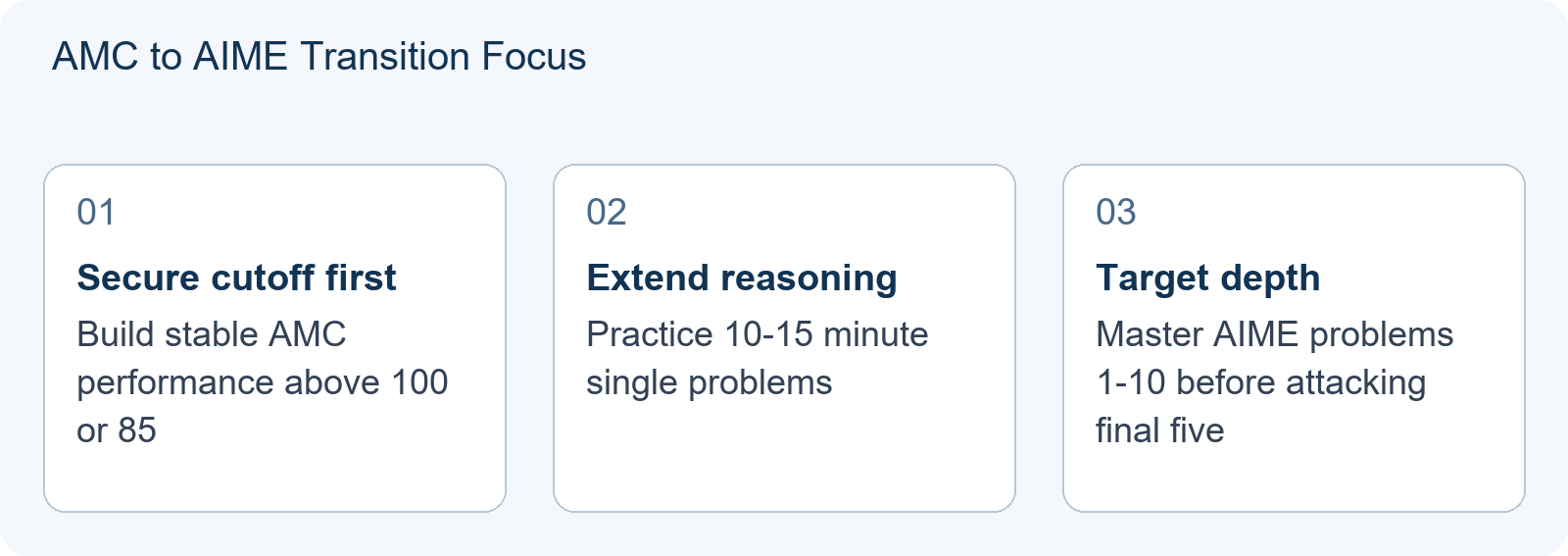
AMC to AIME Transition Focus

Frequently Asked Questions

What exactly are the 2027 AIME fixed cutoff scores?

For the 2027 season, AIME qualification requires AMC 10 score of at least 100 or AMC 12 score of at least 85. These are fixed thresholds announced by MAA on August 26, 2026.

How much above the cutoff should I aim to score?

Aim for a buffer based on your score stability, not a fixed number. Students with narrow score ranges (±3 points) may need only 5 points above cutoff. Those with volatile performance should target 10–15 points above to absorb bad days.

Does China use the same AIME format as the US and Canada in 2027?

No. China-region students take a single 180-minute continuous exam with free navigation among all problems. The US and Canada have February 5 and 6, 2027 as testing dates; the specific session structure depends on the testing center, and students should verify with their local organizer.
AIME 2027 USAMO/USAJMO Selection: Why AMC Scores No Longer Count

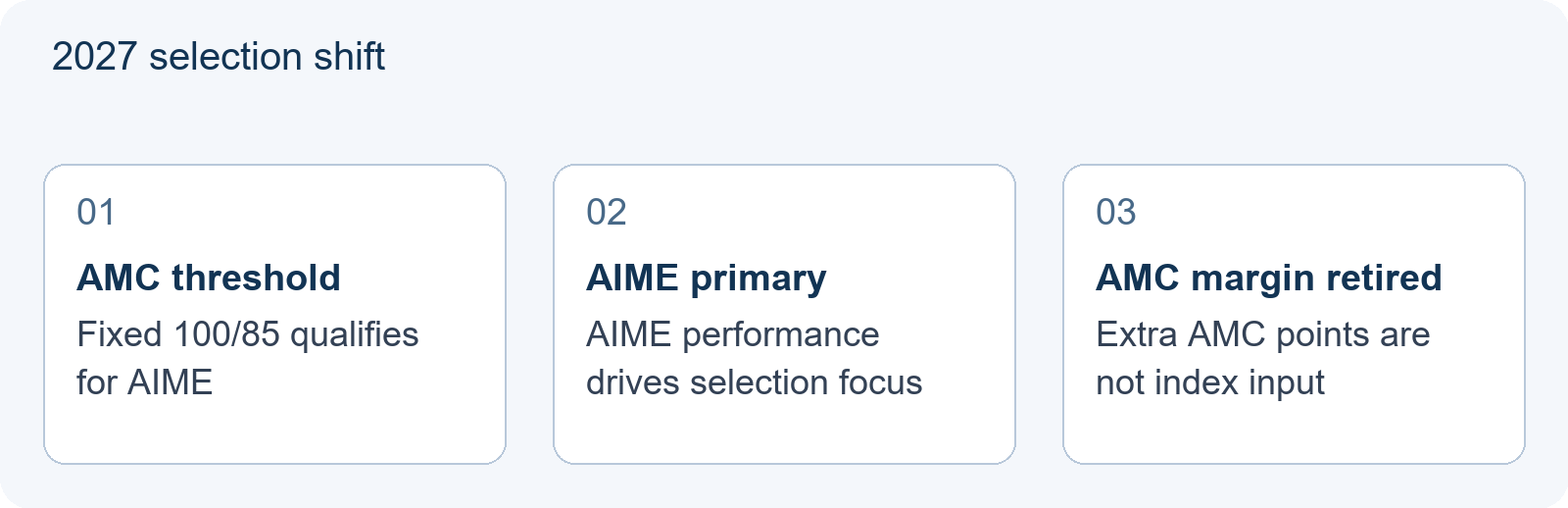
This AIME 2027 USAMO/USAJMO selection guide answers the practical question first: for 2027, a strong AMC 10 or AMC 12 score still can earn AIME qualification at the fixed thresholds — AMC 10 at least 100 and AMC 12 at least 85. It no longer does the second job many families assumed it did. MAA guidance verified for this report on 26 August 2026 says USAMO/USAJMO selection is based primarily on AIME scores; AMC scores no longer count because the AMC + 20 x AIME index is retired. The practical answer is therefore: qualify through AMC, then compete for USAMO/USAJMO through AIME performance. An AMC margin above the threshold is not protection inside the selection index.

What changed: qualification is not selection

AIME qualification and USAMO/USAJMO selection are separate gates. The first gate is now fixed for 2027: students on AMC 10 at or above 100, or AMC 12 at or above 85, meet the stated qualification threshold, subject to the applicable eligibility rules. That fixed line replaces the percentage-based cutoff logic many families remember. Qualification still matters, but it is a doorway, not the selection ranking.

The second gate is the selection process that follows AIME. Under the retired index, a student's AMC score and AIME score were combined in a way that could let a high AMC score compensate for a lower AIME score. That arithmetic is gone. MAA guidance verified on 26 August 2026 states that USAMO/USAJMO selection is based primarily on AIME scores and that AMC scores no longer count. The AIME also becomes a single opportunity in 2027, with AIME I/II discontinued in favour of one 5-6 February 2027 window. One strong AIME performance now carries more planning weight than it did when families could think in terms of an AMC cushion.

A worked contrast: why a 20-point AMC margin stops protecting you

The following is a teaching illustration, not an actual contest result, an official cutoff, or a prediction of selection. It uses simple numbers to show why the old index changed the planning question.

Hypothetical student AMC 12 score AIME score Retired index arithmetic 2027 planning reading
Student A 120 5 120 + 20 x 5 = 220 The AIME score is the selection focus
Student B 100 8 100 + 20 x 8 = 260 The AIME score is the selection focus

Both hypothetical students clear the fixed AMC 12 threshold of at least 85. Under the retired index arithmetic, Student B's AIME advantage more than offsets Student A's 20-point AMC lead. Under the 2027 rule described by MAA, the AMC lead is not part of that selection index at all. Student B's AIME 8 does not guarantee selection, and Student A is not mathematically eliminated by this illustration. The point is narrower and more useful: the comparison no longer begins with Student A's AMC margin. It begins with AIME performance.

2027 selection shift

Who is affected — and who is not

The change matters most to students who have already qualified for AIME and are aiming at USAMO/USAJMO. Those students need to stop treating AMC preparation as a reserve score that can be spent later. Once the fixed threshold is cleared, additional AMC points may still be a personal achievement or a useful confidence signal, but they are not the selection currency described in the 2027 rule.

Students still below the fixed thresholds are in a different position. Their immediate task is qualification, not USAMO/USAJMO selection planning. A student who is not yet stable above AMC 10 100 or AMC 12 85 should not abandon AMC fundamentals for AIME material too early. The relevant decision aid is AIME Qualification Targets: Build a Reliable Margin Above the AMC Cutoff. For students who have cleared the line, the useful question becomes whether their AIME work is stable enough for a single-opportunity exam.

China and US/Canada candidates also need to separate qualification rules from administration rules. The AIME is a single opportunity in 2027, but the sitting format differs by region. Hanlin's 10 October 2026 report, translated as 'Attention, students preparing for AIME: 2027 qualification thresholds are fixed, China arrangements are clarified, and AIME test-site booking opens!', says China retains a 180-minute continuous session, while US/Canada candidates use two 90-minute segments of 8 and 7 questions. International entrants follow their International Group Leader; the Pearson self-scheduling process should not be applied to China. The China-specific format is summarised in AIME China 2027: Age, Format, and Single-Exam Differences.

Preparation priority: from cutoff margin to AIME stability

AMC and AIME reward different behaviours. AMC is a 25-question, 75-minute selection paper where speed, triage and clean short solutions matter. AIME is a 15-question integer-answer paper where a student must sustain reasoning across longer derivations. The 2027 selection change makes that difference strategic, not merely stylistic. A student who has qualified should move the centre of preparation from 'Can I push my AMC score higher?' to 'Can I produce reliable AIME accuracy under one sitting?'

That shift does not mean ignoring AMC entirely. It means changing what is optimised. Extra AMC speed drills may still help a student who is close to the qualification threshold. For a qualified USAMO/USAJMO aspirant, the higher-value work is multi-step derivation, checking whether an answer is an integer that satisfies every condition, and reviewing errors by cause rather than by topic label alone. The adjacent preparation question is covered in AIME Preparation After AMC: When to Switch From Speed to Sustained Reasoning. Score bands are a separate question; no score band should be read as a 2027 selection cutoff.

Decision table: audit your current plan

Old planning assumption 2027 planning question What to practise What to stop optimising
'My AMC margin protects my USAMO/USAJMO path.' Can I produce stable AIME accuracy in one opportunity? Longer derivations, integer-answer verification, timed recovery Chasing extra AMC points after the fixed threshold is secure
'AIME qualification is the finish line.' Have I separated qualification from selection? Full AIME sets under the correct regional format Treating qualification as if it were a selection ranking
'AIME I/II gives me a second chance.' How do I manage a single AIME sitting? Pacing, skip-and-return discipline, error checks Planning around a retake that no longer exists in 2027

The first row is the central change. A family may still be proud of a high AMC score, and a student may still benefit from AMC work as general training. But the selection index no longer uses AMC scores, so a plan that spends November and December trying to enlarge an already sufficient AMC margin is solving last season's problem. The second row guards against a different mistake: qualification is necessary but not the same as selection. The third row matters because the single AIME opportunity raises the cost of poor pacing and unreviewed errors, without creating a new official cutoff formula.

A practice design that matches the new selection logic

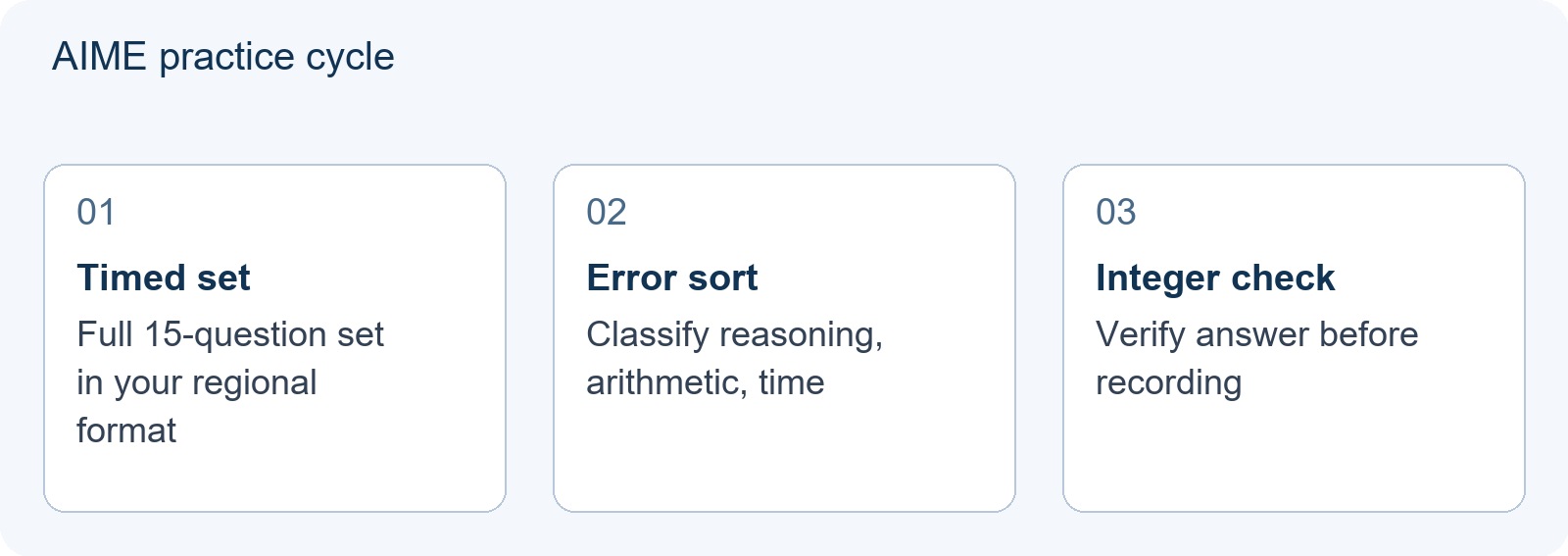
A practical weekly cycle has three parts. First, a timed AIME set using the student's actual regional format: 180 continuous minutes in China, or the two-segment 8 + 7 structure for US/Canada candidates. Second, an error sort into three boxes: reasoning gap, arithmetic or sign slip, and time or decision error. Third, an integer-answer verification pass in which the student checks the answer against the original conditions rather than only against the last line of algebra.

Teaching illustration only: suppose a practice equation produces candidates 12 and -3. The negative value cannot be the recorded integer answer, so the student must decide whether it is an extraneous root, a domain restriction, or a sign error in the derivation. The lesson is not the particular equation; it is the habit of verifying before recording. AIME preparation should build that habit under time pressure, because the 2027 selection logic rewards the student who can produce a correct integer answer repeatedly, not the student who merely recognises a familiar AMC shortcut.

Single-opportunity planning, without inventing a cutoff

The move to one AIME opportunity changes risk management. A student cannot assume that a bad first attempt will be followed by a second AIME I/II sitting. That makes full-run pacing, scratch-work discipline and recovery after a difficult problem more important. For US/Canada candidates, the two 90-minute segments also mean that segment-one choices cannot be revisited in segment two; students should practise that constraint rather than assuming a single continuous paper. For China candidates, the 180-minute continuous session allows self-directed time allocation, but it also removes the external break that might otherwise reset concentration.

What this article does not do is publish an unofficial USAMO/USAJMO cutoff formula. The verified 2027 rule says selection is based primarily on AIME scores and that AMC scores no longer count. It does not follow that every AIME score above some invented number guarantees selection, and it does not follow that every AIME score below some invented number eliminates a student. Families should reject any table that presents such numbers as official without a current MAA source. The safe planning conclusion is narrower: AMC gets the student to AIME; AIME performance is the primary selection input to prepare for.

How to prepare for a course-fit or resource review

A useful preparation conversation should start with evidence, not a sales promise. Bring a recent timed AIME set completed under the correct regional format, a short error log that separates reasoning from arithmetic and pacing, the student's current AMC threshold status, and a clear target: qualification, a stronger AIME score band, or USAMO/USAJMO selection preparation. Ask whether the review distinguishes those goals, because a student still chasing AMC 10 100 or AMC 12 85 needs different work from a qualified student who is already training for a single AIME sitting.

Ask also how integer-answer verification and full-paper pacing will be reviewed, and whether the plan uses the student's actual format rather than a generic 15-question set. A good review should be able to explain why a particular drill is assigned and what error pattern it addresses. It should not promise a selection outcome, invent a cutoff, or treat a high AMC score as a reserve that can be spent in the AIME index. The qualification and format articles linked above answer different questions; this article is specifically about the 2027 selection shift after AIME qualification.

General event background is available at Event background.

AIME practice cycle

Frequently Asked Questions

Does a high AMC score still help with USAMO/USAJMO selection in 2027?

A high AMC score can still help a student meet the fixed AIME qualification threshold: AMC 10 at least 100 or AMC 12 at least 85. It does not contribute to the USAMO/USAJMO selection index described for 2027, because AMC scores no longer count and the AMC + 20 x AIME index is retired. Selection is based primarily on AIME scores.

Does AIME qualification alone imply USAMO/USAJMO eligibility?

No. AIME qualification is a separate step from USAMO/USAJMO selection. A student must qualify for AIME, but selection is based primarily on AIME performance under the 2027 rule. This article does not publish an unofficial USAMO/USAJMO cutoff or imply that any particular AIME score guarantees selection.

How should China and US/Canada candidates prepare differently for the 2027 AIME?

Both should prepare for stable AIME accuracy under a single opportunity, but the sitting format differs. Hanlin's 10 October 2026 report says China retains a 180-minute continuous session, while US/Canada candidates use two 90-minute segments of 8 and 7 questions. International entrants should follow their International Group Leader, and the Pearson process should not be applied to China.

AIME Qualification Targets: Build a Reliable Margin Above the AMC Cutoff

Starting with the 2026–27 competition cycle, AIME qualification no longer depends on fluctuating percentage cutoffs. The MAA has set fixed thresholds: 100 points on AMC10 and 85 points on AMC12 (MAA AIME official rules, checked October 12 2026). For students and families researching preparation strategy, this change removes uncertainty about "where the line will fall"—but it replaces that uncertainty with a different question: how much above the fixed cutoff should you aim to score in practice, so that the official result feels secure rather than lucky?

Important distinction: these are official qualification thresholds, not guarantees. Meeting the score requirement is necessary but not sufficient; eligibility also depends on age and other criteria. For US/Canada test takers at Pearson centers, students must be 13 years or older as of the 2027 AIME date, with no exceptions (MAA AIME official rules, checked October 12 2026). International participants, including China-region students, follow their regional International Group Leader policies; the age condition and other eligibility rules may differ. This article focuses on building practice margin above the cutoff score, which is separate from verifying full eligibility.

Why a "Reliable Margin" Matters More Than the Minimum

A score at or above the relevant threshold meets the score component of eligibility. However, competition conditions differ from practice. Time pressure, problem-order effects, and the occasional misread can each cost points. A practice score at the threshold leaves no numerical margin for variation on a later paper. The goal should be to reach a level where the official cutoff feels like a floor, not a ceiling.

The fixed cutoff also changes the preparation dynamic. Under the old percentage system, a student might hope for an easy test that affects the cutoff. With a fixed score, the number is known in advance, which makes preparation more transparent. Under a percentile-based system, an easier paper can raise the score needed to reach the same percentile. That is different from the fixed threshold used in this cycle. The only variable left is your own performance.

Worked Teaching Case: Building an Illustrative Training Target

Let us examine a concrete scenario with checked arithmetic. Suppose a student is preparing for AMC10 and wants to qualify for AIME. The fixed cutoff is 100. The student sets an illustrative training target of 115 points in practice conditions—this is a personal benchmark, not an official safe margin or guarantee.

Step 1: Understand the scoring reality. AMC10 awards 6 points for a correct answer, 1.5 points for a blank, and 0 for an incorrect answer. With 25 questions in 75 minutes, the maximum is 150 points.

Step 2: Establish a baseline with verified counts. Consider a student who attempts 20 problems, leaving 5 blank, with 17 correct and 3 wrong. The score is: 17 × 6 + 5 × 1.5 + 3 × 0 = 102 + 7.5 = 109.5. This clears the 100 cutoff but illustrates how a student can be above minimum yet still short of a comfortable margin.

Step 3: Show improvement path with same attempt count. Suppose this student improves accuracy without increasing attempts: 19 correct, 1 wrong, 5 blank (still 20 attempted, 5 blank). The score becomes: 19 × 6 + 5 × 1.5 + 1 × 0 = 114 + 7.5 = 121.5. The gain is 121.5 − 109.5 = 12 points—from fixing just two errors. The problem counts verify: 19 + 1 + 5 = 25.

This case illustrates a general principle: for students near the cutoff, accuracy on accessible problems often yields more margin than attempts at harder problems.

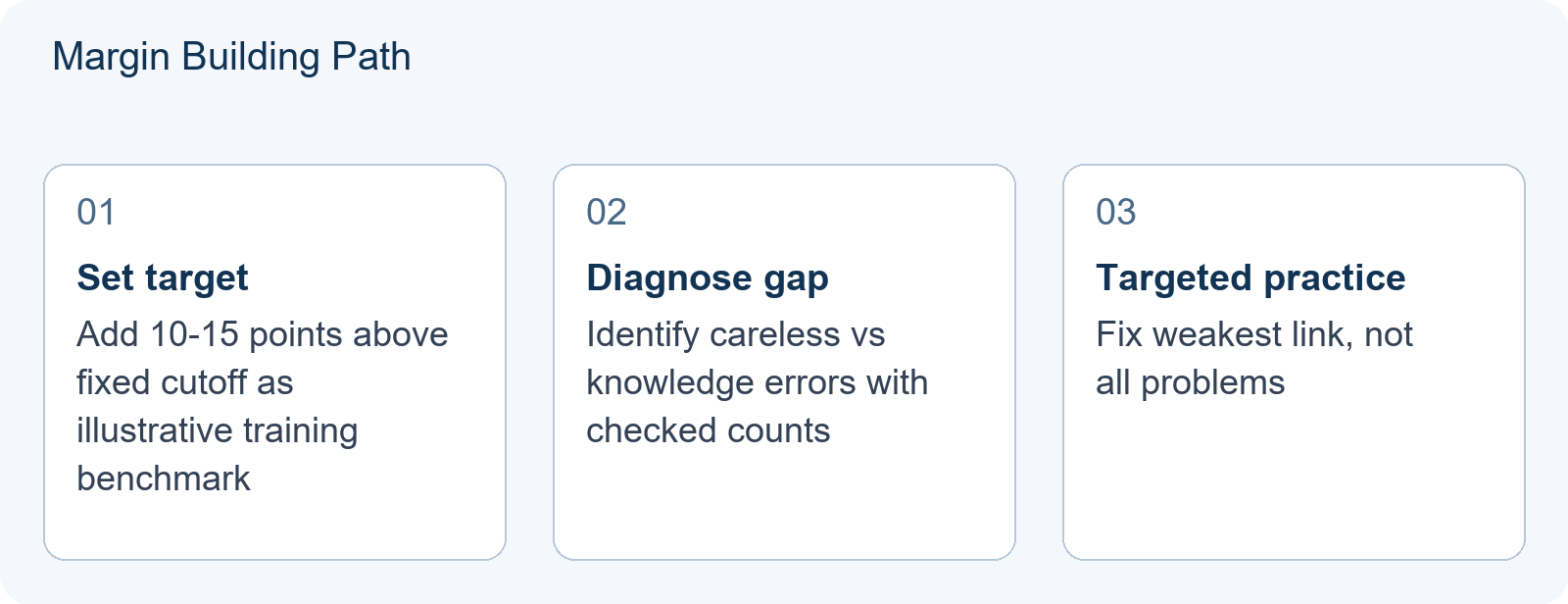
Margin Building Path

Contrasting Case: Where Chasing Hard Problems Fails

Consider a different student with the same 115 illustrative target but a different profile: strong theoretical knowledge but slow execution. This student can solve problems 20–25 correctly when given unlimited time but rushes through early problems.

In practice, this student attempts 22 problems: 17 correct, 5 wrong, 3 blank. Using the checked calculation: 17 × 6 + 3 × 1.5 + 5 × 0 = 102 + 4.5 = 106.5 (not 105 as rough estimation might suggest). This clears the cutoff with only 6.5 points of margin—insufficient comfort for test-day variation.

The superficially similar approach of "attempt many problems" fails here because the student's time allocation is inverted. The two additional attempts beyond our first case came at the cost of two more errors. If those two problems had been left blank instead, the student would have earned 2 × 1.5 = 3 points; by getting them wrong, they earned 0. The hard-problem success did not compensate for this loss.

This contrast highlights that margin-building is not primarily about ceiling performance. It is about floor protection: ensuring that the problems you know how to do become points you actually earn.

Diagnostic: Where Is Your Margin Right Now?

To apply this framework, use a recent timed AMC practice test under realistic conditions. Record:

  • Problems correct, blank, and incorrect
  • Which problems were "careless errors" versus "did not know how to solve"
  • Time spent on each problem (estimate if not tracked)

Calculate your score and categorize your errors. Then ask:

If I eliminated all careless errors while keeping everything else constant, what would my score be? This is your "clean execution" ceiling. If this exceeds your illustrative target (e.g., 115 for AMC10), your priority is process discipline, not new content.

If I had unlimited time, what would my score be? This measures knowledge versus execution. A large gap between unlimited-time and actual score indicates speed or time-management issues. A small gap indicates knowledge gaps.

How many problems did I attempt in the first 30 minutes versus the final 45? Front-loading attempts often leads to rushed errors. A more even pace, with time reserved for checking, typically improves accuracy.

Complete answers to these three questions give you a specific preparation direction. Generic advice like "do more practice tests" is less useful than targeted work on your identified gap.

What the Diagnostic Means for Next Steps

Suppose your diagnostic reveals a gap between your clean-execution ceiling and your illustrative target. The specific feedback that addresses this depends on the error pattern:

Pattern: Careless errors concentrated in problems 1–15. Feedback needed: structured checking protocol, not harder problems. One approach is the "two-pass" method: first pass completes problems with confidence; second pass reviews flagged items. Another is explicit estimation—does the answer make sense?—before finalizing.

Pattern: Time runs out with unattempted problems you could solve. Feedback needed: timed practice with strict problem-allocation budgets. For AMC10, a rough guide is 2 minutes per problem for 1–10, 3 minutes for 11–20, and remaining time for 21–25. Adjust based on your personal speed.

Pattern: Knowledge gaps in specific content areas. Feedback needed: targeted topic review, not more full tests. Common AMC10/12 topics include counting and probability, number theory, and geometric configurations. Identifying which topics cost you points allows efficient study.

Use the final practice period to address the errors your own records reveal. Students who have built reliable margin through consistent practice perform more predictably than those who peak on occasional strong showings.

China-Specific Preparation Context

For students in China, the 2026–27 season has additional considerations. The AMC10/12 A and B exams remain available, with dates of November 6 and November 14, 2026; Hanlin's October 24, 2026 report gives the B registration deadline as November 3. China-region students take the exam offline at authorized test centers, not online. The AIME itself, if qualified, is also administered offline in China with a continuous 180-minute format—unlike the US/Canada split-session structure (Hanlin operator report, October 10, 2026).

This matters for margin-building because the test-day environment differs. Students should practice under conditions that match their actual administration: paper test, continuous time, and the specific materials allowed. The US/Canada AIME format of split 90-minute sessions with no return to earlier problems does not apply to China-region test takers, so preparation should not emphasize that constraint.

Students in China register through the International Group Leader system; MAA lists distinct public-school and private-school IGLs for China (MAA International 2026–27 participation). The private-school listing connects to ASDAN China. This registration pathway is separate from US/Canada direct registration and should be planned in advance.

Connecting to Broader Preparation Resources

For students seeking to understand the full progression from AMC to AIME and beyond, several related articles provide complementary coverage. The AMC10 to AIME Qualification Guide: Cutoff Scores, Exam Dates & Prep Strategies offers overview information on cutoff scores, exam dates, and general preparation strategies. For students earlier in their competition journey, the From AMC8 to AIME: The Ultimate Math Competition Progression Path describes how foundational competition experience builds toward qualification. Those interested in how AIME performance specifically influences advanced opportunities can consult AIME Competition Score Weight Adjustment: How to Prepare for 2026.

These resources address adjacent questions; this article's specific contribution is the worked methodology for building and verifying a reliable margin above the fixed cutoff.

Preparing for Consultation: What to Bring

If you are considering structured preparation support, having the following information ready makes consultation more productive:

  • Your most recent timed AMC practice score, with problem-level breakdown if available
  • Your target competition date (A or B exam, or both)
  • Your current grade level and math coursework, to assess foundational readiness
  • Specific topics or problem types where you consistently lose points

This preparation allows a focused discussion about whether your gap is primarily knowledge-based, execution-based, or strategic—and what specific practice structure would address it.

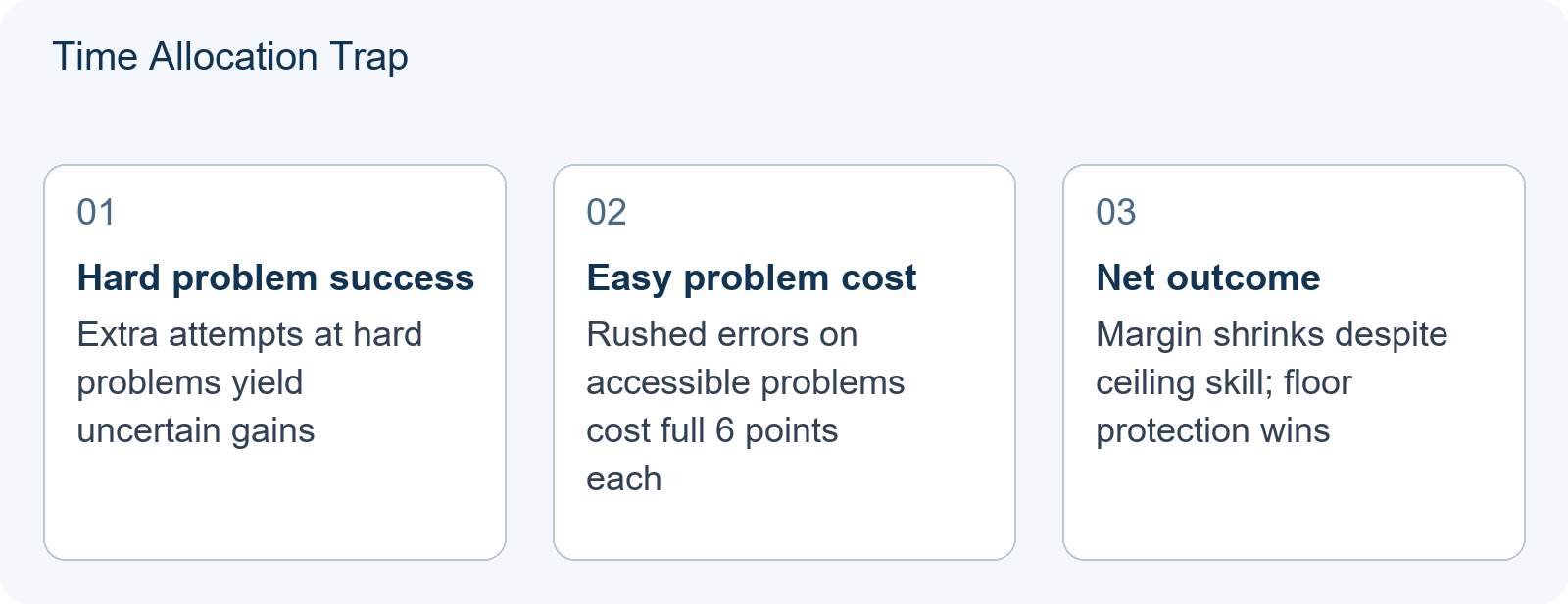
Time Allocation Trap

Frequently Asked Questions

Is 100 on AMC10 or 85 on AMC12 enough to guarantee AIME qualification?

These are the fixed minimum qualifying scores set by MAA for the 2026-27 cycle. However, 'guarantee' depends on meeting all eligibility criteria. For US/Canada test takers, this includes a minimum age of 13; international participants follow regional IGL policies with potentially different requirements. For test-day security, you should aim to consistently score above these thresholds in practice to account for performance variation. Practice targets are illustrative benchmarks, not official safe margins.

How does the China-region AIME format differ from US/Canada?

China-region AIME remains a continuous 180-minute offline exam according to the October 10, 2026 operator report. The US/Canada format splits into two 90-minute sessions with no return to earlier problems. China students should practice continuous-time conditions, not the split-session structure. International participants follow their regional International Group Leader policies.

Should I focus on solving harder problems or reducing errors on easier ones?

For building margin above the cutoff, reducing errors on problems you already know how to solve typically yields more reliable point gains than attempting harder problems. The worked case in this article shows how improving two wrong answers to correct ones—keeping the same attempt count—gains 12 points without requiring new knowledge or additional attempts.

Online Consultation
Online Consultation