
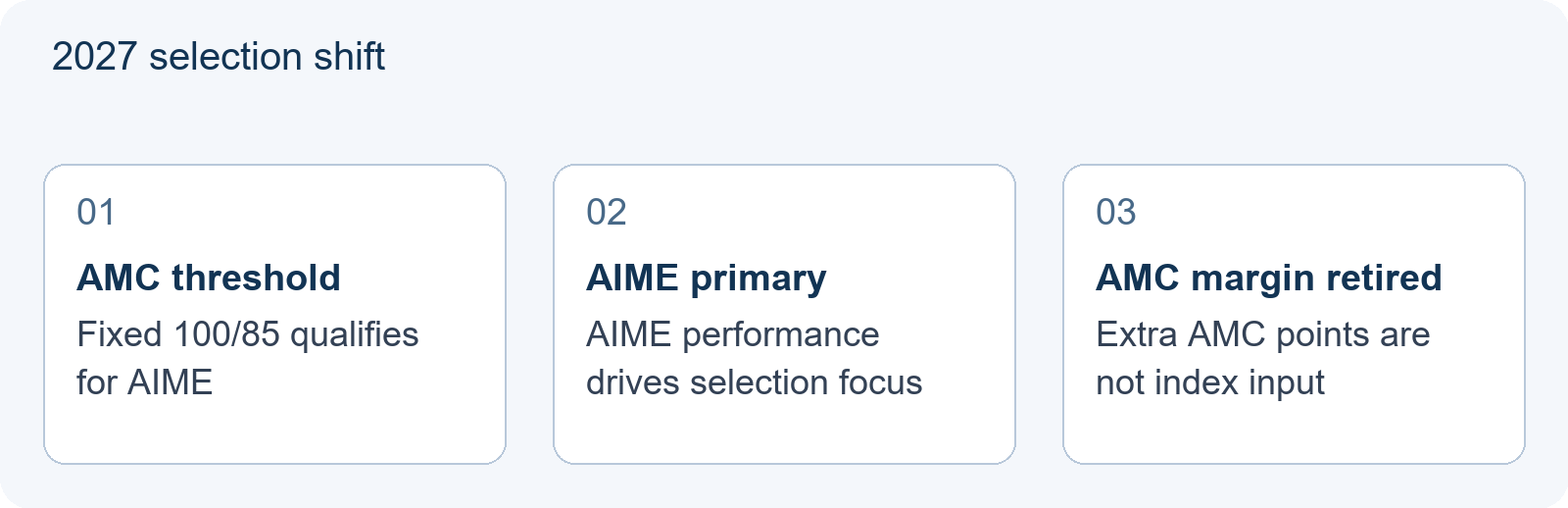
This AIME 2027 USAMO/USAJMO selection guide answers the practical question first: for 2027, a strong AMC 10 or AMC 12 score still can earn AIME qualification at the fixed thresholds — AMC 10 at least 100 and AMC 12 at least 85. It no longer does the second job many families assumed it did. MAA guidance verified for this report on 26 August 2026 says USAMO/USAJMO selection is based primarily on AIME scores; AMC scores no longer count because the AMC + 20 x AIME index is retired. The practical answer is therefore: qualify through AMC, then compete for USAMO/USAJMO through AIME performance. An AMC margin above the threshold is not protection inside the selection index.
What changed: qualification is not selection
AIME qualification and USAMO/USAJMO selection are separate gates. The first gate is now fixed for 2027: students on AMC 10 at or above 100, or AMC 12 at or above 85, meet the stated qualification threshold, subject to the applicable eligibility rules. That fixed line replaces the percentage-based cutoff logic many families remember. Qualification still matters, but it is a doorway, not the selection ranking.
The second gate is the selection process that follows AIME. Under the retired index, a student's AMC score and AIME score were combined in a way that could let a high AMC score compensate for a lower AIME score. That arithmetic is gone. MAA guidance verified on 26 August 2026 states that USAMO/USAJMO selection is based primarily on AIME scores and that AMC scores no longer count. The AIME also becomes a single opportunity in 2027, with AIME I/II discontinued in favour of one 5-6 February 2027 window. One strong AIME performance now carries more planning weight than it did when families could think in terms of an AMC cushion.
A worked contrast: why a 20-point AMC margin stops protecting you
The following is a teaching illustration, not an actual contest result, an official cutoff, or a prediction of selection. It uses simple numbers to show why the old index changed the planning question.
| Hypothetical student | AMC 12 score | AIME score | Retired index arithmetic | 2027 planning reading |
|---|---|---|---|---|
| Student A | 120 | 5 | 120 + 20 x 5 = 220 | The AIME score is the selection focus |
| Student B | 100 | 8 | 100 + 20 x 8 = 260 | The AIME score is the selection focus |
Both hypothetical students clear the fixed AMC 12 threshold of at least 85. Under the retired index arithmetic, Student B's AIME advantage more than offsets Student A's 20-point AMC lead. Under the 2027 rule described by MAA, the AMC lead is not part of that selection index at all. Student B's AIME 8 does not guarantee selection, and Student A is not mathematically eliminated by this illustration. The point is narrower and more useful: the comparison no longer begins with Student A's AMC margin. It begins with AIME performance.
Who is affected — and who is not
The change matters most to students who have already qualified for AIME and are aiming at USAMO/USAJMO. Those students need to stop treating AMC preparation as a reserve score that can be spent later. Once the fixed threshold is cleared, additional AMC points may still be a personal achievement or a useful confidence signal, but they are not the selection currency described in the 2027 rule.
Students still below the fixed thresholds are in a different position. Their immediate task is qualification, not USAMO/USAJMO selection planning. A student who is not yet stable above AMC 10 100 or AMC 12 85 should not abandon AMC fundamentals for AIME material too early. The relevant decision aid is AIME Qualification Targets: Build a Reliable Margin Above the AMC Cutoff. For students who have cleared the line, the useful question becomes whether their AIME work is stable enough for a single-opportunity exam.
China and US/Canada candidates also need to separate qualification rules from administration rules. The AIME is a single opportunity in 2027, but the sitting format differs by region. Hanlin's 10 October 2026 report, translated as 'Attention, students preparing for AIME: 2027 qualification thresholds are fixed, China arrangements are clarified, and AIME test-site booking opens!', says China retains a 180-minute continuous session, while US/Canada candidates use two 90-minute segments of 8 and 7 questions. International entrants follow their International Group Leader; the Pearson self-scheduling process should not be applied to China. The China-specific format is summarised in AIME China 2027: Age, Format, and Single-Exam Differences.
Preparation priority: from cutoff margin to AIME stability
AMC and AIME reward different behaviours. AMC is a 25-question, 75-minute selection paper where speed, triage and clean short solutions matter. AIME is a 15-question integer-answer paper where a student must sustain reasoning across longer derivations. The 2027 selection change makes that difference strategic, not merely stylistic. A student who has qualified should move the centre of preparation from 'Can I push my AMC score higher?' to 'Can I produce reliable AIME accuracy under one sitting?'
That shift does not mean ignoring AMC entirely. It means changing what is optimised. Extra AMC speed drills may still help a student who is close to the qualification threshold. For a qualified USAMO/USAJMO aspirant, the higher-value work is multi-step derivation, checking whether an answer is an integer that satisfies every condition, and reviewing errors by cause rather than by topic label alone. The adjacent preparation question is covered in AIME Preparation After AMC: When to Switch From Speed to Sustained Reasoning. Score bands are a separate question; no score band should be read as a 2027 selection cutoff.
Decision table: audit your current plan
| Old planning assumption | 2027 planning question | What to practise | What to stop optimising |
|---|---|---|---|
| 'My AMC margin protects my USAMO/USAJMO path.' | Can I produce stable AIME accuracy in one opportunity? | Longer derivations, integer-answer verification, timed recovery | Chasing extra AMC points after the fixed threshold is secure |
| 'AIME qualification is the finish line.' | Have I separated qualification from selection? | Full AIME sets under the correct regional format | Treating qualification as if it were a selection ranking |
| 'AIME I/II gives me a second chance.' | How do I manage a single AIME sitting? | Pacing, skip-and-return discipline, error checks | Planning around a retake that no longer exists in 2027 |
The first row is the central change. A family may still be proud of a high AMC score, and a student may still benefit from AMC work as general training. But the selection index no longer uses AMC scores, so a plan that spends November and December trying to enlarge an already sufficient AMC margin is solving last season's problem. The second row guards against a different mistake: qualification is necessary but not the same as selection. The third row matters because the single AIME opportunity raises the cost of poor pacing and unreviewed errors, without creating a new official cutoff formula.
A practice design that matches the new selection logic
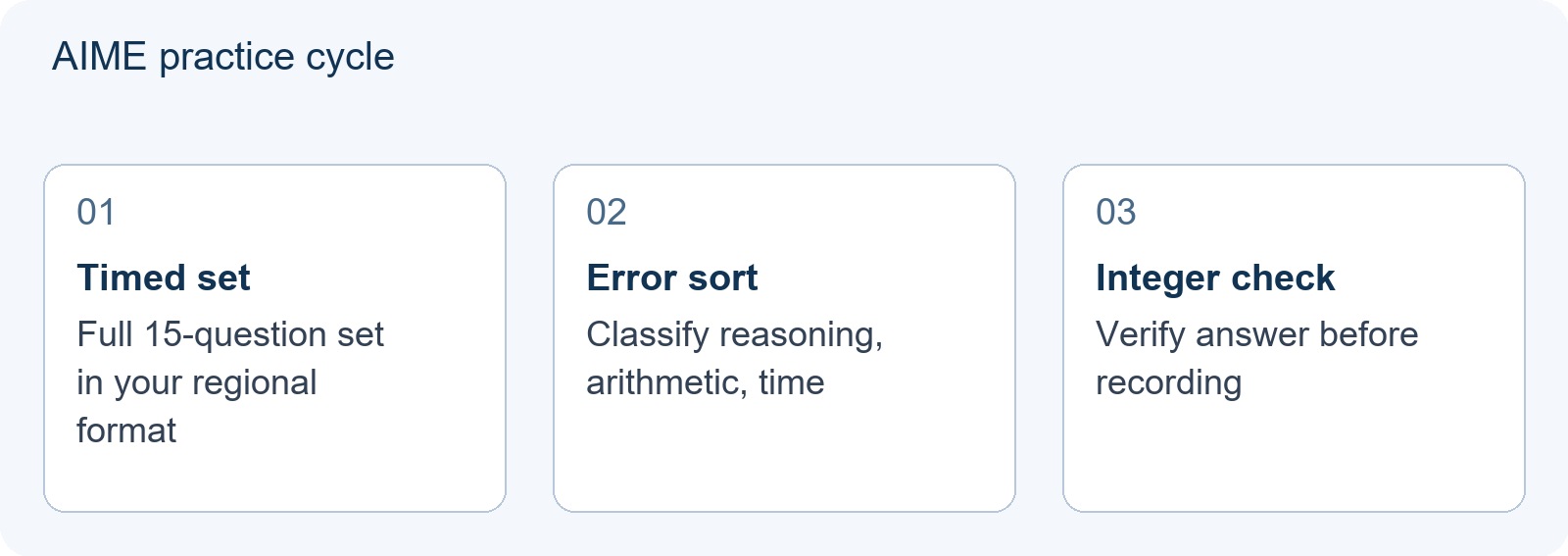
A practical weekly cycle has three parts. First, a timed AIME set using the student's actual regional format: 180 continuous minutes in China, or the two-segment 8 + 7 structure for US/Canada candidates. Second, an error sort into three boxes: reasoning gap, arithmetic or sign slip, and time or decision error. Third, an integer-answer verification pass in which the student checks the answer against the original conditions rather than only against the last line of algebra.
Teaching illustration only: suppose a practice equation produces candidates 12 and -3. The negative value cannot be the recorded integer answer, so the student must decide whether it is an extraneous root, a domain restriction, or a sign error in the derivation. The lesson is not the particular equation; it is the habit of verifying before recording. AIME preparation should build that habit under time pressure, because the 2027 selection logic rewards the student who can produce a correct integer answer repeatedly, not the student who merely recognises a familiar AMC shortcut.
Single-opportunity planning, without inventing a cutoff
The move to one AIME opportunity changes risk management. A student cannot assume that a bad first attempt will be followed by a second AIME I/II sitting. That makes full-run pacing, scratch-work discipline and recovery after a difficult problem more important. For US/Canada candidates, the two 90-minute segments also mean that segment-one choices cannot be revisited in segment two; students should practise that constraint rather than assuming a single continuous paper. For China candidates, the 180-minute continuous session allows self-directed time allocation, but it also removes the external break that might otherwise reset concentration.
What this article does not do is publish an unofficial USAMO/USAJMO cutoff formula. The verified 2027 rule says selection is based primarily on AIME scores and that AMC scores no longer count. It does not follow that every AIME score above some invented number guarantees selection, and it does not follow that every AIME score below some invented number eliminates a student. Families should reject any table that presents such numbers as official without a current MAA source. The safe planning conclusion is narrower: AMC gets the student to AIME; AIME performance is the primary selection input to prepare for.
How to prepare for a course-fit or resource review
A useful preparation conversation should start with evidence, not a sales promise. Bring a recent timed AIME set completed under the correct regional format, a short error log that separates reasoning from arithmetic and pacing, the student's current AMC threshold status, and a clear target: qualification, a stronger AIME score band, or USAMO/USAJMO selection preparation. Ask whether the review distinguishes those goals, because a student still chasing AMC 10 100 or AMC 12 85 needs different work from a qualified student who is already training for a single AIME sitting.
Ask also how integer-answer verification and full-paper pacing will be reviewed, and whether the plan uses the student's actual format rather than a generic 15-question set. A good review should be able to explain why a particular drill is assigned and what error pattern it addresses. It should not promise a selection outcome, invent a cutoff, or treat a high AMC score as a reserve that can be spent in the AIME index. The qualification and format articles linked above answer different questions; this article is specifically about the 2027 selection shift after AIME qualification.
General event background is available at Event background.
Frequently Asked Questions
Does a high AMC score still help with USAMO/USAJMO selection in 2027?
A high AMC score can still help a student meet the fixed AIME qualification threshold: AMC 10 at least 100 or AMC 12 at least 85. It does not contribute to the USAMO/USAJMO selection index described for 2027, because AMC scores no longer count and the AMC + 20 x AIME index is retired. Selection is based primarily on AIME scores.
Does AIME qualification alone imply USAMO/USAJMO eligibility?
No. AIME qualification is a separate step from USAMO/USAJMO selection. A student must qualify for AIME, but selection is based primarily on AIME performance under the 2027 rule. This article does not publish an unofficial USAMO/USAJMO cutoff or imply that any particular AIME score guarantees selection.
How should China and US/Canada candidates prepare differently for the 2027 AIME?
Both should prepare for stable AIME accuracy under a single opportunity, but the sitting format differs. Hanlin's 10 October 2026 report says China retains a 180-minute continuous session, while US/Canada candidates use two 90-minute segments of 8 and 7 questions. International entrants should follow their International Group Leader, and the Pearson process should not be applied to China.