
For students preparing for the 2027 AIME, AIME floor function bounds are a practical way to turn a discontinuous floor expression into a solvable inequality. The concise answer is: isolate the floor term, convert it using the definition k ≤ argument < k + 1, solve the resulting compound inequality, then apply the problem’s domain and integer restrictions. The official 0–999 AIME answer rule applies to the final submitted answer only, not automatically to every variable or intermediate value.
According to the MAA Invitational Competitions page checked on October 26, 2026, the 2027 AIME uses integer answers from 0 to 999. That is an answer-format constraint. It does not mean that x, an inner expression, or an intermediate count must lie between 0 and 999. A problem can involve negative values, large intermediate bounds, or non-integer variables while still producing a final answer inside the official range.
The examples below are teaching illustrations, not actual contest problems or official scoring guidance.
The Core Definition: Floor as a Compound Inequality
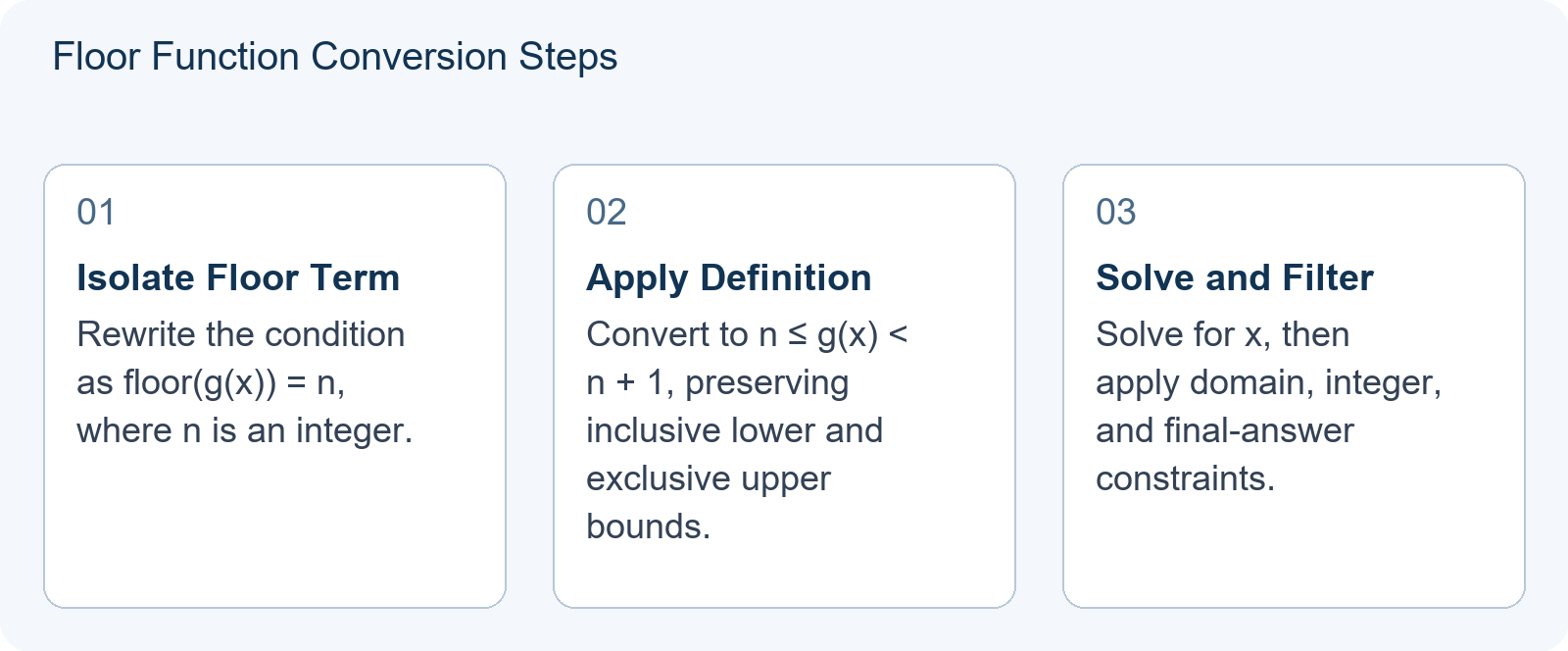
The entire technique rests on one definition. If n is an integer and floor(x) = n, then:
- n ≤ x < n + 1
This conversion is the bridge from floor notation to ordinary algebra. It works because the floor function returns the greatest integer less than or equal to the input. The lower endpoint is included, while the upper endpoint is excluded.
For an equation such as floor(2x − 1) = 5, do not guess values. Write the compound inequality:
- 5 ≤ 2x − 1 < 6
Add 1 to all three parts:
- 6 ≤ 2x < 7
Divide by 2:
- 3 ≤ x < 3.5
If the problem says x is an integer, then x = 3 is the only solution. If the problem asks for real x, the full interval [3, 3.5) is valid. The distinction matters, and the algebra itself gives the correct range.
Teaching Illustration 1: Counting Integer Solutions
Suppose a teaching exercise asks for the number of integer solutions to floor(x² / 10) = 3. This is not a past AIME problem; it is a skill drill.
Apply the definition directly to the inner expression x² / 10:
- 3 ≤ x² / 10 < 4
Multiply by 10, which is positive, so the inequality signs do not change:
- 30 ≤ x² < 40
Now identify integers whose squares lie in [30, 40). Check nearby perfect squares:
- 5² = 25, too small
- 6² = 36, valid because 30 ≤ 36 < 40
- 7² = 49, too large
Because x can be negative, both x = 6 and x = −6 satisfy the condition. The number of integer solutions is 2. This example shows why bounding the inner expression is safer than trying to manipulate the floor symbol as if it were a multiplier.
Handling Strict Versus Non-Strict Boundaries
The most common error in floor-function inequalities is mishandling the boundary. For floor(x) = n, the lower bound is inclusive and the upper bound is exclusive. A small table helps prevent slips:
| Condition | Integer meaning | Variable range |
|---|---|---|
| floor(x) = n | floor value is exactly n | n ≤ x < n + 1 |
| floor(x) > n | floor value is at least n + 1 | x ≥ n + 1 |
| floor(x) < n | floor value is at most n − 1 | x < n |
For example, floor(x) > 2 does not mean x > 2. It means the floor value is at least 3, so x ≥ 3. Similarly, floor(x) < 2 means the floor value is at most 1, so x < 2. Students often lose points by writing x ≥ 2 or x ≤ 1 in these cases.
Complex Arguments: Square Roots and Powers
When the argument inside the floor function is more complicated, the strategy stays the same: isolate the floor term and bound the argument. Domain restrictions become especially important.
Teaching illustration: solve for integer x in floor(√x) = 4. This is not a contest problem; it is a boundary drill.
By definition:
- 4 ≤ √x < 5
Since all parts are non-negative, square all three parts:
- 16 ≤ x < 25
The integer solutions are 16, 17, …, 24. There are 24 − 16 + 1 = 9 solutions. The value x = 25 is excluded because √25 = 5, and floor(5) = 5, not 4. Checking the upper boundary is essential.
AIME Final-Answer Constraint Without Over-Bounding Variables
The 2027 AIME final answer must be an integer from 0 to 999. That rule does not restrict the variables in the mathematical model. For example, x may be negative, the inner expression may be large, or a count may temporarily exceed 999. What matters is the quantity the problem asks you to submit.
If a problem asks for the sum of all valid integer solutions, then that sum is the final answer and must fit the 0–999 format. If the problem asks for a count, then the count is the final answer. Do not clip intermediate intervals at 999 unless the problem itself imposes that restriction.
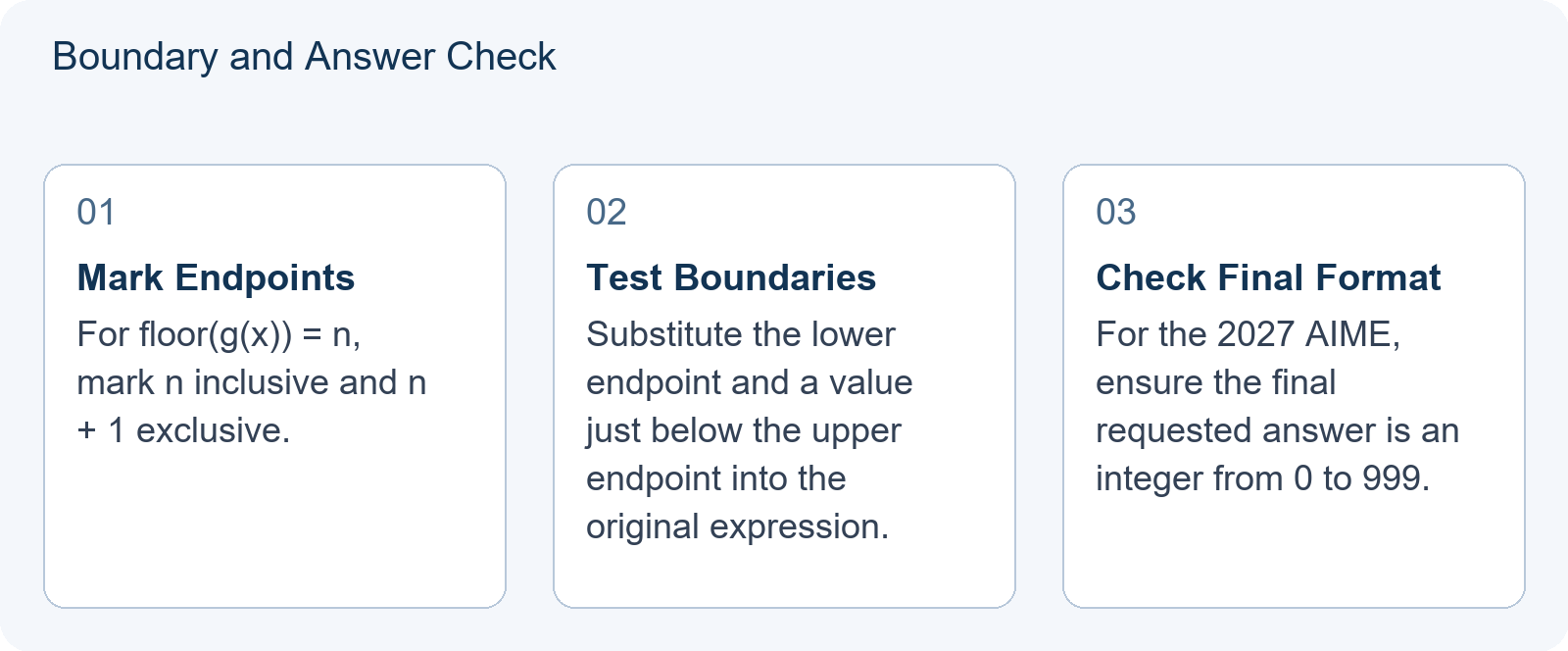
2026 Hanlin coaching notes titled Important Notice: Domestic AIME Math Exam Schedule Confirmed! advise a final integer-property, range, and substitution check to reduce calculation errors. A practical way to apply that advice is: after deriving a range such as 16 ≤ x < 25, substitute the lower endpoint and a value just below the upper endpoint into the original floor expression. Confirm that the floor value matches the target.
Diagnostic Strategy: Real Solutions Versus Integer Solutions
Before solving, clarify what the problem asks for:
- Real solutions: express the answer as an interval, such as [3, 3.5).
- Integer solutions: list the specific integer values or count them.
- Count of integers: compute the number of integers in the interval, adjusting for inclusive and exclusive endpoints.
For instance, if a teaching exercise asks for the number of real numbers x satisfying floor(x) = 5, the answer is infinite because the interval is [5, 6). If it asks for integers, the answer is 1. Misreading the requested type of solution produces a wrong answer even when the algebra is correct.
Common Pitfalls and Verification
Three major pitfalls occur in floor-function problems:
- Ignoring the exclusive upper bound: treating floor(x) = n as x ≤ n + 1 instead of x < n + 1.
- Misrounding negative numbers: remember that floor(−2.5) = −3, not −2. The floor function rounds down, not toward zero.
- Forgetting domain restrictions: if the argument contains a square root or a denominator, the valid domain must be applied before counting solutions.
To verify, pick test points inside the derived interval. If you found 3 ≤ x < 3.5, test x = 3 and x = 3.4. Both should satisfy the original equation. Test x = 3.5; it should fail because floor(2·3.5 − 1) = floor(6) = 6, not 5. This substitution check aligns with the method discussed in AIME Answer Checking: Catching Extraneous Roots Before Recording an Integer.
Integrating Floor-Function Skills With AIME Preparation
Floor-function inequalities are part of the broader algebra toolkit needed for AIME. They reward precision with inequalities, integer awareness, and boundary checking. Students who practice the conversion n ≤ argument < n + 1 build habits that also help in piecewise functions, modular arithmetic, and counting problems.
For a wider view of qualification, scoring, and preparation, see the AIME Math Competition Guide: Qualification Rules, Scoring Changes & Prep Strategies. For another algebra skill, see AIME Vieta's Formulas: Find Symmetric Expressions Without Solving Every Root.
Diagnostic Drill: The Ceiling Function Trap
While the previous sections focused on the floor function, a common source of error in AIME preparation is confusing floor with ceiling. The ceiling function, denoted ⌈x⌉, returns the least integer greater than or equal to x. This distinction changes the inequality structure entirely. If ⌈x⌉ = n, then n − 1 < x ≤ n. Note that the lower bound is exclusive and the upper bound is inclusive—the exact opposite of the floor definition.
Teaching Illustration: Consider the equation ⌈2x + 1⌉ = 7 for real x. Applying the ceiling definition:
- 6 < 2x + 1 ≤ 7
Subtract 1 from all parts:
- 5 < 2x ≤ 6
Divide by 2:
- 2.5 < x ≤ 3
The solution interval is (2.5, 3]. If the problem asked for integer solutions, only x = 3 would qualify. Testing boundaries is critical here. If x = 2.5, then 2(2.5) + 1 = 6, and ⌈6⌉ = 6, not 7. Thus, 2.5 is excluded. If x = 3, then 2(3) + 1 = 7, and ⌈7⌉ = 7. Thus, 3 is included. Students often mistakenly write [2.5, 3] or (2.5, 3), leading to incorrect counts or intervals.
Next Practice Task: To solidify this skill, solve for the number of integer values of k such that ⌈k/4⌉ = 5. Apply the definition: 4 < k/4 ≤ 5. Multiply by 4: 16 < k ≤ 20. The integers are 17, 18, 19, 20. There are 4 solutions. Verify by substitution: ⌈16/4⌉ = ⌈4⌉ = 4 (fail); ⌈17/4⌉ = ⌈4.25⌉ = 5 (pass); ⌈20/4⌉ = ⌈5⌉ = 5 (pass); ⌈21/4⌉ = ⌈5.25⌉ = 6 (fail). This drill reinforces the importance of checking both endpoints against the specific function definition.
Frequently Asked Questions
Can I graph floor function inequalities?
Yes. Plotting y = floor(g(x)) helps visualize step boundaries. Identify horizontal segments at integer heights and note open or closed circles at endpoints to determine valid x-ranges.
Does the 0–999 rule apply to intermediate variables?
No. The 0–999 constraint applies only to the final answer submitted for the 2027 AIME. Intermediate variables and expressions can be negative, large, or non-integer if the problem’s logic allows them.
How do I handle negative numbers in floor functions?
Remember that floor rounds down to the next lower integer. For example, floor(−2.5) is −3, not −2. Always check the direction of rounding when working with negative arguments.