
For students preparing for the American Invitational Mathematics Examination (AIME), algebraic fluency is not merely about the ability to solve equations. It is fundamentally about recognizing structure. A common trap in polynomial problems is the instinct to find every individual root explicitly. In many AIME-style questions, the roots are irrational, complex, or simply too cumbersome to calculate by hand. Attempting to do so wastes precious minutes and introduces significant risk of arithmetic error. The efficient path often lies in AIME Vieta's Formulas, which connect polynomial coefficients directly to symmetric expressions such as sums of squares, reciprocal sums, and sums of cubes.
The AIME consists of 15 questions where answers must be integers between 0 and 999 inclusive. This strict answer format rewards clean symbolic work. If a problem asks for a symmetric function of roots, you should almost never solve for the roots first. Instead, you must translate the question into the language of coefficients. This article explores how to manipulate these symmetric expressions using only the sums and products derived from Vieta's formulas, emphasizing the efficiency crucial for the AIME's tight time limits.
The Core Principle: Coefficients Encode Root Relationships
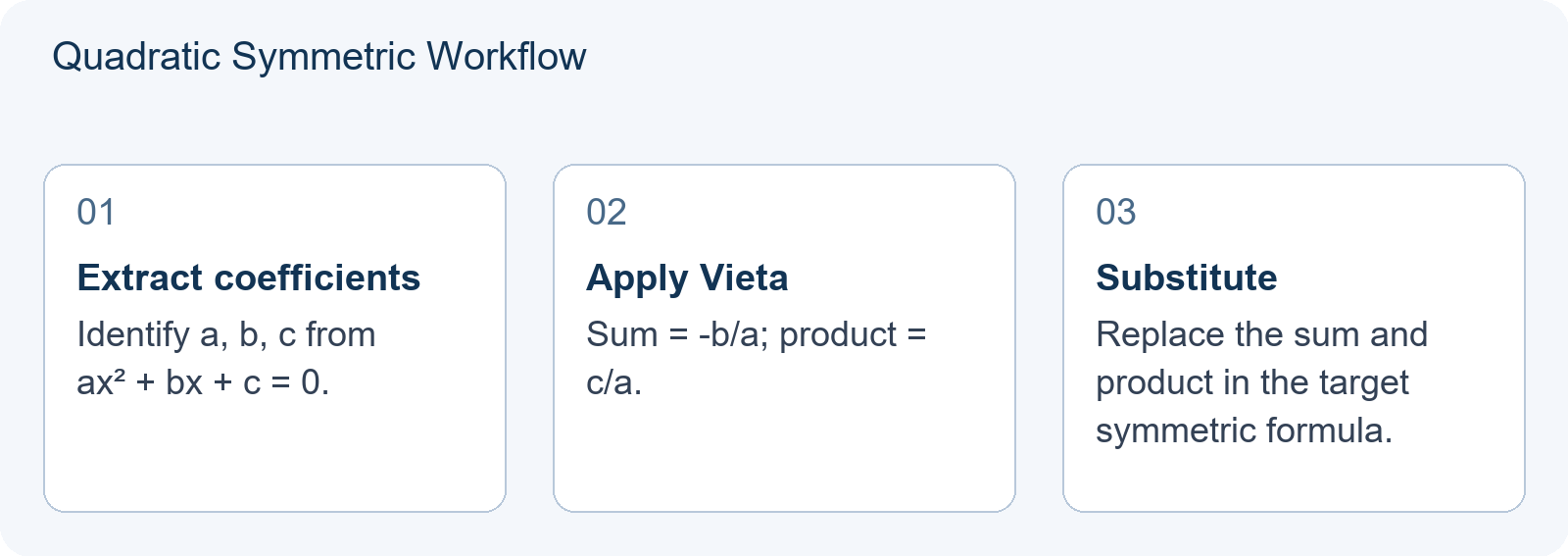
Vieta's formulas establish a direct link between the coefficients of a polynomial and the elementary symmetric sums of its roots. For a quadratic equation with roots and , the relationships are:
For a cubic equation with roots , the pattern extends to three elementary symmetric polynomials:
For a general polynomial , the sum of the roots is , and the product of the roots is . These identities hold whether the roots are real or complex. That universality is exactly why they are useful in AIME preparation: a polynomial may not factor over the integers, but its coefficients still encode the symmetric information you need. Understanding this distinction allows you to bypass the messy radical calculations entirely.
Identifying Symmetric Expressions
An expression is symmetric if swapping any two roots does not change its value. Examples include , , and . Because these expressions depend only on elementary symmetric sums, they can be rewritten in terms of coefficients. This is the key insight: if the target quantity is symmetric, it is determined solely by the coefficients.
By contrast, an expression such as is not symmetric. Swapping and changes the sign of the result. Vieta's formulas alone cannot determine the value of non-symmetric quantities without additional information, such as the discriminant or specific ordering constraints. This distinction matters significantly in test-taking strategy: if a problem asks for a non-symmetric quantity, you may need a different tool like the quadratic formula or geometric interpretation. If it asks for a symmetric quantity, Vieta's formulas should be your immediate first check.
Technique 1: Squaring the Sum
A productive application in AIME algebra is finding the sum of squared roots. Students often solve for and individually, then square them. This is inefficient. Instead, expand the square of the sum:
Rearranging gives the identity:
Teaching illustration, not an official contest problem: For the quadratic , Vieta gives and . Therefore . The roots are , which are irrational, but you never need to write them. The coefficient calculation is immediate and exact.
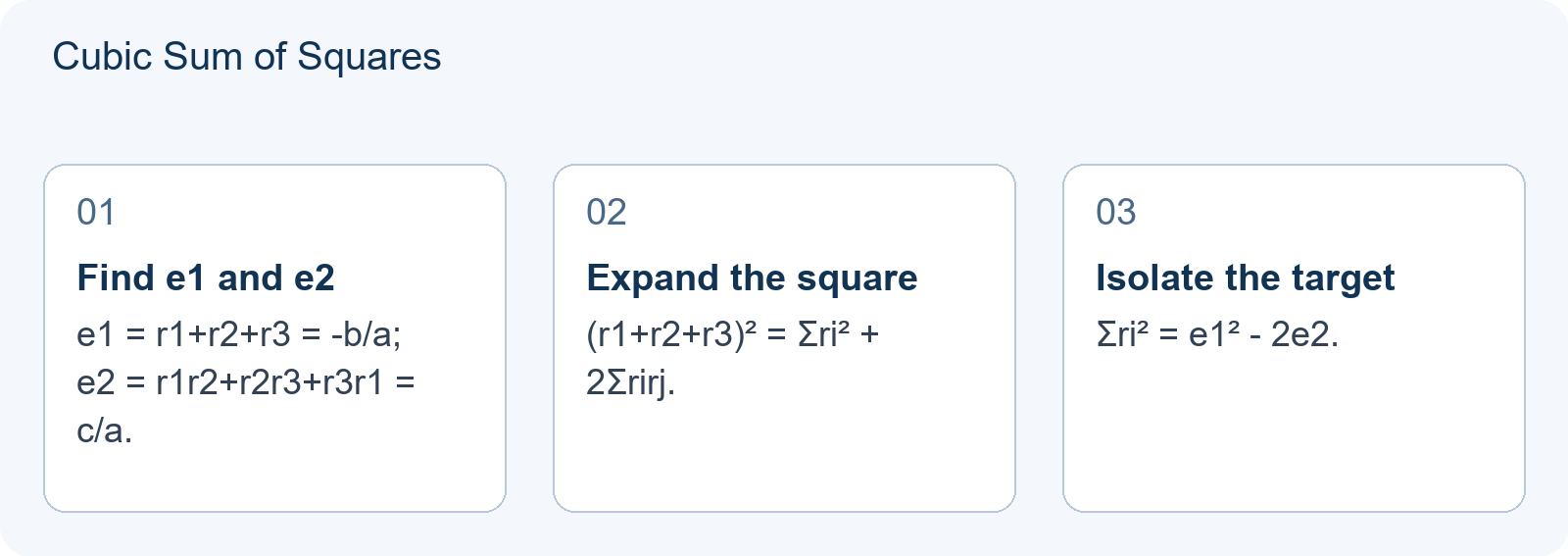
For three roots, the same idea becomes:
In terms of elementary symmetric polynomials, this is . This is a useful Vieta identity for AIME algebra problems because it converts a root question into two simple coefficient lookups.
Technique 2: Reciprocal Sums
Problems asking for require combining fractions. The common denominator is the product of the roots:
For a cubic, two related identities are particularly useful:
These are especially useful when the roots are messy but the elementary symmetric sums are simple integers. A reciprocal sum may be a fraction as an intermediate value. That is acceptable. The final AIME answer must be an integer from 0 to 999, but the symmetric expression inside a problem can be fractional before a later step combines it with other terms.
Technique 3: Sum of Cubes and Newton's Sums
For two roots, the sum of cubes follows from the identity:
For three roots, the corresponding identity is:
While memorizing these specific expansions is helpful, a more powerful general tool is Newton's Sums. Let . For a monic polynomial , the recurrence relation for is:
For :
This systematic approach allows you to compute etc., without memorizing complex multinomial expansions. A useful preparation benchmark is to know the pattern up to ; the recursive structure then extends to higher powers if a problem requires it.
Worked Example: Cubic Sum of Squares
Teaching illustration, not an official contest problem: Suppose the roots of are . Find .
Step 1: Identify coefficients. Here , , , .
Step 2: Apply Vieta's formulas to find elementary symmetric sums.
Step 3: Use the square-of-sum identity.
The answer is 4, which is an integer in the AIME answer range. You can verify this by factoring: , so is a factor. Division gives , whose roots are and . Their squares are and . The total sum of squares is . The coefficient method avoids all complex arithmetic.
Avoiding the 'Solve First' Trap
The primary advantage of mastering AIME Vieta's Formulas is time management. AIME problems often reward the shortest valid path, not the most explicit one. Spending several minutes calculating irrational or complex roots when a short substitution exists is a strategic error. Manual root calculation also increases the risk of sign errors, especially with negative coefficients or when dealing with conjugate pairs.
Before solving, ask: is the requested quantity symmetric in the roots? If yes, write it in terms of the sum and product. If the polynomial is cubic, write it in terms of the sum, pairwise sum, and product. If the expression is not symmetric, Vieta may still help as one part of a larger solution, but it will not determine the value alone. Recognizing this symmetry instantly saves cognitive load.
Final Check: Integer Constraints and Sign Errors
After deriving a symmetric expression, verify that the final requested result fits the AIME answer format: an integer from 0 to 999. If your calculation yields a fraction or a non-integer, re-examine the problem statement and your Vieta signs. Did you miss a leading coefficient? Did you forget the alternating sign in the product term?
Common errors include forgetting the negative sign in , misidentifying the constant term in a cubic, and mixing up the product formula for even and odd degree. For a quadratic , the product is . For a cubic , the product is . The alternating sign is not optional. Always double-check the parity of the degree when calculating the product of roots.
For a complementary check on recording integer answers and avoiding extraneous results, see the related guide on AIME Answer Checking: Catching Extraneous Roots Before Recording an Integer.
Related Coefficient Methods
Vieta's formulas are not the only coefficient-shortcut in AIME algebra. Remainder problems also often become manageable when you avoid expanding every term. If you want to strengthen the same coefficient-focused instinct, review the method in AIME Polynomial Remainders: Solving Without Expanding Every Term. Both techniques rely on treating the polynomial as a black box defined by its coefficients rather than its roots.
Integrating Algebra into Broader Preparation
Polynomial manipulation is rarely isolated. It intersects with number theory, geometry, and combinatorics. For example, integer-root questions may require checking divisors of the constant term, while symmetric sums help analyze root distributions. The practical goal is not to memorize every identity but to build a reflex: when a problem mentions roots, scan for elementary symmetric sums.
For students moving from AMC-style speed rounds into AIME-style sustained reasoning, pacing changes matter. A useful companion article is AIME Preparation After AMC: When to Switch From Speed to Sustained Reasoning. Vieta practice fits that transition because it reduces computation while increasing the amount of structure you must recognize. Similarly, understanding qualification targets helps prioritize which algebraic skills yield the highest return on investment, as discussed in AIME Qualification Targets: Build a Reliable Margin Above the AMC Cutoff.
A Short Practice Plan
To make Vieta's formulas automatic, practice with a deliberate sequence.
- Start with quadratics. For random coefficients, compute , , , and .
- Move to cubics. Compute , , , then evaluate and .
- Read past AIME polynomial problems and identify which ones ask for symmetric expressions before attempting any root calculation.
- Practice Newton's Sums for on a cubic to understand the recursive pattern.
This kind of practice is more useful than simply reading solved examples. The skill is recognizing the pattern under time pressure, not just agreeing with a solution after it is shown.
Final Takeaway
When an AIME polynomial problem asks for a symmetric expression of roots, do not solve for the roots first. Use Vieta's formulas to translate the expression into coefficients. For quadratics, use sum and product. For cubics, use sum, pairwise sum, and product. Verify the final integer range and watch the alternating signs. With enough practice, AIME Vieta's Formulas become a fast, reliable tool rather than a formula to look up, giving you a decisive edge in both accuracy and speed.
Frequently Asked Questions
Can Vieta's formulas be used if the roots are complex?
Yes. Vieta's formulas apply to all roots of a polynomial, including complex numbers. When the coefficients are real, symmetric expressions of conjugate pairs produce real values, and the AIME integer answer format means the final expression must resolve to an integer.
What if the leading coefficient is not 1?
You can still use the general rules directly. For a quadratic, the sum is -b/a and the product is c/a. For a cubic, the product is -d/a. For a general degree-n polynomial, the product of roots is (-1)^n times the constant term divided by the leading coefficient. Do not ignore the leading coefficient.
How does this help with AIME time management?
It replaces lengthy radical or complex-root calculations with simple coefficient arithmetic. That saves time and reduces arithmetic errors, allowing you to spend more attention on harder combinatorial or geometric problems later in the exam.