
Starting with the 2026–27 competition cycle, AIME qualification no longer depends on fluctuating percentage cutoffs. The MAA has set fixed thresholds: 100 points on AMC10 and 85 points on AMC12 (MAA AIME official rules, checked October 12 2026). For students and families researching preparation strategy, this change removes uncertainty about "where the line will fall"—but it replaces that uncertainty with a different question: how much above the fixed cutoff should you aim to score in practice, so that the official result feels secure rather than lucky?
Important distinction: these are official qualification thresholds, not guarantees. Meeting the score requirement is necessary but not sufficient; eligibility also depends on age and other criteria. For US/Canada test takers at Pearson centers, students must be 13 years or older as of the 2027 AIME date, with no exceptions (MAA AIME official rules, checked October 12 2026). International participants, including China-region students, follow their regional International Group Leader policies; the age condition and other eligibility rules may differ. This article focuses on building practice margin above the cutoff score, which is separate from verifying full eligibility.
Why a "Reliable Margin" Matters More Than the Minimum
A score at or above the relevant threshold meets the score component of eligibility. However, competition conditions differ from practice. Time pressure, problem-order effects, and the occasional misread can each cost points. A practice score at the threshold leaves no numerical margin for variation on a later paper. The goal should be to reach a level where the official cutoff feels like a floor, not a ceiling.
The fixed cutoff also changes the preparation dynamic. Under the old percentage system, a student might hope for an easy test that affects the cutoff. With a fixed score, the number is known in advance, which makes preparation more transparent. Under a percentile-based system, an easier paper can raise the score needed to reach the same percentile. That is different from the fixed threshold used in this cycle. The only variable left is your own performance.
Worked Teaching Case: Building an Illustrative Training Target
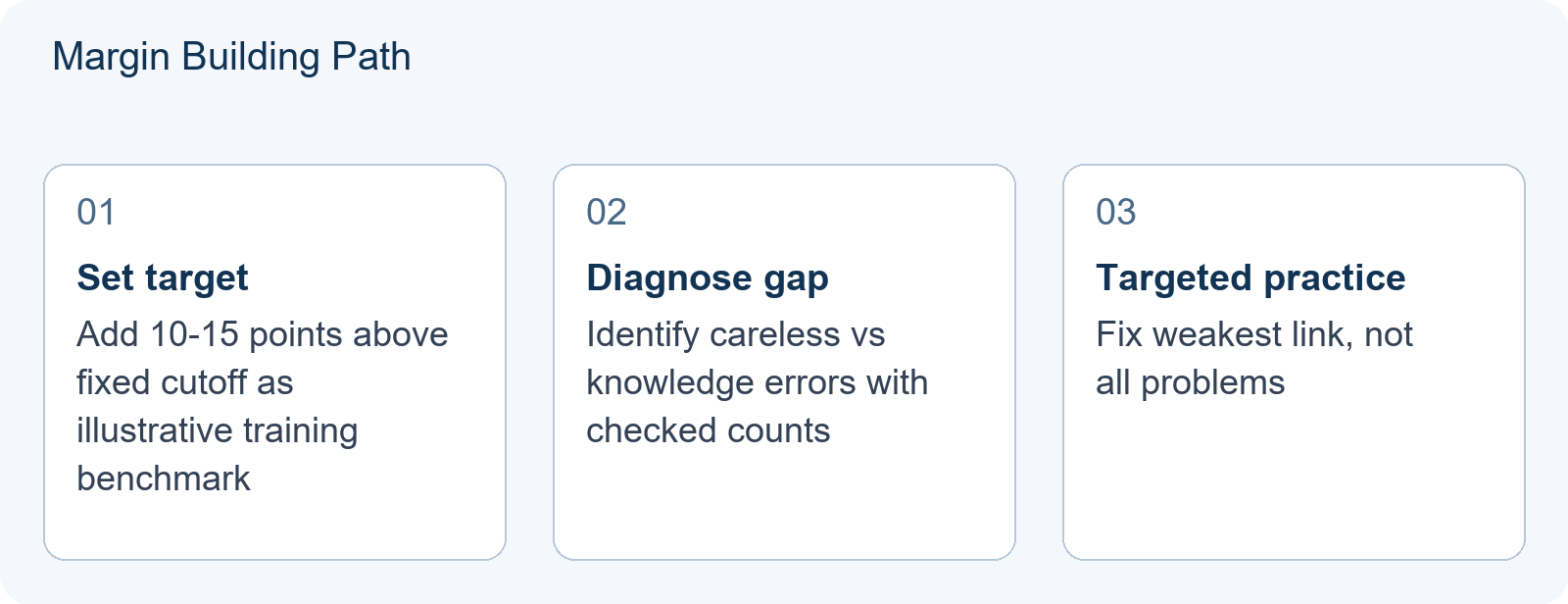
Let us examine a concrete scenario with checked arithmetic. Suppose a student is preparing for AMC10 and wants to qualify for AIME. The fixed cutoff is 100. The student sets an illustrative training target of 115 points in practice conditions—this is a personal benchmark, not an official safe margin or guarantee.
Step 1: Understand the scoring reality. AMC10 awards 6 points for a correct answer, 1.5 points for a blank, and 0 for an incorrect answer. With 25 questions in 75 minutes, the maximum is 150 points.
Step 2: Establish a baseline with verified counts. Consider a student who attempts 20 problems, leaving 5 blank, with 17 correct and 3 wrong. The score is: 17 × 6 + 5 × 1.5 + 3 × 0 = 102 + 7.5 = 109.5. This clears the 100 cutoff but illustrates how a student can be above minimum yet still short of a comfortable margin.
Step 3: Show improvement path with same attempt count. Suppose this student improves accuracy without increasing attempts: 19 correct, 1 wrong, 5 blank (still 20 attempted, 5 blank). The score becomes: 19 × 6 + 5 × 1.5 + 1 × 0 = 114 + 7.5 = 121.5. The gain is 121.5 − 109.5 = 12 points—from fixing just two errors. The problem counts verify: 19 + 1 + 5 = 25.
This case illustrates a general principle: for students near the cutoff, accuracy on accessible problems often yields more margin than attempts at harder problems.
Contrasting Case: Where Chasing Hard Problems Fails
Consider a different student with the same 115 illustrative target but a different profile: strong theoretical knowledge but slow execution. This student can solve problems 20–25 correctly when given unlimited time but rushes through early problems.
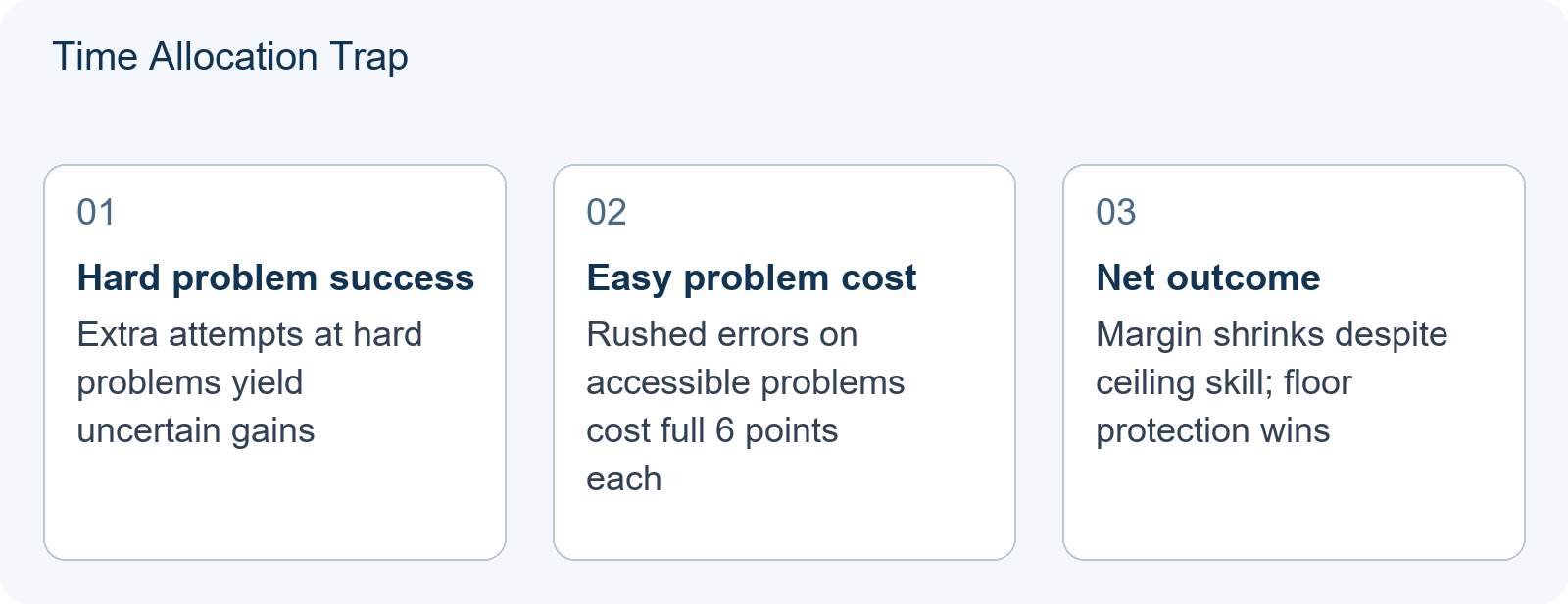
In practice, this student attempts 22 problems: 17 correct, 5 wrong, 3 blank. Using the checked calculation: 17 × 6 + 3 × 1.5 + 5 × 0 = 102 + 4.5 = 106.5 (not 105 as rough estimation might suggest). This clears the cutoff with only 6.5 points of margin—insufficient comfort for test-day variation.
The superficially similar approach of "attempt many problems" fails here because the student's time allocation is inverted. The two additional attempts beyond our first case came at the cost of two more errors. If those two problems had been left blank instead, the student would have earned 2 × 1.5 = 3 points; by getting them wrong, they earned 0. The hard-problem success did not compensate for this loss.
This contrast highlights that margin-building is not primarily about ceiling performance. It is about floor protection: ensuring that the problems you know how to do become points you actually earn.
Diagnostic: Where Is Your Margin Right Now?
To apply this framework, use a recent timed AMC practice test under realistic conditions. Record:
- Problems correct, blank, and incorrect
- Which problems were "careless errors" versus "did not know how to solve"
- Time spent on each problem (estimate if not tracked)
Calculate your score and categorize your errors. Then ask:
If I eliminated all careless errors while keeping everything else constant, what would my score be? This is your "clean execution" ceiling. If this exceeds your illustrative target (e.g., 115 for AMC10), your priority is process discipline, not new content.
If I had unlimited time, what would my score be? This measures knowledge versus execution. A large gap between unlimited-time and actual score indicates speed or time-management issues. A small gap indicates knowledge gaps.
How many problems did I attempt in the first 30 minutes versus the final 45? Front-loading attempts often leads to rushed errors. A more even pace, with time reserved for checking, typically improves accuracy.
Complete answers to these three questions give you a specific preparation direction. Generic advice like "do more practice tests" is less useful than targeted work on your identified gap.
What the Diagnostic Means for Next Steps
Suppose your diagnostic reveals a gap between your clean-execution ceiling and your illustrative target. The specific feedback that addresses this depends on the error pattern:
Pattern: Careless errors concentrated in problems 1–15. Feedback needed: structured checking protocol, not harder problems. One approach is the "two-pass" method: first pass completes problems with confidence; second pass reviews flagged items. Another is explicit estimation—does the answer make sense?—before finalizing.
Pattern: Time runs out with unattempted problems you could solve. Feedback needed: timed practice with strict problem-allocation budgets. For AMC10, a rough guide is 2 minutes per problem for 1–10, 3 minutes for 11–20, and remaining time for 21–25. Adjust based on your personal speed.
Pattern: Knowledge gaps in specific content areas. Feedback needed: targeted topic review, not more full tests. Common AMC10/12 topics include counting and probability, number theory, and geometric configurations. Identifying which topics cost you points allows efficient study.
Use the final practice period to address the errors your own records reveal. Students who have built reliable margin through consistent practice perform more predictably than those who peak on occasional strong showings.
China-Specific Preparation Context
For students in China, the 2026–27 season has additional considerations. The AMC10/12 A and B exams remain available, with dates of November 6 and November 14, 2026; Hanlin's October 24, 2026 report gives the B registration deadline as November 3. China-region students take the exam offline at authorized test centers, not online. The AIME itself, if qualified, is also administered offline in China with a continuous 180-minute format—unlike the US/Canada split-session structure (Hanlin operator report, October 10, 2026).
This matters for margin-building because the test-day environment differs. Students should practice under conditions that match their actual administration: paper test, continuous time, and the specific materials allowed. The US/Canada AIME format of split 90-minute sessions with no return to earlier problems does not apply to China-region test takers, so preparation should not emphasize that constraint.
Students in China register through the International Group Leader system; MAA lists distinct public-school and private-school IGLs for China (MAA International 2026–27 participation). The private-school listing connects to ASDAN China. This registration pathway is separate from US/Canada direct registration and should be planned in advance.
Connecting to Broader Preparation Resources
For students seeking to understand the full progression from AMC to AIME and beyond, several related articles provide complementary coverage. The AMC10 to AIME Qualification Guide: Cutoff Scores, Exam Dates & Prep Strategies offers overview information on cutoff scores, exam dates, and general preparation strategies. For students earlier in their competition journey, the From AMC8 to AIME: The Ultimate Math Competition Progression Path describes how foundational competition experience builds toward qualification. Those interested in how AIME performance specifically influences advanced opportunities can consult AIME Competition Score Weight Adjustment: How to Prepare for 2026.
These resources address adjacent questions; this article's specific contribution is the worked methodology for building and verifying a reliable margin above the fixed cutoff.
Preparing for Consultation: What to Bring
If you are considering structured preparation support, having the following information ready makes consultation more productive:
- Your most recent timed AMC practice score, with problem-level breakdown if available
- Your target competition date (A or B exam, or both)
- Your current grade level and math coursework, to assess foundational readiness
- Specific topics or problem types where you consistently lose points
This preparation allows a focused discussion about whether your gap is primarily knowledge-based, execution-based, or strategic—and what specific practice structure would address it.
Frequently Asked Questions
Is 100 on AMC10 or 85 on AMC12 enough to guarantee AIME qualification?
These are the fixed minimum qualifying scores set by MAA for the 2026-27 cycle. However, 'guarantee' depends on meeting all eligibility criteria. For US/Canada test takers, this includes a minimum age of 13; international participants follow regional IGL policies with potentially different requirements. For test-day security, you should aim to consistently score above these thresholds in practice to account for performance variation. Practice targets are illustrative benchmarks, not official safe margins.
How does the China-region AIME format differ from US/Canada?
China-region AIME remains a continuous 180-minute offline exam according to the October 10, 2026 operator report. The US/Canada format splits into two 90-minute sessions with no return to earlier problems. China students should practice continuous-time conditions, not the split-session structure. International participants follow their regional International Group Leader policies.
Should I focus on solving harder problems or reducing errors on easier ones?
For building margin above the cutoff, reducing errors on problems you already know how to solve typically yields more reliable point gains than attempting harder problems. The worked case in this article shows how improving two wrong answers to correct ones—keeping the same attempt count—gains 12 points without requiring new knowledge or additional attempts.