
The question of when to switch from speed to sustained reasoning in AIME preparation after AMC is no longer a matter of guessing cutoff percentages. For the 2027 season, the Mathematical Association of America (MAA) has established fixed qualification thresholds: a score of at least100 on AMC 10 or85 on AMC 12 meets the score requirement, provided other criteria are met. This structural change simplifies the goal but complicates the strategy. Students often ask whether they should begin AIME-specific training immediately upon hitting these scores or wait until after the November AMC exams. The answer depends less on the calendar date and more on the student's consistency in achieving these fixed benchmarks under timed conditions.
The New Fixed Thresholds and Their Strategic Implications
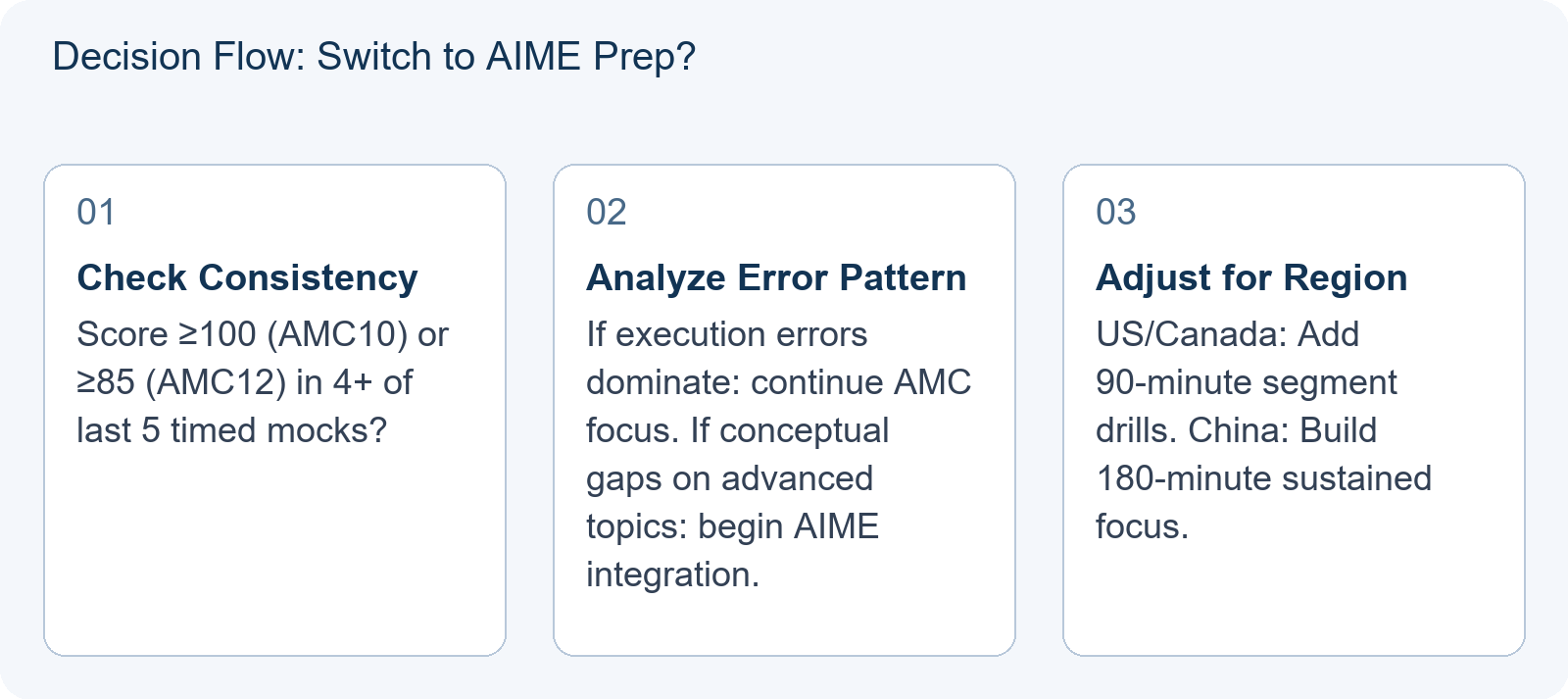
Previously, AIME qualification relied on percentile rankings, which fluctuated based on the strength of the applicant pool each year. This created uncertainty: a student might score well but fail to qualify due to high competition, or vice versa. According to MAA official rules verified in October 2026, the shift to absolute scores (100/85) removes this ambiguity. However, it introduces a new challenge: stability. A student who occasionally clears100 on AMC 10 practice tests may not consistently achieve this result under exam pressure. Analysis of preparation patterns suggests that the primary risk for students near the threshold is variance, not lack of knowledge. Therefore, the decision to switch to AIME-style sustained reasoning should be triggered by demonstrated consistency, not just a single passing score.
Distinguishing US/Canada Format Changes from China Region Rules
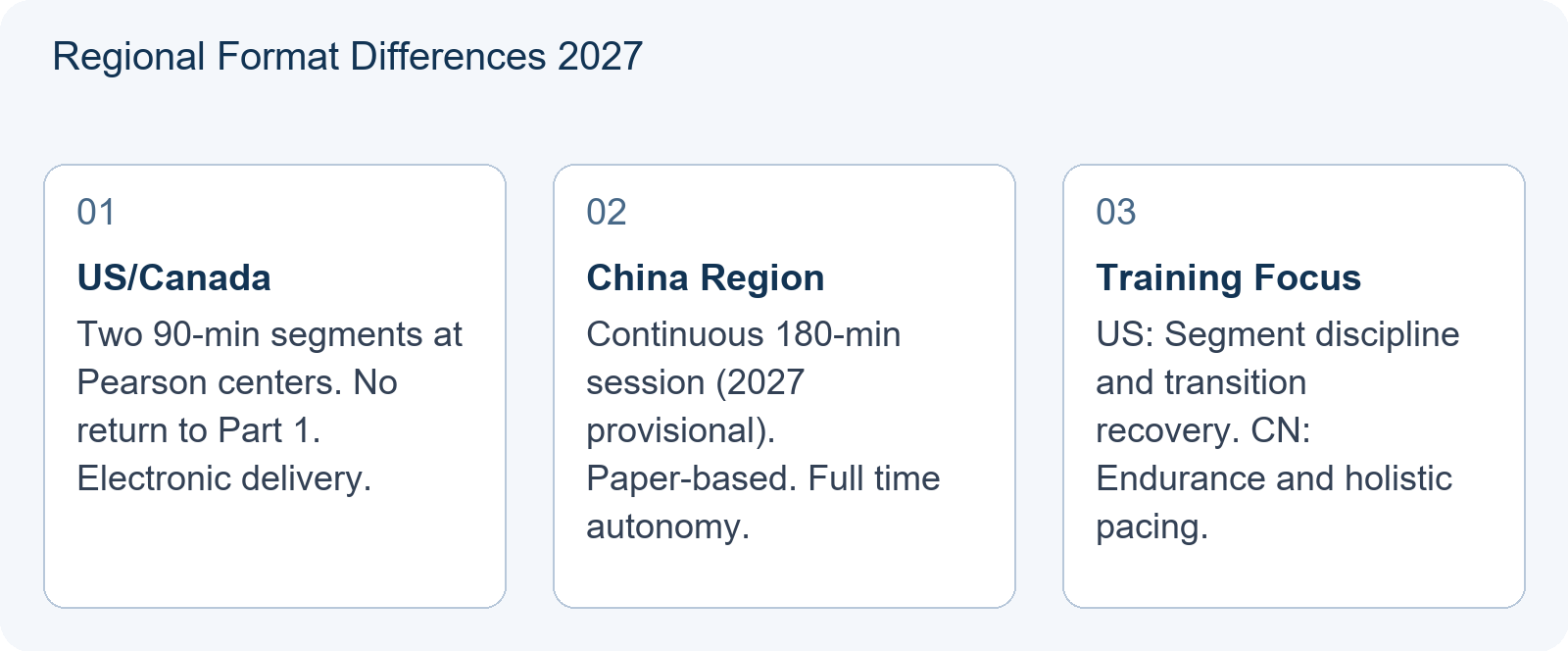
A critical distinction exists between the US/Canada and international regions regarding the 2027 AIME format. In the US and Canada, the exam will be administered electronically at Pearson Professional Centers, split into two 90-minute segments with no return to the first half. For China region participants in 2027, the format has not yet adopted the 90+90 minute structure; according to the October 10 operator report, the current arrangement follows a continuous session with full autonomy over time allocation. This difference fundamentally alters the "switch" moment. US/Canada students must train for segmented focus and strict time-boxing earlier, as the inability to revisit questions changes the cognitive load. Chinese students, however, can continue practicing holistic time management and strategic skipping, meaning their transition to deep reasoning can be more gradual, focusing on problem-solving depth rather than rigid segment adherence. Note that the China format is provisional for 2027 and subject to future policy updates.
Teaching Illustration: The Consistency Diagnostic
[Teaching illustration: invented example for pedagogical purposes]
To determine if a student is ready to switch to AIME preparation, consider this diagnostic framework. Suppose a student takes five recent AMC 10 past papers under timed conditions and scores: 96, 102, 97.5, 105, and 99. The sum is 499.5, giving a mean of 99.9. Exactly two scores meet or exceed 100 (102 and 105), while three fall below (96, 97.5, and 99). Despite averaging close to 100, this student fails three out of five attempts to reach the fixed threshold. The errors are primarily calculation slips in the middle range (questions 11-20). In this scenario, switching to AIME problems is premature. The bottleneck is not conceptual depth but execution reliability. AIME problems require sustained attention; if a student cannot maintain accuracy over 75 minutes on AMC, they will likely struggle with the endurance required for AIME. The correct next step is targeted error analysis on AMC mid-range questions, not advanced AIME topics.
Contrasting Case: When Depth Becomes the Priority
[Teaching illustration: invented example for pedagogical purposes]
Contrast this with a student whose scores are consistently 115+ on AMC 10. They have mastered speed and basic accuracy. If this student continues only doing AMC drills, they face diminishing returns. Their errors now occur on questions 21-25, which involve complex combinatorics or number theory—topics that overlap significantly with early AIME problems. Here, the switch is overdue. This student should begin integrating AIME-style problems that require multi-step logical chains. Unlike AMC, where elimination strategies often work, AIME requires deriving an integer answer from scratch. Students who delay this switch often hit a "wall" in February, realizing too late that their AMC speed does not translate to AIME derivation skills.
The Role of Endurance Training in the Transition
Sustained reasoning differs from speed solving in cognitive stamina. AMC 10/12 allows for rapid pattern recognition and heuristic shortcuts. AIME demands rigorous proof-like thinking, even though formal proofs are not written. For students preparing for the China region's current 180-minute continuous exam, building this endurance is crucial. Many students burn out mentally before the final hour. The transition phase should include "long-form" practice sessions where students solve 3-4 difficult problems without time pressure, focusing entirely on clarity of logic and checking steps. This contrasts with the US/Canada segmented model, where endurance is tested within tighter 90-minute windows. Regardless of region, the ability to hold complex variables in working memory for extended periods is the key skill developed during this switch.
Diagnostic Application: Analyzing Error Types
Families can use a simple error-type analysis to decide the timing of the switch. Categorize mistakes from recent AMC mock tests into three buckets: 1) Knowledge Gaps (didn't know the theorem), 2) Execution Errors (calculation/slip), and 3) Strategy Errors (spent too long on easy questions). If Bucket 2 dominates, stay in AMC mode. If Bucket 1 involves advanced topics like modular arithmetic or complex geometry, switch to AIME prep. If Bucket 3 is high, work on pacing. This diagnostic prevents the common mistake of jumping to hard problems while still making basic errors. It ensures that the "switch" is data-driven, aligning with the fixed threshold reality where marginal gains come from eliminating specific weaknesses.
Practical Next Steps and Regional Considerations
When consulting with educators about AIME preparation, bring concrete data. Instead of asking "Is my child good enough?", present consistency diagnostic results. Ask specifically about regional format differences: "How do we adjust our study plan for the continuous session format versus the segmented US format?" Request feedback on whether current practice materials reflect the difficulty jump from AMC Q20 to AIME Q1. Understanding that AIME answers are integers from 0-999 helps frame the need for precise calculation skills. This approach moves the conversation from vague anxiety to targeted strategy, leveraging the new fixed-score environment to create a clear roadmap for success.
For students in China, the current format preserves flexibility in time allocation, so training should emphasize sustained concentration rather than segment-specific pacing. For US/Canada students, early adaptation to the 90-minute segment boundary is essential. Both groups should note that the fixed thresholds mean qualification is now a transparent target—but reaching it consistently remains the prerequisite for productive AIME preparation.
Related reading: For a deeper look at polynomial techniques common in early AIME problems, see AIME Polynomial Remainders: Solving Without Expanding Every Term. Students transitioning from AMC should also review AMC Math Competition: A Guide to AIME Qualification and Preparation for qualification mechanics, and AIME: 7 Points is the Watershed, 10 Points is the Stepping Stone for score-targeted strategy.
Applying the Consistency Diagnostic to Real-World Preparation Timelines
The teaching illustration above demonstrates that a mean score of 99.9 on AMC 10 practice tests does not guarantee qualification, as only two out of five attempts met the fixed threshold of 100. This discrepancy highlights a critical gap in student preparation: the failure to distinguish between average performance and reliable execution under pressure. For students aiming for AIME, this distinction dictates the immediate next steps in their study plan.
[Teaching illustration: invented example for pedagogical purposes]
Consider a hypothetical student who has completed three full AMC 10 mock exams in October 2026 with scores of 96, 102, and 97.5. The sum is 295.5, yielding a mean of 98.5. Here, one score exceeds the threshold, but two fall below it. If this student begins solving AIME problems immediately, they risk reinforcing bad habits. AIME questions require multi-step derivations where a single arithmetic error invalidates the entire solution. If the student’s primary weakness is calculation slips in the mid-range (questions 11–20), attempting AIME problems will likely result in frustration rather than skill acquisition. The correct strategic move is to pause advanced topic study and focus exclusively on error analysis from these three mocks. Identify whether the losses were due to knowledge gaps or execution errors. If execution dominates, drill timed accuracy on AMC-style problems until at least four out of five consecutive attempts exceed 100.
Conversely, examine a student with scores of112.5,118.5,and115.5. The mean is115.5, and all three attempts comfortably clear the 100-point bar. This consistency indicates mastery of speed and basic accuracy. Continuing to drill AMC papers offers diminishing returns. Their errors now likely occur on questions 21–25, involving complex combinatorics or number theory—topics that overlap significantly with early AIME problems. For this student, switching to sustained reasoning is overdue. They should begin integrating AIME-style problems that require deriving an integer answer from scratch without multiple-choice elimination strategies. Delaying this switch often leads to a "wall" in February, when students realize their AMC speed does not translate to AIME derivation skills.
This diagnostic approach prevents the common mistake of jumping to hard problems while still making basic errors. It ensures that the transition to AIME preparation is data-driven, aligning with the new fixed-score environment where marginal gains come from eliminating specific weaknesses. Students near the threshold must prioritize stability over novelty. Only when consistency is demonstrated should the focus shift to depth. This methodical progression respects the cognitive demands of both competitions and maximizes the probability of qualifying for AIME in the 2027 season.
Frequently Asked Questions
Does the fixed AIME cutoff mean I can stop worrying about percentile rankings?
Yes, for qualification purposes. You only need to meet the absolute score (100 for AMC 10, 85 for AMC 12). However, strong AMC performance builds the foundational skills that translate to higher AIME scores, which are now the primary factor for USAMO/USA(J)MO selection starting in 2027. Aiming above the minimum remains advisable for skill development, not for direct selection advantage.
What is the minimum age for AIME participation in my region?
For the US/Canada region, MAA rules state that participants must be aged 13 or older for 2027. International participants follow their respective country's policies through their International Group Leader. China region participants should verify current age requirements with their local organizer, as regional policies may differ from the US/Canada standard. Do not generalize the US/Canada minimum age 13 to China.
Should I buy AIME prep books before taking the AMC exam?
It depends on your current level. If you consistently exceed the AMC qualification thresholds, starting AIME prep early is beneficial. If you are borderline, focus on mastering AMC content first to ensure qualification, then switch to AIME materials after the November exam. Coaching judgment, not rigid rules, should guide this decision.