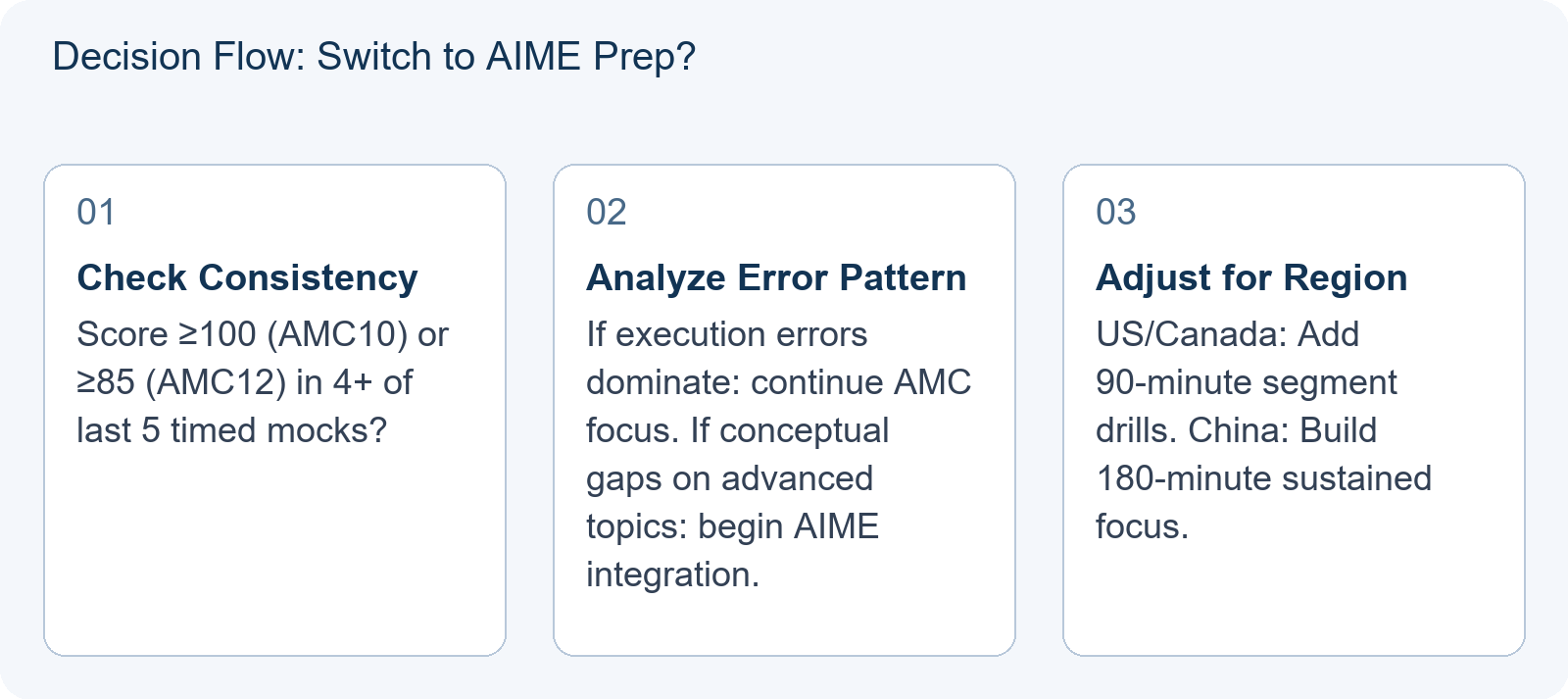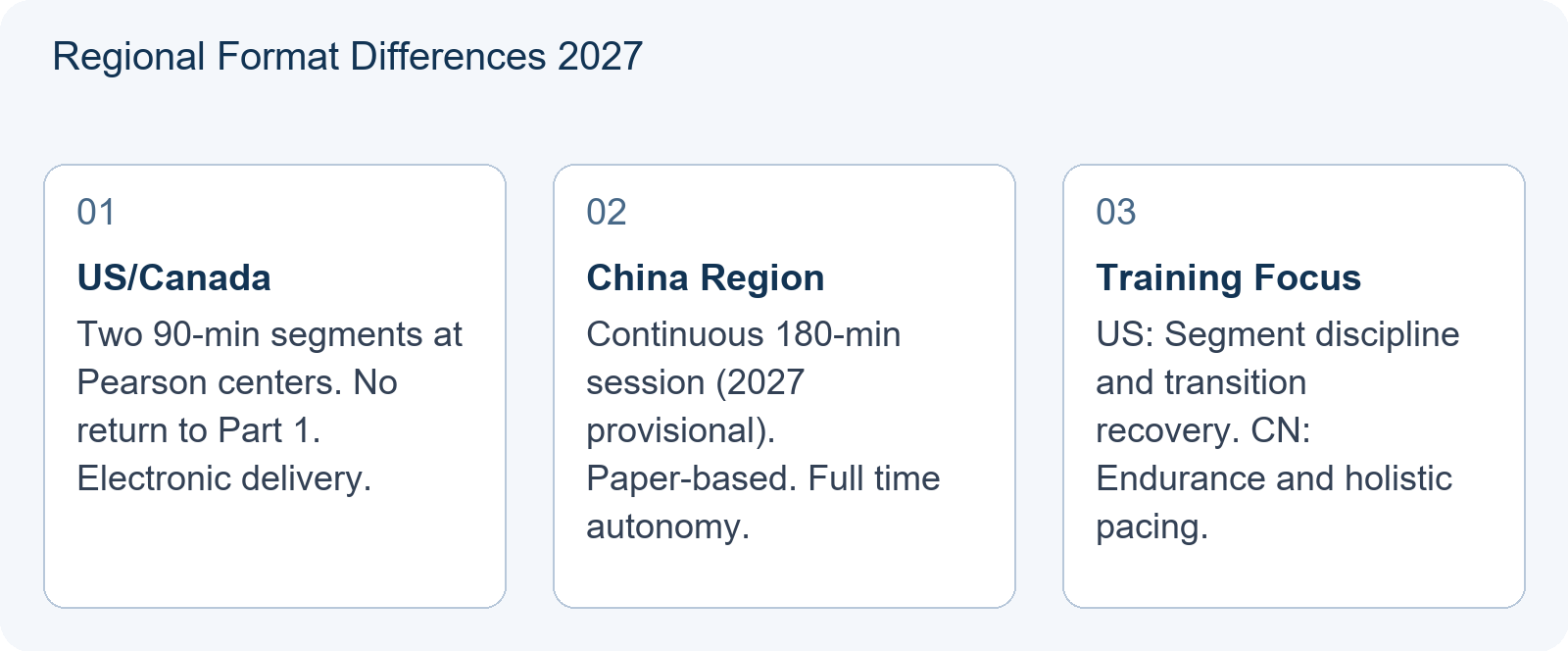
The gap between AMC success and AIME competence is not merely a matter of harder problems. It is a fundamental shift from rapid recognition to sustained written reasoning. Many students who breeze through AMC questions by pattern-matching find themselves frozen when an AIME problem demands fifteen minutes of concentrated deduction. This article offers a practical diagnostic framework to identify where your reasoning breaks down and how to rebuild it for the longer, more demanding AIME format.
Recognizing the Speed-to-Stamina Transition Point
The AMC rewards quick identification of familiar structures. Most problems are designed to be solved in under two minutes, and the highest scorers often finish with time to spare. AIME problems, by contrast, are engineered for depth. A common observation notes that AIME questions 1 through 5 roughly correspond to AMC 12 questions 15 through 18 in difficulty, yet they demand written justification rather than multiple-choice elimination. This means a student who comfortably scores 120 on the AMC may still struggle to complete five AIME problems in the allotted time.
The transition point manifests differently for each student. Some find themselves racing through the first few AIME problems only to stall on calculation-heavy steps. Others over-invest time in early problems, leaving insufficient energy for the middle tier where strategic choices matter most. The diagnostic task is to locate your personal breakpoint: the problem number at which your current habits shift from productive to counterproductive.
Teaching illustration: Consider the case of a student we will call M. After qualifying for AIME with a 112 on the AMC 10, M spent the first practice session attempting to solve problems as quickly as possible. M completed three problems in the first hour but made arithmetic errors on two of them and had no meaningful progress on problems 4 through 6. The diagnostic revealed that M's AMC-trained pace was actively harmful; the solution was not more speed but deliberate slowing and structured verification.
Building a Personal Diagnostic Protocol
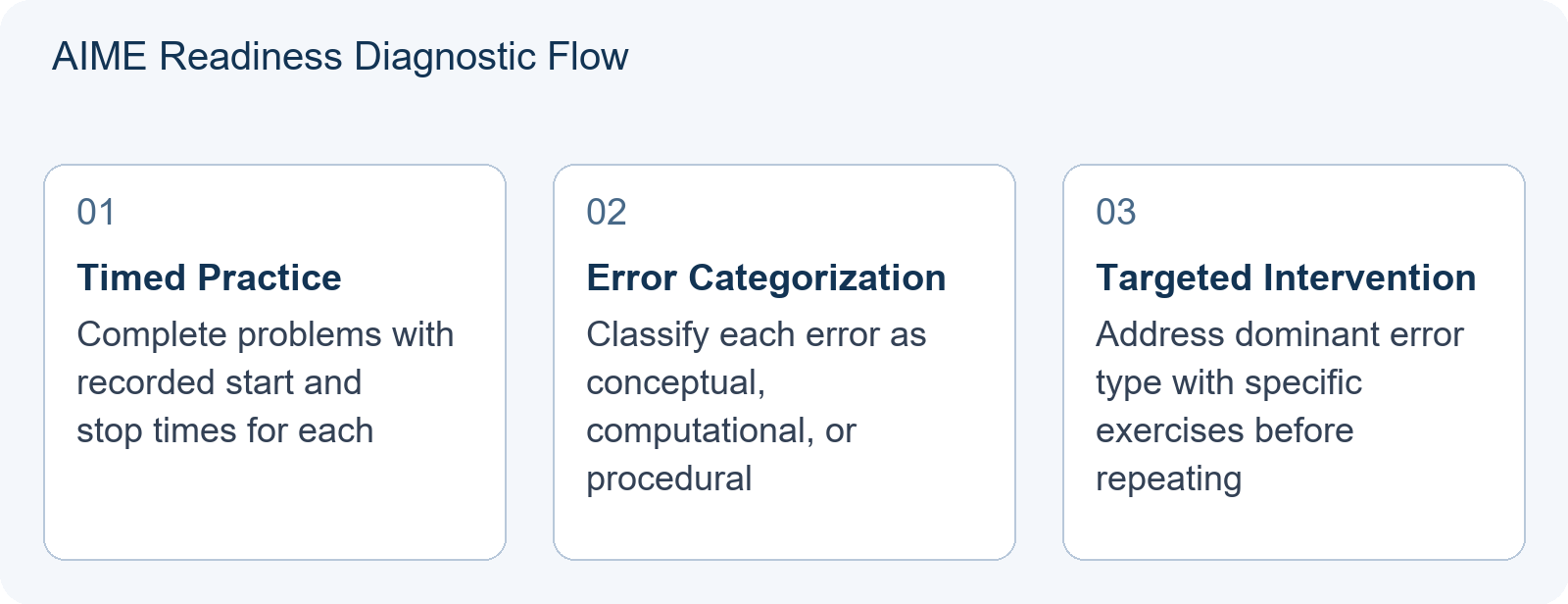
A useful AIME Readiness Diagnostic must measure more than problem count. It should capture where your time goes, where your errors cluster, and how your confidence aligns with actual performance. The protocol begins with a timed practice session using problems from past competitions, but with a twist: you must record your start and stop time for each problem, mark your confidence level before checking answers, and categorize every error as conceptual, computational, or procedural.
Conceptual errors indicate missing knowledge or misapplied theorems. Computational errors are arithmetic or algebraic slips despite correct approach. Procedural errors occur when you abandon a viable path or fail to complete a solution strategy. Over multiple sessions, patterns emerge. A student with frequent conceptual errors in number theory knows to prioritize Euler's theorem and the Chinese Remainder Theorem. One with computational errors needs verification rituals. Procedural errors suggest the need for more explicit planning before writing.
The Hanlin teaching team emphasizes that this diagnostic should be repeated every two weeks during preparation, with results tracked in a simple spreadsheet. The goal is not to maximize any single score but to watch the error distribution shift. When computational errors decline and procedural errors become the dominant category, you are approaching AIME readiness. When conceptual errors persist in specific topics, targeted study is indicated before further full-length practice.
Allocating Time With the Three-Zone Model
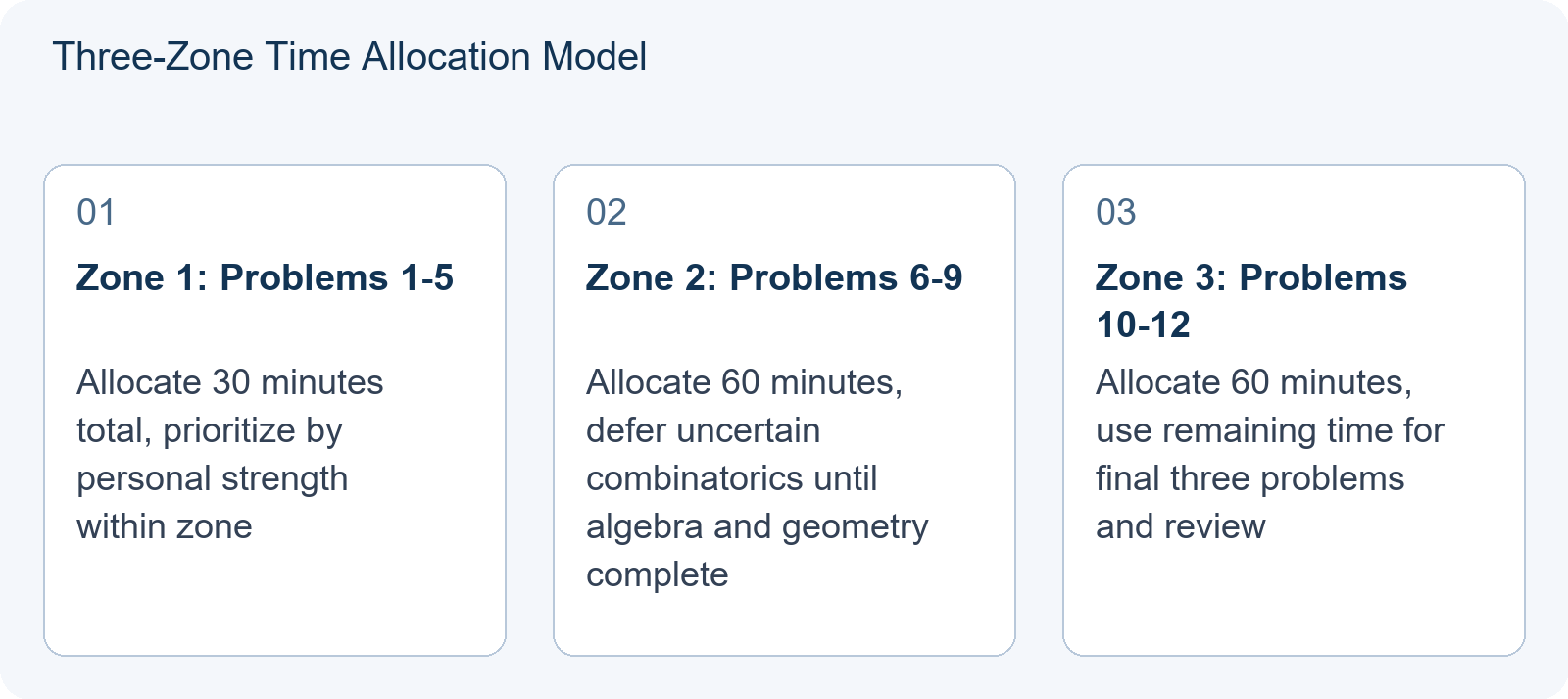
Effective AIME pacing rejects uniform time distribution. The three-zone model, derived from the Hanlin difficulty mapping, assigns 30 minutes to problems 1 through 5, 60 minutes to problems 6 through 9, and 60 minutes to problems 10 through 12, with remaining time for the final three problems and review. This reflects the empirical observation that securing eight correct answers typically requires solid execution in the first two zones rather than partial progress across all fifteen problems.
The model is prescriptive but not rigid. Within each zone, you should sequence problems by personal strength rather than numerical order. If combinatorics consistently consumes disproportionate time with uncertain outcomes, defer those problems within a zone until the algebra and geometry questions are addressed. The Hanlin analysis notes that algebra and geometry together comprise approximately ten of the 15 problems, with number theory and combinatorics splitting the remainder in various ratios.
Teaching illustration: For a hypothetical student, implementing the three-zone model meant initially skipping problem 7, a combinatorics question, in favor of problem 8, a geometry problem involving trigonometric relationships. This sequencing choice allowed the student to accumulate correct answers more efficiently and build momentum. The diagnostic insight was that time allocation had previously been dictated by problem order rather than strategic assessment of expected return on time investment.
Developing Written Reasoning Stamina
AMC preparation often emphasizes mental calculation and answer selection. AIME demands the opposite: extended written chains of reasoning without intermediate feedback. The shift is analogous to training for a sprint versus a middle-distance race. Muscles used for explosive speed must be reconditioned for sustained output, and the same applies to cognitive processes.
Building stamina requires graduated exposure. Begin with single problems that take 10 to 15 minutes, working fully through the writing process without interruption. Progress to pairs of problems in 25 minutes, then triples in 40 minutes. Only after several weeks should you attempt full 15-problem sessions. The Hanlin recommendation of daily mock examinations in the final week is effective precisely because it assumes this base has already been built; premature full-length practice risks reinforcing bad habits under fatigue.
The writing itself matters. AIME solutions are graded on correctness, not elegance, but clear organization reduces error rates. A suggested template includes: restate given conditions, identify the target quantity, note the key theorem or technique to be applied, execute calculations in sequence, and verify boundary conditions. This structure added perhaps 30 seconds per problem but dramatically reduced the rate of abandoned partial solutions and unnoticed algebraic sign errors.
Mastering the Core Algebra and Geometry Toolkit
The Hanlin analysis identifies algebra and geometry as the backbone of AIME preparation, typically accounting for ten or more problems per examination. Within algebra, particular attention should go to trigonometric identities beyond the basic set, including auxiliary angle formulas and sum-to-product transformations. These appear in symmetric triangle conditions and periodic function analysis that AMC 12 rarely explores in depth.
Geometry preparation must emphasize computational tools over classical theorem memorization. While Menelaus, Ceva, and Ptolemy have their place, a common observation is that modern AIME geometry problems are generally solvable with basic properties plus heavy application of trigonometry, coordinate geometry, and complex numbers. The critical skill is identifying which computational framework simplifies a given configuration. A hypothetical student initially attempted synthetic approaches to every geometry problem, often stalling; after diagnostic review, the student learned to assess within 60 seconds whether coordinate or trigonometric methods offered cleaner access.
For algebra specifically, Newton sum techniques and functional equations appear with modest frequency but high payoff when recognized. The preparation strategy is not to master the most general forms but to recognize the characteristic patterns: symmetric polynomial relationships, recursive coefficient structures, and substitution opportunities that reduce unfamiliar equations to standard forms.
Navigating Number Theory at the Advanced Boundary
Number theory problems on the AIME, particularly from question 11 onward, regularly invoke Euler's theorem and the Chinese Remainder Theorem in ways that AMC 10 and 12 only hint at. The diagnostic question here is whether you can state these theorems precisely, identify their preconditions, and execute the multi-step constructions they require.
Euler's theorem states that for coprime integers a and n, a raised to the power of phi(n) is congruent to 1 modulo n, where phi(n) is Euler's totient function. The AIME application typically requires computing phi(n) for composite moduli, verifying the coprimality condition, and then using the resulting exponent reduction to solve a congruence. The Chinese Remainder Theorem requires solving a system of congruences with pairwise coprime moduli by constructing a solution through linear combinations. Both theorems demand comfort with modular arithmetic manipulation that goes beyond the AMC level.
Teaching illustration: A hypothetical student's diagnostic revealed conceptual weakness in applying these theorems to composite moduli. The targeted response was a sequence of exercises: first verifying Euler's theorem for small cases, then applying it to reduce large exponents, then combining with the Chinese Remainder Theorem for problems with multiple modulus conditions. This progression, maintained over two weeks, transformed number theory from a feared category to a reliable source of points in the middle and upper zones.
Approaching Combinatorics With Recursive Structure
AIME combinatorics diverges from AMC practice primarily in its emphasis on recursive methods and advanced combinatorial identities. Vandermonde's identity and related convolution formulas appear with sufficient regularity to warrant deliberate study. The diagnostic challenge is recognizing when a counting problem admits recursive decomposition rather than direct enumeration.
The state table technique, referenced in validated materials, provides a concrete framework. Before writing a recurrence, explicitly enumerate the states that describe partial configurations, identify transitions between states, and verify boundary conditions. This discipline prevents the common error of writing recurrences that miscount initial conditions or double-count intermediate configurations. For path-counting problems on grids or graphs, the state might encode current position and a constraint history; for coloring problems, it might track the pattern of the last few elements.
Teaching illustration: A hypothetical student applied this method to a practice problem involving counting sequences with local constraints. The initial attempt used direct multiplication and yielded an incorrect answer. After constructing an explicit state table with three states representing the relevant history, the recurrence emerged cleanly, and the boundary conditions were verifiable by inspection. The diagnostic lesson was that combinatorics errors were largely procedural: rushing to algebra before establishing structural clarity.
Implementing Verification and Review Rituals
The AIME answer format, a three-digit integer from 0 to 999, offers no partial credit and no opportunity to learn from multiple-choice distractors. Verification is therefore not a luxury but a necessity. The Hanlin guidance emphasizes checking both the mathematical reasoning and the final transcription, with particular attention to extraneous roots in algebraic problems and off-by-one errors in combinatorial counting.
A practical verification ritual has three components. First, after completing a solution, pause and articulate the answer in words: what does this number represent in the problem context? This semantic check catches many computational errors. Second, verify boundary cases explicitly. If a formula was derived for general n, does it hold for the smallest stated case? Third, recompute critical steps by an alternative method. If a geometry problem was solved with coordinates, check key lengths with the law of cosines; if a recurrence was solved by characteristic equation, verify the first few terms by direct computation.
Teaching illustration: For a hypothetical student, implementing these rituals initially felt time-consuming, but the diagnostic data showed a reduction in incorrect answers from 40 percent to under 15 percent. The time invested in verification was more than recovered by eliminating the need to revisit problems during review time. In the final preparation phase, practice scores stabilized in the 8 to 10 range, a significant improvement from the initial 3 to 4, and the diagnostic protocol had served its purpose of identifying and addressing the specific barriers between AMC competence and AIME readiness.
General event background is available at Event background.
Frequently Asked Questions
How early should I begin AIME preparation after completing the AMC?
Begin immediately after the AMC, regardless of whether you have received official confirmation of qualification. A common observation emphasizes that waiting until results are announced leaves insufficient time to develop the sustained reasoning skills AIME requires. Start with diagnostic practice to identify your transition point from AMC speed to AIME stamina.
What is the most common mistake students make when transitioning from AMC to AIME?
The most common mistake is maintaining AMC pacing habits. Students who attempt to solve AIME problems in two to three minutes typically make careless errors or abandon viable approaches prematurely. The diagnostic protocol specifically targets this by forcing timed recording and error categorization to break the speed habit.
How should I balance topic study versus full-length practice?
Spend the majority of preparation time on targeted topic study and graduated stamina building. Full-length practice becomes dominant only in the final two weeks. A common recommendation of daily mock examinations in the last week assumes a foundation already built; premature full-length practice reinforces errors under fatigue rather than correcting them.