AIME 180-Minute Practice: Block Timing That Matches Real Exam Pressure

The AIME rewards sustained reasoning over speed, and the best way to prepare is to practice under conditions that mirror the real exam's 180-minute pressure. A proven block-timing strategy divides the test into four difficulty-based segments: about 30 minutes for the opening five problems, 60 minutes for the middle four, 60 minutes for the next three, and 45 to 135 minutes for the final three problems, depending on their individual difficulty. This structure, drawn from Hanlin's teaching observations (WeChat article, November 4, 2026), helps students build the stamina and decision-making habits needed for a strong score.

Why Block Timing Matters for AIME

Unlike the AMC, where speed and pattern recognition dominate, the AIME demands deep, uninterrupted thought. Each answer is an integer from 0 to 999, and partial credit does not exist. A single careless error on an early problem can cost as much as a failed attempt at a late problem. The block-timing method protects against both risks: it ensures you secure points on accessible problems while preserving energy for harder ones.

The core insight from Hanlin's AIME teaching experience is that problems cluster by difficulty and time requirement. Treating the exam as a uniform sprint leads to rushed errors on early problems and premature abandonment of late problems that yield to patience.

The Four-Block Framework

Below is the recommended time allocation, with problem ranges mapped to approximate AMC 12 difficulty equivalents and per-problem time budgets.

Block AIME Problems AMC 12 Equivalent Time Budget Per-Problem Average
1 Q1–Q5 Q15–Q18 ~30 minutes ~6 minutes
2 Q6–Q9 Q18–Q21 ~60 minutes ~15 minutes
3 Q10–Q12 Q21–Q23 ~60 minutes
~20 minutes 4 Q13–Q15 Q24–Q25 45–135 minutes

Note that the total for all four blocks ranges from 195 to 285 minutes. Because the exam is only 180 minutes, successful students must reallocate time from earlier blocks when those problems yield quickly, or accept that not every problem can receive full attention. The table above represents target investments, not fixed entitlements.
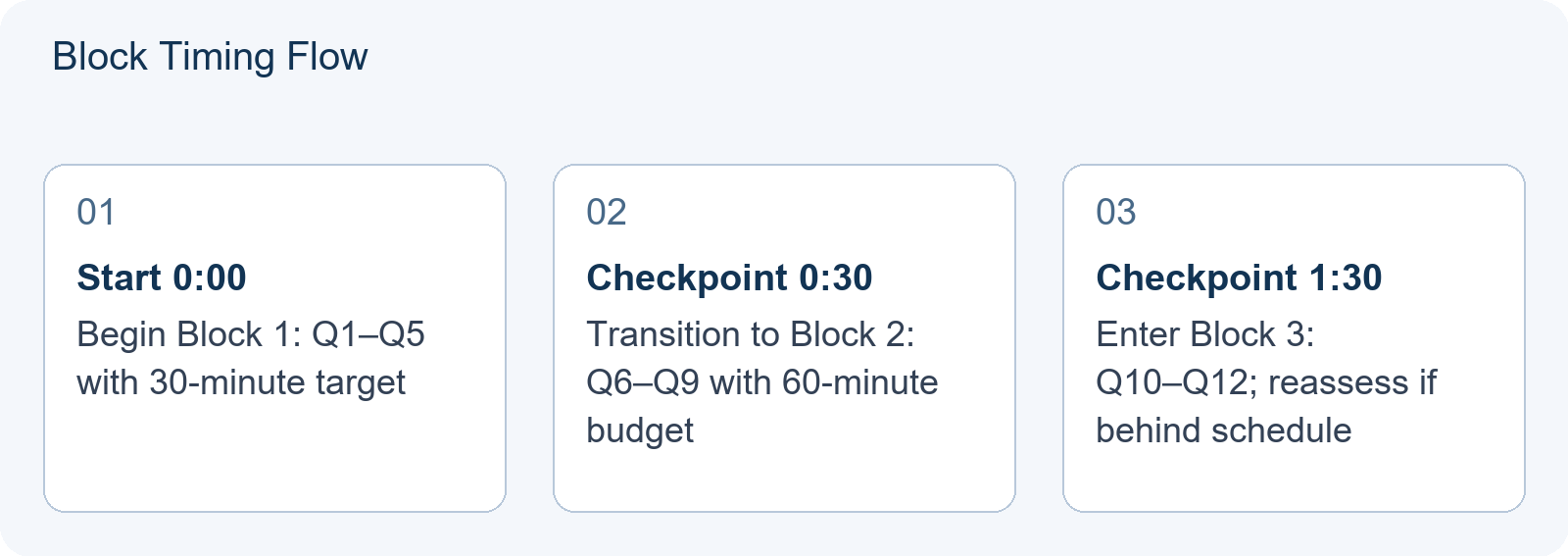
Block Timing Flow

Block 1: Secure the Foundation (Q1–Q5, ~30 Minutes)

The first five problems correspond roughly to AMC 12 problems 15 through 18 in difficulty. They test core competency in algebra, geometry, counting, and number theory without requiring advanced techniques. The goal is near-perfect accuracy with minimal time expenditure.

Teaching illustration: Consider a problem asking for the sum of all positive integers n ≤ 100 such that n² + 3n + 2 is divisible by 5. A student using block timing would recognize this as a modular arithmetic pattern: n² + 3n + 2 ≡ (n+1)(n+2) ≡ 0 (mod 5), so n ≡ 3 or 4 (mod 5). The count is 20 + 20 = 40, and the sum is computed via arithmetic series. This should take under 5 minutes, preserving mental energy.

If a Block 1 problem resists quick solution, mark it and move on. The cost of a 6-minute struggle here is 20% of your early-problem budget.

Block 2: Build Momentum (Q6–Q9, ~60 Minutes)

Problems six through nine introduce more complex structures: systems with symmetric substitutions, geometric configurations requiring auxiliary constructions, or counting problems with multiple constraints. The per-problem average rises to about 15 minutes, but individual problems may vary.

This block is where AIME Combinatorics: Build a State Table Before Writing a Recurrence and AIME Number Theory: Choose Euler or CRT With a Divisibility Ladder become valuable. Students should have these techniques automated enough that choosing the right tool is instinctive, not deliberative.

The 60-minute budget assumes two problems at 10 minutes, one at 15, and one at 25. If you find yourself exceeding 20 minutes on any single problem here, flag it for potential return and invest in Block 3 confidence.

Block 3: Deep Work (Q10–Q12, ~60 Minutes)

Problems ten through twelve represent a significant difficulty escalation, comparable to AMC 12 problems 21 through 23. These problems often require synthesizing multiple techniques or sustaining a long chain of deductions. The 20-minute per-problem average acknowledges that some solutions require extensive computation or careful case analysis.

According to Hanlin's teaching observations (November 4, 2026), this is also where knowledge of advanced trigonometric identities, Newton sums, and recursive methods pays dividends. Students who have systematically prepared find that algebra and geometry problems in this block offer more reliable paths to completion than combinatorics problems, which can have hidden complexity.

Block 4: The Final Push (Q13–Q15, 45–135 Minutes)

The last three problems are the most variable in time requirement. The source explicitly notes that each averages 15 to 45 minutes, meaning the total investment for this block alone can range from 45 to 135 minutes. This is not a typo or exaggeration; it reflects genuine variance in problem difficulty and individual student preparation.

Given the 180-minute exam constraint, students aiming for scores of 10 or below should treat Q13–Q15 as opportunities for selective depth rather than mandatory completion. The path to 8+ points runs through mastery of Q1–Q10, not through heroic stands at Q15.

For students targeting USA/JMO qualification or similar distinctions, the strategy shifts: secure Q1–Q10 efficiently to create a time surplus, then allocate that surplus to the problem in this block that best matches your strengths. A geometry specialist might invest 40 minutes in Q13 while accepting minimal time for Q14–Q15, whereas a combinatorics specialist makes the opposite choice.

Implementing the Practice Schedule

To train with this framework, use past AIME papers under strict 180-minute conditions. Record your actual time spent per problem and compare against the block targets. Over multiple practice exams, patterns emerge: perhaps you consistently overspend in Block 2 due to hesitation between methods, or you rush Block 4 and abandon viable approaches.

Weekly practice structure:

  • Day 1: Full 180-minute timed practice with fresh problems. Record block times.
  • Day 2: Review errors without time pressure. Identify whether each error was conceptual (did not know method), procedural (knew method but executed poorly), or strategic (spent too long on wrong problem).
  • Day 3: Targeted skill work on the weakest block from Day 1's practice.
  • Day 4: Second full 180-minute practice, ideally with problems from a different year to reduce familiarity effects.
  • Day 5: Light review and mental preparation; avoid new material.

Reallocation and Review Strategy

Because the block totals exceed 180 minutes, effective time management requires dynamic reallocation. The source emphasizes that students who score 8 or above typically complete Q1–Q10 in about 90 minutes, leaving 90 minutes for the remaining problems and review.

This 90-minute surplus is where the final three problems receive their funding. A student who solves Q1–Q10 in 80 minutes has potentially 100 minutes for Q11–Q15, but a student who needs 110 minutes for Q1–Q10 has only 70 minutes remaining and must be more selective.

Review time should focus on:

  • Arithmetic verification in Block 1 answers (quick wins, high return)
  • Checking that answers are integers between 0 and 999 (format errors are disqualifying)
  • Re-examining problems where you have a partial solution but recorded no final answer

When to Adjust the Framework

This block structure is a teaching tool, not an official MAA rule. Individual variation is expected. Students with exceptional speed but occasional carelessness might reduce Block 1 to 20 minutes and increase review time. Students who find middle problems particularly challenging might accept a 70-minute Block 2 and correspondingly tighten Block 3.

The essential discipline is honest measurement. Without timing data from practice exams, adjustments are guesswork. With data, you build a personalized pacing plan grounded in your actual performance distribution.

Connecting Preparation to Competition Format

For the 2027 season, AIME qualification in the US and Canada requires AMC 10 scores of at least 100 or AMC 12 scores of at least 85, per MAA announcement (August 26, 2026). Testing dates are February 5 and 6, 2027. These specifics apply to the US and Canada; other regions may have different administrative arrangements.

Students preparing outside the US and Canada should verify their local AIME format, timing, and any regional administrative differences with their competition manager.

Summary: Your 180-Minute Practice Plan

Priority Action Target Outcome
1 Master Q1–Q5 with near-perfect accuracy under 30 minutes 5 points secured, minimal energy expended
2 Develop reliable methods for Q6–Q9, especially algebra and geometry 4 additional points, building to 9 total
3 Strategically select Q10–Q12 based on personal strength 1–2 more points, reaching 10+ threshold
4 Allocate remaining time to Q13–Q15 selectively 0–3 points depending on problem match and time surplus
5 Reserve 10–15 minutes for targeted review Eliminate careless errors, confirm answer format

The block-timing method transforms an overwhelming 180-minute endurance test into a series of manageable intervals with clear decision points. Practice it consistently, measure your results, and adjust to your own pattern of strength and speed.

Diagnosing Your Own Block-Timing Leaks

Knowing the framework is different from executing it. The most common failure pattern is not that students spend too long on hard problems, but that they lose track of which block they are in and let a single problem consume the budget of an entire segment. A practical diagnostic, drawn from Hanlin's teaching observations (WeChat article, November 4, 2026), is to treat every practice exam as a data-collection exercise rather than a score-maximization exercise.

After each timed practice, record four numbers: the actual minutes spent on each block, the number of problems fully solved in each block, and the number of problems where you recorded an answer but later found an error. Most students discover that their leakage is concentrated in one of two places. Either Block 2 expands to 80 minutes because of hesitation between methods, or Block 4 collapses to 10 minutes because earlier blocks ran over and panic set in.

Teaching illustration: A student consistently scores 6 points on practice exams despite solving 10 problems correctly in untimed conditions. Her timing data reveals 45 minutes on Block 1, 75 minutes on Block 2, 40 minutes on Block 3, and 20 minutes on Block 4. The leak is in Block 1: she is verifying answers three times and re-reading problems for hidden complexity that does not exist. The correction is a hard 30-minute alarm and a forced move to Block 2 regardless of remaining uncertainty. After three practices with this constraint, her Block 1 accuracy remains unchanged at 4 out of 5, but her Block 2 completion rises from 2 to 4 problems, lifting her score to 9.

The concrete next task is to run this diagnostic on your next two practice exams before modifying any other part of your preparation. Without this measurement, block timing remains a theoretical preference rather than a trained habit.

General event background is available at Event background.
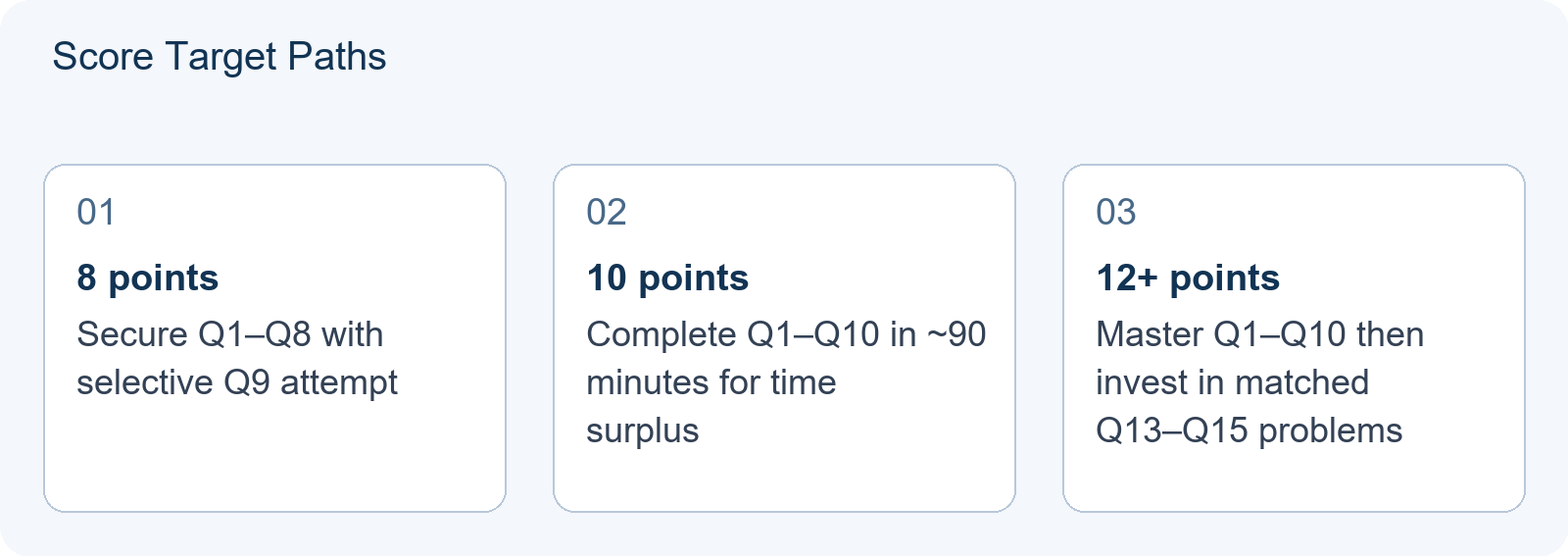
Score Target Paths

Frequently Asked Questions

What if I can't finish Q1-Q5 in 30 minutes?

This signals a gap in foundational skills or excessive caution. Practice untimed first to build method familiarity, then reintroduce time pressure gradually. If a problem resists quick solution after 2-3 minutes, mark your best approach and move on—you can return if time permits.

How does the 180-minute limit work with block totals exceeding 180 minutes?

The block times represent investment targets, not simultaneous requirements. You reallocate time from faster blocks to slower ones. Completing Q1-Q10 in 90 minutes leaves 90 minutes for the remaining problems, which matches the source guidance for 8+ scores.

Should I attempt every problem or focus on my strongest blocks?

For most students, a full attempt at Q1-Q10 with selective investment in Q11-Q15 maximizes expected score. Only students consistently solving Q1-Q12 in practice should plan mandatory attempts at Q13-Q15. The final three problems average 15-45 minutes each—time that must come from earlier efficiency.
AIME Vieta's Formulas: Find Symmetric Expressions Without Solving Every Root

For students preparing for the American Invitational Mathematics Examination (AIME), algebraic fluency is not merely about the ability to solve equations. It is fundamentally about recognizing structure. A common trap in polynomial problems is the instinct to find every individual root explicitly. In many AIME-style questions, the roots are irrational, complex, or simply too cumbersome to calculate by hand. Attempting to do so wastes precious minutes and introduces significant risk of arithmetic error. The efficient path often lies in AIME Vieta's Formulas, which connect polynomial coefficients directly to symmetric expressions such as sums of squares, reciprocal sums, and sums of cubes.

The AIME consists of 15 questions where answers must be integers between 0 and 999 inclusive. This strict answer format rewards clean symbolic work. If a problem asks for a symmetric function of roots, you should almost never solve for the roots first. Instead, you must translate the question into the language of coefficients. This article explores how to manipulate these symmetric expressions using only the sums and products derived from Vieta's formulas, emphasizing the efficiency crucial for the AIME's tight time limits.

The Core Principle: Coefficients Encode Root Relationships

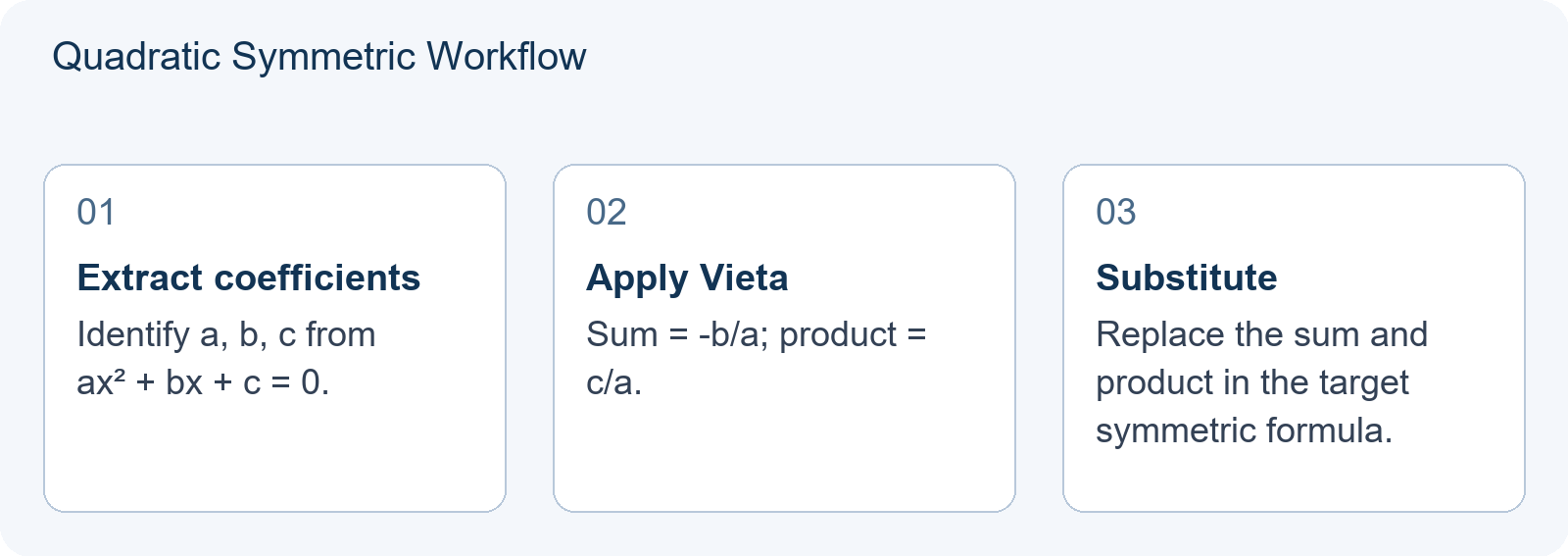
Vieta's formulas establish a direct link between the coefficients of a polynomial and the elementary symmetric sums of its roots. For a quadratic equation ax2+bx+c=0 with roots r1 and r2, the relationships are:

  • r1+r2=−ba
  • r1r2=ca

For a cubic equation ax3+bx2+cx+d=0 with roots r1,r2,r3, the pattern extends to three elementary symmetric polynomials:

  • e1=r1+r2+r3=−ba
  • e2=r1r2+r2r3+r3r1=ca
  • e3=r1r2r3=−da

For a general polynomial P(x)=anxn+an−1xn−1+⋯+a0, the sum of the roots is −an−1an, and the product of the roots is (−1)na0an. These identities hold whether the roots are real or complex. That universality is exactly why they are useful in AIME preparation: a polynomial may not factor over the integers, but its coefficients still encode the symmetric information you need. Understanding this distinction allows you to bypass the messy radical calculations entirely.

Identifying Symmetric Expressions

An expression is symmetric if swapping any two roots does not change its value. Examples include r12+r22, 1/r1+1/r2, and r13+r23. Because these expressions depend only on elementary symmetric sums, they can be rewritten in terms of coefficients. This is the key insight: if the target quantity is symmetric, it is determined solely by the coefficients.

By contrast, an expression such as r1−r2 is not symmetric. Swapping r1 and r2 changes the sign of the result. Vieta's formulas alone cannot determine the value of non-symmetric quantities without additional information, such as the discriminant or specific ordering constraints. This distinction matters significantly in test-taking strategy: if a problem asks for a non-symmetric quantity, you may need a different tool like the quadratic formula or geometric interpretation. If it asks for a symmetric quantity, Vieta's formulas should be your immediate first check.

Quadratic Symmetric Workflow

Technique 1: Squaring the Sum

A productive application in AIME algebra is finding the sum of squared roots. Students often solve for r1 and r2 individually, then square them. This is inefficient. Instead, expand the square of the sum:

(r1+r2)2=r12+2r1r2+r22

Rearranging gives the identity:

r12+r22=(r1+r2)2−2r1r2

Teaching illustration, not an official contest problem: For the quadratic x2−5x+1=0, Vieta gives r1+r2=5 and r1r2=1. Therefore r12+r22=52−2(1)=25−2=23. The roots are rac5±212, which are irrational, but you never need to write them. The coefficient calculation is immediate and exact.

For three roots, the same idea becomes:

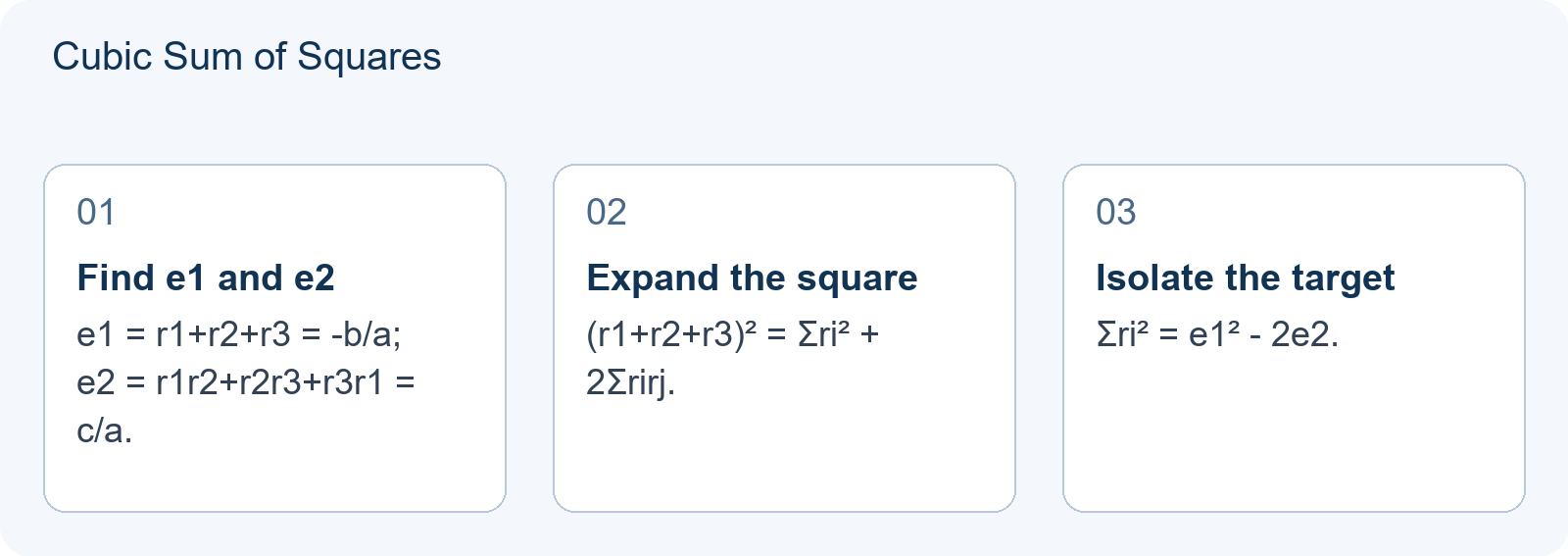
r12+r22+r32=(r1+r2+r3)2−2(r1r2+r2r3+r3r1)

In terms of elementary symmetric polynomials, this is e12−2e2. This is a useful Vieta identity for AIME algebra problems because it converts a root question into two simple coefficient lookups.

Technique 2: Reciprocal Sums

Problems asking for 1/r1+1/r2 require combining fractions. The common denominator is the product of the roots:

1r1+1r2=r2+r1r1r2=e1e2

For a cubic, two related identities are particularly useful:

  • 1r1+1r2+1r3=r1r2+r2r3+r3r1r1r2r3=e2e3
  • 1r1r2+1r2r3+1r3r1=r1+r2+r3r1r2r3=e1e3

These are especially useful when the roots are messy but the elementary symmetric sums are simple integers. A reciprocal sum may be a fraction as an intermediate value. That is acceptable. The final AIME answer must be an integer from 0 to 999, but the symmetric expression inside a problem can be fractional before a later step combines it with other terms.

Technique 3: Sum of Cubes and Newton's Sums

For two roots, the sum of cubes follows from the identity:

r13+r23=(r1+r2)3−3r1r2(r1+r2)=e13−3e1e2

For three roots, the corresponding identity is:

r13+r23+r33=e13−3e1e2+3e3

While memorizing these specific expansions is helpful, a more powerful general tool is Newton's Sums. Let Sk=r1k+r2k+…+rnk. For a monic polynomial xn+c1xn−1+c2xn−2+…+cn=0, the recurrence relation for 1≤k≤n is:

Sk+c1Sk−1+c2Sk−2+…+ck−1S1+kck=0.

For k>n:

Sk+c1Sk−1+…+cnSk−n=0.

This systematic approach allows you to compute S4,S5, etc., without memorizing complex multinomial expansions. A useful preparation benchmark is to know the pattern up to S3; the recursive structure then extends to higher powers if a problem requires it.

Worked Example: Cubic Sum of Squares

Teaching illustration, not an official contest problem: Suppose the roots of P(x)=x3−4x2+6x−4 are r1,r2,r3. Find r12+r22+r32.

Step 1: Identify coefficients. Here a=1, b=−4, c=6, d=−4.

Step 2: Apply Vieta's formulas to find elementary symmetric sums.

  • e1=r1+r2+r3=−(−4)/1=4
  • e2=r1r2+r2r3+r3r1=6/1=6
  • e3=r1r2r3=−(−4)/1=4

Step 3: Use the square-of-sum identity.

(r1+r2+r3)2=r12+r22+r32+2(r1r2+r2r3+r3r1)

e12=S2+2e2

42=S2+2(6)

16=S2+12

S2=4

The answer is 4, which is an integer in the AIME answer range. You can verify this by factoring: P(2)=8−16+12−4=0, so (x−2) is a factor. Division gives x2−2x+2, whose roots are 1+i and 1−i. Their squares are (1+i)2=2i and (1−i)2=−2i. The total sum of squares is 22+2i−2i=4. The coefficient method avoids all complex arithmetic.

Avoiding the 'Solve First' Trap

The primary advantage of mastering AIME Vieta's Formulas is time management. AIME problems often reward the shortest valid path, not the most explicit one. Spending several minutes calculating irrational or complex roots when a short substitution exists is a strategic error. Manual root calculation also increases the risk of sign errors, especially with negative coefficients or when dealing with conjugate pairs.

Before solving, ask: is the requested quantity symmetric in the roots? If yes, write it in terms of the sum and product. If the polynomial is cubic, write it in terms of the sum, pairwise sum, and product. If the expression is not symmetric, Vieta may still help as one part of a larger solution, but it will not determine the value alone. Recognizing this symmetry instantly saves cognitive load.

Final Check: Integer Constraints and Sign Errors

After deriving a symmetric expression, verify that the final requested result fits the AIME answer format: an integer from 0 to 999. If your calculation yields a fraction or a non-integer, re-examine the problem statement and your Vieta signs. Did you miss a leading coefficient? Did you forget the alternating sign in the product term?

Common errors include forgetting the negative sign in −b/a, misidentifying the constant term in a cubic, and mixing up the product formula for even and odd degree. For a quadratic ax2+bx+c, the product is c/a. For a cubic ax3+bx2+cx+d, the product is −d/a. The alternating sign is not optional. Always double-check the parity of the degree when calculating the product of roots.

For a complementary check on recording integer answers and avoiding extraneous results, see the related guide on AIME Answer Checking: Catching Extraneous Roots Before Recording an Integer.

Related Coefficient Methods

Vieta's formulas are not the only coefficient-shortcut in AIME algebra. Remainder problems also often become manageable when you avoid expanding every term. If you want to strengthen the same coefficient-focused instinct, review the method in AIME Polynomial Remainders: Solving Without Expanding Every Term. Both techniques rely on treating the polynomial as a black box defined by its coefficients rather than its roots.

Integrating Algebra into Broader Preparation

Polynomial manipulation is rarely isolated. It intersects with number theory, geometry, and combinatorics. For example, integer-root questions may require checking divisors of the constant term, while symmetric sums help analyze root distributions. The practical goal is not to memorize every identity but to build a reflex: when a problem mentions roots, scan for elementary symmetric sums.

For students moving from AMC-style speed rounds into AIME-style sustained reasoning, pacing changes matter. A useful companion article is AIME Preparation After AMC: When to Switch From Speed to Sustained Reasoning. Vieta practice fits that transition because it reduces computation while increasing the amount of structure you must recognize. Similarly, understanding qualification targets helps prioritize which algebraic skills yield the highest return on investment, as discussed in AIME Qualification Targets: Build a Reliable Margin Above the AMC Cutoff.

A Short Practice Plan

To make Vieta's formulas automatic, practice with a deliberate sequence.

  1. Start with quadratics. For random coefficients, compute r1+r2, r1r2, r12+r22, and 1/r1+1/r2.
  2. Move to cubics. Compute e1, e2, e3, then evaluate r12+r22+r32 and r13+r23+r33.
  3. Read past AIME polynomial problems and identify which ones ask for symmetric expressions before attempting any root calculation.
  4. Practice Newton's Sums for S4 on a cubic to understand the recursive pattern.

This kind of practice is more useful than simply reading solved examples. The skill is recognizing the pattern under time pressure, not just agreeing with a solution after it is shown.

Final Takeaway

When an AIME polynomial problem asks for a symmetric expression of roots, do not solve for the roots first. Use Vieta's formulas to translate the expression into coefficients. For quadratics, use sum and product. For cubics, use sum, pairwise sum, and product. Verify the final integer range and watch the alternating signs. With enough practice, AIME Vieta's Formulas become a fast, reliable tool rather than a formula to look up, giving you a decisive edge in both accuracy and speed.

Cubic Sum of Squares

Frequently Asked Questions

Can Vieta's formulas be used if the roots are complex?

Yes. Vieta's formulas apply to all roots of a polynomial, including complex numbers. When the coefficients are real, symmetric expressions of conjugate pairs produce real values, and the AIME integer answer format means the final expression must resolve to an integer.

What if the leading coefficient is not 1?

You can still use the general rules directly. For a quadratic, the sum is -b/a and the product is c/a. For a cubic, the product is -d/a. For a general degree-n polynomial, the product of roots is (-1)^n times the constant term divided by the leading coefficient. Do not ignore the leading coefficient.

How does this help with AIME time management?

It replaces lengthy radical or complex-root calculations with simple coefficient arithmetic. That saves time and reduces arithmetic errors, allowing you to spend more attention on harder combinatorial or geometric problems later in the exam.

AIME Modular Arithmetic: Recover an Integer From Two Remainders

In AIME number theory, many problems hide a single integer behind two or more remainder clues. You might know that N leaves remainder 2 when divided by 5 and remainder 3 when divided by 7, but under exam time pressure the wrong move is to list numbers until one fits. The right move is to reconstruct N by substitution, then verify against the allowed answer range. This article focuses on the recovery step: how to turn two remainders into one integer efficiently, how to handle non-coprime moduli, and how to avoid off-by-one range errors. AIME answers are recorded as integers from 0 through 999. The mathematical reconstruction method below focuses only on the modular step.

Why AIME Modular Arithmetic Rewards Reconstruction

AIME problems often do not ask for the solution to a congruence system in abstract language. They ask for a number: the smallest positive integer, the number of objects, the missing digit, or the value that fits a range. Because the final answer must be an integer 0-999, you need both a correct congruence family and the specific representative selected by the problem's wording. Reconstruction is faster than brute force because it uses the structure of division.

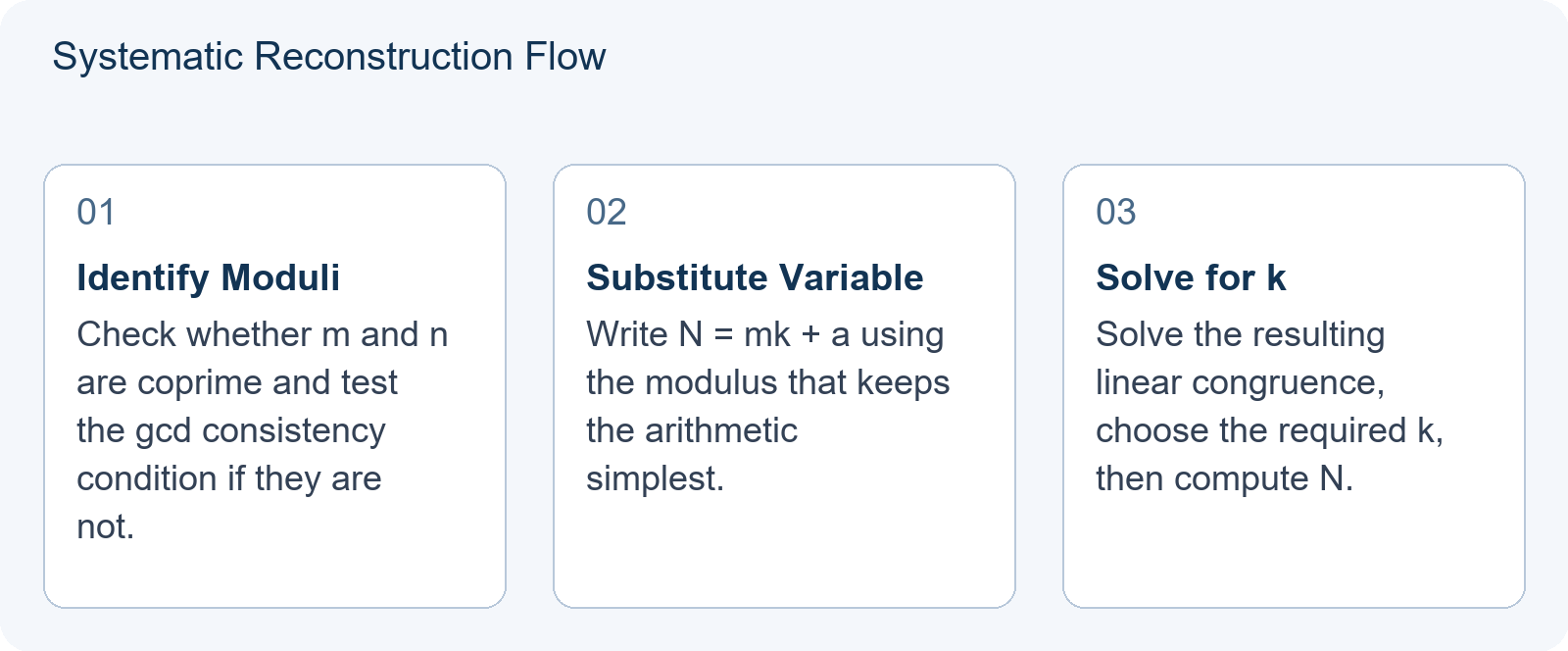
Suppose N is congruent to a modulo m and N is congruent to b modulo n. The first statement says N = mk + a for some integer k. That single substitution turns the second congruence into a one-variable linear congruence. If m and n are coprime, there is one solution modulo mn. If they are not coprime, consistency requires a congruent to b modulo gcd(m,n). Many AIME-style traps are built around this consistency condition.

The Core Equation: From Two Remainders to One Variable

Start with the congruence with the larger modulus if you want fewer steps. Let N = mk + a. Substitute into the second congruence:

mk + a is congruent to b modulo n.

Rearrange:

mk is congruent to b - a modulo n.

If gcd(m,n)=1, multiply by the inverse of m modulo n. If gcd(m,n)=d is greater than 1, first check that d divides b-a. If it does not, no solution exists. If it does, divide the entire congruence by d to reduce to a coprime case. Then solve for k modulo n/d. Finally compute N = mk + a. Note that this gives you a base solution N0. The general solution is N = N0 + t * lcm(m,n).

This is the entire engine. The Chinese Remainder Theorem guarantees existence and uniqueness under coprime moduli, but you rarely need to quote the theorem in an AIME solution. You need the substitution.

Systematic Reconstruction Flow

Step-by-Step Method Using the Least Common Multiple

Use this checklist:

  1. Identify m, n, a, and b. Check gcd(m,n). If gcd is greater than 1, test whether b-a is divisible by gcd(m,n).
  2. Write N = mk + a, choosing the modulus that makes the arithmetic simplest, often the larger one.
  3. Solve the resulting linear congruence for k, choose the smallest nonnegative k, then compute N0.
  4. Determine the period L = lcm(m,n). The solutions are N0, N0+L, N0-L, etc.

The lcm tells you how often solutions repeat. If m=5 and n=7, every solution repeats by 35. If the problem asks for the smallest positive N, choose the smallest nonnegative k that gives N greater than 0. If the problem asks for a number between 1 and 999, you must find the specific member of the family N0 + tL that satisfies the additional constraints given in the text.

Teaching Illustration: Two Coprime Remainders

Teaching illustration, not an actual contest problem. Find the smallest positive integer N such that N is congruent to 2 modulo 5 and N is congruent to 3 modulo 7. Here m=5 and n=7 are coprime, and lcm=35.

Use the larger modulus 7. Let N = 7k + 3. Substitute into the first congruence:

7k + 3 is congruent to 2 modulo 5.

Since 7 is congruent to 2 modulo 5, this becomes 2k + 3 is congruent to 2 modulo 5. Subtract 3: 2k is congruent to -1, which is congruent to 4 modulo 5. Multiply by the inverse of 2 modulo 5, which is 3: k is congruent to 12, which is congruent to 2 modulo 5. The smallest nonnegative k is 2. Then N = 7(2)+3 = 17.

Check: 17 divided by 5 leaves remainder 2; 17 divided by 7 leaves remainder 3. The answer 17 is in the 0-999 range. The full solution set is 17 + 35t for integers t.

Notice what did not happen. We did not list numbers ending in 2 until one also had remainder 3 mod 7. We solved one linear congruence for k. That is the efficiency gain.

Teaching Illustration: Non-Coprime Remainders

Teaching illustration, not an actual contest problem. Find the smallest positive integer N such that N is congruent to 1 modulo 4 and N is congruent to 5 modulo 6. Here gcd(4,6)=2. The difference b-a = 5-1 = 4 is divisible by 2, so a solution exists.

Let N = 4k + 1. Substitute into the second congruence: 4k + 1 is congruent to 5 modulo 6, so 4k is congruent to 4 modulo 6. Divide the congruence by 2: 2k is congruent to 2 modulo 3. Since 2 is invertible modulo 3, k is congruent to 1 modulo 3. The smallest nonnegative k is 1, so N = 4(1)+1 = 5. Check: 5 mod 4 = 1 and 5 mod 6 = 5. The solution repeats modulo lcm(4,6)=12, so the solutions are 5 + 12t.

This example shows why the gcd check is not optional. If the original remainders had been N is congruent to 1 modulo 4 and N is congruent to 2 modulo 6, then b-a = 1, not divisible by gcd(4,6)=2, so no integer could satisfy both congruences. Recognizing that in one line saves minutes.

Verification Trick for AIME Answers

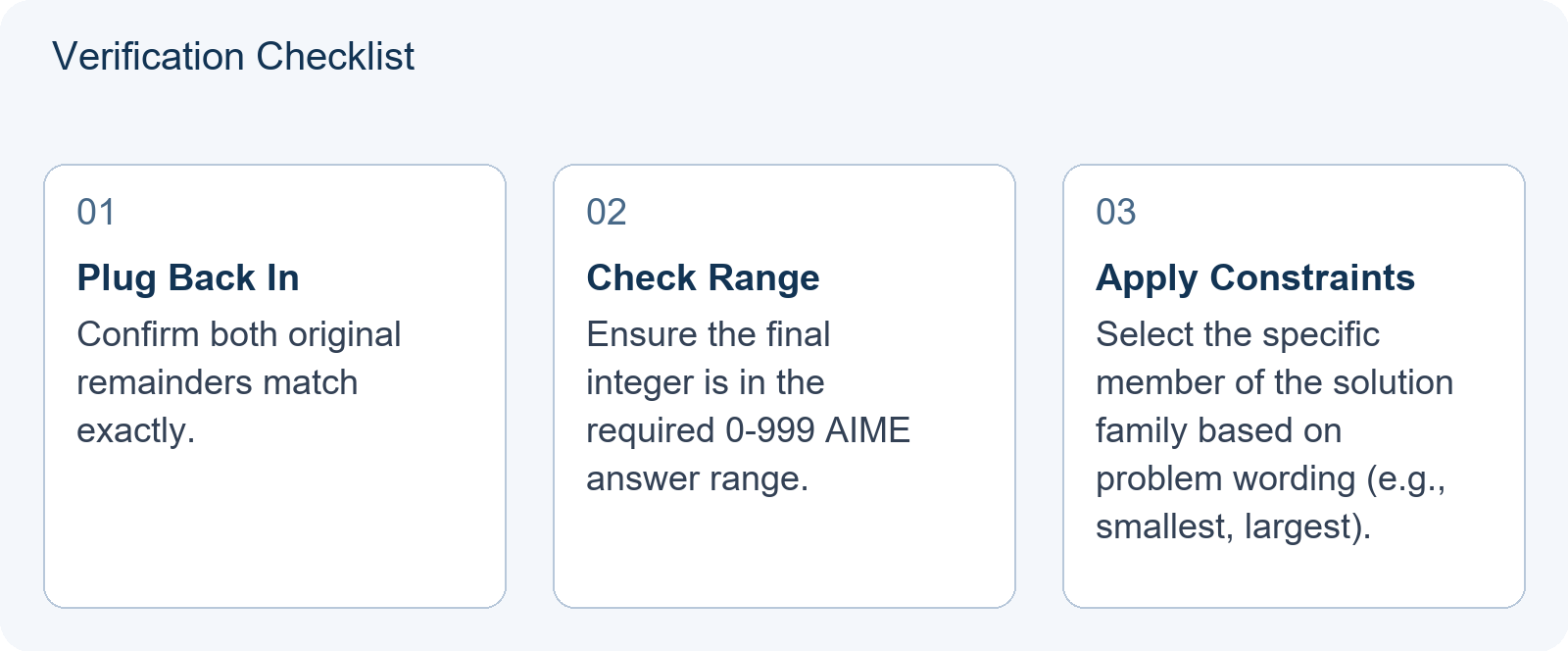
After computing N, plug it back into both original remainder statements. This catches arithmetic errors in the substitution. Then perform a second, independent check: confirm the answer is an integer from 0 through 999 and that it satisfies the problem's selection condition.

Do not stop at "it satisfies the congruences." AIME answers are not expressions like 17 + 35t. They are single integers. However, simply being in the 0-999 range is not enough to identify the correct answer if multiple members of the family fall within that range. You must re-read the problem for specific selection criteria, such as "smallest," "largest," or "divisible by X."

Common Pitfalls in AIME Modular Arithmetic

1. Forgetting the gcd consistency condition. If gcd(m,n) is greater than 1, the remainders must agree modulo that gcd. If they do not, no solution exists. If they do, reduce the problem carefully.

2. Dividing a congruence without checking divisibility. You can divide a congruence ax is congruent to b modulo n by d only when d divides a, b, and n. The safer route is to use the gcd condition and reduce the modulus correctly.

3. Using the product instead of the lcm. The solution repeats modulo lcm(m,n), not always mn. For coprime moduli they are equal; for non-coprime moduli they are not.

4. Confusing the answer range with a selection rule. AIME integer answers have a fixed range, but that range does not by itself select a unique member of a congruence family. Re-read the problem for constraints such as "smallest," "largest," or "divisible by X."

5. Reversing the substitution. If you write N = nk + b instead of N = mk + a, you must substitute into the other congruence. Mixing labels is the most common source of sign errors.

Choosing the Larger Modulus: A Small Heuristic

When you write N = mk + a, the modulus m multiplies k. If m is large, the final multiplication may be slightly larger, but the number of possible k values before reaching the target range is smaller. More importantly, choosing the larger modulus often makes the resulting congruence simpler because the variable k is being solved modulo the smaller modulus. For example, with moduli 5 and 7, use N = 7k + 3 and solve modulo 5. This keeps the linear congruence modulo 5. If you choose N = 5k + 2, you solve modulo 7, which is also fine, but arithmetic with 7 can be slightly less immediate. There is no universal rule; choose the representation that makes the inverse easy.

Range Selection: The Critical Step for Uniqueness

AIME answers are integers 0-999. This means after finding the full solution family N = N0 + L t, where L = lcm(m,n), you need the representative requested by the problem. It is crucial to understand that the answer format (0-999) does not automatically make the solution unique. Many families have multiple members in this range.

For the teaching illustration N is congruent to 2 modulo 5 and N is congruent to 3 modulo 7, N0 = 17 and L = 35. The solutions are 17, 52, 87, 122, 157, ... up to 997. All are valid integers in the 0-999 range.

  • If the problem asked for the smallest positive integer, the answer is 17.
  • If the problem asked for the largest solution below 100, the answer would be 87.
  • If the problem asked for the smallest solution above 100, the answer would be 122.
  • If the problem asked for a three-digit solution divisible by 11, you would impose that extra condition: 17+35t ≡ 0 (mod 11). Since 17 ≡ 6 and 35 ≡ 2 modulo 11, this gives 6+2t ≡ 0, so 2t ≡ 5 and t ≡ 8 modulo 11. Thus N=17+35(8)=297, which is divisible by 11.

The modular reconstruction gives the family; the wording selects the member. If the problem asks for a specific property, find the t that satisfies it rather than assuming the 0-999 range is enough.

Practice Strategy: Build Speed with Small Numbers

Before practicing full AIME problems, drill two-remainder reconstructions with small moduli. Use pairs such as mod 3 and mod 4, mod 5 and mod 7, and mod 4 and mod 6. For each pair, write the substitution, solve for k, compute N, and verify. Then identify the smallest positive member of the family N0 + tL. Doing ten of these mentally builds the pattern recognition that AIME speed requires.

When small examples feel automatic, increase the size of the remainders or moduli. The method does not change. The only additional work is arithmetic. This is also a good transition from AMC speed tactics to AIME sustained reasoning, as discussed in AIME Preparation After AMC: When to Switch From Speed to Sustained Reasoning. The goal is not to memorize cases but to trust a repeatable algorithm.

How Modular Reconstruction Connects to Other AIME Topics

Modular reconstruction often appears alongside polynomial remainders. A polynomial remainder problem may ask for a coefficient or constant that satisfies a congruence condition, and the same substitution logic applies. The linked article AIME Polynomial Remainders: Solving Without Expanding Every Term covers the polynomial side; use this article for the integer-recovery side. You can also combine modular thinking with counting problems, where the final count must be reported modulo a small number or placed in a specific residue class.

Answer checking is another natural companion. After finding N, verify that it satisfies both original statements and that it is the correct representative in the AIME range. A focused checklist for that final step appears in AIME Answer Checking: Catching Extraneous Roots Before Recording an Integer. Modular arithmetic rarely rewards rushing; it rewards a short, verifiable chain of arithmetic.

How to Avoid Arithmetic Errors Under Time Pressure

Write the substitution line clearly. Many errors come from skipping the intermediate congruence. If you go straight to a final N, you cannot debug. A three-line habit works well: first, N = mk + a; second, mk + a is congruent to b modulo n; third, mk is congruent to b - a modulo n. Then solve. Keep the original remainders visible. After computing N, check both remainders with division, not with mental modulo shortcuts. Finally, check the range and the specific selection criterion (smallest, largest, etc.).

If the problem gives more than two remainders, pair them one at a time. Solve the first two to get a combined congruence N is congruent to N0 modulo L. Then combine that with the third remainder. The method is identical, and the modulus becomes the lcm of the first two moduli. This is how AIME problems sometimes disguise a multi-step CRT problem as a word problem.

Verification Checklist

Frequently Asked Questions

Do I need to memorize the Chinese Remainder Theorem formula?

No. For AIME modular arithmetic, the constructive substitution method is usually faster and less prone to memory errors than recalling a general formula.

What if the moduli are not coprime?

First check whether the remainders agree modulo the gcd of the moduli. If they do not, no solution exists. If they do, reduce the congruence correctly and solve the remaining linear congruence.

Does the 0-999 answer range make the solution unique?

No. The range only limits which representatives can be recorded. You still need the problem's own selection condition, such as "smallest positive" or "divisible by 11," to choose the unique member of the congruence family. Then verify that the chosen integer satisfies both original remainder conditions.

Online Consultation
Online Consultation