
For 2027 AIME combinatorics preparation, build the state table before writing a recurrence. Name the ending classes that control the next legal move, list their transitions, hand-check small cases, and only then trust the algebra. This matters when a counting condition depends on the last symbol, the last two symbols, or an asymmetric restriction rather than on a single total.
Why the state table comes before the recurrence
A recurrence is a compressed description of transitions between states. If the state is wrong, the recurrence can look neat and still count the wrong objects. A common failure is to assume every valid string of length n has the same number of legal extensions. That is true only when the restriction is symmetric with respect to the next symbol. Many AIME-style counting conditions are not symmetric: whether a 1 may be appended can depend on whether the current string already ends in 1.
The order should be: name the states, write the legal moves between states, compute the first few values by hand, and only then solve or iterate the recurrence. This is also the discipline behind the period-detection method in the related AIME Recurrence Relations: Find the Period Before Expanding Long Sequences: a recurrence must be correctly specified before its long-term behavior means anything. The state table is the specification.
MAA’s public invitational-competitions page lists the 2027 AIME as 15 integer-answer questions with answers 0–999; the final count must collapse to one integer, but the counting logic must be valid first.
A complete teaching illustration: length-6 binary strings
Teaching illustration (original, not an official contest problem): Count the length-6 binary strings that contain no two consecutive 1s. A binary string uses only 0 and 1; “no consecutive 1s” means the substring 11 never appears.
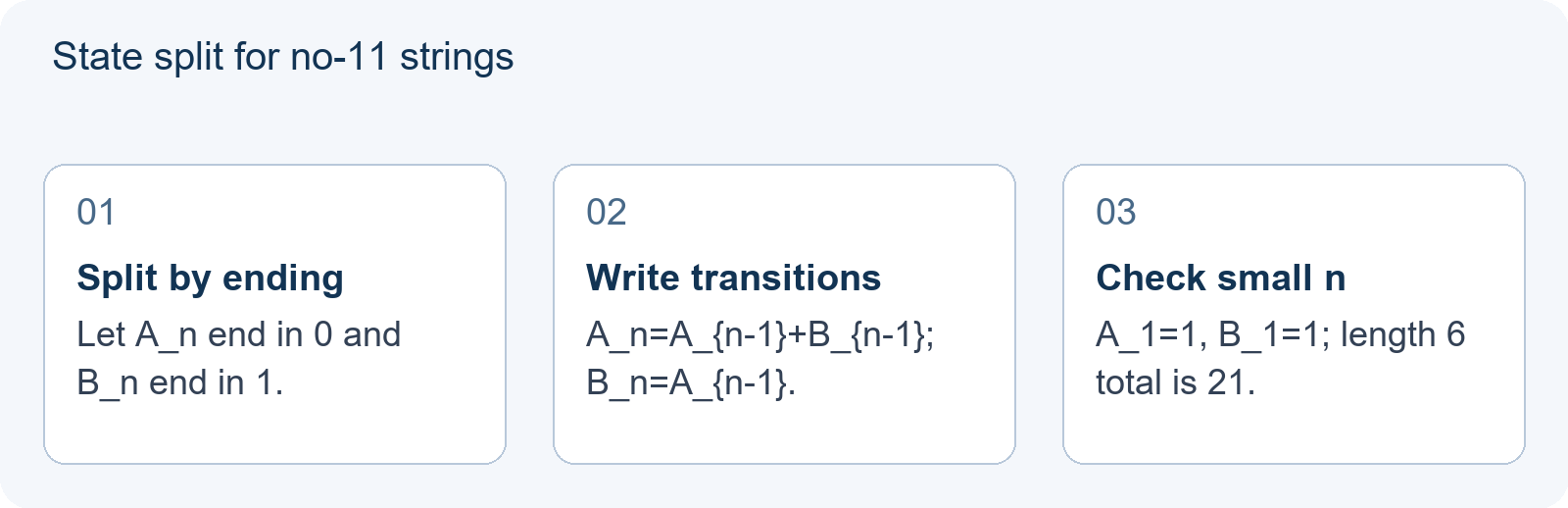
Do not start with a recurrence. Start with the last symbol, because that is what controls whether appending another 1 is legal. Let An be the number of valid length-n strings ending in 0, and let Bn be the number of valid length-n strings ending in 1.
- To form a valid length-n string ending in 0, append 0 to any valid length-(n−1) string. So An = An−1 + Bn−1.
- To form a valid length-n string ending in 1, the previous string must end in 0. So Bn = An−1.
- The initial values are A1 = 1, from the string 0, and B1 = 1, from the string 1.
| n | An: ends in 0 | Bn: ends in 1 | Total valid strings |
|---|---|---|---|
| 1 | 1 | 1 | 2 |
| 2 | 2 | 1 | 3 |
| 3 | 3 | 2 | 5 |
| 4 | 5 | 3 | 8 |
| 5 | 8 | 5 | 13 |
| 6 | 13 | 8 | 21 |
The length-6 count is 21. The hand checks support the table: length 1 gives 0 and 1; length 2 gives 00, 01, and 10; length 3 has five valid strings, including 010 and 101, while 011 and 110 are excluded.
What a failed one-state attempt looks like
A solver who writes “each string has two possible next symbols, so Tn+1 = 2Tn” has skipped the state question. From length 1, T1 = 2. The false recurrence gives T2 = 4, but the actual valid length-2 strings are 00, 01, and 10. The missing fourth candidate, 11, is illegal because the first 1 cannot be extended by another 1.
The error is not arithmetic. The error is that “valid string” is not a sufficient state when the next allowed symbol depends on the final symbol. The transition from a string ending in 0 is different from the transition from a string ending in 1. Once those two states are separated, the overcount disappears.
This is why a recurrence that happens to produce the right numbers for one or two cases is not proof. A Fibonacci-like formula may fit a few values and still fail later if the state model is incomplete. Checking n = 1, 2, and 3 by hand is not cosmetic; it tests whether the transition rules match the actual objects.
The four-column diagnostic table
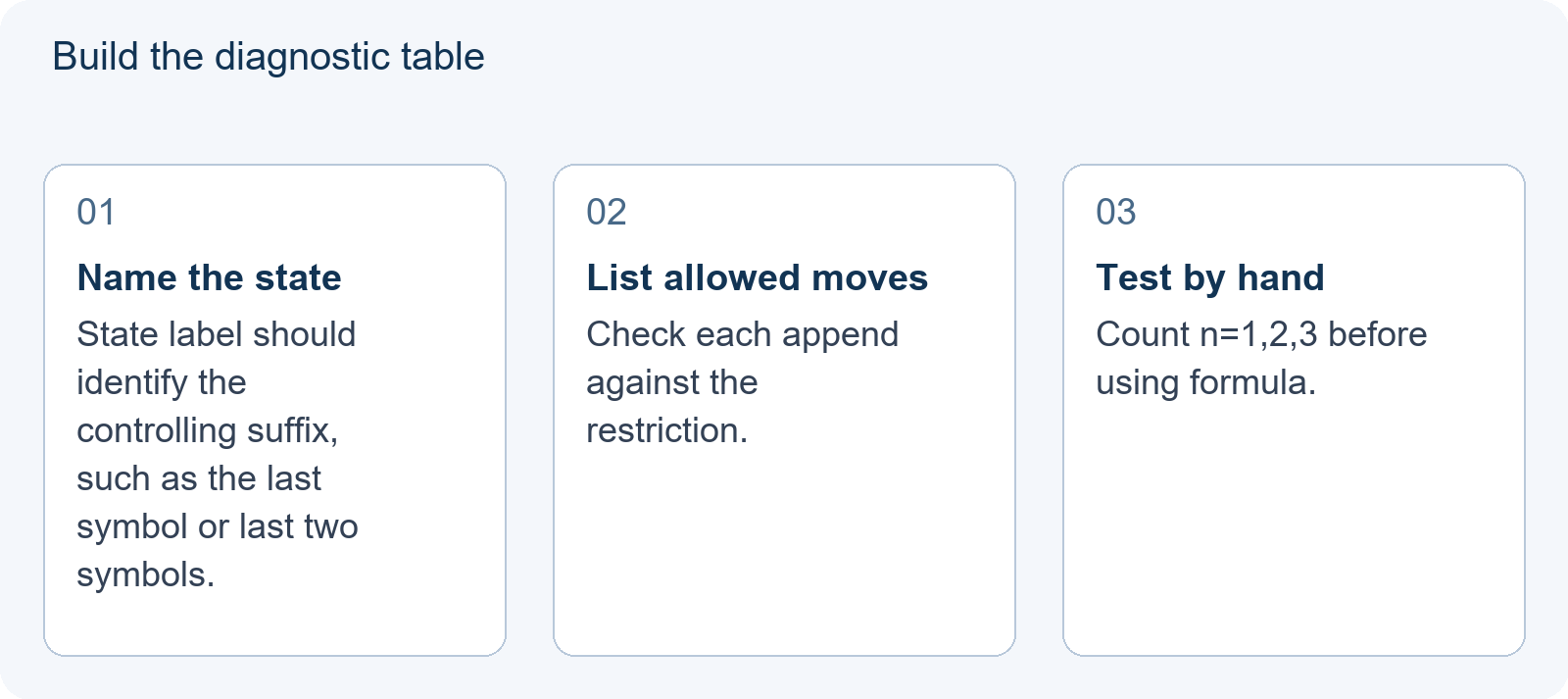
Before writing algebra, fill a table with four columns. The table is deliberately small; its purpose is to expose hidden assumptions.
| State name | Meaning | Allowed transition | Count |
|---|---|---|---|
| S0 | Valid strings ending in 0 | Append 0 or append 1; both remain valid | An |
| S1 | Valid strings ending in 1 | Append 0 only; appending 1 would create 11 | Bn |
The “Allowed transition” column is where most errors become visible. If the entry says “append 0 or 1” for every state, the restriction has been ignored. If the entry depends on more than the last symbol, such as a rule forbidding 101, the table needs states that remember the last two symbols or an equivalent automaton state.
The “Count” column must be defined before it is used. An and Bn are not interchangeable totals; they are counts of different ending classes. The final answer is A6 + B6, not A6 or B6 alone.
Three warning signs that your state is incomplete
1. The condition is asymmetric. If appending one symbol is sometimes legal and sometimes not, a single state is probably too coarse. The no-11 condition is the simplest example: a 1 is legal after 0 but not after 1.
2. The next choice depends on more than one previous item. If the rule forbids a pattern of length three, such as 101, knowing only the last symbol is not enough. You need a state that records the relevant suffix, or you need to redefine the states so the forbidden pattern can be detected.
3. You are splitting by an ending pattern but forgetting to add the classes back. State counts are usually components of a total. Students sometimes compute the number ending in 0 and report it as the answer, or add a state twice because two labels describe overlapping sets. The state definitions must be disjoint and exhaustive for the objects being counted. This is the same counting discipline discussed in the AIME Inclusion-Exclusion: Count Overlaps Without Overcounting and the AIME Counting With Symmetry: When Dividing by the Number of Rotations Fails: before dividing, adding, or applying a formula, define the sets precisely.
How this fits AIME combinatorics preparation
A Hanlin Course WeChat article, “2027 AIME Qualification Moves to Fixed Cutoffs: Preparation Planning and a High-Energy Trial Class” (2026-11-04), reports the Hanlin teaching team’s judgment that AIME combinatorics calls for recursive methods and advanced combinatorial identities such as Vandermonde, and recommends targeted practice. That is a coaching analysis, not an official syllabus. Its practical value is that recursion and identities are not replacements for state design; they are tools applied after the counted objects and transitions are defined.
A separate Hanlin Course WeChat note, “Important Notice: Domestic AIME Mathematics Exam Arrangements Confirmed,” recommends classified AIME past-paper practice for students who already have AMC/AIME preparation and are targeting an AIME score of 8–10, with targeted work in number theory and combinatorics because the note describes those modules as common weak areas for Chinese students. That is a preparation recommendation, not a rule about what every AIME will contain. For combinatorics, classified practice is most useful when each attempt is annotated with the state definition, the transition rule, and the first place the count stopped matching a hand check.
The 2027 MAA invitational-competitions page is the current official reference for the AIME’s integer-answer format; this article does not infer regional booking routes or selection rules from it. The technique here is independent of any one paper: it is a way to make a counting attempt auditable.
A 20-minute practice protocol
Use one small counting problem, not a full timed set, and work in this order:
- Minutes 0–4: Write the object definition. State the alphabet, the length, and the forbidden pattern in your own words. Do not begin with a recurrence.
- Minutes 4–8: Name states by the information that controls the next move. For the no-11 example, the controlling information is the last symbol. For a longer forbidden pattern, choose the shortest suffix that determines legality.
- Minutes 8–12: Fill the four-column table. Write each allowed transition and the count symbol it feeds. If a transition is not allowed, say why in words.
- Minutes 12–16: Hand-count n = 1, 2, and 3. Compare with the table. If they disagree, fix the state or transition before doing algebra.
- Minutes 16–20: Write the recurrence and compute one more value. Then check whether the recurrence’s structure matches the table’s transitions. Do not trust a formula that has not survived the small cases.
This protocol is deliberately slower than pattern-matching at the start. Its advantage is that it localizes failure. When an answer is wrong, you can ask whether the error began in the state definition, the transition rule, the initial conditions, or the arithmetic. That diagnosis is more useful than redoing the whole problem from the top.
Preparing for a course-fit or diagnostic conversation
If you are considering a diagnostic session or a combinatorics course, bring one counting attempt rather than a list of topics. Include your state table, your first three hand-checked values, and a note on where the transition stopped matching the actual objects. A coach can then distinguish a state-definition problem from a recurrence-execution problem. That is more actionable than a general request for “harder combinatorics.”
Ask for classified practice only if you can name the error type you need to fix: missing ending state, invalid transition, wrong initial condition, or overcount when adding classes. Not every student needs the same drill. The state-table habit is the common foundation; the next step depends on which column of the table broke.
General event background is available at Event background.
Frequently Asked Questions
Is a state table necessary if I already know a Fibonacci-like recurrence?
Not always necessary, but it justifies when the recurrence applies. For no consecutive 1s, the table splits strings by their last symbol and produces the correct transitions. If the restriction is asymmetric, a one-state recurrence is usually unsafe.
Does this article use real AIME problems?
No. The length-6 binary-string problem is an original teaching illustration, not an official contest problem. It is designed to show state definition, transition checking, and initial conditions; use authorized past papers for actual AIME practice.
What should I bring to an AIME combinatorics diagnostic?
Bring one timed or untimed counting attempt, including your state table, your first three hand-checked values, and a note on where the count stopped matching. That lets a coach identify whether the error is in state definition, transition, initial conditions, or arithmetic.