
The AIME rewards sustained reasoning over speed, and the best way to prepare is to practice under conditions that mirror the real exam's 180-minute pressure. A proven block-timing strategy divides the test into four difficulty-based segments: about 30 minutes for the opening five problems, 60 minutes for the middle four, 60 minutes for the next three, and 45 to 135 minutes for the final three problems, depending on their individual difficulty. This structure, drawn from Hanlin's teaching observations (WeChat article, November 4, 2026), helps students build the stamina and decision-making habits needed for a strong score.
Why Block Timing Matters for AIME
Unlike the AMC, where speed and pattern recognition dominate, the AIME demands deep, uninterrupted thought. Each answer is an integer from 0 to 999, and partial credit does not exist. A single careless error on an early problem can cost as much as a failed attempt at a late problem. The block-timing method protects against both risks: it ensures you secure points on accessible problems while preserving energy for harder ones.
The core insight from Hanlin's AIME teaching experience is that problems cluster by difficulty and time requirement. Treating the exam as a uniform sprint leads to rushed errors on early problems and premature abandonment of late problems that yield to patience.
The Four-Block Framework
Below is the recommended time allocation, with problem ranges mapped to approximate AMC 12 difficulty equivalents and per-problem time budgets.
| Block | AIME Problems | AMC 12 Equivalent | Time Budget | Per-Problem Average |
|---|---|---|---|---|
| 1 | Q1–Q5 | Q15–Q18 | ~30 minutes | ~6 minutes |
| 2 | Q6–Q9 | Q18–Q21 | ~60 minutes | ~15 minutes |
| 3 | Q10–Q12 | Q21–Q23 | ~60 minutes | |
| ~20 minutes | 4 | Q13–Q15 | Q24–Q25 | 45–135 minutes |
Note that the total for all four blocks ranges from 195 to 285 minutes. Because the exam is only 180 minutes, successful students must reallocate time from earlier blocks when those problems yield quickly, or accept that not every problem can receive full attention. The table above represents target investments, not fixed entitlements.
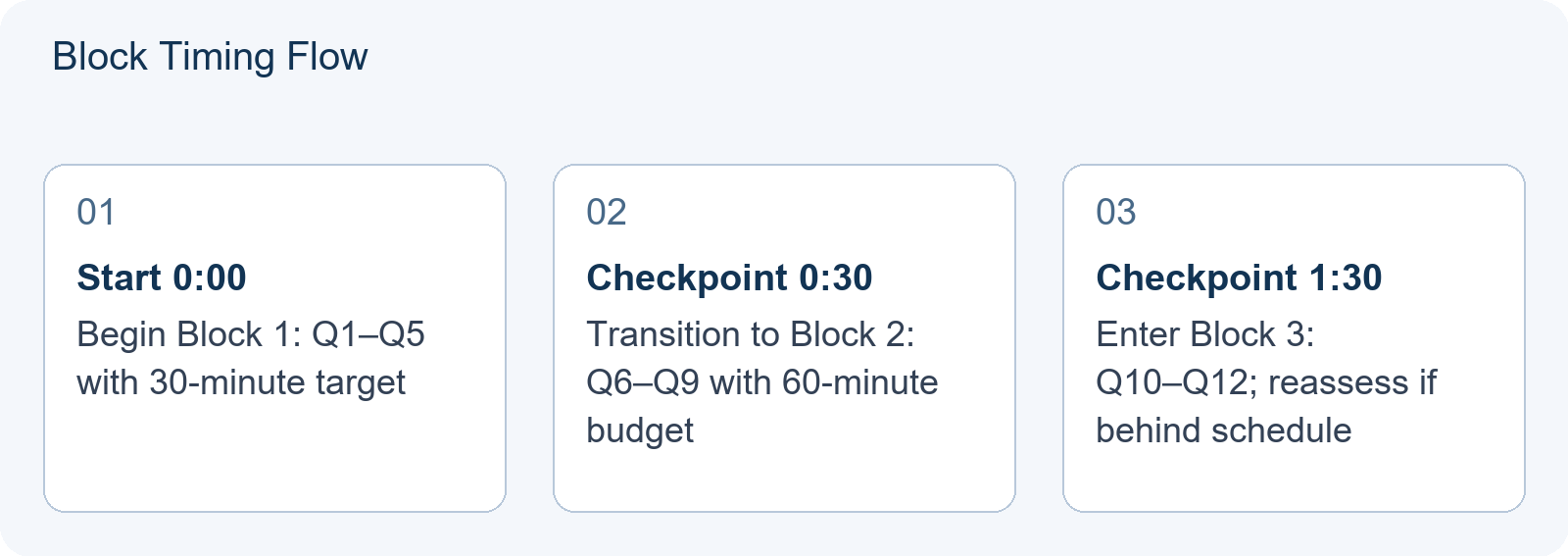
Block 1: Secure the Foundation (Q1–Q5, ~30 Minutes)
The first five problems correspond roughly to AMC 12 problems 15 through 18 in difficulty. They test core competency in algebra, geometry, counting, and number theory without requiring advanced techniques. The goal is near-perfect accuracy with minimal time expenditure.
Teaching illustration: Consider a problem asking for the sum of all positive integers n ≤ 100 such that n² + 3n + 2 is divisible by 5. A student using block timing would recognize this as a modular arithmetic pattern: n² + 3n + 2 ≡ (n+1)(n+2) ≡ 0 (mod 5), so n ≡ 3 or 4 (mod 5). The count is 20 + 20 = 40, and the sum is computed via arithmetic series. This should take under 5 minutes, preserving mental energy.
If a Block 1 problem resists quick solution, mark it and move on. The cost of a 6-minute struggle here is 20% of your early-problem budget.
Block 2: Build Momentum (Q6–Q9, ~60 Minutes)
Problems six through nine introduce more complex structures: systems with symmetric substitutions, geometric configurations requiring auxiliary constructions, or counting problems with multiple constraints. The per-problem average rises to about 15 minutes, but individual problems may vary.
This block is where AIME Combinatorics: Build a State Table Before Writing a Recurrence and AIME Number Theory: Choose Euler or CRT With a Divisibility Ladder become valuable. Students should have these techniques automated enough that choosing the right tool is instinctive, not deliberative.
The 60-minute budget assumes two problems at 10 minutes, one at 15, and one at 25. If you find yourself exceeding 20 minutes on any single problem here, flag it for potential return and invest in Block 3 confidence.
Block 3: Deep Work (Q10–Q12, ~60 Minutes)
Problems ten through twelve represent a significant difficulty escalation, comparable to AMC 12 problems 21 through 23. These problems often require synthesizing multiple techniques or sustaining a long chain of deductions. The 20-minute per-problem average acknowledges that some solutions require extensive computation or careful case analysis.
According to Hanlin's teaching observations (November 4, 2026), this is also where knowledge of advanced trigonometric identities, Newton sums, and recursive methods pays dividends. Students who have systematically prepared find that algebra and geometry problems in this block offer more reliable paths to completion than combinatorics problems, which can have hidden complexity.
Block 4: The Final Push (Q13–Q15, 45–135 Minutes)
The last three problems are the most variable in time requirement. The source explicitly notes that each averages 15 to 45 minutes, meaning the total investment for this block alone can range from 45 to 135 minutes. This is not a typo or exaggeration; it reflects genuine variance in problem difficulty and individual student preparation.
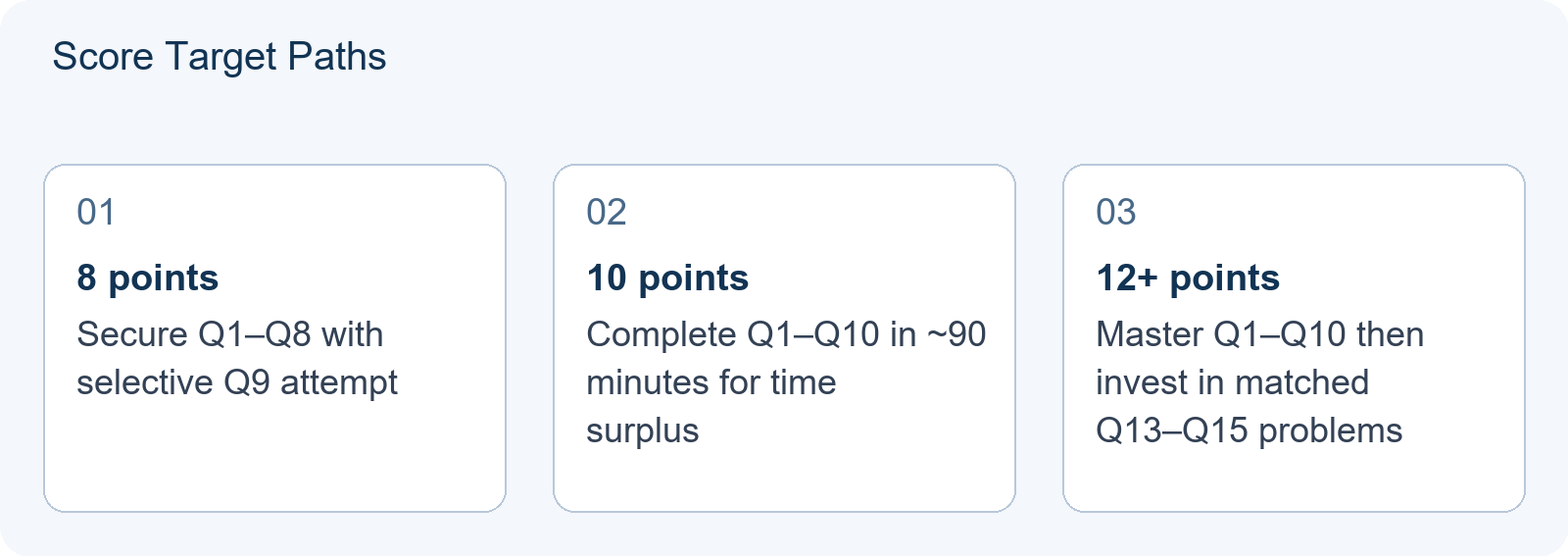
Given the 180-minute exam constraint, students aiming for scores of 10 or below should treat Q13–Q15 as opportunities for selective depth rather than mandatory completion. The path to 8+ points runs through mastery of Q1–Q10, not through heroic stands at Q15.
For students targeting USA/JMO qualification or similar distinctions, the strategy shifts: secure Q1–Q10 efficiently to create a time surplus, then allocate that surplus to the problem in this block that best matches your strengths. A geometry specialist might invest 40 minutes in Q13 while accepting minimal time for Q14–Q15, whereas a combinatorics specialist makes the opposite choice.
Implementing the Practice Schedule
To train with this framework, use past AIME papers under strict 180-minute conditions. Record your actual time spent per problem and compare against the block targets. Over multiple practice exams, patterns emerge: perhaps you consistently overspend in Block 2 due to hesitation between methods, or you rush Block 4 and abandon viable approaches.
Weekly practice structure:
- Day 1: Full 180-minute timed practice with fresh problems. Record block times.
- Day 2: Review errors without time pressure. Identify whether each error was conceptual (did not know method), procedural (knew method but executed poorly), or strategic (spent too long on wrong problem).
- Day 3: Targeted skill work on the weakest block from Day 1's practice.
- Day 4: Second full 180-minute practice, ideally with problems from a different year to reduce familiarity effects.
- Day 5: Light review and mental preparation; avoid new material.
Reallocation and Review Strategy
Because the block totals exceed 180 minutes, effective time management requires dynamic reallocation. The source emphasizes that students who score 8 or above typically complete Q1–Q10 in about 90 minutes, leaving 90 minutes for the remaining problems and review.
This 90-minute surplus is where the final three problems receive their funding. A student who solves Q1–Q10 in 80 minutes has potentially 100 minutes for Q11–Q15, but a student who needs 110 minutes for Q1–Q10 has only 70 minutes remaining and must be more selective.
Review time should focus on:
- Arithmetic verification in Block 1 answers (quick wins, high return)
- Checking that answers are integers between 0 and 999 (format errors are disqualifying)
- Re-examining problems where you have a partial solution but recorded no final answer
When to Adjust the Framework
This block structure is a teaching tool, not an official MAA rule. Individual variation is expected. Students with exceptional speed but occasional carelessness might reduce Block 1 to 20 minutes and increase review time. Students who find middle problems particularly challenging might accept a 70-minute Block 2 and correspondingly tighten Block 3.
The essential discipline is honest measurement. Without timing data from practice exams, adjustments are guesswork. With data, you build a personalized pacing plan grounded in your actual performance distribution.
Connecting Preparation to Competition Format
For the 2027 season, AIME qualification in the US and Canada requires AMC 10 scores of at least 100 or AMC 12 scores of at least 85, per MAA announcement (August 26, 2026). Testing dates are February 5 and 6, 2027. These specifics apply to the US and Canada; other regions may have different administrative arrangements.
Students preparing outside the US and Canada should verify their local AIME format, timing, and any regional administrative differences with their competition manager.
Summary: Your 180-Minute Practice Plan
| Priority | Action | Target Outcome |
|---|---|---|
| 1 | Master Q1–Q5 with near-perfect accuracy under 30 minutes | 5 points secured, minimal energy expended |
| 2 | Develop reliable methods for Q6–Q9, especially algebra and geometry | 4 additional points, building to 9 total |
| 3 | Strategically select Q10–Q12 based on personal strength | 1–2 more points, reaching 10+ threshold |
| 4 | Allocate remaining time to Q13–Q15 selectively | 0–3 points depending on problem match and time surplus |
| 5 | Reserve 10–15 minutes for targeted review | Eliminate careless errors, confirm answer format |
The block-timing method transforms an overwhelming 180-minute endurance test into a series of manageable intervals with clear decision points. Practice it consistently, measure your results, and adjust to your own pattern of strength and speed.
Diagnosing Your Own Block-Timing Leaks
Knowing the framework is different from executing it. The most common failure pattern is not that students spend too long on hard problems, but that they lose track of which block they are in and let a single problem consume the budget of an entire segment. A practical diagnostic, drawn from Hanlin's teaching observations (WeChat article, November 4, 2026), is to treat every practice exam as a data-collection exercise rather than a score-maximization exercise.
After each timed practice, record four numbers: the actual minutes spent on each block, the number of problems fully solved in each block, and the number of problems where you recorded an answer but later found an error. Most students discover that their leakage is concentrated in one of two places. Either Block 2 expands to 80 minutes because of hesitation between methods, or Block 4 collapses to 10 minutes because earlier blocks ran over and panic set in.
Teaching illustration: A student consistently scores 6 points on practice exams despite solving 10 problems correctly in untimed conditions. Her timing data reveals 45 minutes on Block 1, 75 minutes on Block 2, 40 minutes on Block 3, and 20 minutes on Block 4. The leak is in Block 1: she is verifying answers three times and re-reading problems for hidden complexity that does not exist. The correction is a hard 30-minute alarm and a forced move to Block 2 regardless of remaining uncertainty. After three practices with this constraint, her Block 1 accuracy remains unchanged at 4 out of 5, but her Block 2 completion rises from 2 to 4 problems, lifting her score to 9.
The concrete next task is to run this diagnostic on your next two practice exams before modifying any other part of your preparation. Without this measurement, block timing remains a theoretical preference rather than a trained habit.
General event background is available at Event background.
Frequently Asked Questions
What if I can't finish Q1-Q5 in 30 minutes?
This signals a gap in foundational skills or excessive caution. Practice untimed first to build method familiarity, then reintroduce time pressure gradually. If a problem resists quick solution after 2-3 minutes, mark your best approach and move on—you can return if time permits.
How does the 180-minute limit work with block totals exceeding 180 minutes?
The block times represent investment targets, not simultaneous requirements. You reallocate time from faster blocks to slower ones. Completing Q1-Q10 in 90 minutes leaves 90 minutes for the remaining problems, which matches the source guidance for 8+ scores.
Should I attempt every problem or focus on my strongest blocks?
For most students, a full attempt at Q1-Q10 with selective investment in Q11-Q15 maximizes expected score. Only students consistently solving Q1-Q12 in practice should plan mandatory attempts at Q13-Q15. The final three problems average 15-45 minutes each—time that must come from earlier efficiency.