AIME 180-Minute Practice: Block Timing That Matches Real Exam Pressure

The AIME rewards sustained reasoning over speed, and the best way to prepare is to practice under conditions that mirror the real exam's 180-minute pressure. A proven block-timing strategy divides the test into four difficulty-based segments: about 30 minutes for the opening five problems, 60 minutes for the middle four, 60 minutes for the next three, and 45 to 135 minutes for the final three problems, depending on their individual difficulty. This structure, drawn from Hanlin's teaching observations (WeChat article, November 4, 2026), helps students build the stamina and decision-making habits needed for a strong score.

Why Block Timing Matters for AIME

Unlike the AMC, where speed and pattern recognition dominate, the AIME demands deep, uninterrupted thought. Each answer is an integer from 0 to 999, and partial credit does not exist. A single careless error on an early problem can cost as much as a failed attempt at a late problem. The block-timing method protects against both risks: it ensures you secure points on accessible problems while preserving energy for harder ones.

The core insight from Hanlin's AIME teaching experience is that problems cluster by difficulty and time requirement. Treating the exam as a uniform sprint leads to rushed errors on early problems and premature abandonment of late problems that yield to patience.

The Four-Block Framework

Below is the recommended time allocation, with problem ranges mapped to approximate AMC 12 difficulty equivalents and per-problem time budgets.

Block AIME Problems AMC 12 Equivalent Time Budget Per-Problem Average
1 Q1–Q5 Q15–Q18 ~30 minutes ~6 minutes
2 Q6–Q9 Q18–Q21 ~60 minutes ~15 minutes
3 Q10–Q12 Q21–Q23 ~60 minutes
~20 minutes 4 Q13–Q15 Q24–Q25 45–135 minutes

Note that the total for all four blocks ranges from 195 to 285 minutes. Because the exam is only 180 minutes, successful students must reallocate time from earlier blocks when those problems yield quickly, or accept that not every problem can receive full attention. The table above represents target investments, not fixed entitlements.
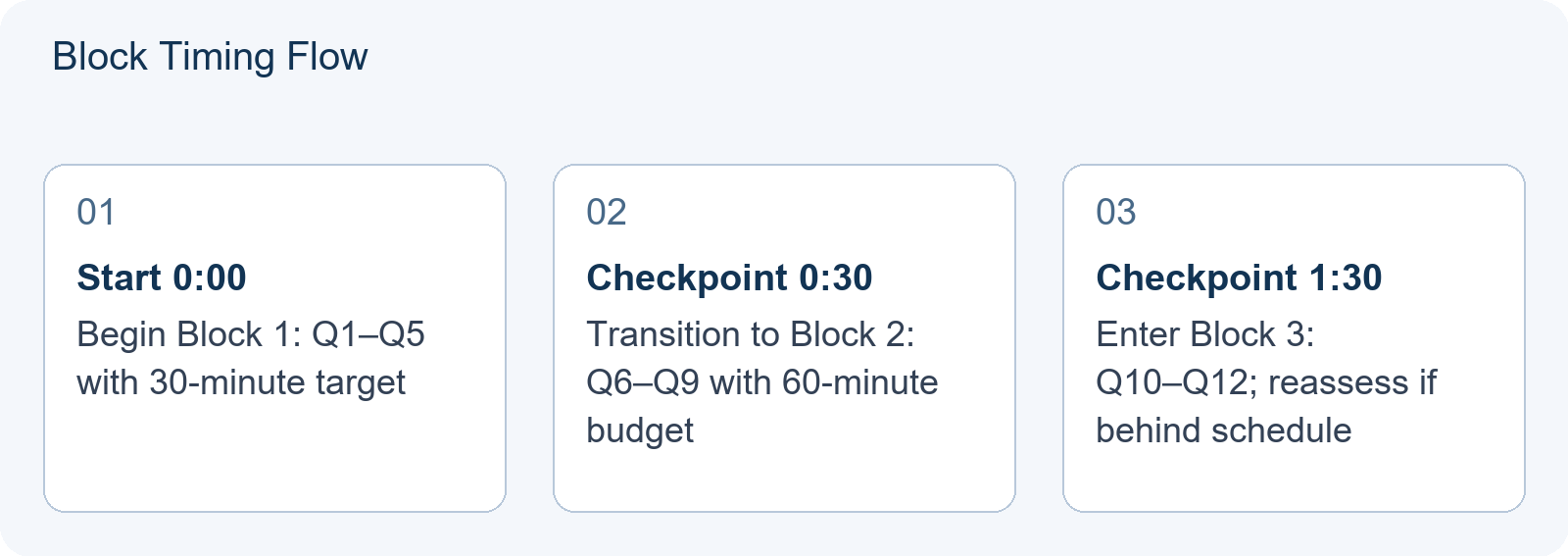
Block Timing Flow

Block 1: Secure the Foundation (Q1–Q5, ~30 Minutes)

The first five problems correspond roughly to AMC 12 problems 15 through 18 in difficulty. They test core competency in algebra, geometry, counting, and number theory without requiring advanced techniques. The goal is near-perfect accuracy with minimal time expenditure.

Teaching illustration: Consider a problem asking for the sum of all positive integers n ≤ 100 such that n² + 3n + 2 is divisible by 5. A student using block timing would recognize this as a modular arithmetic pattern: n² + 3n + 2 ≡ (n+1)(n+2) ≡ 0 (mod 5), so n ≡ 3 or 4 (mod 5). The count is 20 + 20 = 40, and the sum is computed via arithmetic series. This should take under 5 minutes, preserving mental energy.

If a Block 1 problem resists quick solution, mark it and move on. The cost of a 6-minute struggle here is 20% of your early-problem budget.

Block 2: Build Momentum (Q6–Q9, ~60 Minutes)

Problems six through nine introduce more complex structures: systems with symmetric substitutions, geometric configurations requiring auxiliary constructions, or counting problems with multiple constraints. The per-problem average rises to about 15 minutes, but individual problems may vary.

This block is where AIME Combinatorics: Build a State Table Before Writing a Recurrence and AIME Number Theory: Choose Euler or CRT With a Divisibility Ladder become valuable. Students should have these techniques automated enough that choosing the right tool is instinctive, not deliberative.

The 60-minute budget assumes two problems at 10 minutes, one at 15, and one at 25. If you find yourself exceeding 20 minutes on any single problem here, flag it for potential return and invest in Block 3 confidence.

Block 3: Deep Work (Q10–Q12, ~60 Minutes)

Problems ten through twelve represent a significant difficulty escalation, comparable to AMC 12 problems 21 through 23. These problems often require synthesizing multiple techniques or sustaining a long chain of deductions. The 20-minute per-problem average acknowledges that some solutions require extensive computation or careful case analysis.

According to Hanlin's teaching observations (November 4, 2026), this is also where knowledge of advanced trigonometric identities, Newton sums, and recursive methods pays dividends. Students who have systematically prepared find that algebra and geometry problems in this block offer more reliable paths to completion than combinatorics problems, which can have hidden complexity.

Block 4: The Final Push (Q13–Q15, 45–135 Minutes)

The last three problems are the most variable in time requirement. The source explicitly notes that each averages 15 to 45 minutes, meaning the total investment for this block alone can range from 45 to 135 minutes. This is not a typo or exaggeration; it reflects genuine variance in problem difficulty and individual student preparation.

Given the 180-minute exam constraint, students aiming for scores of 10 or below should treat Q13–Q15 as opportunities for selective depth rather than mandatory completion. The path to 8+ points runs through mastery of Q1–Q10, not through heroic stands at Q15.

For students targeting USA/JMO qualification or similar distinctions, the strategy shifts: secure Q1–Q10 efficiently to create a time surplus, then allocate that surplus to the problem in this block that best matches your strengths. A geometry specialist might invest 40 minutes in Q13 while accepting minimal time for Q14–Q15, whereas a combinatorics specialist makes the opposite choice.

Implementing the Practice Schedule

To train with this framework, use past AIME papers under strict 180-minute conditions. Record your actual time spent per problem and compare against the block targets. Over multiple practice exams, patterns emerge: perhaps you consistently overspend in Block 2 due to hesitation between methods, or you rush Block 4 and abandon viable approaches.

Weekly practice structure:

  • Day 1: Full 180-minute timed practice with fresh problems. Record block times.
  • Day 2: Review errors without time pressure. Identify whether each error was conceptual (did not know method), procedural (knew method but executed poorly), or strategic (spent too long on wrong problem).
  • Day 3: Targeted skill work on the weakest block from Day 1's practice.
  • Day 4: Second full 180-minute practice, ideally with problems from a different year to reduce familiarity effects.
  • Day 5: Light review and mental preparation; avoid new material.

Reallocation and Review Strategy

Because the block totals exceed 180 minutes, effective time management requires dynamic reallocation. The source emphasizes that students who score 8 or above typically complete Q1–Q10 in about 90 minutes, leaving 90 minutes for the remaining problems and review.

This 90-minute surplus is where the final three problems receive their funding. A student who solves Q1–Q10 in 80 minutes has potentially 100 minutes for Q11–Q15, but a student who needs 110 minutes for Q1–Q10 has only 70 minutes remaining and must be more selective.

Review time should focus on:

  • Arithmetic verification in Block 1 answers (quick wins, high return)
  • Checking that answers are integers between 0 and 999 (format errors are disqualifying)
  • Re-examining problems where you have a partial solution but recorded no final answer

When to Adjust the Framework

This block structure is a teaching tool, not an official MAA rule. Individual variation is expected. Students with exceptional speed but occasional carelessness might reduce Block 1 to 20 minutes and increase review time. Students who find middle problems particularly challenging might accept a 70-minute Block 2 and correspondingly tighten Block 3.

The essential discipline is honest measurement. Without timing data from practice exams, adjustments are guesswork. With data, you build a personalized pacing plan grounded in your actual performance distribution.

Connecting Preparation to Competition Format

For the 2027 season, AIME qualification in the US and Canada requires AMC 10 scores of at least 100 or AMC 12 scores of at least 85, per MAA announcement (August 26, 2026). Testing dates are February 5 and 6, 2027. These specifics apply to the US and Canada; other regions may have different administrative arrangements.

Students preparing outside the US and Canada should verify their local AIME format, timing, and any regional administrative differences with their competition manager.

Summary: Your 180-Minute Practice Plan

Priority Action Target Outcome
1 Master Q1–Q5 with near-perfect accuracy under 30 minutes 5 points secured, minimal energy expended
2 Develop reliable methods for Q6–Q9, especially algebra and geometry 4 additional points, building to 9 total
3 Strategically select Q10–Q12 based on personal strength 1–2 more points, reaching 10+ threshold
4 Allocate remaining time to Q13–Q15 selectively 0–3 points depending on problem match and time surplus
5 Reserve 10–15 minutes for targeted review Eliminate careless errors, confirm answer format

The block-timing method transforms an overwhelming 180-minute endurance test into a series of manageable intervals with clear decision points. Practice it consistently, measure your results, and adjust to your own pattern of strength and speed.

Diagnosing Your Own Block-Timing Leaks

Knowing the framework is different from executing it. The most common failure pattern is not that students spend too long on hard problems, but that they lose track of which block they are in and let a single problem consume the budget of an entire segment. A practical diagnostic, drawn from Hanlin's teaching observations (WeChat article, November 4, 2026), is to treat every practice exam as a data-collection exercise rather than a score-maximization exercise.

After each timed practice, record four numbers: the actual minutes spent on each block, the number of problems fully solved in each block, and the number of problems where you recorded an answer but later found an error. Most students discover that their leakage is concentrated in one of two places. Either Block 2 expands to 80 minutes because of hesitation between methods, or Block 4 collapses to 10 minutes because earlier blocks ran over and panic set in.

Teaching illustration: A student consistently scores 6 points on practice exams despite solving 10 problems correctly in untimed conditions. Her timing data reveals 45 minutes on Block 1, 75 minutes on Block 2, 40 minutes on Block 3, and 20 minutes on Block 4. The leak is in Block 1: she is verifying answers three times and re-reading problems for hidden complexity that does not exist. The correction is a hard 30-minute alarm and a forced move to Block 2 regardless of remaining uncertainty. After three practices with this constraint, her Block 1 accuracy remains unchanged at 4 out of 5, but her Block 2 completion rises from 2 to 4 problems, lifting her score to 9.

The concrete next task is to run this diagnostic on your next two practice exams before modifying any other part of your preparation. Without this measurement, block timing remains a theoretical preference rather than a trained habit.

General event background is available at Event background.
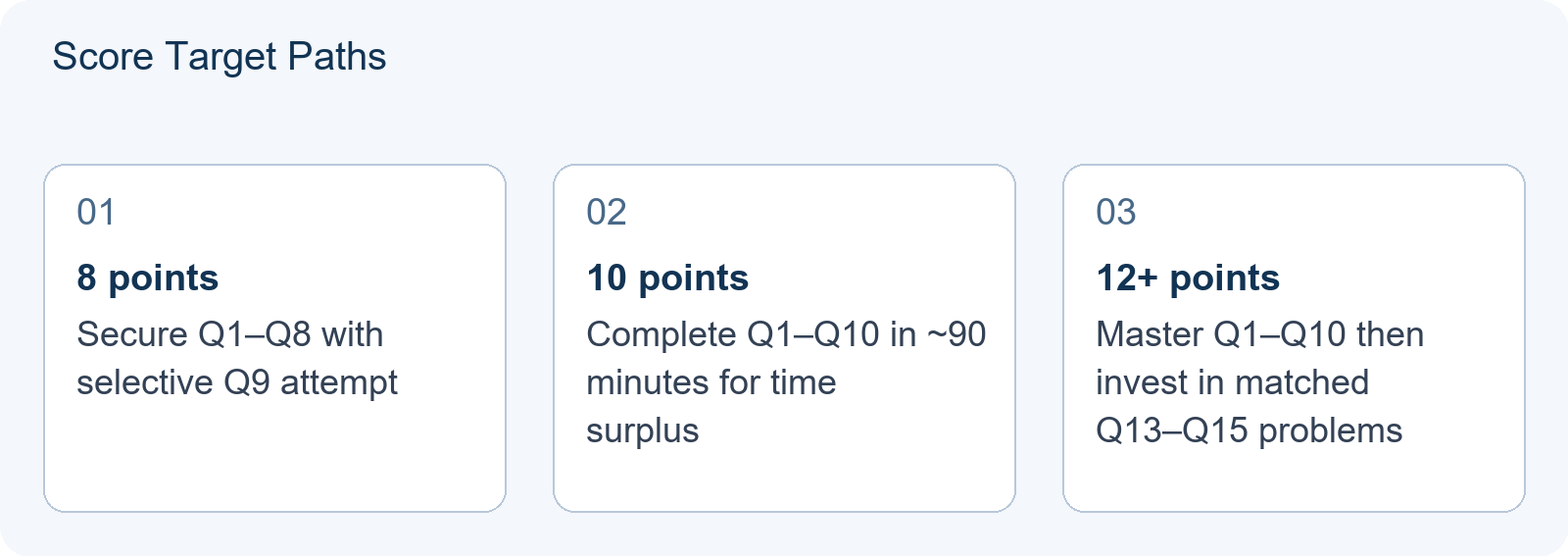
Score Target Paths

Frequently Asked Questions

What if I can't finish Q1-Q5 in 30 minutes?

This signals a gap in foundational skills or excessive caution. Practice untimed first to build method familiarity, then reintroduce time pressure gradually. If a problem resists quick solution after 2-3 minutes, mark your best approach and move on—you can return if time permits.

How does the 180-minute limit work with block totals exceeding 180 minutes?

The block times represent investment targets, not simultaneous requirements. You reallocate time from faster blocks to slower ones. Completing Q1-Q10 in 90 minutes leaves 90 minutes for the remaining problems, which matches the source guidance for 8+ scores.

Should I attempt every problem or focus on my strongest blocks?

For most students, a full attempt at Q1-Q10 with selective investment in Q11-Q15 maximizes expected score. Only students consistently solving Q1-Q12 in practice should plan mandatory attempts at Q13-Q15. The final three problems average 15-45 minutes each—time that must come from earlier efficiency.
AIME Mock Review: Separate Setup Errors From Execution Errors

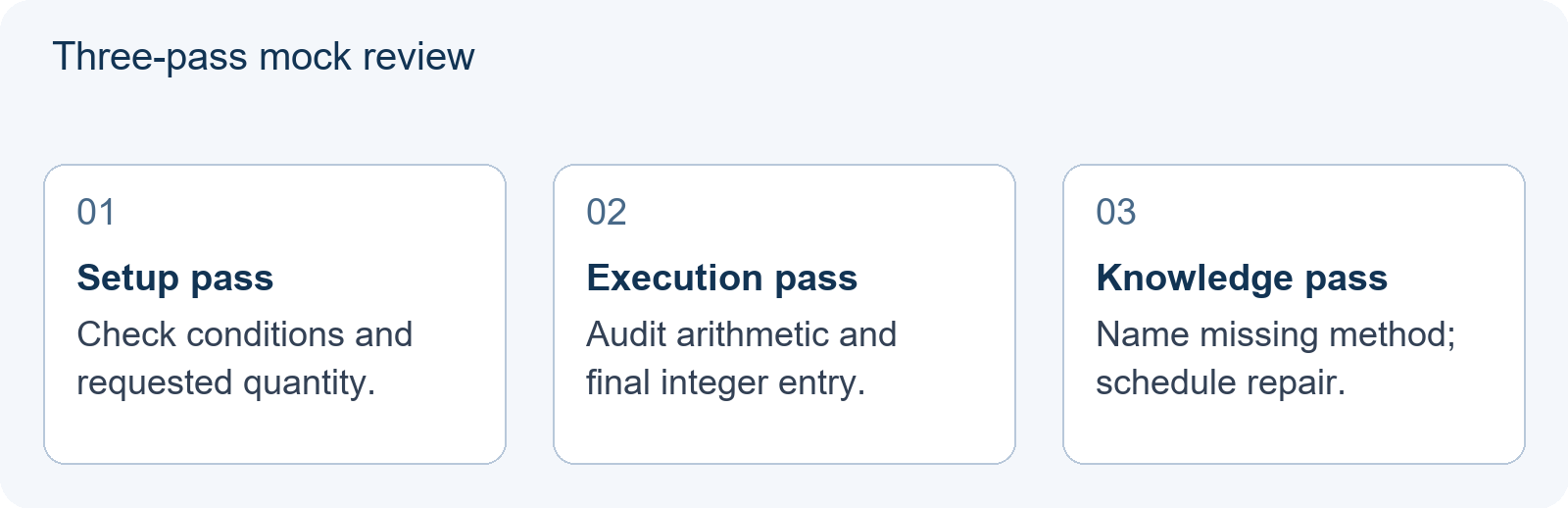
An AIME mock review should turn each miss into a next action, not stop at the raw score. For the 2027 cycle, the MAA describes a 15-question, integer-answer AIME with a single attempt, so a completed mock is diagnostic evidence. Review it in three passes: setup, execution and knowledge. Then choose the next drill from the dominant error category. This is a Hanlin preparation perspective, not official scoring guidance.

Why a raw score cannot choose your next drill

Two hypothetical students can both score 6/15 and need opposite plans. Student A loses three questions by misreading a condition, answering the complement, or recording an unscaled variable. Student B understood those questions but loses three marks to sign slips, a modular inverse error and a final answer outside 0-999. If both respond by taking another mock, Student A practises the same setup weakness, while Student B rehearses the same final-check omission. The score is identical; the repair is not.

Hanlin course WeChat, 2027 AIME fixed cutoff and prep planning (4 November 2026), says the teaching team recommends sufficient daily mock tests in the final week to find weak or forgotten knowledge and to practise time allocation and competition mindset. Hanlin course WeChat, AMC10/12 mock test free open (9 October 2026), describes mock diagnostics that identify weak modules and generate an advantage/disadvantage report and an error book. For an AIME mock, adapt that principle carefully: the artifact you need is a classified error log, not only a score report. If your question is still whether to move from AMC speed to sustained reasoning, see AIME Preparation After AMC: When to Switch From Speed to Sustained Reasoning; this article begins after one mock is finished.

Define setup, execution and knowledge without overlap

Use operational definitions. Setup is what you did before the first line of algebra: reading conditions, defining variables, choosing the requested quantity, tracking units and constraints. Execution is what happened after a correct plan: algebra, arithmetic, modular reduction, sign control and final entry. Knowledge is the missing theorem, method or recognition pattern that prevented a credible plan.

Category Typical evidence Question to ask
Setup Wrong variable, dropped condition, answered complement, missed scale Would a correct restatement have prevented the miss?
Execution Correct plan, wrong sign, arithmetic slip, bad final integer Did the plan survive the first line?
Knowledge No usable method, theorem not known, pattern not recognised Could the student start without a hint?

When a miss could fit two categories, assign the earliest category that would have prevented it. A forgotten theorem is knowledge; a correct theorem applied with a wrong inverse is execution; a correct method used on the wrong quantity is setup.

An original teaching example, not an AIME problem

Suppose an exercise asks for the least positive integer n such that n leaves remainder 5 when divided by 8 and remainder 2 when divided by 9. This is a complete teaching example, not an official prompt. A correct setup writes n = 8a + 5 = 9b + 2 and records the word least. Solving gives a = 3 mod 9, so n = 29 is the least positive solution; all solutions differ by 72. If a student never notes least and answers 101, classify setup. If the student has already recorded the word least in setup and writes the general solution 29 + 72k, then selects k = 1 and records 101, classify the final selection as execution, not knowledge.

Three-pass mock review

A labelled hypothetical 15-question diagnostic

The following is a teaching illustration, not real contest data and not a Hanlin score report. Assume six correct answers and nine misses. The point is the classification habit, not the invented question content.

Miss Review evidence Category Next action
Q3 Changed a strict inequality to equality and dropped an endpoint Setup Rewrite every inequality before solving
Q5 Solved for the complement but recorded it as the requested count Setup Box the requested quantity in the final sentence
Q7 Defined a variable in thousands, then recorded the variable value Setup Add a unit and scale check
Q9 Correct plan; sign slip when moving terms Execution Audit signed arithmetic line by line
Q10 Correct congruence; modular inverse off by one Execution Verify inverse by multiplication
Q11 Computed a value outside 0-999 without rechecking the requested integer Execution Add a final range and quantity check
Q13 No usable recurrence method Knowledge Targeted recurrence block before another mock
Q14 Did not know the needed trigonometric identity Knowledge Identity mini-set, then retry a fresh item
Q15 Counting recursion not recognised Knowledge Repair the topic before a full timed set

This hypothetical student has three setup, three execution and three knowledge misses. The next week should not be evenly split three ways. Pick the category that cost the most recoverable marks first, then keep the other repairs small.

Pass one: setup review

Review with a blank sheet. Read the original wording and underline every condition: positive, integer, distinct, increasing, nonnegative, least, greatest, or a stated range. Then write the requested quantity in your own words before looking at your solution. Compare that restatement with the first two lines you wrote in the mock. The comparison exposes setup errors: you optimised the wrong quantity, lost a boundary, or used a variable without defining its scale.

For the 2027 format, the first 90-minute section cannot be revisited, so do not award yourself a return visit during review. If you left a setup ambiguity unresolved in the mock, note it as a real cost. A setup drill is short: take five fresh conditions, rewrite each as an equation or inequality, name the requested quantity and state the admissible range. Do not solve yet. The goal is to make condition-reading automatic before more full mocks.

Pass two: execution review

Execution review starts only after the plan is judged correct. Re-solve from the first equation, but this time mark every arithmetic or algebraic transition. Check signs, distribution, cancellation and modular inverses. Then check the last three lines: did you answer the requested quantity, and is the final integer in the required range? The MAA page (2027 rules) states answers are integers from 0 to 999, so a final value outside that range is a signal to re-read the question, not a value to submit.

A practical repair is a 90-second final check, not a vague instruction to be careful. The check has a fixed order: re-read the final sentence, verify units and scale, recompute the last arithmetic step, confirm the answer range, and only then record. For related checking habits, see AIME Answer Checking: Catching Extraneous Roots Before Recording an Integer. If execution errors dominate, keep the topic level stable and add this check before adding more mock volume.

Pass three: knowledge review

Knowledge review asks a blunt question: could you have started without a hint? If not, name the missing object precisely. Not 'number theory is weak', but 'I did not recognise a linear recurrence that could be reduced by a characteristic equation', or 'I did not know the identity needed to collapse a symmetric triangle expression'. Precise naming prevents a vague topic block from becoming re-reading.

Hanlin's 4 November 2026 teaching note treats final-week mocks as a way to find weak or forgotten knowledge; that is a coaching judgment, not a claim that mocks replace study. Use the mock to identify the gap, then schedule a short targeted block: one worked example, two guided items, then one fresh item without notes. If the fresh item still fails at setup, the gap remains knowledge; if the setup is clear but the ending fails, move the repair to execution.

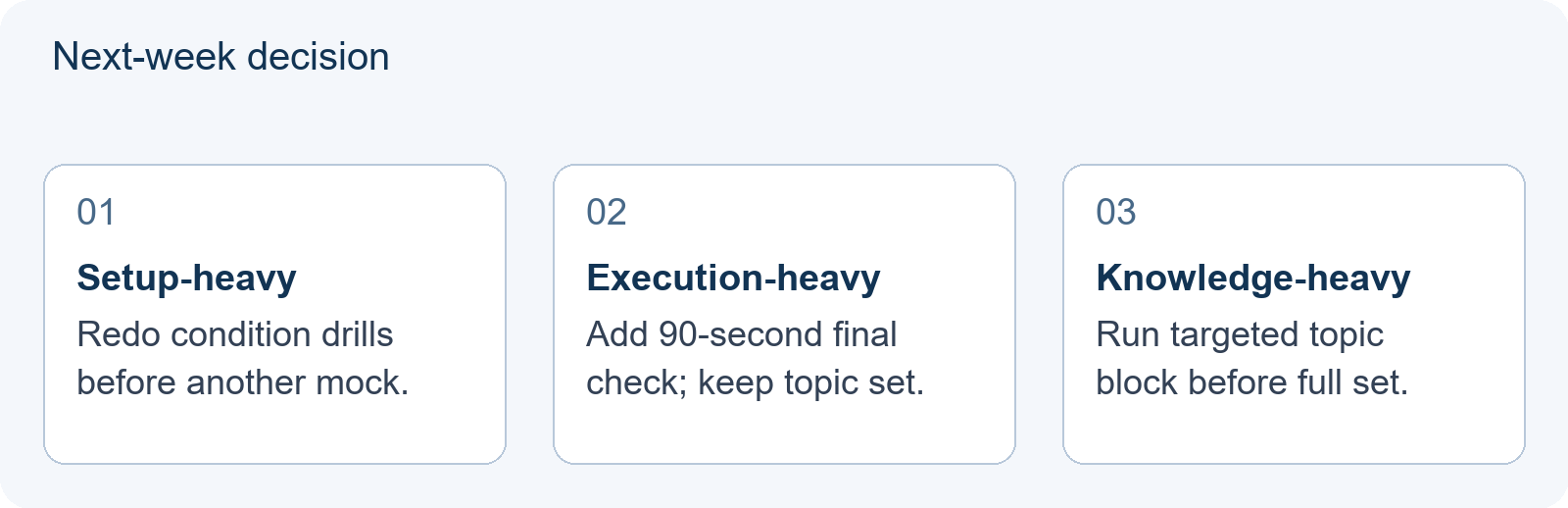
Decision rules for the next week

Dominant category Next seven days Evidence to re-check
Setup-heavy Condition and requested-quantity drills before another full mock You can restate the goal before solving
Execution-heavy Keep topic level; add a fixed 90-second final check Errors move into the check, not the plan
Knowledge-heavy One focused topic block before the next full set A fresh item starts without a hint
Mixed One dominant repair plus one secondary repair only The error log changes category, not just score

Use one weekly cycle: one mock, one classified review, one targeted repair set, then a short timed re-check. Do not take a second full mock merely because the first score felt low. The re-check should be shorter than a full mock and should test the repaired category under time pressure. If the same category repeats, review whether the repair was too broad and narrow it to one observable behaviour.

Rehearse the single 2027 sitting, then prepare a useful review conversation

The MAA Invitational Competitions page (2027 rules, accessed 16 November 2026) states that AIME has 15 integer-answer questions with answers 0-999, in two 90-minute sections of 8 and 7 questions; the first section cannot be revisited. It also states a Pearson testing window of 5-6 February 2027, a single window and one attempt, with AIME I/II discontinued. The source page is linked here: MAA Invitational Competitions. Because the 2027 setting removes a retake, a mock should rehearse the same no-return conditions, not only the score. For pacing practice around that change, see AIME Pacing Practice: Prepare for Your Region's 2027 Format. Hanlin is independent of the MAA, which sets AIME rules.

If you discuss a completed mock with a teacher or coach, prepare a compact evidence file: one completed mock or section, the original answer sheet, scratch work showing your setup and final line, and a three-column log with question number, category and one-line evidence. Add timing notes only if you actually recorded them. Bring one focused question, such as whether the next two weeks should prioritise setup drills, execution checks or a topic block. This preparation list is a decision aid, not a claim that every item is a separate service. A teacher can then respond to the evidence rather than to a raw score alone.

Next-week decision

Frequently Asked Questions

What is the first step after scoring an AIME mock?

Classify each miss as setup, execution or knowledge before choosing another mock. For the 2027 cycle, the MAA describes one attempt, so the review should produce next actions, not just a score.

How many categories should an AIME error log use?

Use three categories: setup, execution and knowledge. If a miss could fit two, assign the earliest category that would have prevented it, then write one next action for that category.

Should I take another full mock right after a low score?

Not usually. If setup-heavy, do condition drills first. If execution-heavy, add a fixed final check. If knowledge-heavy, repair one topic before a full set. Then use a short timed re-check.

AIME Pacing Practice: Prepare for Your Region's 2027 Format

Preparing for the American Invitational Mathematics Examination (AIME) requires more than just solving difficult problems; it demands precise time management matched to your region's specific format. As we look toward the 2027 competition cycle, a critical distinction emerges between the United States/Canada region and China. The US/Canada region adopts a new split-block format, while China retains its continuous 180-minute structure according to operator reports dated October 10, 2026. This article clarifies the specific format changes, explains why the pacing strategies diverge, and provides concrete practice methods for each region.

US/Canada 2027: Two 90-Minute Blocks With Comparable Difficulty

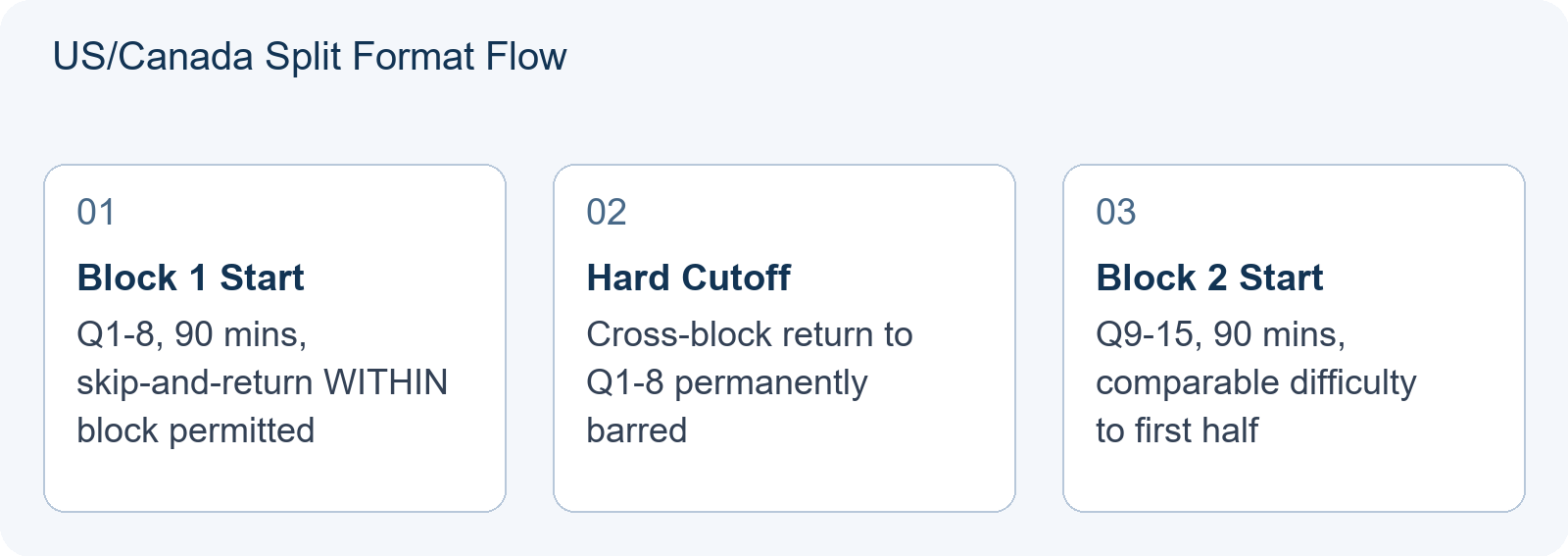
For students competing in the United States and Canada, the 2027 AIME introduces a structural overhaul verified by MAA official rules checked October 12, 2026. The exam is administered at Pearson Professional Centers in two distinct 90-minute parts with a short break between them. The first part contains questions 1–8; the second part contains questions 9–15. The critical constraint: once the second 90-minute block begins, students cannot return to questions 1–8. However, students MAY skip questions and return to them within the same 90-minute half. This within-half flexibility is essential to proper pacing strategy.

Importantly, MAA confirms the two halves have comparable difficulty—not the traditional pattern of early easy and late hard. This means students should not assume questions 1–8 are uniformly simple or that questions 9–15 are uniformly harder. The comparable-difficulty design rewards consistent performance across both blocks rather than front-loaded security.

Why the Split Format Changes Strategic Decisions

In the historical continuous format, a student stuck on question 4 could abandon it, progress through questions 5–10, and return to question 4 later with fresh perspective. The new US/Canada format preserves this flexibility WITHIN each 90-minute block but removes it ACROSS blocks. Time spent on questions 1–8 is permanently subtracted from questions 9–15, but time spent on question 3 can still be reallocated to question 7 if both fall within the same block.

The arithmetic bears examination: 90 minutes divided by 7 questions (second block) yields approximately 12.86 minutes per question, which is LARGER—not smaller—than the 12 minutes per question available across the full 180 minutes for 15 questions. The second block offers more time per question than the average, not less, though this must be weighed against the comparable difficulty of the problems.

Worked Teaching Illustration: Within-Half Return Strategy

Consider a student working through Block 1 (questions 1–8) with the following time expenditures: Q1 takes 10 minutes, Q2 takes 15 minutes, Q3 takes 10 minutes, Q4 takes 12 minutes, Q5 takes 15 minutes, Q6 takes 20 minutes. The cumulative time is 82 minutes. The student has 8 minutes remaining in Block 1 and CAN use this time to retry Q4, which had been skipped after initial difficulty. This within-half return is explicitly permitted and strategically valuable.

Contrast this with the same student in Block 2: if she spends 82 minutes on questions 9–13, the remaining 8 minutes cannot be redirected to Q4 from Block 1. The cross-block barrier is absolute.

China 2027: Continuous 180 Minutes, Full Self-Allocation

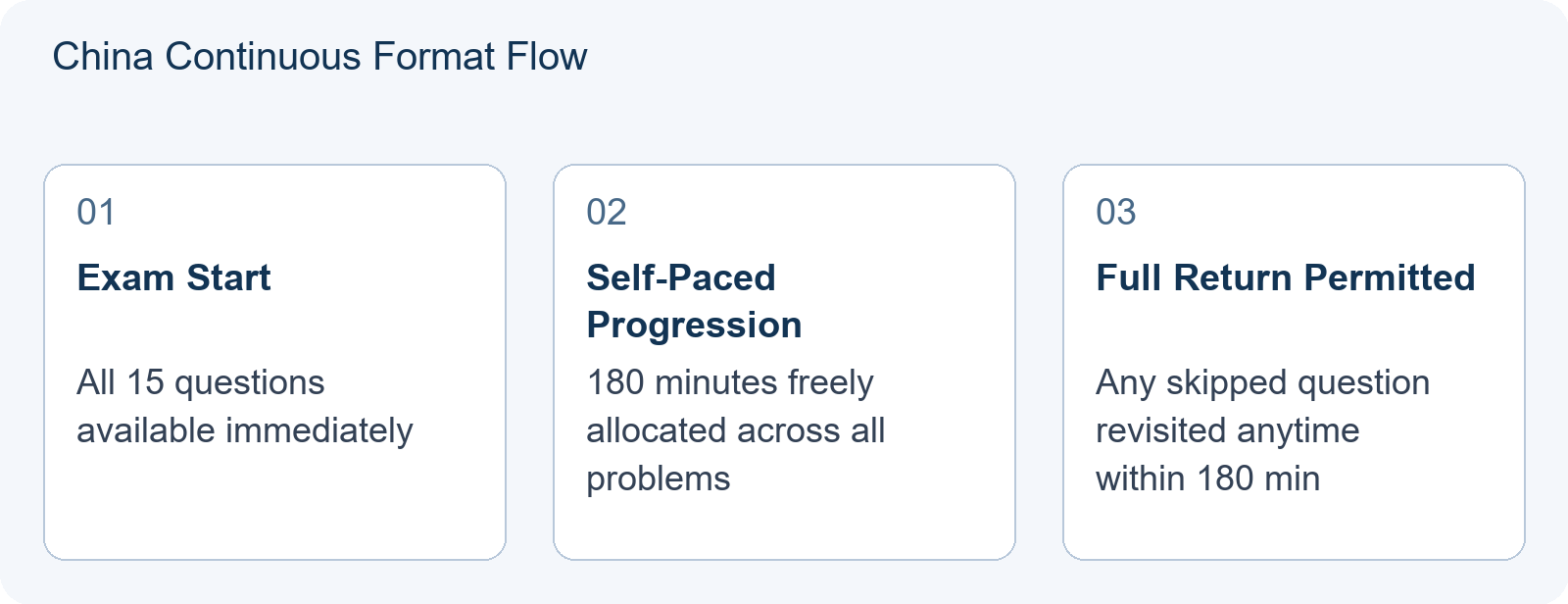
China's AIME implementation follows a different structure. According to operator reports dated October 10, 2026, Chinese candidates continue with a continuous 180-minute session for all 15 questions. Students retain full autonomy to allocate time across the entire exam and may return to skipped questions at any point. This is the confirmed format for the Chinese region, though it is not a MAA global guarantee—other regions may have different arrangements.

Implications for China Preparation

China students should not train for the 90+90 split. The relevant skills are three-hour stamina, strategic skipping with planned returns across the full exam, and dynamic time reallocation. A student who masters the US/Canada split-block drill would be underprepared for China's format, having trained to treat questions 1–8 as a closed chapter. Conversely, a China-trained student attempting the US/Canada format without adjustment would face difficulty at the 90-minute hard cutoff between blocks.

US/Canada Split Format Flow

Teaching Illustration: Same Student, Different Formats

Consider a student with typical per-question times on a past AIME: Q1–3 at 5 minutes each; Q4–6 at 10 minutes each; Q7–8 at 15 minutes each; Q9–10 at 20 minutes each; Q11–15 attempted only if time permits.

Scenario A: China Continuous Format

The student spends 15 minutes on Q1–3, then 30 minutes on Q4–6 (total 45 minutes). Q7 takes 15 minutes (60 minutes elapsed). Q8 takes 15 minutes (75 minutes). She has completed Q1–8 in 75 minutes, leaving 105 minutes for Q9–15. She attempts Q9 (20 minutes, 95 total), skips Q10 after 10 minutes of no progress, proceeds to Q11 (20 minutes, 125 total), returns to Q10 with 55 minutes remaining, and solves it with 25 minutes of additional work. She then attempts Q12 with 30 minutes left. Total completed: Q1–11. The cross-exam return to Q10 was decisive.

Scenario B: US/Canada Split Format (Same Student)

Block 1: Q1–3 (15 minutes), Q4–6 (30 minutes, total 45), Q7 (15 minutes, 60), Q8 (15 minutes, 75). She has 15 minutes remaining in Block 1. She uses 10 minutes to verify Q5, catches a calculation error, and corrects it. With 5 minutes left, she cannot productively start another problem, so she briefly reviews Q6. Block 1 ends with Q1–8 completed and verified.

Block 2: Q9 (20 minutes), Q10 (abandoned after 15 minutes of no progress), Q11 (20 minutes, 55 total), leaving 35 minutes for Q12–15. She attempts Q12 but makes no progress in 20 minutes, abandons it, and spends remaining time on Q13 with partial success. Total completed: Q1–9, Q11, partial Q13. The Q10 abandonment was correct given the block constraint; the Q12 attempt consumed time that could not be redirected to earlier questions.

Key Difference

In Scenario A, the return to Q10 added a completed problem. In Scenario B, the block boundary prevented this, and the student instead made progress on Q13. The continuous format rewarded persistence across the full exam; the split format rewarded securing early points and accepting strategic abandonment within each block. The optimal strategy is not merely "go faster"—it is "decide earlier within each bounded window."

Contrasting Case: When Old Paper Splits Mislead Preparation

A student preparing for US/Canada 2027 finds a 2015 AIME and splits it Q1–8 versus Q9–15 as a mock Block 1 and Block 2. However, older AIME papers may not reflect the new comparable-difficulty design. The 2015 paper might have genuinely easier problems in positions 1–8, leading the student to expect Block 1 to be comfortable. On the actual 2027 exam, with comparable difficulty across halves, Block 1 problems 6–8 may require Block 2-level effort. The student, unprepared for this, exhausts 90 minutes on only six problems and enters Block 2 with depleted confidence. The teaching illustration: do not assume old paper position numbers predict 2027 half difficulty. Use full timed blocks without pre-splitting by difficulty.

Diagnostic Application: Identify Your Regional Pacing Profile

Perform this timed diagnostic using any past AIME paper. For US/Canada candidates: set a hard 90-minute timer for Q1–8. You MAY skip and return within this window. Stop at 90 minutes. Reset for Q9–15. Record: (a) questions attempted per block, (b) questions completed per block, (c) time of first abandonment decision, (d) whether within-half returns were productive. For China candidates: run a continuous 180-minute session. Record cumulative time at each question's completion, note all skips and returns, and identify whether returns were productive.

Interpreting Your Results

If you are US/Canada-bound and your first abandonment occurs after minute 80 of Block 1, you are deciding too late. Target: abandon any problem consuming more than 12 minutes without clear progress, preserving time for within-half returns. If you are China-bound and your cumulative time on Q1–8 exceeds 90 minutes, you are front-loading and risking a rushed endgame. Target: complete Q1–8 in 75–85 minutes to preserve flexibility for returns across the full exam.

Next Steps: Region-Specific Practice Adjustments

For US/Canada students, incorporate "hard-stop" drills weekly: solve 8 questions from varied positions in a past paper in 90 minutes with within-half skip-and-return permitted, practicing early abandonment and return. For China students, take full 3-hour continuous tests biweekly, deliberately practicing skip-and-return sequences across the entire exam. Both groups should track accuracy rates separately for questions 1–5, 6–10, and 11–15 to identify where time investment yields the highest marginal return.

For further technique development, see our guides on AIME Polynomial Remainders: Solving Without Expanding Every Term and AIME Counting With Symmetry: When Dividing by the Number of Rotations Fails. For qualification context, refer to AMC Math Competition: A Guide to AIME Qualification and Preparation.

Practical Drill: The "Two-Pass" Block Strategy for US/Canada Candidates

The most common pacing failure in the new 90-minute split format is not running out of time, but spending it inefficiently on problems that yield no partial credit. AIME answers are integers from 0 to 999; there is no partial credit for work shown. Therefore, a student who spends 15 minutes attempting a problem and fails to produce an integer answer has gained zero points, whereas a student who spends 3 minutes verifying a solved problem secures those points. To address this, we introduce a structured "Two-Pass" drill specifically designed for the US/Canada 2027 format.

Step 1: The Rapid Scan (Minutes 0–15)

In your next practice session for Block 1 (Questions 1–8), do not start solving Question 1 immediately. Instead, spend the first 15 minutes reading all eight questions. Your goal is not to solve them, but to categorize each as "Confident," "Possible," or "Unknown." Mark these categories mentally or on your scratch paper. This initial investment prevents the trap of getting stuck on a difficult early question while easier later questions remain untouched. For example, if you identify Q6 as "Confident" but Q2 as "Unknown," you can prioritize Q6 after finishing Q1, ensuring you secure points from solvable problems before tackling harder ones.

Step 2: The Confident Pass (Minutes 15–45)

Solve only the questions marked "Confident." Aim to complete these within 30 minutes. If you finish early, use the remaining time to review your answers for calculation errors. This phase builds momentum and secures a baseline score. In a typical scenario, a strong student might find 4–5 questions in Block 1 to be "Confident." Completing these quickly frees up significant mental bandwidth for the more challenging "Possible" questions.

Step 3: The Strategic Return (Minutes 45–90)

Now, tackle the "Possible" questions. You have 45 minutes left. If you get stuck on one for more than 10 minutes without progress, abandon it and move to the next. Crucially, remember that you can return to skipped questions within this same block. Use the final 10 minutes to make a second attempt at any abandoned "Possible" questions with fresh perspective. This structured approach ensures that time is allocated based on expected point yield rather than question number order.

Diagnostic Check

After completing this drill, analyze your timing log. Did you spend more than 15 minutes on any single question during the "Confident Pass"? If so, your self-assessment was inaccurate—practice identifying true confidence levels. Did you leave any "Confident" questions unsolved? If yes, your scan phase was too rushed. Adjust your next drill by extending the scan to 20 minutes if necessary. This iterative refinement helps calibrate your internal clock to the 90-minute constraint, transforming abstract time management into concrete, measurable habits.

Conclusion

The 2027 AIME presents divergent pacing challenges. US/Canada candidates face a split format with comparable-difficulty halves that demands rapid decision-making, strategic within-half returns, and early security without assuming front-loaded ease. China candidates retain continuous 180-minute flexibility but must build three-hour stamina and disciplined self-regulation. Neither format is inherently easier—the challenge is alignment between preparation and reality. Verify your regional format with your local organizing body, then train specifically for that structure. Generic AIME practice without regional format awareness risks preventable timing errors.

China Continuous Format Flow

Frequently Asked Questions

Does the 90+90 minute split apply to China AIME 2027?

No. The 90+90 split is confirmed for US/Canada Pearson centers only. According to operator reports dated October 10, 2026, China's 2027 AIME uses a continuous 180-minute format with full time self-allocation. This is not a MAA global guarantee for all regions.

Can I return to questions from the first half during the second half in US/Canada format?

No. The cross-block return is permanently barred once Block 2 begins. However, within each 90-minute half, you MAY skip questions and return to them. For example, if you spend 82 minutes on questions 1-6, you have 8 minutes remaining to retry question 4 within Block 1.

What is the fixed AIME qualifying threshold for 2027?

MAA lists minimum AMC10/AMC12 thresholds of100/85 for this cycle, subject to all other applicable eligibility conditions. The minimum age13 requirement is specified for US/Canada Pearson administration; international participants should confirm their regional IGL requirements.

Online Consultation
Online Consultation