AIME Trigonometry: Reduce Symmetric Triangle Conditions With One Identity

Direct answer. For 2027 AIME preparation, when a triangle problem gives A+B+C=pi and a symmetric trigonometric expression in all three angles, first test whether the expression is unchanged by every permutation of A, B, C. If it is, pair two angles with sum-to-product, use A+B=pi-C, and convert the remaining terms to half-angles. The central reduction is cos A + cos B + cos C = 1 + 4 sin(A/2) sin(B/2) sin(C/2). Do not begin by assigning convenient angle values; that discards the constraint that makes the problem solvable. This is a Hanlin preparation discussion, not official MAA scoring guidance.

Hanlin's 4 November 2026 AIME preparation article, “2027 AIME Qualification Moves to Fixed Score Lines: Preparation Planning and a High-Energy Trial Class” (WeChat public account Hanlin Courses), observes that AIME algebra extends AMC12 with advanced trigonometric identities—auxiliary-angle, sum-to-product, and product-to-sum—and that symmetric expressions in the three angles of a triangle are part of that AIME algebra scope. The same article says trigonometric, coordinate, and complex-number computation drives difficulty in higher-numbered AIME geometry questions. That is the teaching problem this article addresses: choosing the first transformation without losing the angle-sum condition.

Why symmetric triangle trigonometry is different from polynomial symmetry

In polynomial problems, symmetry usually means that coefficients or roots can be permuted without changing the expression. Root relations then let you replace elementary symmetric sums by Vieta values. Triangle trigonometry has a different constraint: the variables are angles, and the relation is angular, A+B+C=pi, not a polynomial equation in independent roots. A symmetric expression such as cos A + cos B + cos C is not helped by solving for A, B, C. It is helped by turning the angular sum into a product of half-angle sines. For the polynomial-root counterpart, see AIME Vieta's Formulas: Find Symmetric Expressions Without Solving Every Root; the present method is different because the constraint is A+B+C=pi.

A second difference is the domain. Every angle of a nondegenerate triangle satisfies 0<A,B,C<pi, so each half-angle lies in (0,pi/2). Sines and cosines are positive there, which makes product bounds and equality conditions usable. If you copy a triangle identity into a problem where the three angles do not sum to pi, the identity is simply false. The domain is part of the method, not an afterthought.

The diagnostic: is the expression genuinely symmetric?

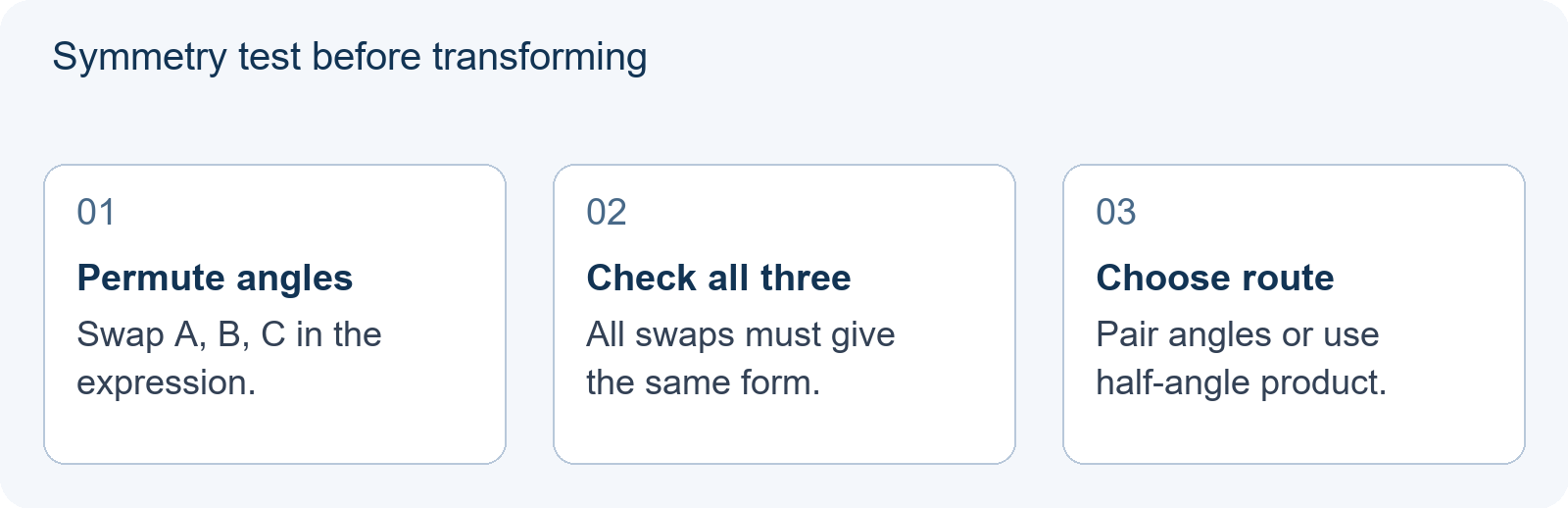
Before transforming, write the expression and test all swaps. If swapping A and B, or B and C, changes the expression, it is not fully symmetric. For example, under A+B+C=pi, the expression cos A + 2 cos B + 3 cos C is not symmetric because swapping A and B changes the coefficients attached to the angles. Pairing cos A + cos B may still be a legal algebraic step, but you cannot conclude that all three angles behave alike or that equality forces A=B=C.

A genuine three-angle symmetric expression must use all three angles in a permutation-invariant way. Simple examples are cos A + cos B + cos C, sin^2 A + sin^2 B + sin^2 C, and products such as sin(A/2) sin(B/2) sin(C/2). A one-angle expression such as 3 cos A + 4 sin A is not a three-angle symmetric problem; it is an auxiliary-angle problem hiding inside a triangle. The auxiliary-angle form R cos(A-phi) compresses one angle combination, but applying it blindly to a symmetric three-angle expression usually destroys the symmetry you need.

Transformation Use it when What it preserves Typical failure
Pair two angles with sum-to-product You see cos A + cos B or sin A + sin B Uses A+B=pi-C explicitly Forgetting the C/2 conversion and losing the constraint
Half-angle product The expression is symmetric in all three angles Turns the sum condition into a product or bound Treating half-angle sines as independent variables
Auxiliary angle One angle dominates, as in a cos theta + b sin theta Compresses one variable combination Applying it to all three angles and breaking symmetry

Symmetry test before transforming

The identity that carries the angle-sum constraint

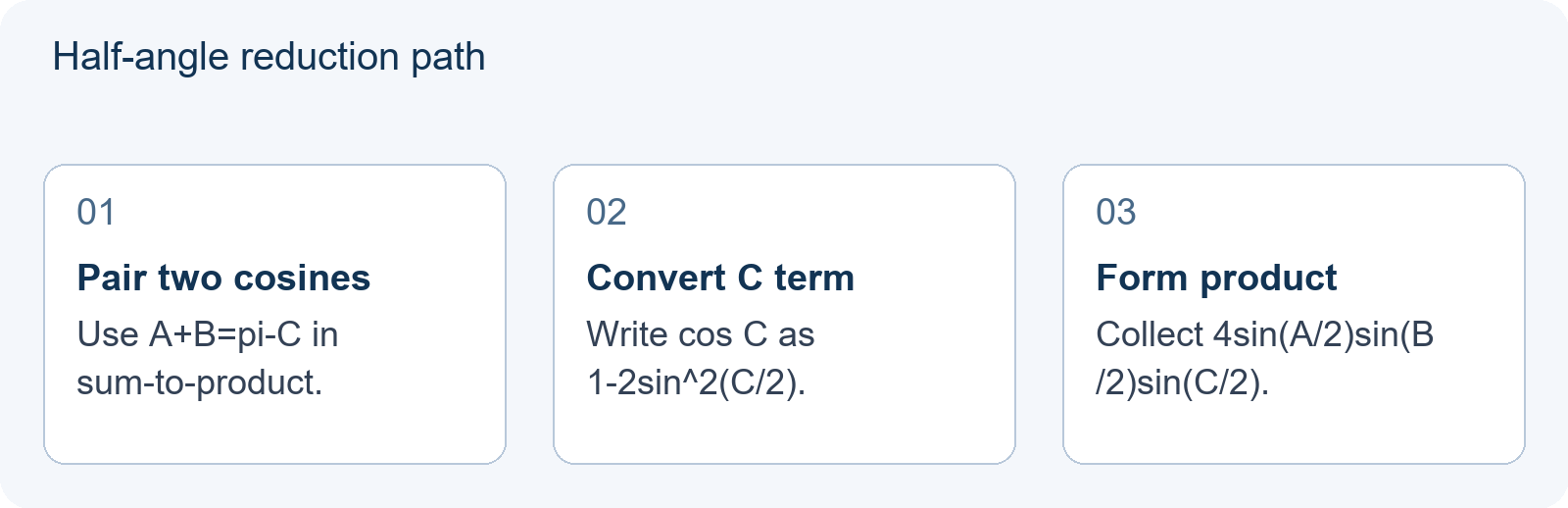
Start with the pair cos A + cos B. Since A+B=pi-C,

cos A + cos B = 2 cos((A+B)/2) cos((A-B)/2) = 2 sin(C/2) cos((A-B)/2).

Add cos C = 1 - 2 sin^2(C/2). Then

cos A + cos B + cos C = 1 + 2 sin(C/2)[cos((A-B)/2) - sin(C/2)].

Because sin(C/2)=cos((A+B)/2), the bracket is cos((A-B)/2) - cos((A+B)/2). The identity cos u - cos v = -2 sin((u+v)/2) sin((u-v)/2) gives

cos((A-B)/2) - cos((A+B)/2) = 2 sin(A/2) sin(B/2).

Multiplying by the outside factor 2 sin(C/2) yields

cos A + cos B + cos C = 1 + 4 sin(A/2) sin(B/2) sin(C/2).

This is the reduction to remember. It is valid exactly when A+B+C=pi and the angles form a nondegenerate triangle. The right side is visibly positive, so the left side is greater than 1 for every nondegenerate triangle. That simple domain check already rules out impossible conditions such as cos A + cos B + cos C = 1.

A fully worked teaching illustration (not a contest problem)

Teaching illustration. Suppose A, B, C are angles of a nondegenerate triangle, so A+B+C=pi and 0<A,B,C<pi. Suppose also that cos A + cos B + cos C = 3/2. Determine the triangle's angle structure.

Apply the identity: 1 + 4 sin(A/2) sin(B/2) sin(C/2) = 3/2, so

sin(A/2) sin(B/2) sin(C/2) = 1/8.

Let x=A/2, y=B/2, z=C/2. Then x+y+z=pi/2 and x,y,z lie in (0,pi/2). The function log(sin t) is concave on this interval, so Jensen's inequality gives

log(sin x)+log(sin y)+log(sin z) <= 3 log(sin((x+y+z)/3)) = 3 log(sin(pi/6)) = 3 log(1/2).

Exponentiating, sin x sin y sin z <= 1/8. The condition reaches equality. Equality in Jensen forces x=y=z=pi/6, hence A=B=C=pi/3. So the symmetric condition forces the equilateral triangle. The key is not the numerical answer equilateral by itself; it is that the identity turned a sum of cosines into a product whose maximum is controlled by the angle-sum constraint.

What changes when the expression is not symmetric

If the expression has unequal coefficients or treats one angle differently, do not force the half-angle product identity as a conclusion about all three angles. For example, with A+B+C=pi, the expression E=cos A + 2 cos B + 3 cos C is not permutation-invariant. You may still pair cos A + cos B and express C in terms of A and B, but the result will generally depend on the difference A-B. That is a signal that the problem is asking for a range, a relation, or a one-variable reduction, not an equilateral conclusion.

Similarly, a condition such as 3 cos A + 4 sin A = 2 is a one-angle auxiliary-angle problem. Rewrite it as 5 cos(A-phi)=2 for an appropriate phi, then use the triangle domain to restrict A. The mistake is to treat this as a symmetric three-angle condition merely because A appears inside a triangle. Symmetry is a property of the whole expression, not a mood created by the word triangle.

Common traps that invalidate an otherwise good method

  • Using a triangle identity outside A+B+C=pi. The half-angle product identity is not a general identity for arbitrary angles.
  • Losing the domain 0<A,B,C<pi. Half-angles are in (0,pi/2), so their sines are positive. If a derived product is zero or negative, the condition is impossible for a nondegenerate triangle.
  • Assuming every symmetric-looking expression becomes one variable. A sum of cosines can reduce to a product, but a sum with unequal coefficients usually retains a difference term.
  • Confusing equality of a product with equality of angles without checking the equality case. Jensen or AM-GM equality conditions must be stated and must lie inside the valid domain.

These traps matter because AIME geometry can reward trigonometric computation in higher-numbered questions. Hanlin's 4 November 2026 article makes the same teaching point: trigonometric fluency is not decorative; it is part of the computational toolkit for difficult AIME geometry. For a geometry-specific decision aid, see AIME Geometry Ratios: Choose an Auxiliary Line Before Chasing Lengths.

A three-step routine for AIME trigonometry practice

Use this routine before expanding anything. First, write the domain and the constraint: A+B+C=pi, 0<A,B,C<pi. Second, test symmetry by swapping two angles at a time; if any swap changes the expression, record that it is not fully symmetric. Third, choose the transformation: pair two angles if a sum-to-product is visible, use the half-angle product if the expression is symmetric in all three, and use an auxiliary angle only when one angle combination is genuinely isolated.

A short self-diagnostic: with A+B+C=pi, decide whether cos A + 2 cos B + 3 cos C is symmetric. It is not, because swapping A and B changes the expression. Decide whether cos(A-B)+cos(B-C)+cos(C-A) is symmetric. It is, because any permutation only reorders the three cosine terms. If you can make these two classifications quickly, you are less likely to apply the equilateral conclusion where it does not belong.

The 2027 AIME format change does not change the mathematics of this reduction, but it does change pacing decisions. The trigonometric reduction should be practised as a short, reliable first move, not as a long derivation during the exam.

Preparing a useful question for a consultation

A useful preparation review starts with one written attempt rather than a folder of unsorted problems. Mark the line where you chose a transformation: Did you pair angles, use an auxiliary angle, or expand? State whether you checked symmetry and whether you checked the triangle domain. That lets a teacher diagnose whether the bottleneck is identity choice, algebraic execution, or domain checking. A useful question is specific: “I paired cos A + cos B but did not know whether to convert C to C/2 or keep C,” not “Please explain AIME trigonometry.” This is preparation advice, not a promise that any particular checklist is a Hanlin service.

For the broader shift from AMC speed to AIME sustained reasoning, see AIME Preparation After AMC: When to Switch From Speed to Sustained Reasoning. Keep the trigonometric identity separate from procedural rules: qualification thresholds and exam logistics are set by the relevant authorities, while the reduction above is a mathematical method you can verify line by line.

General event background is available at Event background.
Half-angle reduction path

Frequently Asked Questions

When should I use sum-to-product in AIME trigonometry?

Use sum-to-product when two angles appear as cos A + cos B or sin A + sin B and the triangle condition A+B+C=pi lets you replace A+B with pi-C. It is a first move in a symmetric three-angle expression because it exposes half-angles and keeps the constraint visible.

Does cos A + cos B + cos C = 3/2 always force an equilateral triangle?

For a nondegenerate triangle with A+B+C=pi, yes. The identity gives sin(A/2)sin(B/2)sin(C/2)=1/8, and the maximum of that product under A/2+B/2+C/2=pi/2 is 1/8, attained only at A=B=C=pi/3. Outside that triangle domain, the conclusion does not apply.

What if the trigonometric expression is not fully symmetric?

Do not force the equilateral conclusion. Test swaps of the angles; unequal coefficients or a singled-out angle mean the expression is not permutation-invariant. You may still pair two terms or use an auxiliary angle, but the remaining difference or one-angle dependence must be handled explicitly.
AIME Complex Numbers: Use Roots of Unity to Count Without Expanding Powers

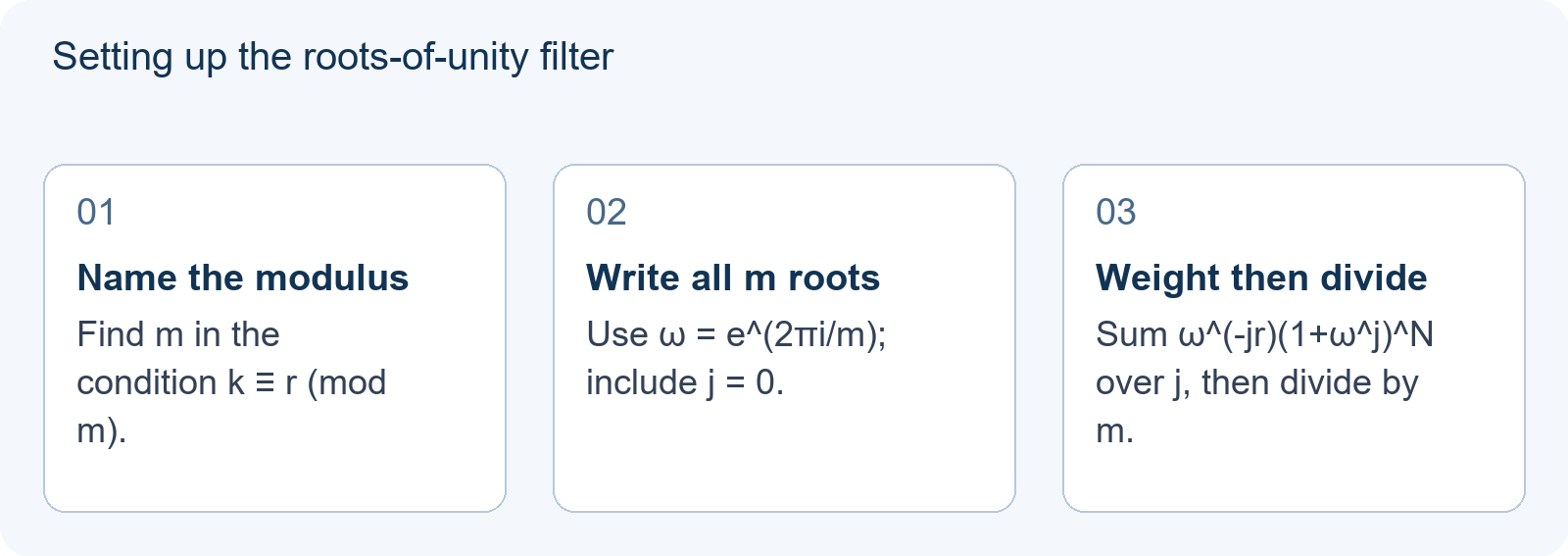
The direct answer: when an AIME-style question asks how many binomial coefficients C(N,k) have an index in a fixed residue class, you do not expand the row. Write m for the modulus in the condition and ω = cos(2π/m) + i sin(2π/m). Then

(1/m) Σj=0m-1 ω-jr(1 + ωj)N

equals the number of indices k with 0 ≤ k ≤ N and k ≡ r (mod m). Each index k carries a weight that averages to 1 when k is wanted and 0 when it is not, so nothing is enumerated and no Pascal row is built. The index range does not need to contain a complete residue system modulo m, because the weight is attached to each index separately; what the closed form needs is that the indices run as one unbroken block starting from 0, which is exactly what a full binomial row provides. Treat this as a technique for AIME complex numbers practice, not as a claim that a particular published problem uses it. AIME 2027 keeps 15 questions with integer answers from 0 to 999 (Hanlin Courses, “2026-27 AMC10/12 New Policies and AIME Reform: Authoritative Compilation”, 27 August 2026), so the final integer check remains part of the routine.

What signal tells you a roots-of-unity filter is the right move?

Four features can point to the filter. There is a congruence condition with a small modulus such as 2, 3, 4, 5 or 6. There is a high exponent N, so listing every coefficient is slow or error-prone. The answer is a total over many coefficients rather than one named coefficient. And the object being summed has a closed polynomial form, typically (1 + x)N, because that is what collapses each root-of-unity term into a single power.

Signal in the problem Filter appropriate? Reason
Indices with k ≡ r (mod m), small m Yes Each index gets a 1/m weight that survives the summation
Indices inside an interval, such as k ≥ 4 No, not by the basic full-row filter The weight cannot be switched off partway through a sum
Weights such as k·C(N,k) Yes, with care Differentiate a power instead of adding term by term
Counting over a recurrence or a list with no closed form No There is no single power to evaluate at each root

If the third row is your situation, the recurrence-period approach in AIME Recurrence Relations: Find the Period Before Expanding Long Sequences is the better first tool.

Why the identity holds: orthogonality in one line

Let t be any integer. The sum 1 + ωt + ω2t + … + ω(m-1)t is a finite geometric series with ratio ωt. If m divides t then every term is 1 and the sum is m. Otherwise the ratio is not 1 and the sum is zero. Dividing by m therefore produces an indicator: it returns 1 when m divides t, and 0 when it does not.

Now replace t by k − r. The indicator is 1 exactly when k ≡ r (mod m). Because a sum of indicators counts the members of a set, the count of wanted indices is the sum over all k from 0 to N of C(N,k) multiplied by that indicator. Swap the two sums, collect the k-th powers, and the binomial theorem gives (1 + ωj)N for each root j. The result is the closed expression above. Two practical notes follow immediately. The average is over all m roots, including the uninteresting-looking j = 0 term, which contributes 2N/m to the final average. And because the j and m − j terms are complex conjugates whenever the residue representative r is real, the total is always real; any surviving imaginary part means an arithmetic slip, not a genuine correction.

Setting up the roots-of-unity filter

Teaching illustration 1: multiples of 3 among the coefficients of (1+x)6

Teaching illustration, constructed for this article and verified by direct enumeration; it is not an actual AIME problem and carries no official status.

Count the coefficients C(6,k) whose index is divisible by 3. By hand the wanted indices are 0, 3 and 6, giving 1 + 20 + 1 = 22. With the filter, the condition has modulus m = 3, so use the three cube roots of unity, with ω3 = 1 and 1 + ω + ω2 = 0. The terms before division by 3 are: j = 0 gives 26 = 64; j = 1 gives (1 + ω)6, and since 1 + ω = −ω2, this is ω12 = 1; j = 2 gives (1 + ω2)6 = (−ω)6 = ω6 = 1. The total is 66, divided by 3 gives 22, matching the hand count. Notice that the modulus 3, not the exponent 6, fixes how many roots you use; the exponent only decides how large the powers become. Note also that adding the three contributions 64 + 1 + 1 before dividing is not optional shorthand: dividing each term by 3 first and rounding can create avoidable errors, so keep the exact total until the final division.

Teaching illustration 2: a residue class where the complex parts must cancel

Teaching illustration, again verified by enumeration and not an actual AIME problem.

Count the coefficients C(8,k) with k ≡ 1 (mod 4). By hand, k = 1 and k = 5 give 8 + 56 = 64.

With the filter, take ω = i, so the four roots are 1, i, −1, −i, and r = 1. The four terms, before division by 4, are:

  • j = 0: (1 + 1)8 = 256.
  • j = 1: i−1(1 + i)8. Since 1 + i has modulus √2 and argument π/4, its eighth power is 24 = 16, so this term is −i · 16 = −16i.
  • j = 2: (−1)−1(1 − 1)8 = −1 · 0 = 0.
  • j = 3: i−3(1 − i)8. Since i−3 = i and (1 − i)8 = 16, this term is 16i.

The imaginary parts cancel and the sum is 256, so the count is 64. This illustration earns its place because it shows the two habits that make the method safe. First, you evaluate a complex power by modulus and argument rather than by multiplying eight times: |1 + i| = √2 and arg(1 + i) = π/4 turn (1 + i)8 into 16 with no expansion. Second, the vanishing imaginary part is a free correctness check. If your bookkeeping had left 16i behind, you would know the error before it reached the answer line.

When the filter is the wrong instrument

The basic full-row filter answers one question only: how many indices fall in a residue class modulo m, summed over a full binomial row. It cannot directly answer a question whose condition is an interval, because the weight is designed to be constant across the whole index set and cannot be clipped. A concrete contrast makes the boundary clear.

Teaching illustration: sum the coefficients C(6,k) with k ≥ 4. The basic full-row filter cannot produce this directly, since it would deliver the count for a residue class across the entire row. Symmetry does the work instead. The row totals 26 = 64, the middle coefficient C(6,3) = 20 stands alone, and the remaining 44 splits evenly between k below 3 and k above 3, giving 22. Direct addition confirms it: 15 + 6 + 1 = 22.

Three further cases deserve the same suspicion. A modulus m larger than the binomial exponent N forces you to compute awkward powers such as (1 + ω)6 at a twelfth root, where the argument is unhelpful and direct counting may be the more practical route. A condition that mixes residues, such as k ≡ 0 (mod 3) and k odd, needs two weights multiplied together; it works in principle but adds an error surface that a small case check would not catch quickly. And a target defined by an inequality inside the collision, such as counting only pairs with a bounded index difference, is a different problem type entirely; the overlap-counting logic in AIME Counting With Symmetry: When Dividing by the Number of Rotations Fails is the relevant neighbour there.

Turning the count into a recorded three-digit integer

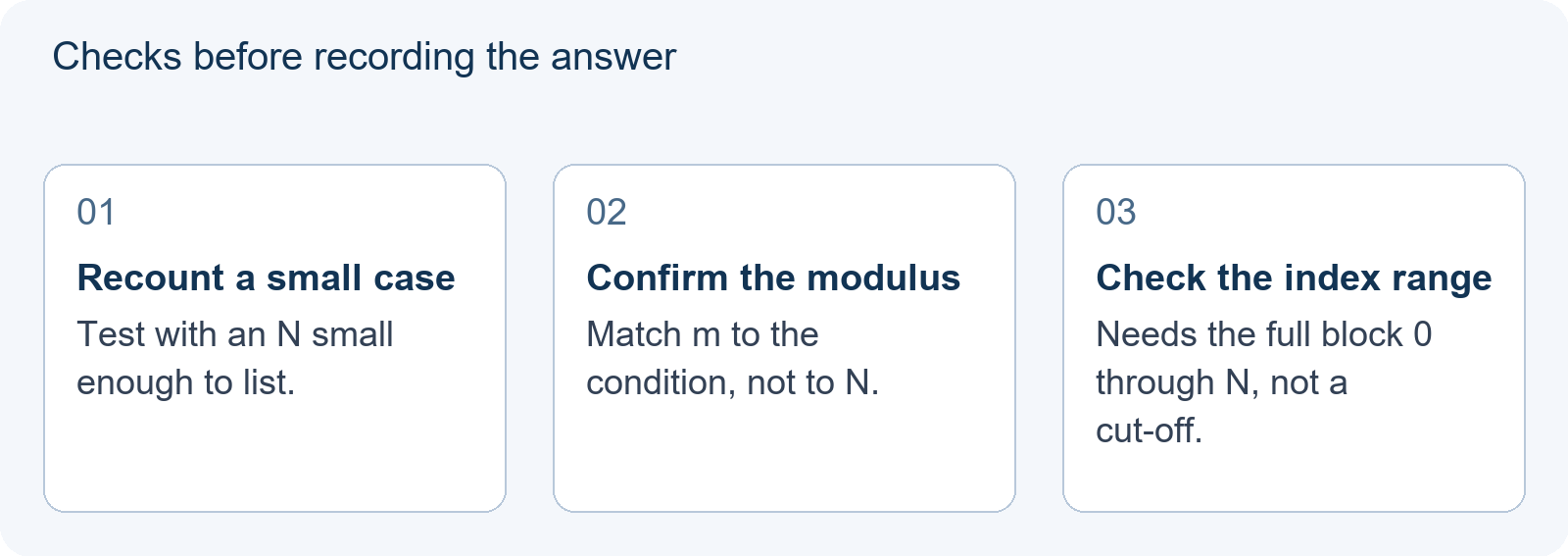
Because AIME answers are integers from 0 to 999 (Hanlin Courses, 27 August 2026), any fractional result is diagnostic rather than unfortunate: it means the number of roots and the modulus did not match, or the division by m was applied unevenly. Before writing the answer, run these three questions.

  • Did I use exactly m roots for a modulus of m, including j = 0?
  • Is my pre-division total an integer, and does dividing by m give an integer?
  • Does a two-line hand check on a smaller exponent agree with the same filter?

If the third check fails, the error is in the setup, not the arithmetic, and no amount of re-adding will fix it. The final-minute checks for recording an integer are the same ones used across AIME practice.

Preparing a specific question for an AIME consultation

A consultation is more useful when it diagnoses a method rather than replays a lecture. Bring one roots-of-unity attempt, written out in full, with the modulus you chose and the total you obtained before dividing. Mark which of the three stages stalled: choosing m, evaluating the powers, or the final division and integer check. That single page lets a teacher tell you whether your difficulty is conceptual, arithmetic, or simply a range assumption, and whether the better route for that problem is filtering, direct counting, or symmetry.

Roots of unity and De Moivre’s theorem are treated as AIME complex-number content in Hanlin’s own preparation material: the Hanlin Courses note of 4 November 2026, “2027 AIME Qualification Switches to Fixed Score Lines: Preparation Planning and an Experience Class”, lists complex numbers with De Moivre’s theorem and roots of unity as the subject of its 7 November 2026 AIME experience class. The wider question of when to shift from AMC speed work to sustained AIME reasoning is addressed in AIME Preparation After AMC: When to Switch From Speed to Sustained Reasoning. International candidates should also confirm their own registration route with their International Group Leader; the Pearson-center process is not a China procedure.

The transferable habit

The filter is worth learning not because it is clever, but because it converts a counting question into a two-part routine: choose the modulus, then evaluate powers at roots. Once that routine is automatic, the remaining risk is mainly in bookkeeping, which is why the imaginary-part check and the small-case recount carry more value in a timed paper than another memorised identity.

General event background is available at Event background.

Checks before recording the answer

Frequently Asked Questions

Does the roots-of-unity filter still work if the exponent range is cut short?

No. The weighting step is still valid for any chosen index set, but the collapse into a single power such as (1 + ω)^N requires the indices to run as one unbroken block from 0 through N. If the problem covers only part of the row, use symmetry or direct counting instead.

Do I need all m-th roots, or only the primitive ones?

All m of them for modulus m. Each root contributes one term, and the j = 0 term supplies 2^N/m to the final average. Dropping roots breaks the averaging that makes unwanted indices count as zero.

Is this method guaranteed to appear on the 2027 AIME?

No topic is guaranteed. What can be said is that AIME 2027 keeps 15 questions with integer answers from 0 to 999, and roots of unity with De Moivre’s theorem are treated as AIME complex-number content in Hanlin’s 4 November 2026 preparation note. Treat the method as a reliable tool, not a prediction.

AIME Recurrence Relations: Find the Period Before Expanding Long Sequences

Direct answer. For many AIME recurrence relations, the fastest route is not to compute hundreds of terms. If a recurrence uses the previous two terms modulo m, record the ordered state pair (an-1, an). Because the pair determines every later term, the sequence must eventually repeat a state. Find the first return of the initial pair when it occurs (otherwise separate any tail from the cycle), call the cycle length p, reduce the target index modulo p, and compute only the needed residue. This is a strategy lesson, not a claim about one official contest question.

Why long expansion is usually the wrong first move

A recurrence such as an = an-1 + an-2 modulo 7 looks harmless for the first ten terms. By the two-hundredth term, hand expansion becomes slow and error-prone. If the target is a2027, expanding is even worse. The exam setting rewards structure: identify what controls the future, prove that a cycle must occur, then jump to the required index.

This is also where careless work appears. Students often compute a correct list but lose the index count, reduce the wrong starting index, or assume a period before checking that the state has actually returned. A good solution separates three tasks: find the cycle, compute the remainder, and verify the final value against the recurrence.

The same state idea appears in modular arithmetic problems where only remainders matter. If you want more practice with that family, the site's AIME Modular Arithmetic: Recover an Integer From Two Remainders is a useful companion because the period method depends on clean residue computation.

The state-pair method in four moves

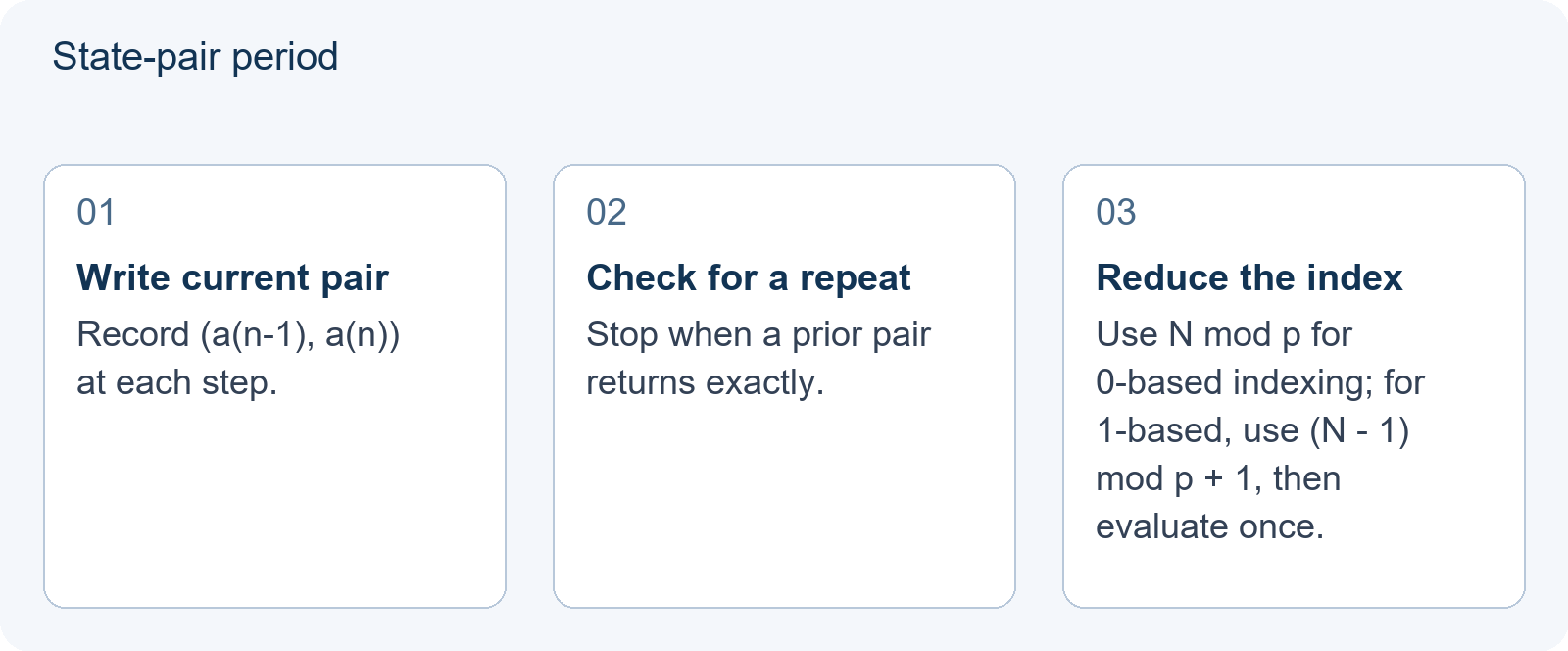
  1. Write the state. For a second-order recurrence, the state at step n is the ordered pair (an-1, an). The order matters: (2,5) and (5,2) are different states.
  2. Generate pairs, not just terms. Compute an+1, then record the new pair (an, an+1). Keep a table with columns for n, an, and the current pair.
  3. Stop when the initial pair returns. If the pair at n = 1 is (a0, a1) and the same pair appears at n = p + 1, then the sequence repeats every p indices from the start.
  4. Reduce the target index. For aN, compute N modulo p. Use the remainder to choose a small term from the verified cycle. Do not round the remainder or shift the index unless the sequence is indexed from a1.

There is a guaranteed bound worth remembering. For modulus m, a second-order recurrence has at most m2 possible ordered pairs. Therefore a repeat must occur within m2 + 1 states. The actual period can be much shorter, so the bound is a safety net, not a target. For modulus 1000, there are one million possible pairs, so the guaranteed repeat bound is just over one million states, which is too large for hand work; in contest problems, the useful discovery is usually a much smaller cycle or a structural shortcut.

State-pair period

Worked teaching illustration: Fibonacci modulo 7

Teaching illustration only, not a past AIME problem. Define a0 = 0, a1 = 1, and an = an-1 + an-2 modulo 7 for n at least 2. Find a2027.

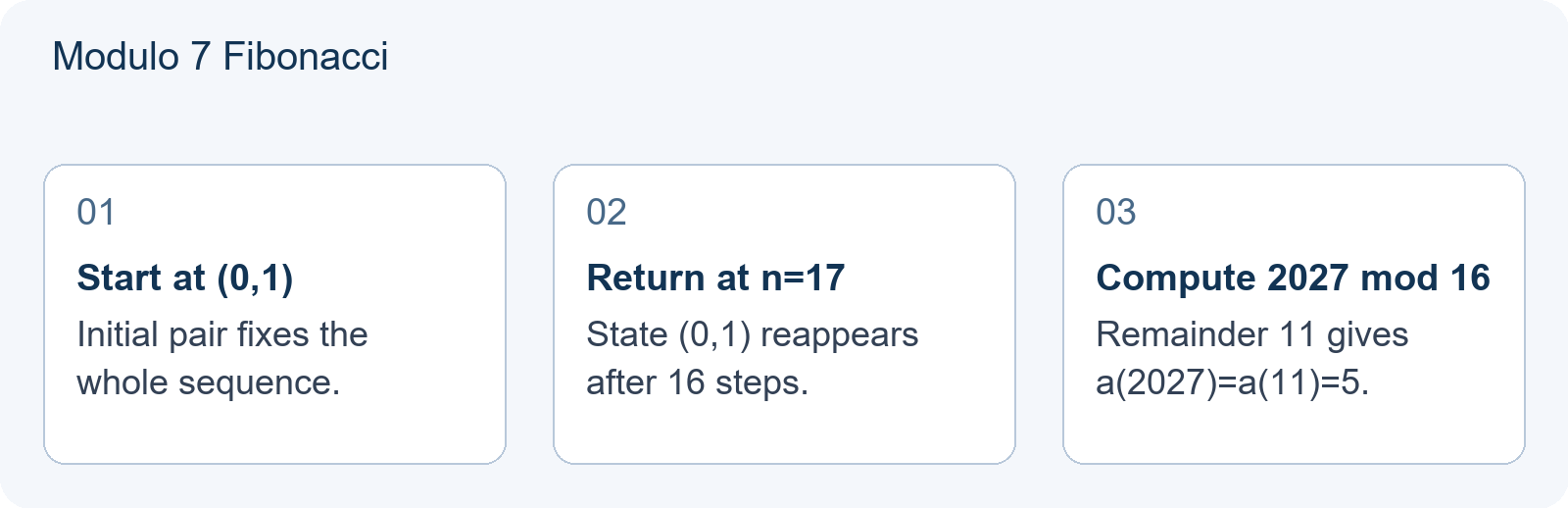
Compute terms modulo 7: 0, 1, 1, 2, 3, 5, 1, 6, 0, 6, 6, 5, 4, 2, 6, 1, 0, 1. At n = 1 the state is (0,1). At n = 17 the state is (a16, a17) = (0,1), the same pair. The gap between matching states is 16, so the sequence has period 16 from the start.

Now reduce the large index: 2027 = 16 × 126 + 11, so 2027 modulo 16 is 11. Therefore a2027 = a11 = 5. The key check is not just that a17 = 1; the state pair must match, because the pair controls the next term.

A second teaching illustration with a different modulus

Teaching illustration only, not a past AIME problem. Let b0 = 0, b1 = 1, and bn = 2bn-1 + bn-2 modulo 5. Compute b2026.

The terms begin 0, 1, 2, 0, 2, 4, 0, 4, 3, 0, 3, 1, 0, 1. The initial state at n = 1 is (0,1). At n = 13 the state is (b12, b13) = (0,1), so the period is 12. Since 2026 = 12 × 168 + 10, the target index reduces to 10. Thus b2026 = b10 = 3.

Teaching recurrence Modulus Pair bound m2 Period found Index reduction Result
Fibonacci: an = an-1 + an-2 7 49 16 2027 mod 16 = 11 a2027 = 5
bn = 2bn-1 + bn-2 5 25 12 2026 mod 12 = 10 b2026 = 3

Index conversion and off-by-one traps

The most common AIME recurrence error is a one-index shift. If a sequence starts at a0 and a state repeats at n = 1 and n = 17, the period is 16. That means an+16 = an for every n in the cycle. It does not mean a17 = a1 is enough by itself; the whole state must match.

If a sequence starts at a1, convert carefully. Suppose the first two terms are a1 and a2, and the state repeats after p steps. Then an+p = an for n at least 1. To reduce aN, compute (N − 1) modulo p, then add 1. Skipping that adjustment can move the answer by one term, which is fatal when the final answer must be a single integer.

Write the index convention at the top of your scratch work. A clean habit is to make a small table with three columns: index n, term an, and state. When the state returns, mark the first occurrence and the return occurrence. The difference is the period, while the term values alone do not prove periodicity.

What if the first repeated pair is not the starting pair?

Some recurrences have a short tail before the cycle begins. The state method still works, but the reduction changes. Record the first occurrence of each state. If a state first appears at step r and next appears at step s, then the cycle length is s − r, with the first occurrence at step r marking the start of the cycle. For a target index N beyond the preperiod, reduce N − r modulo the cycle length, then add r.

Do not automatically assume that every repeating sequence is periodic from the initial pair. That assumption is only safe after the initial state itself has returned. For many contest recurrences the cycle starts immediately, but a careful solution states why. The state-pair table gives you the evidence, not a guess.

How to check a period claim before trusting it

First, check that two consecutive terms match the starting pair. If the recurrence depends on the previous two terms, matching only one term is not enough. Second, check that the return is the first return of that state; otherwise you may have found a multiple of the true period. Third, recompute the reduced index directly from the table. A final value should satisfy the original recurrence when you step one term forward and one term backward where possible.

This checking habit is the same one used in other integer-answer settings: verify the condition that defines the answer, not just the arithmetic that produced it. The site's AIME Answer Checking: Catching Extraneous Roots Before Recording an Integer guide is relevant because recurrence questions often fail at the final integer, after the hard structure has already been found.

A practical practice routine for AIME recurrence relations

Use short, repeatable drills rather than long random expansion.

  1. Five-minute warm-up. Choose a modulus from 3 to 9 and a second-order recurrence. Build the state table until the initial pair returns. Write the period and one sentence explaining why the return proves repetition.
  2. Index drill. Ask for three targets: one small, one exactly on a period boundary, and one just after a boundary. This exposes off-by-one errors immediately.
  3. No-calculator residue practice. Reduce the target modulo the period by hand. Keep the quotient and remainder visible so the reduction can be audited.
  4. Error review. When an answer is wrong, classify the error as state error, period error, index error, or arithmetic error. Recurrence practice improves fastest when the error type is named.
  5. Timed set. After accuracy is stable, practise choosing quickly between direct computation and period discovery. This is a pacing decision as much as a mathematical one. The site's AIME Pacing Practice: Prepare for Your Region's 2027 Format guide supports that broader training choice.

How preparation support should respond

A useful recurrence lesson should ask the student to explain why the state pair determines the future, not merely to memorise a period. A Hanlin Course teacher profile published 25 October 2024 describes a coaching preference for guided reasoning and independent thinking rather than answer routines. Applied here, that means the teacher should ask: what information is needed to compute the next term, what would make the sequence repeat, and how do we know the repeat is the first one? Those questions transfer to unfamiliar recurrences.

Parents deciding on preparation support can look for worked solutions that show the state table, the period claim, and the index reduction in that order. A page that only lists terms and announces a period is less useful than one that exposes the logic. The goal is not to make every recurrence look the same; it is to build a reliable first move when the sequence is long, the modulus is fixed, and the answer must be an integer.

For independent practice, keep a one-page template: recurrence, modulus, starting state, first return, period, target reduction, final check. Fill it in for several small moduli before attempting a long-index problem. The template turns a messy expansion into a short, auditable argument.

General event background is available at Event background.

Modulo 7 Fibonacci

Frequently Asked Questions

What does period mean in an AIME recurrence relation?

It is the number of steps after which the controlling state returns to an earlier state. For a second-order recurrence, the state is the ordered pair of the previous two terms. If the initial pair returns after p steps, the sequence repeats every p indices from that point.

Do I need to prove that a recurrence is periodic?

For a finite modulus, a repeat of some state is guaranteed because only finitely many ordered pairs exist. In a written solution, show the state table and identify the first repeated state. If the initial pair returns, that proves a period from the start; if a later state repeats first, record the tail and cycle separately.

What if the recurrence uses three previous terms?

Use a three-term state instead of a two-term pair. The same logic applies: the state determines all future terms, so a repeat gives a cycle. The state-space bound becomes m cubed, so the bound is larger, but the method is unchanged.

AIME Vieta's Formulas: Find Symmetric Expressions Without Solving Every Root

For students preparing for the American Invitational Mathematics Examination (AIME), algebraic fluency is not merely about the ability to solve equations. It is fundamentally about recognizing structure. A common trap in polynomial problems is the instinct to find every individual root explicitly. In many AIME-style questions, the roots are irrational, complex, or simply too cumbersome to calculate by hand. Attempting to do so wastes precious minutes and introduces significant risk of arithmetic error. The efficient path often lies in AIME Vieta's Formulas, which connect polynomial coefficients directly to symmetric expressions such as sums of squares, reciprocal sums, and sums of cubes.

The AIME consists of 15 questions where answers must be integers between 0 and 999 inclusive. This strict answer format rewards clean symbolic work. If a problem asks for a symmetric function of roots, you should almost never solve for the roots first. Instead, you must translate the question into the language of coefficients. This article explores how to manipulate these symmetric expressions using only the sums and products derived from Vieta's formulas, emphasizing the efficiency crucial for the AIME's tight time limits.

The Core Principle: Coefficients Encode Root Relationships

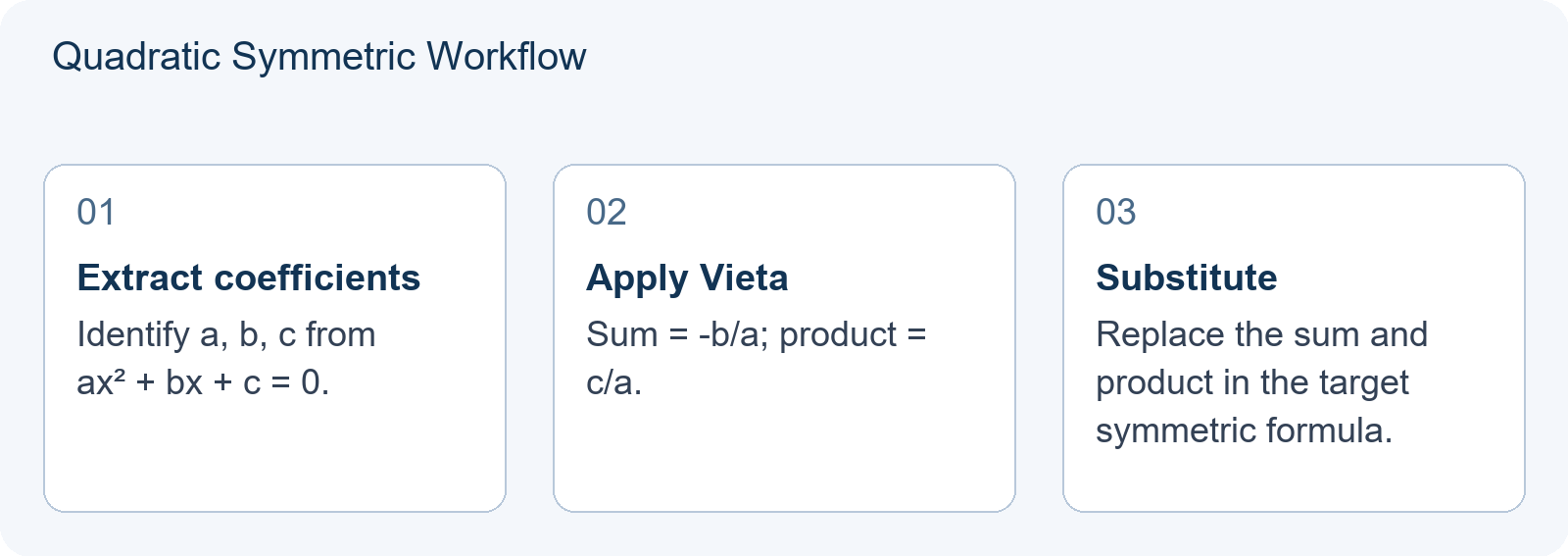
Vieta's formulas establish a direct link between the coefficients of a polynomial and the elementary symmetric sums of its roots. For a quadratic equation ax2+bx+c=0 with roots r1 and r2, the relationships are:

  • r1+r2=−ba
  • r1r2=ca

For a cubic equation ax3+bx2+cx+d=0 with roots r1,r2,r3, the pattern extends to three elementary symmetric polynomials:

  • e1=r1+r2+r3=−ba
  • e2=r1r2+r2r3+r3r1=ca
  • e3=r1r2r3=−da

For a general polynomial P(x)=anxn+an−1xn−1+⋯+a0, the sum of the roots is −an−1an, and the product of the roots is (−1)na0an. These identities hold whether the roots are real or complex. That universality is exactly why they are useful in AIME preparation: a polynomial may not factor over the integers, but its coefficients still encode the symmetric information you need. Understanding this distinction allows you to bypass the messy radical calculations entirely.

Identifying Symmetric Expressions

An expression is symmetric if swapping any two roots does not change its value. Examples include r12+r22, 1/r1+1/r2, and r13+r23. Because these expressions depend only on elementary symmetric sums, they can be rewritten in terms of coefficients. This is the key insight: if the target quantity is symmetric, it is determined solely by the coefficients.

By contrast, an expression such as r1−r2 is not symmetric. Swapping r1 and r2 changes the sign of the result. Vieta's formulas alone cannot determine the value of non-symmetric quantities without additional information, such as the discriminant or specific ordering constraints. This distinction matters significantly in test-taking strategy: if a problem asks for a non-symmetric quantity, you may need a different tool like the quadratic formula or geometric interpretation. If it asks for a symmetric quantity, Vieta's formulas should be your immediate first check.

Quadratic Symmetric Workflow

Technique 1: Squaring the Sum

A productive application in AIME algebra is finding the sum of squared roots. Students often solve for r1 and r2 individually, then square them. This is inefficient. Instead, expand the square of the sum:

(r1+r2)2=r12+2r1r2+r22

Rearranging gives the identity:

r12+r22=(r1+r2)2−2r1r2

Teaching illustration, not an official contest problem: For the quadratic x2−5x+1=0, Vieta gives r1+r2=5 and r1r2=1. Therefore r12+r22=52−2(1)=25−2=23. The roots are rac5±212, which are irrational, but you never need to write them. The coefficient calculation is immediate and exact.

For three roots, the same idea becomes:

r12+r22+r32=(r1+r2+r3)2−2(r1r2+r2r3+r3r1)

In terms of elementary symmetric polynomials, this is e12−2e2. This is a useful Vieta identity for AIME algebra problems because it converts a root question into two simple coefficient lookups.

Technique 2: Reciprocal Sums

Problems asking for 1/r1+1/r2 require combining fractions. The common denominator is the product of the roots:

1r1+1r2=r2+r1r1r2=e1e2

For a cubic, two related identities are particularly useful:

  • 1r1+1r2+1r3=r1r2+r2r3+r3r1r1r2r3=e2e3
  • 1r1r2+1r2r3+1r3r1=r1+r2+r3r1r2r3=e1e3

These are especially useful when the roots are messy but the elementary symmetric sums are simple integers. A reciprocal sum may be a fraction as an intermediate value. That is acceptable. The final AIME answer must be an integer from 0 to 999, but the symmetric expression inside a problem can be fractional before a later step combines it with other terms.

Technique 3: Sum of Cubes and Newton's Sums

For two roots, the sum of cubes follows from the identity:

r13+r23=(r1+r2)3−3r1r2(r1+r2)=e13−3e1e2

For three roots, the corresponding identity is:

r13+r23+r33=e13−3e1e2+3e3

While memorizing these specific expansions is helpful, a more powerful general tool is Newton's Sums. Let Sk=r1k+r2k+…+rnk. For a monic polynomial xn+c1xn−1+c2xn−2+…+cn=0, the recurrence relation for 1≤k≤n is:

Sk+c1Sk−1+c2Sk−2+…+ck−1S1+kck=0.

For k>n:

Sk+c1Sk−1+…+cnSk−n=0.

This systematic approach allows you to compute S4,S5, etc., without memorizing complex multinomial expansions. A useful preparation benchmark is to know the pattern up to S3; the recursive structure then extends to higher powers if a problem requires it.

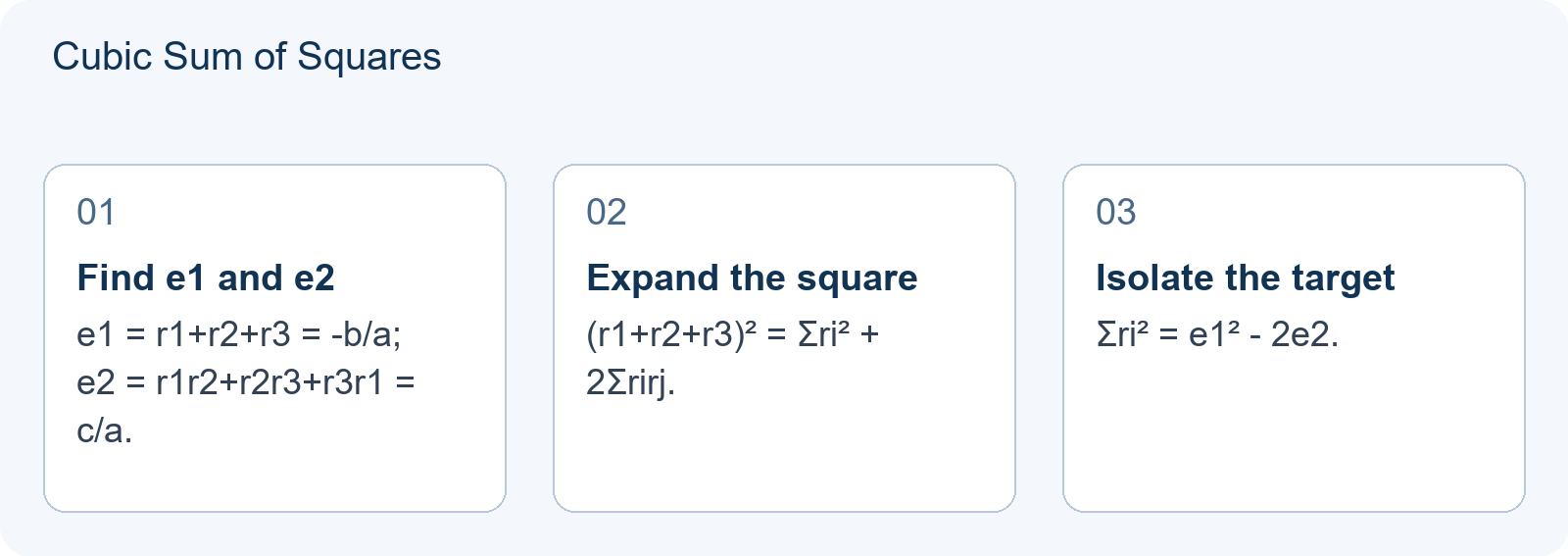
Worked Example: Cubic Sum of Squares

Teaching illustration, not an official contest problem: Suppose the roots of P(x)=x3−4x2+6x−4 are r1,r2,r3. Find r12+r22+r32.

Step 1: Identify coefficients. Here a=1, b=−4, c=6, d=−4.

Step 2: Apply Vieta's formulas to find elementary symmetric sums.

  • e1=r1+r2+r3=−(−4)/1=4
  • e2=r1r2+r2r3+r3r1=6/1=6
  • e3=r1r2r3=−(−4)/1=4

Step 3: Use the square-of-sum identity.

(r1+r2+r3)2=r12+r22+r32+2(r1r2+r2r3+r3r1)

e12=S2+2e2

42=S2+2(6)

16=S2+12

S2=4

The answer is 4, which is an integer in the AIME answer range. You can verify this by factoring: P(2)=8−16+12−4=0, so (x−2) is a factor. Division gives x2−2x+2, whose roots are 1+i and 1−i. Their squares are (1+i)2=2i and (1−i)2=−2i. The total sum of squares is 22+2i−2i=4. The coefficient method avoids all complex arithmetic.

Avoiding the 'Solve First' Trap

The primary advantage of mastering AIME Vieta's Formulas is time management. AIME problems often reward the shortest valid path, not the most explicit one. Spending several minutes calculating irrational or complex roots when a short substitution exists is a strategic error. Manual root calculation also increases the risk of sign errors, especially with negative coefficients or when dealing with conjugate pairs.

Before solving, ask: is the requested quantity symmetric in the roots? If yes, write it in terms of the sum and product. If the polynomial is cubic, write it in terms of the sum, pairwise sum, and product. If the expression is not symmetric, Vieta may still help as one part of a larger solution, but it will not determine the value alone. Recognizing this symmetry instantly saves cognitive load.

Final Check: Integer Constraints and Sign Errors

After deriving a symmetric expression, verify that the final requested result fits the AIME answer format: an integer from 0 to 999. If your calculation yields a fraction or a non-integer, re-examine the problem statement and your Vieta signs. Did you miss a leading coefficient? Did you forget the alternating sign in the product term?

Common errors include forgetting the negative sign in −b/a, misidentifying the constant term in a cubic, and mixing up the product formula for even and odd degree. For a quadratic ax2+bx+c, the product is c/a. For a cubic ax3+bx2+cx+d, the product is −d/a. The alternating sign is not optional. Always double-check the parity of the degree when calculating the product of roots.

For a complementary check on recording integer answers and avoiding extraneous results, see the related guide on AIME Answer Checking: Catching Extraneous Roots Before Recording an Integer.

Related Coefficient Methods

Vieta's formulas are not the only coefficient-shortcut in AIME algebra. Remainder problems also often become manageable when you avoid expanding every term. If you want to strengthen the same coefficient-focused instinct, review the method in AIME Polynomial Remainders: Solving Without Expanding Every Term. Both techniques rely on treating the polynomial as a black box defined by its coefficients rather than its roots.

Integrating Algebra into Broader Preparation

Polynomial manipulation is rarely isolated. It intersects with number theory, geometry, and combinatorics. For example, integer-root questions may require checking divisors of the constant term, while symmetric sums help analyze root distributions. The practical goal is not to memorize every identity but to build a reflex: when a problem mentions roots, scan for elementary symmetric sums.

For students moving from AMC-style speed rounds into AIME-style sustained reasoning, pacing changes matter. A useful companion article is AIME Preparation After AMC: When to Switch From Speed to Sustained Reasoning. Vieta practice fits that transition because it reduces computation while increasing the amount of structure you must recognize. Similarly, understanding qualification targets helps prioritize which algebraic skills yield the highest return on investment, as discussed in AIME Qualification Targets: Build a Reliable Margin Above the AMC Cutoff.

A Short Practice Plan

To make Vieta's formulas automatic, practice with a deliberate sequence.

  1. Start with quadratics. For random coefficients, compute r1+r2, r1r2, r12+r22, and 1/r1+1/r2.
  2. Move to cubics. Compute e1, e2, e3, then evaluate r12+r22+r32 and r13+r23+r33.
  3. Read past AIME polynomial problems and identify which ones ask for symmetric expressions before attempting any root calculation.
  4. Practice Newton's Sums for S4 on a cubic to understand the recursive pattern.

This kind of practice is more useful than simply reading solved examples. The skill is recognizing the pattern under time pressure, not just agreeing with a solution after it is shown.

Final Takeaway

When an AIME polynomial problem asks for a symmetric expression of roots, do not solve for the roots first. Use Vieta's formulas to translate the expression into coefficients. For quadratics, use sum and product. For cubics, use sum, pairwise sum, and product. Verify the final integer range and watch the alternating signs. With enough practice, AIME Vieta's Formulas become a fast, reliable tool rather than a formula to look up, giving you a decisive edge in both accuracy and speed.

Cubic Sum of Squares

Frequently Asked Questions

Can Vieta's formulas be used if the roots are complex?

Yes. Vieta's formulas apply to all roots of a polynomial, including complex numbers. When the coefficients are real, symmetric expressions of conjugate pairs produce real values, and the AIME integer answer format means the final expression must resolve to an integer.

What if the leading coefficient is not 1?

You can still use the general rules directly. For a quadratic, the sum is -b/a and the product is c/a. For a cubic, the product is -d/a. For a general degree-n polynomial, the product of roots is (-1)^n times the constant term divided by the leading coefficient. Do not ignore the leading coefficient.

How does this help with AIME time management?

It replaces lengthy radical or complex-root calculations with simple coefficient arithmetic. That saves time and reduces arithmetic errors, allowing you to spend more attention on harder combinatorial or geometric problems later in the exam.

Online Consultation
Online Consultation