
For many students preparing for the American Invitational Mathematics Examination, geometry problems create a predictable trap: the urge to calculate every unknown length with the Pythagorean theorem, coordinates, or trigonometric laws. This approach is mathematically valid, but under AIME timing it is often computational overkill. The stronger habit is to prioritize AIME Geometry Ratios. If you can establish a proportional relationship, you can often skip the messy length calculations entirely and move straight toward the integer answer.
That shift is also part of the broader move from AMC speed to AIME reasoning. A useful companion discussion is AIME Preparation After AMC: When to Switch From Speed to Sustained Reasoning, but this article focuses on one concrete geometry decision: choosing an auxiliary line before you start chasing lengths.
The Trap of Length Chasing
Imagine a triangle with several cevians meeting at an interior point. A student using length chasing may assign coordinates, write equations for each line, solve for intersection points, and then compute distances. Each step can be correct, yet the method is fragile. One sign error, one inverted fraction, or one mislabeled intersection ruins the final answer. AIME problems often have clean final answers from 0 to 999, but intermediate coordinate calculations can involve radicals, fractions, and large expressions.
The deeper issue is structural. When you focus only on absolute lengths, you ignore the relative relationships in the figure. Ratio methods ask a different question: what is preserved or proportional? If two triangles are similar, corresponding lengths share the same scale factor. If two triangles share a height, their areas are proportional to their bases. These relationships are often easier to verify than a long coordinate computation.
Ratio Sources That Actually Pay Off
In AIME-style geometry, most useful ratios come from a small set of sources.
Similar triangles. If two triangles have two equal angles, or if an angle is shared and the adjacent sides are proportional, the triangles are similar. Once similarity is established, every corresponding linear measurement scales by the same factor. This includes sides, altitudes, medians, and perimeters. You do not need the actual lengths to know their ratio.
Parallel lines. A line drawn parallel to one side of a triangle can create similar triangles or invoke the Basic Proportionality Theorem. This is especially useful when a transversal cuts across two sides and you need to relate segments on different sides.
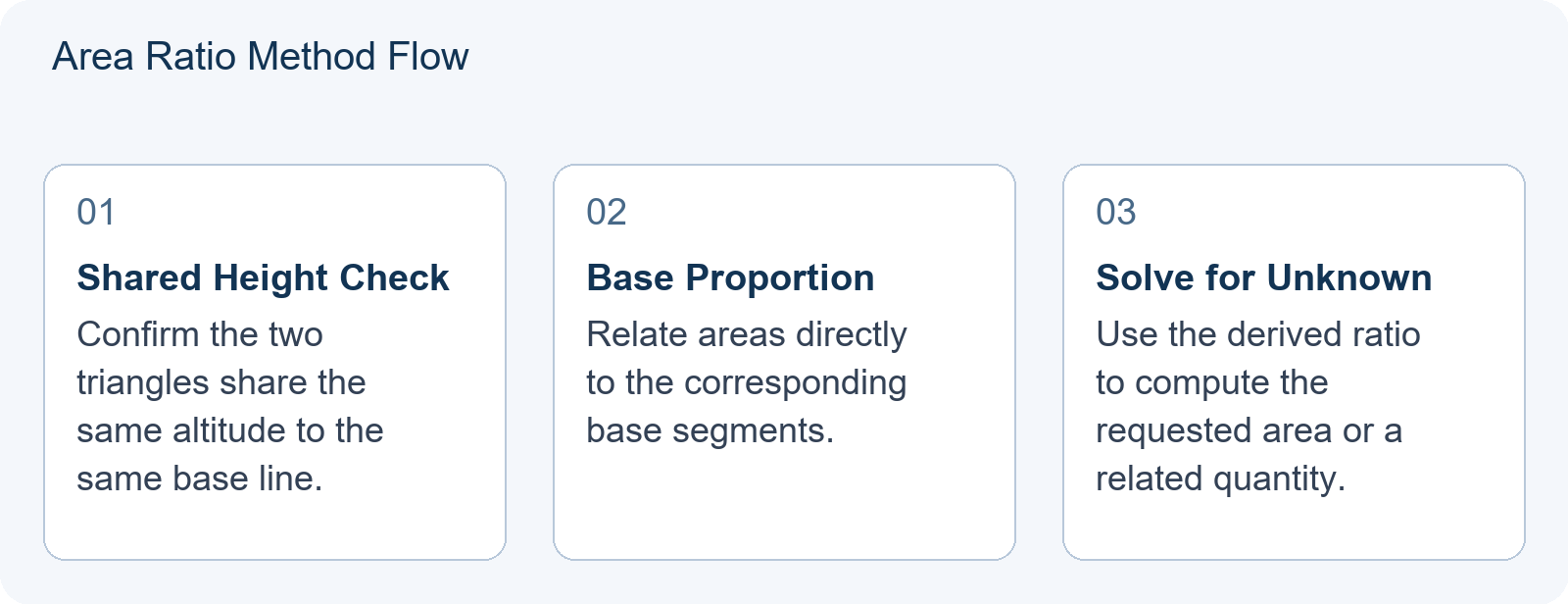
Area ratios. Triangles with the same height have areas proportional to their bases. This is the workhorse for cevian problems. If a cevian from vertex A meets side BC at D, then [ABD] : [ACD] = BD : DC. The shape of the triangle and the angle of the cevian do not change that relationship, because both smaller triangles share the same altitude from A to line BC.
Angle bisector ratios. The Angle Bisector Theorem says that an angle bisector in a triangle divides the opposite side in the ratio of the adjacent sides. If you know or can create those adjacent-side ratios, you can transfer them directly to the opposite side.
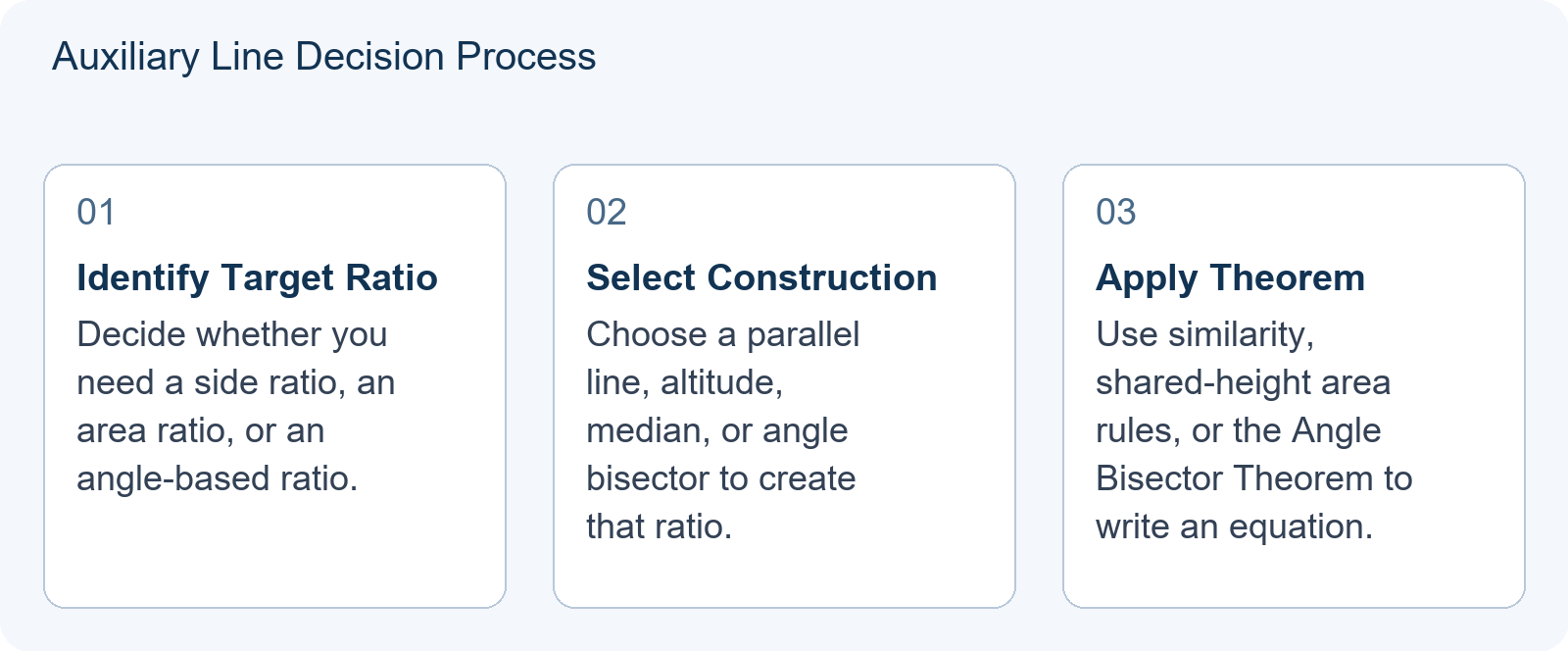
Decision Tree: When to Draw Which Auxiliary Line
The key skill is not drawing many auxiliary lines. It is drawing the right one. Use the ratio you want as your starting point.
- Parallel line: Draw a line parallel to a side when you want similar triangles or direct segment proportions. This is the first choice when a problem involves a cevian crossing a triangle and you need to compare segments on two different sides.
- Altitude: Drop an altitude when you need shared-height area ratios or a right triangle. Altitudes are also useful when the problem hints at cyclic quadrilaterals or trigonometric relationships inside a sub-triangle.
- Median: Connect a vertex to the midpoint of the opposite side when you want equal-area splitting or centroid properties. A median divides a triangle into two equal-area triangles, which can anchor a ratio chain.
- Angle bisector: Draw an angle bisector when adjacent side lengths or their ratios are known or easy to express. This directly links an angle condition to a split on the opposite side.
If a construction does not create a similarity, an area ratio, or a known theorem, it is probably not the line you need. Stop and reconsider the target ratio before adding more ink.
Worked Example: Area Ratios Without Length Chasing
This is a hypothetical teaching illustration, not an official contest problem.
Let triangle ABC have point D on side BC such that BD = 3 and DC = 5. Let point E lie on AD such that AE = 2ED. Find the ratio of the area of triangle ABE to the area of triangle CDE.
Length-chasing temptation: You could place B(0,0), C(8,0), D(3,0), then introduce variables for A and E. That creates unnecessary algebra. The ratio structure is already visible.
Ratio solution: Triangles ABD and ACD share the same altitude from A to line BC. Therefore, their areas are proportional to their bases:
[ABD] : [ACD] = BD : DC = 3 : 5.
Let [ABD] = 3k and [ACD] = 5k.
Now focus on triangle ABD. Since AE = 2ED, we have AE : ED = 2 : 1, so AE : AD = 2 : 3. Triangles ABE and ABD share the same altitude from B to line AD. Their areas are proportional to their bases AE and AD:
[ABE] = (2/3)[ABD] = (2/3)(3k) = 2k.
Next, focus on triangle ACD. Triangles CDE and ACD share the same altitude from C to line AD. Their bases are ED and AD. Since ED = (1/3)AD,
[CDE] = (1/3)[ACD] = (1/3)(5k) = 5k/3.
Therefore,
[ABE] : [CDE] = 2k : 5k/3 = 6 : 5.
No coordinates, no radicals, and no length chasing were needed. The construction was conceptual: recognize shared heights and compare bases.
Common Failure Modes and How to Catch Them
The first failure mode is drawing an auxiliary line that creates a new unknown instead of a ratio. For example, dropping an altitude in a triangle where no area or right-triangle relationship is needed may simply add variables. Before drawing, name the relationship you hope to create: similar triangles, equal heights, or angle bisector division.
The second failure mode is mixing up which triangles share a height. In the worked example, [ABE] and [ABD] share the height from B to line AD, not from A to BC. If you compare the wrong pair, the ratio becomes meaningless. Label the common vertex and the common base line before writing an equation.
The third failure mode is forgetting that area ratios must be multiplied along a chain. If [ABD] is 3k and [ABE] is 2/3 of that, the result is 2k. If another ratio is needed, multiply it in the correct order. A quick dimensional check helps: area ratios are unitless, so the k should cancel in the final comparison.
Finally, after obtaining a ratio, translate it back to the requested integer answer. If the problem asks for a sum, product, or difference of two quantities, express both in terms of the same variable before substituting. This is also where robust AIME Answer Checking: Catching Extraneous Roots Before Recording an Integer matter: confirm that the final quantity is an integer in the required range and that no hidden condition was ignored.
Note-Taking Strategy on Laminated Graph Paper
Under the MAA-announced 2027 AIME format for the MAA-administered exam, students cannot bring compasses or rulers. Test centers provide laminated graph paper booklets and fine-tip pens, with additional booklets available on request. This changes how you should use diagrams during practice.
You cannot measure lengths to guess ratios. Instead, sketch clearly enough to show topology and labels. Use the grid to keep parallel lines visually parallel and to estimate slopes, but do not treat estimates as exact unless the problem specifies lattice coordinates. Mark equal segments with matching tick marks, parallel lines with arrowheads, and right angles with small squares. Draw auxiliary lines with dashed strokes so you can distinguish your construction from the given figure.
Because you will be writing on laminated pages with fine-tip pens, plan the construction mentally before writing. A useful habit is to write the target ratio in the margin first, such as [ABE] : [CDE], then draw only the lines that help you express those areas. This prevents accidental clutter and keeps your diagram aligned with the algebra.
Connecting Ratios to the Integer Answer
AIME answers are integers from 0 to 999. Ratio results often appear as fractions, so the final step is usually to express the requested quantity in terms of a common scale factor. For example, if a side ratio is 3 : 4 and the problem asks for 100a + b where a : b = 3 : 4, write a = 3k and b = 4k, so the expression becomes 300k + 4k = 304k. If k is not determined by the given conditions, look for another ratio in the figure.
Do not assume the integer answer appears automatically. The integer requirement often serves as a check: if your ratio chain forces a non-integer for a quantity that must be an integer, revisit your auxiliary line. Did you use the correct shared height? Did you invert a base ratio? Is there a symmetry or midpoint condition you overlooked?
Drill Recommendation: Identify Ratios Before Solving
To build this skill, practice past AIME geometry problems in a deliberately incomplete way. Spend five minutes on a problem without solving it. Ask: which auxiliary line would create similar triangles? Which two triangles share a height? Which cevian divides an area proportionally? Then compare your proposed construction with a full solution.
This drill trains recognition. It also keeps you from defaulting to coordinates. Over time, you will notice that many AIME-style geometry problems are designed so that one well-chosen line turns a length calculation into a short ratio equation. The goal is not to avoid algebra; it is to use the smallest amount of algebra that reliably reaches the answer.
Resource Fit
If auxiliary-line choices are your bottleneck, focus your review on construction choices rather than longer computations. Hanlin is an authorized AMC-China test center, and Hanlin teaching resources include competition-oriented course materials. For general AIME context, see the AIME Math Competition Guide: Qualification Rules, Scoring Changes & Prep Strategies.
Keep the focus practical: bring a small set of attempted AIME geometry problems, mark where you chose an auxiliary line, and identify whether the line created a ratio or merely added calculation. That diagnosis is often more useful than another hour of unfocused length chasing.
Frequently Asked Questions
Can I use rulers or compasses in the 2027 AIME?
Under the MAA-announced 2027 AIME format for the MAA-administered exam, no. Students cannot bring any materials, including compasses or rulers. Laminated graph paper booklets and fine-tip pens are provided, with additional booklets available on request. China-region logistics are separate and should be checked against official China-region notices.
Why are ratios often faster than coordinates in AIME geometry?
Ratio methods reduce the number of algebraic steps and avoid many messy intermediate radicals or fractions. Coordinates are still useful, but when a problem gives segment ratios, midpoints, parallel lines, or cevians, a ratio approach often reaches the final integer more reliably.
Does the two-part 2027 AIME format change how I should practice ratios?
The MAA-announced format uses two 90-minute parts with a short break; the first part covers questions 1-8 and the second covers 9-15, and students cannot return to the first part. Practice ratio recognition in timed 90-minute blocks and rehearse clear diagram labeling, since efficient constructions conserve time for the later questions.