
AIME Geometry Construction: Practice Without a Compass or Ruler in 2027

For the 2027 AIME at a Pearson Professional Center, a compass and ruler are not part of the allowed kit. The IMA note 2026–27 AMC 10/12 Policy Changes and AIME Reform: Authoritative Compilation (Organizing Committee + MAA Official Dual Source), dated 27 August 2026, states that Pearson candidates may not bring any materials, including a compass and ruler. The center issues a laminated graph-paper booklet and a fine-tip pen, with reissue available. The practical answer for AIME geometry construction is therefore to practise on graph paper with a fine-tip pen, treat every diagram as a labelled reasoning aid rather than a measuring instrument, and rehearse the two 90-minute segments separately.

What the 2027 rule changes for construction

The note describes a different examination environment from an ordinary classroom contest. AIME geometry construction cannot rely on bringing personal drawing tools, and it cannot rely on returning to an earlier segment after the midpoint. The table below separates supplied facts from their practice implications.

Item What the 27 August 2026 IMA note states Practice implication
Personal materials Pearson candidates may not bring any materials, including a compass and ruler. Do not train as if personal geometry tools will be available. Simulate the issued format.
Issued materials The center issues a laminated graph-paper booklet and a fine-tip pen; reissue is available. Use graph paper and a fine-tip pen in practice; keep the drawing simple and labelled.
Timing Two 90-minute segments: questions 1–8 first, then questions 9–15. No return to segment one; a mid-segment exit voids that segment. Build a segment break into practice. Write diagram facts before the break, but do not plan on carrying notes forward.
Answering The examination is electronic, with answers entered on screen. Do not let a paper sketch become the final answer record. Transfer the integer answer deliberately.

The note also places AIME 2027 in a single 5–6 February 2027 window, with each candidate sitting once. There is no AIME I/II retake to plan around. For the wider scheduling change, see AIME 2027 Single Exam: Plan Without an AIME I/II Retake.

Where the Pearson rule stops

The tool rule above belongs to the Pearson-administered route described in the note. It should not be pasted onto every AIME candidate. The note's China-organizer information says China uses concentrated test centers and describes the China and US AIME papers as relatively independent. China entrants follow China organizer arrangements, not the Pearson materials process. International entrants outside the Pearson-described route should follow their International Group Leader.

This distinction matters for practice. A student preparing for a Pearson center should rehearse with graph paper and pen because personal compass and ruler use is not permitted there. A student preparing through a different route should first confirm that route's materials instructions with the relevant organizer. Do not assume that a rule written for one administration applies to another.
Tool-Free Simulator

The graph-paper simulation drill

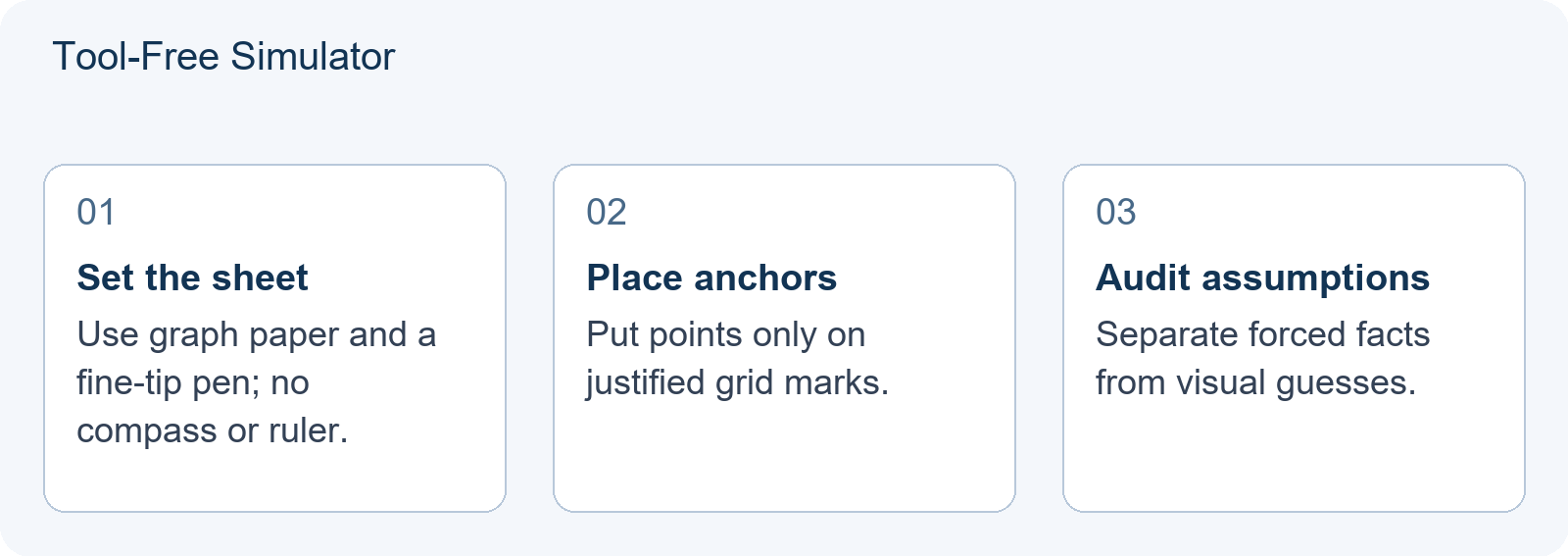
A useful AIME geometry construction routine has three parts: simulate the surface, force the labels, and audit the assumptions. The goal is not to produce a beautiful drawing. The goal is to make the diagram carry only relations that the problem statement or a calculation justifies.

1. Simulate the issued surface

Use plain graph paper and a fine-tip pen. Do not begin with a compass, ruler, or a pre-drawn figure that silently supplies lengths and right angles. Mark a small coordinate frame in the corner of the practice page. This frame is not part of the real test; it is a training device that makes grid counts explicit and prevents the eye from doing arithmetic that the pen has not recorded.

2. Place only justified anchors

Put key points on grid intersections only when the problem's conditions allow a coordinate choice. If a practice problem gives a triangle with side lengths 6, 4, and 5, for example, do not place all three vertices on convenient intersections merely because the sketch looks neat. Choose coordinates that match the given lengths, or work without coordinates and label only the stated lengths. A grid is a bookkeeping tool, not a licence to round a length into a prettier one.

3. Separate forced facts from visual guesses

After sketching, write two short lists beside the figure: forced and looks like. A forced fact might be that D lies on AB or that CD is vertical because C and D have the same x-coordinate. A visual guess might be that CD looks perpendicular to AB or that D looks like the midpoint. Only the first list may enter a calculation. This habit is the core of tool-free AIME geometry construction: the diagram organises reasoning, but it does not become evidence.

Teaching illustration: one auxiliary line, one audit

Teaching illustration, not an AIME problem and not official scoring guidance. Suppose a practice prompt gives coordinates A=(0,0), B=(6,0), and C=(2,4). On graph paper, mark A and B six grid units apart, then mark C two units right and four units up. Add D=(2,0), the vertical projection of C onto AB. Because AB is horizontal and CD is vertical, angle CDB is 90°. The grid counts give AD=2, DB=4, and CD=4. Hence CB = √(4²+4²) = 4√2, and AC = √(2²+4²) = 2√5. The area is ½ × AB × CD = ½ × 6 × 4 = 12. No compass or ruler is needed, because every used relation comes from coordinates or a stated right angle.

Now contrast that with one possible slip. A student might place D at the midpoint (3,0) because the sketch looks central. Then CD = √((3−2)²+(0−4)²) = √17, and angle CDB is not 90°: the vectors from D are (−1,4) and (3,0), whose dot product is −3, not zero. The midpoint is not the foot. The drawing looked plausible, but the label D is the foot was never forced. This is exactly the kind of error that a neat grid sketch can hide. The audit list catches it before the calculation begins.

The same audit applies to auxiliary lines. If you add a line from a vertex to the opposite side, label the new point and state why it is there: midpoint, foot of an altitude, intersection with a parallel, or a point defined by a given ratio. If the only reason is that the line makes the diagram easier to look at, the line is not yet a construction. It is a guess. A useful auxiliary line should create a right triangle, a similar triangle, a cyclic quadrilateral, or a coordinate relation that connects known quantities to the target.

This is also where the article AIME Geometry Ratios: Choose an Auxiliary Line Before Chasing Lengths covers the adjacent question of which line to add when ordinary drawing tools are available. The present problem is narrower: how to build and check the diagram when compass and ruler are unavailable and only the center-issued graph-paper format is simulated.

Segment-one and segment-two construction protocol

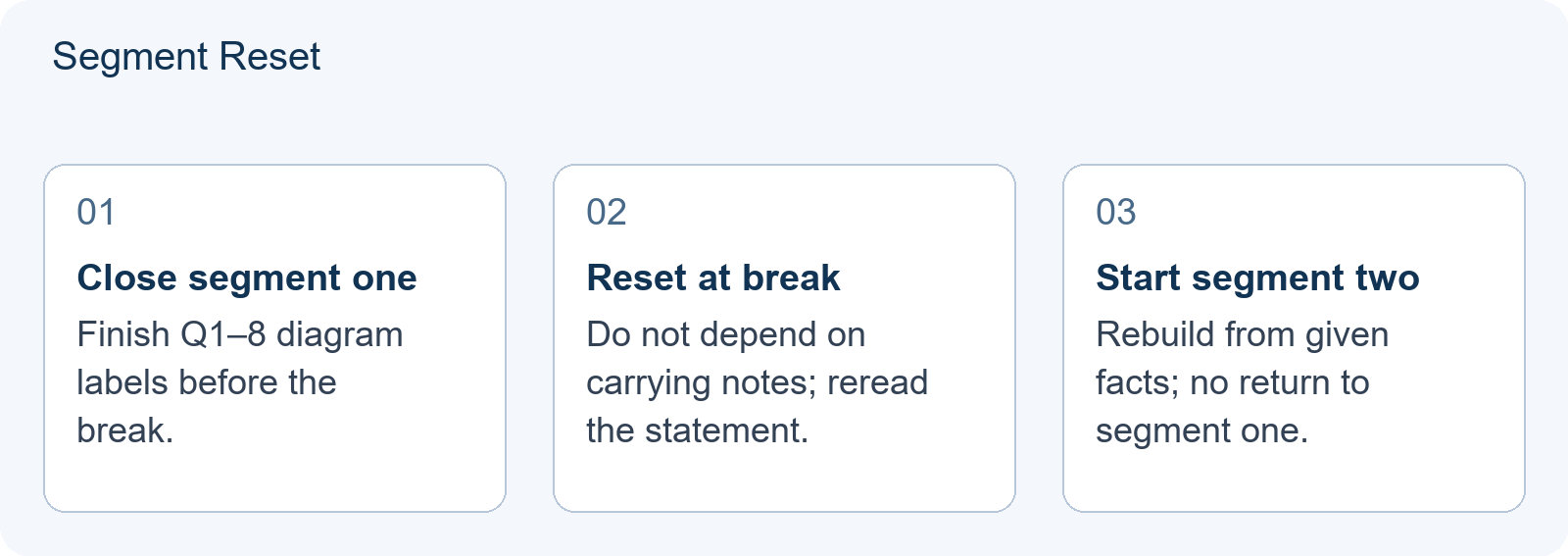
The two-segment structure changes how a candidate should manage diagrams. In segment one, questions 1–8 come first. In segment two, questions 9–15 follow, and there is no return to segment one. A mid-segment exit voids that segment. A candidate therefore cannot plan to solve an early construction problem during the second segment.

A practical training device is to give every construction problem a short diagram passport before moving on. The passport records four things: the coordinates or labelled lengths, the auxiliary line and its justification, the target quantity, and any unresolved doubt. In practice, this takes only a few lines and prevents a neat but ambiguous sketch from becoming a memory trap. The passport is a training discipline, not an assumption about exam scratch-paper retention: the supplied note does not say that notes can be carried across the break. The safe exam plan is not to depend on carrying them.

At the break, reset mentally. In segment two, rebuild only from the problem statement and the facts you can write in the new segment. Do not rely on crossed-segment note access. Do not assume that a line which looked parallel in segment one was parallel. Do not assume that a point which looked central was a midpoint. For broader pacing practice across regional formats, see AIME Pacing Practice: Prepare for Your Region's 2027 Format.

Traps that survive a neat sketch

  • Trusting the grid too much. A point on a grid intersection is exact only if the coordinates are justified. A clean intersection can make an unforced midpoint or right angle look real.
  • Importing remembered figures. A recalled diagram from a past paper is not the current problem's figure. Redraw from the stated conditions, not from memory.
  • Redrawing instead of labelling. If the first sketch is messy, do not spend minutes producing a prettier one. Add one clear auxiliary line and write the forced relations beside it.
  • Letting the sketch replace the algebra. A grid can suggest that two lengths are equal, but only a calculation or a stated condition proves it. The answer must still be derived and checked.
  • Forgetting the electronic answer. The sketch is not the answer sheet. After the calculation, transfer the integer answer deliberately and check the allowed range.

A useful diagnostic is to take one tool-free geometry sketch you have already drawn and mark every label as F for forced or G for guess. If any labels are G, the diagram is doing too much work. Replace the guessed labels with stated conditions or remove them.

Preparing a consultation with one tool-free sketch

For a preparation consultation, bring one graph-paper geometry sketch made with a fine-tip pen and no compass or ruler. Include the original conditions, the auxiliary line you added, the target quantity, and your F/G audit. The point is not to show a polished drawing. The point is to expose where the diagram stopped supporting the reasoning and started supplying assumptions.

A productive discussion can then focus on three questions: Did the auxiliary line create a forced relation, or only a visual one? Did the labels survive a segment reset? Would a simpler line or a coordinate check have reached the answer with less redrawing? This is a Hanlin preparation perspective on tool-constrained AIME geometry construction, not a claim about any candidate's score or invitation outcome.

General event background is available at Event background.
Segment Reset

Frequently Asked Questions

Can I bring a compass and ruler to the AIME 2027 at a Pearson center?

No, for Pearson centers. The 27 August 2026 IMA note states that Pearson candidates may not bring any materials, including a compass and ruler. The center issues a laminated graph-paper booklet and a fine-tip pen, with reissue available. China entrants follow China organizer arrangements, so do not transfer the Pearson materials rule to a China test center.

Is graph paper enough for AIME geometry construction?

It is enough as a reasoning aid, not as a measuring instrument. Practise placing justified points, labelling forced lengths and angles, and writing an F/G audit. A neat grid sketch can still contain unforced assumptions, so every relation used in a calculation should come from the problem statement or a checkable coordinate fact.

How should I practise the two 90-minute AIME segments?

Simulate questions 1–8 in the first 90-minute segment and questions 9–15 in the second, with no return to segment one. In practice, finish each diagram with forced labels before moving on because segment two cannot revisit segment one. Do not assume issued scratch notes can be carried across the break; follow the center procedure, and at the start of segment two rebuild from the problem statement.
AIME Geometry Ratios: Choose an Auxiliary Line Before Chasing Lengths

For many students preparing for the American Invitational Mathematics Examination, geometry problems create a predictable trap: the urge to calculate every unknown length with the Pythagorean theorem, coordinates, or trigonometric laws. This approach is mathematically valid, but under AIME timing it is often computational overkill. The stronger habit is to prioritize AIME Geometry Ratios. If you can establish a proportional relationship, you can often skip the messy length calculations entirely and move straight toward the integer answer.

That shift is also part of the broader move from AMC speed to AIME reasoning. A useful companion discussion is AIME Preparation After AMC: When to Switch From Speed to Sustained Reasoning, but this article focuses on one concrete geometry decision: choosing an auxiliary line before you start chasing lengths.

The Trap of Length Chasing

Imagine a triangle with several cevians meeting at an interior point. A student using length chasing may assign coordinates, write equations for each line, solve for intersection points, and then compute distances. Each step can be correct, yet the method is fragile. One sign error, one inverted fraction, or one mislabeled intersection ruins the final answer. AIME problems often have clean final answers from 0 to 999, but intermediate coordinate calculations can involve radicals, fractions, and large expressions.

The deeper issue is structural. When you focus only on absolute lengths, you ignore the relative relationships in the figure. Ratio methods ask a different question: what is preserved or proportional? If two triangles are similar, corresponding lengths share the same scale factor. If two triangles share a height, their areas are proportional to their bases. These relationships are often easier to verify than a long coordinate computation.

Ratio Sources That Actually Pay Off

In AIME-style geometry, most useful ratios come from a small set of sources.

Similar triangles. If two triangles have two equal angles, or if an angle is shared and the adjacent sides are proportional, the triangles are similar. Once similarity is established, every corresponding linear measurement scales by the same factor. This includes sides, altitudes, medians, and perimeters. You do not need the actual lengths to know their ratio.

Parallel lines. A line drawn parallel to one side of a triangle can create similar triangles or invoke the Basic Proportionality Theorem. This is especially useful when a transversal cuts across two sides and you need to relate segments on different sides.

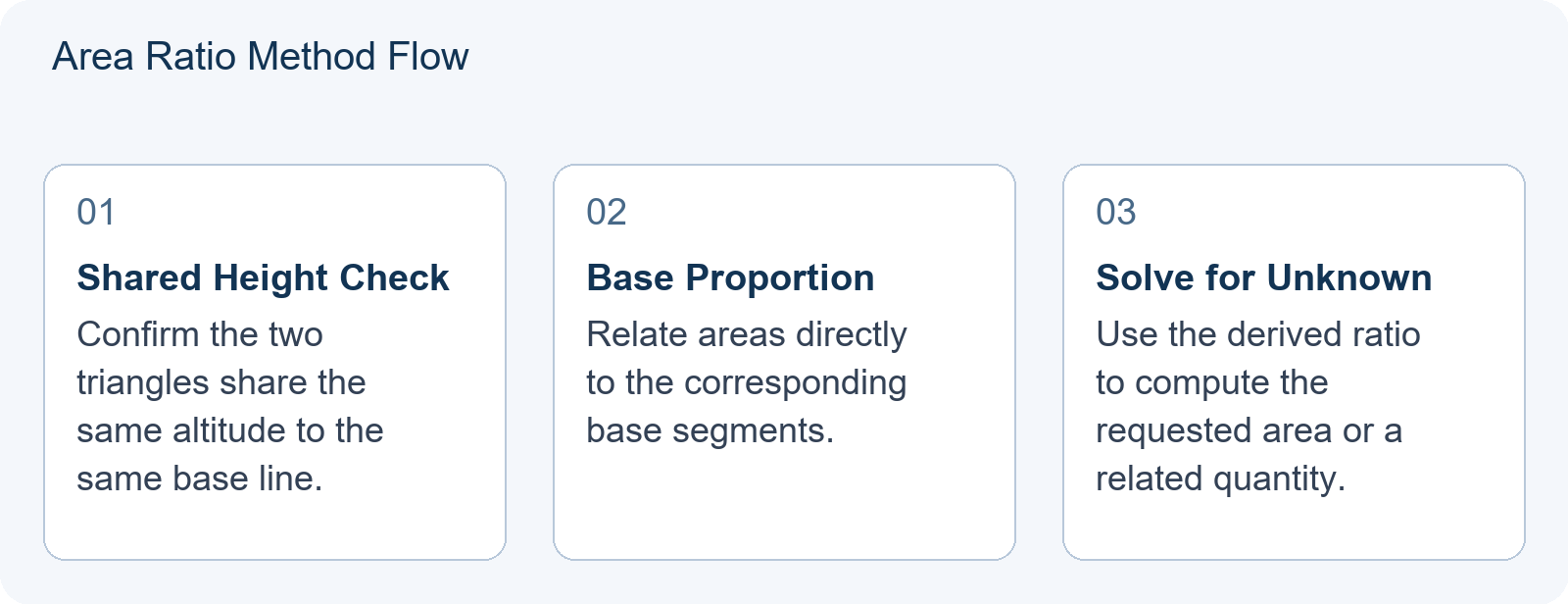
Area ratios. Triangles with the same height have areas proportional to their bases. This is the workhorse for cevian problems. If a cevian from vertex A meets side BC at D, then [ABD] : [ACD] = BD : DC. The shape of the triangle and the angle of the cevian do not change that relationship, because both smaller triangles share the same altitude from A to line BC.

Angle bisector ratios. The Angle Bisector Theorem says that an angle bisector in a triangle divides the opposite side in the ratio of the adjacent sides. If you know or can create those adjacent-side ratios, you can transfer them directly to the opposite side.

Auxiliary Line Decision Process

Decision Tree: When to Draw Which Auxiliary Line

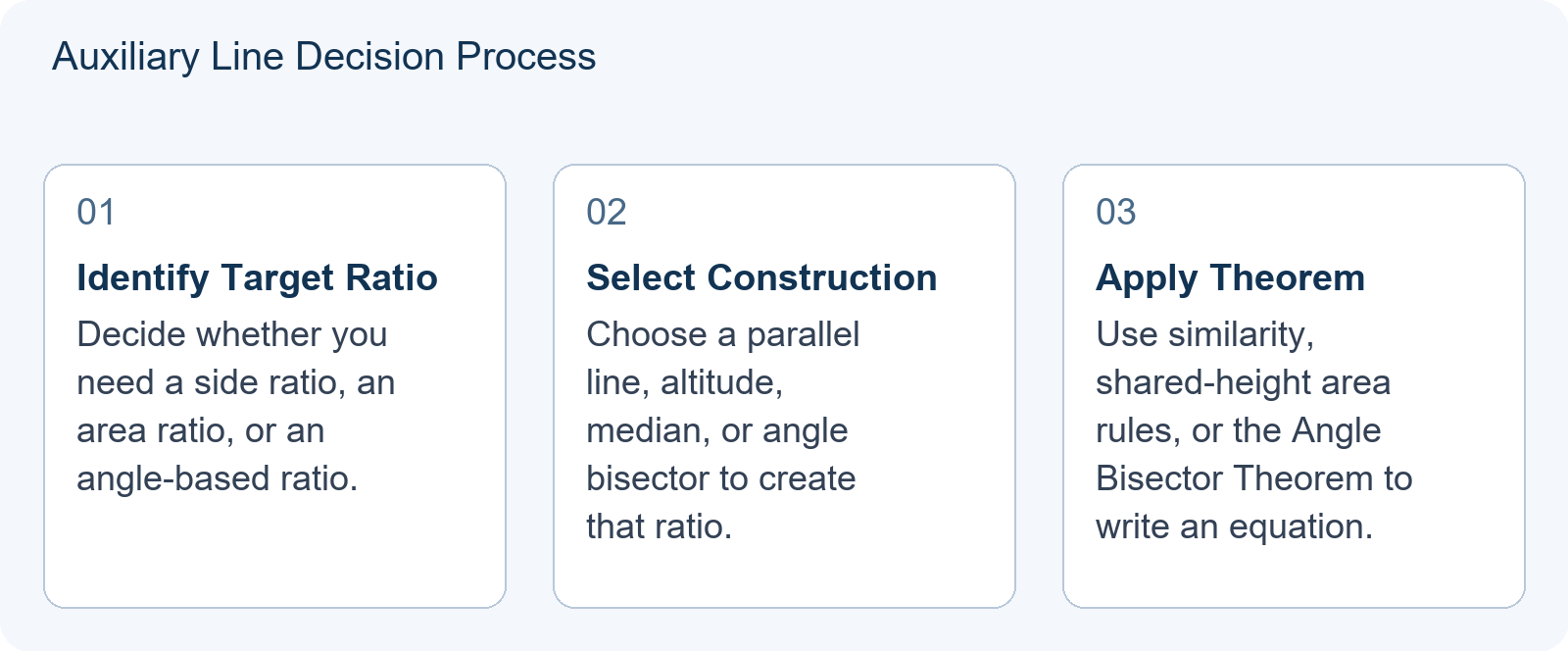
The key skill is not drawing many auxiliary lines. It is drawing the right one. Use the ratio you want as your starting point.

  • Parallel line: Draw a line parallel to a side when you want similar triangles or direct segment proportions. This is the first choice when a problem involves a cevian crossing a triangle and you need to compare segments on two different sides.
  • Altitude: Drop an altitude when you need shared-height area ratios or a right triangle. Altitudes are also useful when the problem hints at cyclic quadrilaterals or trigonometric relationships inside a sub-triangle.
  • Median: Connect a vertex to the midpoint of the opposite side when you want equal-area splitting or centroid properties. A median divides a triangle into two equal-area triangles, which can anchor a ratio chain.
  • Angle bisector: Draw an angle bisector when adjacent side lengths or their ratios are known or easy to express. This directly links an angle condition to a split on the opposite side.

If a construction does not create a similarity, an area ratio, or a known theorem, it is probably not the line you need. Stop and reconsider the target ratio before adding more ink.

Worked Example: Area Ratios Without Length Chasing

This is a hypothetical teaching illustration, not an official contest problem.

Let triangle ABC have point D on side BC such that BD = 3 and DC = 5. Let point E lie on AD such that AE = 2ED. Find the ratio of the area of triangle ABE to the area of triangle CDE.

Length-chasing temptation: You could place B(0,0), C(8,0), D(3,0), then introduce variables for A and E. That creates unnecessary algebra. The ratio structure is already visible.

Ratio solution: Triangles ABD and ACD share the same altitude from A to line BC. Therefore, their areas are proportional to their bases:

[ABD] : [ACD] = BD : DC = 3 : 5.

Let [ABD] = 3k and [ACD] = 5k.

Now focus on triangle ABD. Since AE = 2ED, we have AE : ED = 2 : 1, so AE : AD = 2 : 3. Triangles ABE and ABD share the same altitude from B to line AD. Their areas are proportional to their bases AE and AD:

[ABE] = (2/3)[ABD] = (2/3)(3k) = 2k.

Next, focus on triangle ACD. Triangles CDE and ACD share the same altitude from C to line AD. Their bases are ED and AD. Since ED = (1/3)AD,

[CDE] = (1/3)[ACD] = (1/3)(5k) = 5k/3.

Therefore,

[ABE] : [CDE] = 2k : 5k/3 = 6 : 5.

No coordinates, no radicals, and no length chasing were needed. The construction was conceptual: recognize shared heights and compare bases.

Common Failure Modes and How to Catch Them

The first failure mode is drawing an auxiliary line that creates a new unknown instead of a ratio. For example, dropping an altitude in a triangle where no area or right-triangle relationship is needed may simply add variables. Before drawing, name the relationship you hope to create: similar triangles, equal heights, or angle bisector division.

The second failure mode is mixing up which triangles share a height. In the worked example, [ABE] and [ABD] share the height from B to line AD, not from A to BC. If you compare the wrong pair, the ratio becomes meaningless. Label the common vertex and the common base line before writing an equation.

The third failure mode is forgetting that area ratios must be multiplied along a chain. If [ABD] is 3k and [ABE] is 2/3 of that, the result is 2k. If another ratio is needed, multiply it in the correct order. A quick dimensional check helps: area ratios are unitless, so the k should cancel in the final comparison.

Finally, after obtaining a ratio, translate it back to the requested integer answer. If the problem asks for a sum, product, or difference of two quantities, express both in terms of the same variable before substituting. This is also where robust AIME Answer Checking: Catching Extraneous Roots Before Recording an Integer matter: confirm that the final quantity is an integer in the required range and that no hidden condition was ignored.

Note-Taking Strategy on Laminated Graph Paper

Under the MAA-announced 2027 AIME format for the MAA-administered exam, students cannot bring compasses or rulers. Test centers provide laminated graph paper booklets and fine-tip pens, with additional booklets available on request. This changes how you should use diagrams during practice.

You cannot measure lengths to guess ratios. Instead, sketch clearly enough to show topology and labels. Use the grid to keep parallel lines visually parallel and to estimate slopes, but do not treat estimates as exact unless the problem specifies lattice coordinates. Mark equal segments with matching tick marks, parallel lines with arrowheads, and right angles with small squares. Draw auxiliary lines with dashed strokes so you can distinguish your construction from the given figure.

Because you will be writing on laminated pages with fine-tip pens, plan the construction mentally before writing. A useful habit is to write the target ratio in the margin first, such as [ABE] : [CDE], then draw only the lines that help you express those areas. This prevents accidental clutter and keeps your diagram aligned with the algebra.

Connecting Ratios to the Integer Answer

AIME answers are integers from 0 to 999. Ratio results often appear as fractions, so the final step is usually to express the requested quantity in terms of a common scale factor. For example, if a side ratio is 3 : 4 and the problem asks for 100a + b where a : b = 3 : 4, write a = 3k and b = 4k, so the expression becomes 300k + 4k = 304k. If k is not determined by the given conditions, look for another ratio in the figure.

Do not assume the integer answer appears automatically. The integer requirement often serves as a check: if your ratio chain forces a non-integer for a quantity that must be an integer, revisit your auxiliary line. Did you use the correct shared height? Did you invert a base ratio? Is there a symmetry or midpoint condition you overlooked?

Drill Recommendation: Identify Ratios Before Solving

To build this skill, practice past AIME geometry problems in a deliberately incomplete way. Spend five minutes on a problem without solving it. Ask: which auxiliary line would create similar triangles? Which two triangles share a height? Which cevian divides an area proportionally? Then compare your proposed construction with a full solution.

This drill trains recognition. It also keeps you from defaulting to coordinates. Over time, you will notice that many AIME-style geometry problems are designed so that one well-chosen line turns a length calculation into a short ratio equation. The goal is not to avoid algebra; it is to use the smallest amount of algebra that reliably reaches the answer.

Resource Fit

If auxiliary-line choices are your bottleneck, focus your review on construction choices rather than longer computations. Hanlin is an authorized AMC-China test center, and Hanlin teaching resources include competition-oriented course materials. For general AIME context, see the AIME Math Competition Guide: Qualification Rules, Scoring Changes & Prep Strategies.

Keep the focus practical: bring a small set of attempted AIME geometry problems, mark where you chose an auxiliary line, and identify whether the line created a ratio or merely added calculation. That diagnosis is often more useful than another hour of unfocused length chasing.

Area Ratio Method Flow

Frequently Asked Questions

Can I use rulers or compasses in the 2027 AIME?

Under the MAA-announced 2027 AIME format for the MAA-administered exam, no. Students cannot bring any materials, including compasses or rulers. Laminated graph paper booklets and fine-tip pens are provided, with additional booklets available on request. China-region logistics are separate and should be checked against official China-region notices.

Why are ratios often faster than coordinates in AIME geometry?

Ratio methods reduce the number of algebraic steps and avoid many messy intermediate radicals or fractions. Coordinates are still useful, but when a problem gives segment ratios, midpoints, parallel lines, or cevians, a ratio approach often reaches the final integer more reliably.

Does the two-part 2027 AIME format change how I should practice ratios?

The MAA-announced format uses two 90-minute parts with a short break; the first part covers questions 1-8 and the second covers 9-15, and students cannot return to the first part. Practice ratio recognition in timed 90-minute blocks and rehearse clear diagram labeling, since efficient constructions conserve time for the later questions.

Online Consultation
Online Consultation