
For the AIME 2027 single exam, the practical answer is simple: plan for one attempt. MAA information verified on 26 August 2026 discontinues AIME I and AIME II and replaces them with a single AIME window on 5–6 February 2027. Qualification for that single exam uses fixed thresholds: AMC 10 at least 100 and AMC 12 at least 85. A student who is waiting for a second sitting to serve as a backup is planning for a format that no longer exists.
The change matters most for students who have heard that AIME I and AIME II are two chances. They are not, for 2027. The Hanlin WeChat article 'Note for Students Aiming for AIME: 2027 Qualification Thresholds Fixed, China Arrangements Clarified, AIME Test-Site Booking Opens!', published 10 October 2026, reports that China’s 2027 AIME remains 15 questions in one 180-minute continuous session, while US/Canada uses two 90-minute segments. Both regions face a single-exam risk, but the risk appears at different points in the clock. The preparation question is no longer 'How do I use the first AIME to prepare for the second?' It is 'What must be reliable before the only sitting?'
What Changed for AIME 2027?
The older AIME I/II structure encouraged a two-sitting mental model: one sitting could act as a warm-up or diagnostic, and the other could be treated as the real attempt. That model should be retired. The table below contrasts assumptions families may still carry with the 2027 single-exam reality.
| Assumption to check | 2027 single-exam reality | Planning consequence |
|---|---|---|
| 'AIME I can be a warm-up; AIME II is the real attempt.' | AIME I/II are discontinued; there is one window on 5–6 February 2027. | Score every full timed set before review and treat it as the only sitting. |
| 'A strong AMC score can cushion a weaker AIME.' | For USAMO/USAJMO selection, AIME scores are primary; AMC scores no longer count. | If the goal extends beyond qualification, AIME accuracy is not a secondary margin. |
| 'I can repair a bad start later.' | China: one 180-minute continuous session with self-directed time. US/Canada: 90 minutes for 8 questions, then 90 minutes for 7; no return to segment one. | China rehearses return-to-blank decisions; US/Canada rehearses first-segment accuracy. |
The fixed thresholds also change the qualification target. Instead of asking whether this year’s cutoff might move, a student can ask whether practice scores sit reliably above AMC 10 100 or AMC 12 85. The fixed line makes the target more legible. It does not create another AIME sitting. A margin-building view is useful alongside this planning question, but the core point remains the single attempt.
Why the Retake Assumption Is Risky
Under a two-sitting model, a student could tell themselves that the first AIME produced information and the second would apply it. For 2027, the first sitting is final. That is especially consequential for students aiming at USAMO or USAJMO, because the verified 2027 rules make AIME scores primary and retire the older AMC-plus-AIME index. A student cannot assume that a strong AMC result will offset a weaker AIME result.
The risk is not only emotional. It changes how practice is designed. A practice set followed by unlimited review is a learning tool, but it is not a simulation of the single exam. If a student always allows a second attempt at the same set, they may never rehearse the decisions that matter most: when to leave a question blank, when to check an answer, and when to stop chasing a hard problem because the recoverable points are elsewhere. The single-exam plan should make those decisions boring and repeatable.
One-Attempt Preparation Priorities
A one-attempt plan does not require a completely different curriculum. It requires a different order of reliability. The following priorities are a suggested preparation framework, not a claim that every student needs the same schedule.
- Front-load answer verification. For integer-answer questions, the final check should be a fixed step, not an optional habit. Domain conditions, sign errors, and 'solved for the wrong quantity' mistakes can turn a correct method into an incorrect entry.
- Rehearse the full regional clock. China’s 180-minute continuous session rewards time allocation and return-to-blank decisions. US/Canada’s two 90-minute segments reward first-segment accuracy because the first eight answers cannot be revisited after the second segment begins. Use AIME Pacing Practice: Prepare for Your Region's 2027 Format to match practice to the correct format.
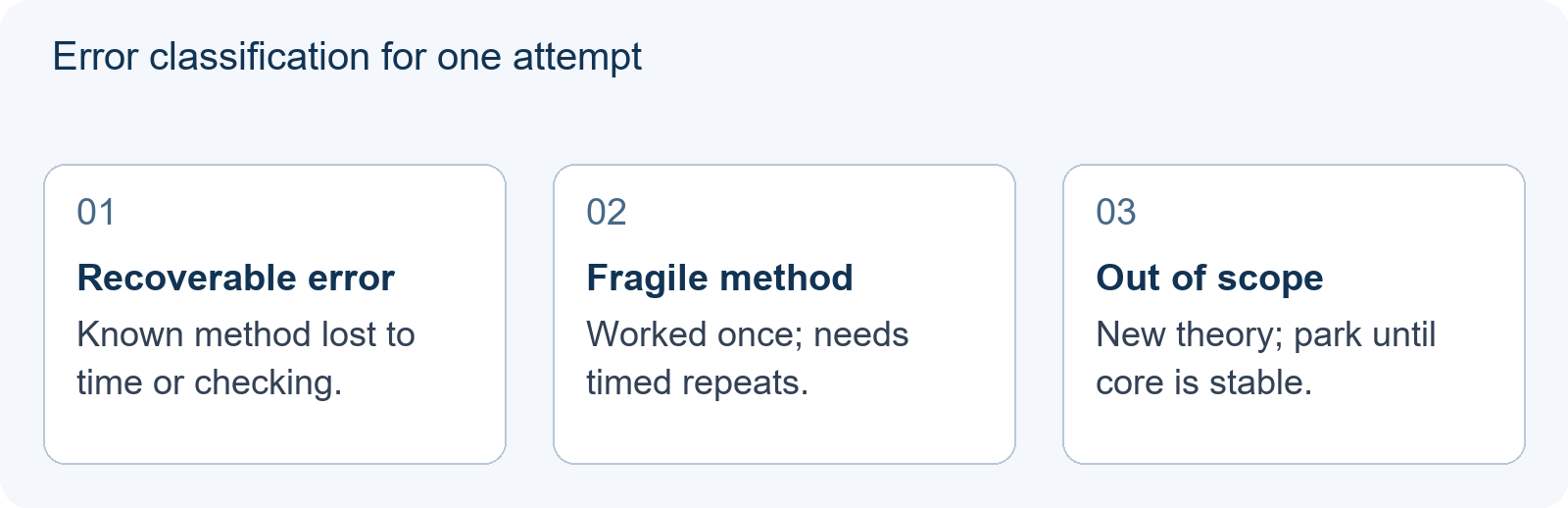
- Classify errors by recoverability. A recoverable error uses a method the student already knows but loses to time pressure, a sign slip, or a missed check. A fragile method worked once but has not survived timed repeats. An out-of-scope item needs new theory and should not displace core accuracy too early.
- Keep a blank log. For every skipped question, record whether the student recognized the method, ran out of time, or never had a viable entry point. Blank logs are more useful than a raw score because they show whether the next practice block should build speed, checking, or new content.
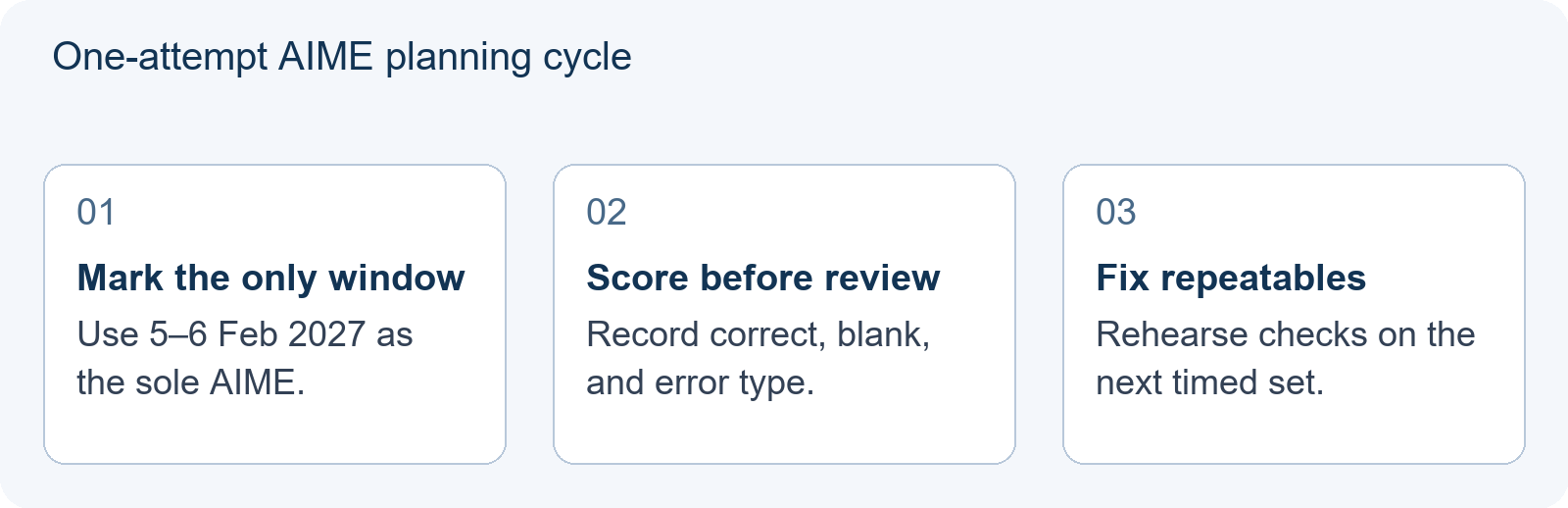
- Use a no-retake practice rule. Finish a timed set, record the verified correct count, and only then review. The review can be generous; the first pass should not be.
Teaching Illustration: One Check Can Change the Recorded Answer
Teaching illustration, not an actual AIME problem or official scoring guidance. Solve sqrt(x + 6) = x. Because the right side equals a principal square root, x must be at least 0. Squaring both sides gives x + 6 = x^2, so x^2 − x − 6 = 0, or (x − 3)(x + 2) = 0. The candidates are 3 and −2. Checking x = 3 gives sqrt(9) = 3, which is valid. Checking x = −2 gives sqrt(4) = 2, while the right side is −2, so the candidate is rejected. The verified answer is 3.
This is a simple error, but it is exactly the kind that a single-exam plan must make non-repeatable. The student did not lack the algebra. They lacked a final verification step. In a one-attempt environment, a 20-second check is not extra caution; it is part of the answer.
Teaching Illustration: A 15-Question Score Audit
Teaching illustration using hypothetical counts, not a real student record. Suppose a student completes a 15-question timed set under one-attempt conditions and records the following audit.
| Question band | In-exam action | Verified correct | Review finding |
|---|---|---|---|
| 1–6 | Answered | 6 | No change |
| 7–9 | Left blank | 0 | Q7 and Q8 use known methods; Q9 needs a new idea |
| 10–12 | Answered | 2 | One sign error |
| 13–15 | Answered | 0 | No recoverable method found in review |
The verified correct count is 8. If Q7, Q8, and the sign-error question are recoverable, the arithmetic ceiling is 11, because 6 + 2 + 2 + 1 = 11. That does not mean the student will score 11; it means the next practice block should not be aimed only at three harder topics. Two blanks were known-method questions, and one error was a checkable sign slip. A sensible next timed set might require the student to revisit Q7 and Q8 before spending time on Q13–15, then add a final sign check on Q10–12. The audit changes the practice target from 'more problems' to 'recoverable points under the clock.'
China and US/Canada: Same Single Exam, Different Failure Points
China’s 2027 AIME remains 15 questions in one 180-minute continuous session, according to the Hanlin Course article dated 10 October 2026. Students can allocate the whole block, skip a question, and return to it. The main single-exam risk is poor time allocation: a student may spend too long on a hard question and fail to return to a blank that was already within reach. Practice should therefore include an explicit return rule, such as 'after two minutes without a path, mark and move,' followed by a planned return window.
US/Canada uses two 90-minute segments: 8 questions, then 7. After entering the second segment, a student cannot return to modify the first eight answers. The main risk is first-segment accuracy and the handoff. A student who is slow to settle in the first eight questions has no late repair. Practice should simulate the handoff, not just the total 180 minutes. Readers outside China and North America should follow their International Group Leader’s instructions; the Pearson process should not be transferred to China. For China-specific age, format, and single-exam differences, see AIME China 2027: Age, Format, and Single-Exam Differences.
Preparing a Course-Fit or Resource Request
Before asking Hanlin for AIME preparation planning, build a one-page attempt profile. This is a preparation aid, not a promise that Hanlin offers a named checklist or a particular service. Include the date of each recent timed set, the regional format used, the verified correct count, the number of blanks, and a short error log separated into recoverable, fragile, and out-of-scope categories. Add the student’s target: qualification, a specific score band, or USAMO/USAJMO preparation. Do not include real student names if the log is shared.
A concrete profile makes the conversation more useful than a vague request for 'AIME preparation.' It also protects against the old retake assumption: if the practice record still contains second attempts at the same set, the profile will show it. The goal is to replace that habit with a single-attempt review cycle that matches the 2027 format. For a score-band perspective, the site’s AIME: 7 Points is the Watershed, 10 Points is the Stepping Stone can help frame target-setting without implying a guaranteed outcome.
The single-exam plan in one sentence: make the ordinary questions reliable, verify before recording, rehearse the region’s clock, and review every timed set as if there is no second sitting. That is the practical meaning of AIME 2027 without an AIME I/II retake.
General event background is available at Event background.
Frequently Asked Questions
Is there an AIME II in 2027?
No. The 2027 cycle replaces AIME I/II with one AIME window on 5–6 February 2027. Plan for one attempt.
Can a student choose between AIME I and AIME II in 2027?
No such choice exists for 2027 because AIME I/II are discontinued. The relevant choice is preparation quality and regional format, not an exam sitting.
Does a lower AIME score allow another attempt?
No. There is no second 2027 AIME sitting under the single-exam change; a lower score is not a retake trigger. Use practice sets to rehearse one-attempt decisions before the official window.