
Direct answer. For 2027 AIME preparation, when a triangle problem gives A+B+C=pi and a symmetric trigonometric expression in all three angles, first test whether the expression is unchanged by every permutation of A, B, C. If it is, pair two angles with sum-to-product, use A+B=pi-C, and convert the remaining terms to half-angles. The central reduction is cos A + cos B + cos C = 1 + 4 sin(A/2) sin(B/2) sin(C/2). Do not begin by assigning convenient angle values; that discards the constraint that makes the problem solvable. This is a Hanlin preparation discussion, not official MAA scoring guidance.
Hanlin's 4 November 2026 AIME preparation article, “2027 AIME Qualification Moves to Fixed Score Lines: Preparation Planning and a High-Energy Trial Class” (WeChat public account Hanlin Courses), observes that AIME algebra extends AMC12 with advanced trigonometric identities—auxiliary-angle, sum-to-product, and product-to-sum—and that symmetric expressions in the three angles of a triangle are part of that AIME algebra scope. The same article says trigonometric, coordinate, and complex-number computation drives difficulty in higher-numbered AIME geometry questions. That is the teaching problem this article addresses: choosing the first transformation without losing the angle-sum condition.
Why symmetric triangle trigonometry is different from polynomial symmetry
In polynomial problems, symmetry usually means that coefficients or roots can be permuted without changing the expression. Root relations then let you replace elementary symmetric sums by Vieta values. Triangle trigonometry has a different constraint: the variables are angles, and the relation is angular, A+B+C=pi, not a polynomial equation in independent roots. A symmetric expression such as cos A + cos B + cos C is not helped by solving for A, B, C. It is helped by turning the angular sum into a product of half-angle sines. For the polynomial-root counterpart, see AIME Vieta's Formulas: Find Symmetric Expressions Without Solving Every Root; the present method is different because the constraint is A+B+C=pi.
A second difference is the domain. Every angle of a nondegenerate triangle satisfies 0<A,B,C<pi, so each half-angle lies in (0,pi/2). Sines and cosines are positive there, which makes product bounds and equality conditions usable. If you copy a triangle identity into a problem where the three angles do not sum to pi, the identity is simply false. The domain is part of the method, not an afterthought.
The diagnostic: is the expression genuinely symmetric?
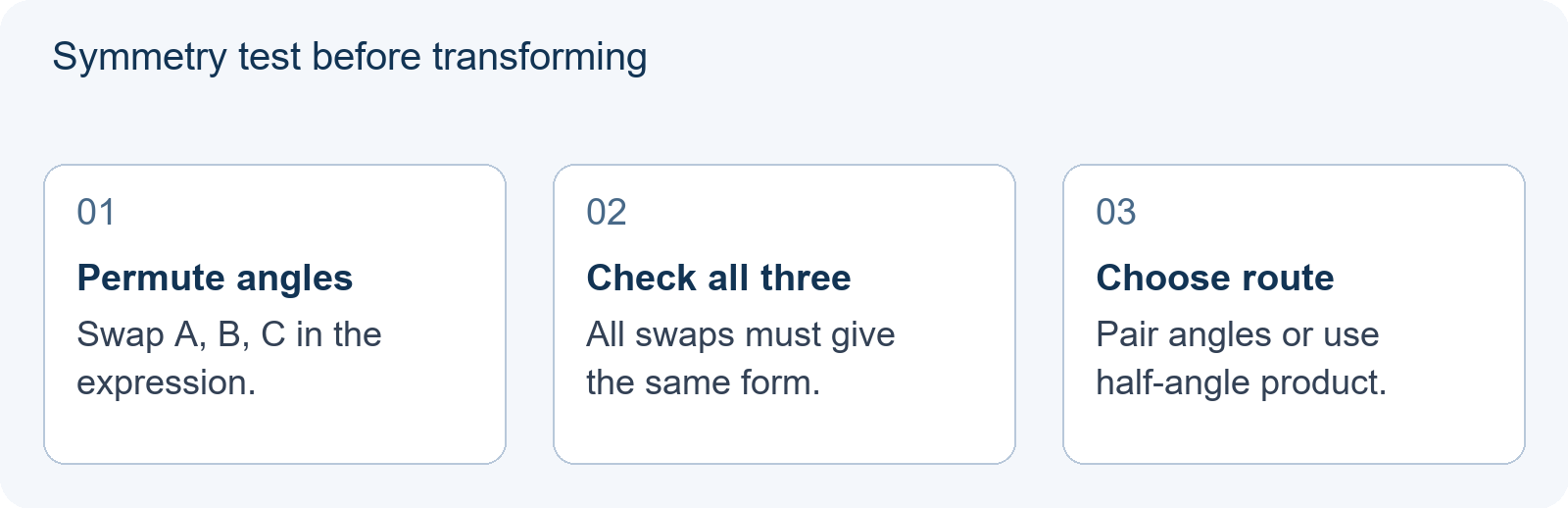
Before transforming, write the expression and test all swaps. If swapping A and B, or B and C, changes the expression, it is not fully symmetric. For example, under A+B+C=pi, the expression cos A + 2 cos B + 3 cos C is not symmetric because swapping A and B changes the coefficients attached to the angles. Pairing cos A + cos B may still be a legal algebraic step, but you cannot conclude that all three angles behave alike or that equality forces A=B=C.
A genuine three-angle symmetric expression must use all three angles in a permutation-invariant way. Simple examples are cos A + cos B + cos C, sin^2 A + sin^2 B + sin^2 C, and products such as sin(A/2) sin(B/2) sin(C/2). A one-angle expression such as 3 cos A + 4 sin A is not a three-angle symmetric problem; it is an auxiliary-angle problem hiding inside a triangle. The auxiliary-angle form R cos(A-phi) compresses one angle combination, but applying it blindly to a symmetric three-angle expression usually destroys the symmetry you need.
| Transformation | Use it when | What it preserves | Typical failure |
|---|---|---|---|
| Pair two angles with sum-to-product | You see cos A + cos B or sin A + sin B | Uses A+B=pi-C explicitly | Forgetting the C/2 conversion and losing the constraint |
| Half-angle product | The expression is symmetric in all three angles | Turns the sum condition into a product or bound | Treating half-angle sines as independent variables |
| Auxiliary angle | One angle dominates, as in a cos theta + b sin theta | Compresses one variable combination | Applying it to all three angles and breaking symmetry |
The identity that carries the angle-sum constraint
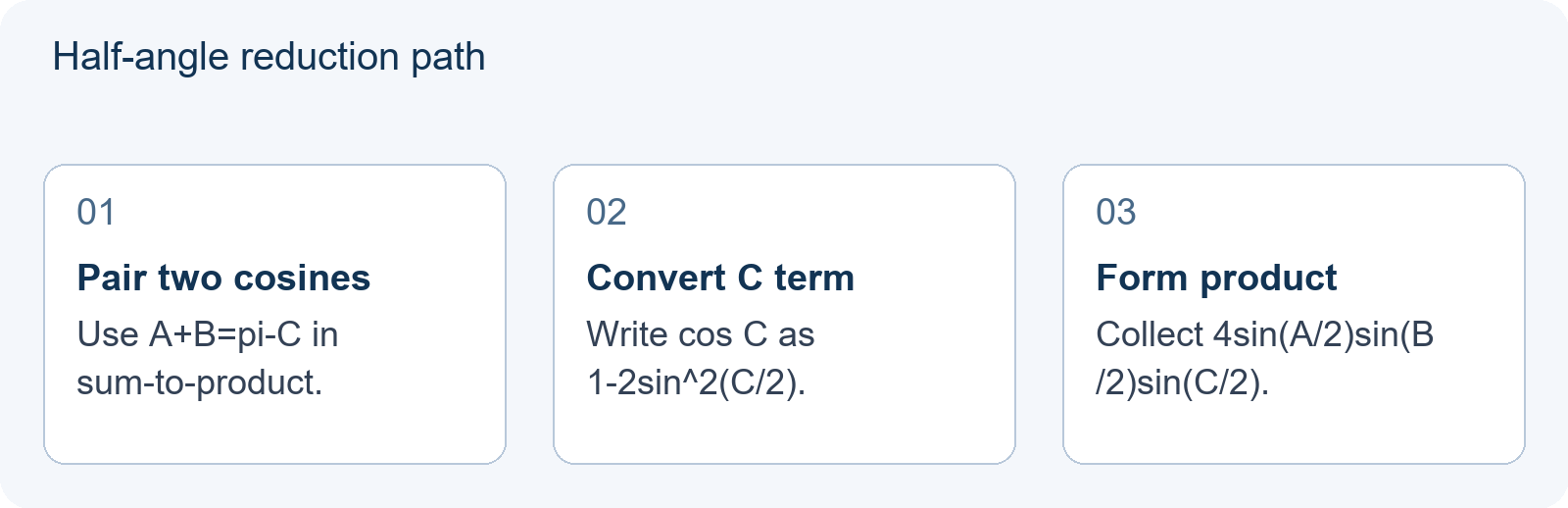
Start with the pair cos A + cos B. Since A+B=pi-C,
cos A + cos B = 2 cos((A+B)/2) cos((A-B)/2) = 2 sin(C/2) cos((A-B)/2).
Add cos C = 1 - 2 sin^2(C/2). Then
cos A + cos B + cos C = 1 + 2 sin(C/2)[cos((A-B)/2) - sin(C/2)].
Because sin(C/2)=cos((A+B)/2), the bracket is cos((A-B)/2) - cos((A+B)/2). The identity cos u - cos v = -2 sin((u+v)/2) sin((u-v)/2) gives
cos((A-B)/2) - cos((A+B)/2) = 2 sin(A/2) sin(B/2).
Multiplying by the outside factor 2 sin(C/2) yields
cos A + cos B + cos C = 1 + 4 sin(A/2) sin(B/2) sin(C/2).
This is the reduction to remember. It is valid exactly when A+B+C=pi and the angles form a nondegenerate triangle. The right side is visibly positive, so the left side is greater than 1 for every nondegenerate triangle. That simple domain check already rules out impossible conditions such as cos A + cos B + cos C = 1.
A fully worked teaching illustration (not a contest problem)
Teaching illustration. Suppose A, B, C are angles of a nondegenerate triangle, so A+B+C=pi and 0<A,B,C<pi. Suppose also that cos A + cos B + cos C = 3/2. Determine the triangle's angle structure.
Apply the identity: 1 + 4 sin(A/2) sin(B/2) sin(C/2) = 3/2, so
sin(A/2) sin(B/2) sin(C/2) = 1/8.
Let x=A/2, y=B/2, z=C/2. Then x+y+z=pi/2 and x,y,z lie in (0,pi/2). The function log(sin t) is concave on this interval, so Jensen's inequality gives
log(sin x)+log(sin y)+log(sin z) <= 3 log(sin((x+y+z)/3)) = 3 log(sin(pi/6)) = 3 log(1/2).
Exponentiating, sin x sin y sin z <= 1/8. The condition reaches equality. Equality in Jensen forces x=y=z=pi/6, hence A=B=C=pi/3. So the symmetric condition forces the equilateral triangle. The key is not the numerical answer equilateral by itself; it is that the identity turned a sum of cosines into a product whose maximum is controlled by the angle-sum constraint.
What changes when the expression is not symmetric
If the expression has unequal coefficients or treats one angle differently, do not force the half-angle product identity as a conclusion about all three angles. For example, with A+B+C=pi, the expression E=cos A + 2 cos B + 3 cos C is not permutation-invariant. You may still pair cos A + cos B and express C in terms of A and B, but the result will generally depend on the difference A-B. That is a signal that the problem is asking for a range, a relation, or a one-variable reduction, not an equilateral conclusion.
Similarly, a condition such as 3 cos A + 4 sin A = 2 is a one-angle auxiliary-angle problem. Rewrite it as 5 cos(A-phi)=2 for an appropriate phi, then use the triangle domain to restrict A. The mistake is to treat this as a symmetric three-angle condition merely because A appears inside a triangle. Symmetry is a property of the whole expression, not a mood created by the word triangle.
Common traps that invalidate an otherwise good method
- Using a triangle identity outside A+B+C=pi. The half-angle product identity is not a general identity for arbitrary angles.
- Losing the domain 0<A,B,C<pi. Half-angles are in (0,pi/2), so their sines are positive. If a derived product is zero or negative, the condition is impossible for a nondegenerate triangle.
- Assuming every symmetric-looking expression becomes one variable. A sum of cosines can reduce to a product, but a sum with unequal coefficients usually retains a difference term.
- Confusing equality of a product with equality of angles without checking the equality case. Jensen or AM-GM equality conditions must be stated and must lie inside the valid domain.
These traps matter because AIME geometry can reward trigonometric computation in higher-numbered questions. Hanlin's 4 November 2026 article makes the same teaching point: trigonometric fluency is not decorative; it is part of the computational toolkit for difficult AIME geometry. For a geometry-specific decision aid, see AIME Geometry Ratios: Choose an Auxiliary Line Before Chasing Lengths.
A three-step routine for AIME trigonometry practice
Use this routine before expanding anything. First, write the domain and the constraint: A+B+C=pi, 0<A,B,C<pi. Second, test symmetry by swapping two angles at a time; if any swap changes the expression, record that it is not fully symmetric. Third, choose the transformation: pair two angles if a sum-to-product is visible, use the half-angle product if the expression is symmetric in all three, and use an auxiliary angle only when one angle combination is genuinely isolated.
A short self-diagnostic: with A+B+C=pi, decide whether cos A + 2 cos B + 3 cos C is symmetric. It is not, because swapping A and B changes the expression. Decide whether cos(A-B)+cos(B-C)+cos(C-A) is symmetric. It is, because any permutation only reorders the three cosine terms. If you can make these two classifications quickly, you are less likely to apply the equilateral conclusion where it does not belong.
The 2027 AIME format change does not change the mathematics of this reduction, but it does change pacing decisions. The trigonometric reduction should be practised as a short, reliable first move, not as a long derivation during the exam.
Preparing a useful question for a consultation
A useful preparation review starts with one written attempt rather than a folder of unsorted problems. Mark the line where you chose a transformation: Did you pair angles, use an auxiliary angle, or expand? State whether you checked symmetry and whether you checked the triangle domain. That lets a teacher diagnose whether the bottleneck is identity choice, algebraic execution, or domain checking. A useful question is specific: “I paired cos A + cos B but did not know whether to convert C to C/2 or keep C,” not “Please explain AIME trigonometry.” This is preparation advice, not a promise that any particular checklist is a Hanlin service.
For the broader shift from AMC speed to AIME sustained reasoning, see AIME Preparation After AMC: When to Switch From Speed to Sustained Reasoning. Keep the trigonometric identity separate from procedural rules: qualification thresholds and exam logistics are set by the relevant authorities, while the reduction above is a mathematical method you can verify line by line.
General event background is available at Event background.
Frequently Asked Questions
When should I use sum-to-product in AIME trigonometry?
Use sum-to-product when two angles appear as cos A + cos B or sin A + sin B and the triangle condition A+B+C=pi lets you replace A+B with pi-C. It is a first move in a symmetric three-angle expression because it exposes half-angles and keeps the constraint visible.
Does cos A + cos B + cos C = 3/2 always force an equilateral triangle?
For a nondegenerate triangle with A+B+C=pi, yes. The identity gives sin(A/2)sin(B/2)sin(C/2)=1/8, and the maximum of that product under A/2+B/2+C/2=pi/2 is 1/8, attained only at A=B=C=pi/3. Outside that triangle domain, the conclusion does not apply.
What if the trigonometric expression is not fully symmetric?
Do not force the equilateral conclusion. Test swaps of the angles; unequal coefficients or a singled-out angle mean the expression is not permutation-invariant. You may still pair two terms or use an auxiliary angle, but the remaining difference or one-angle dependence must be handled explicitly.