AIME 2027 Single Exam: Plan Without an AIME I/II Retake

For the AIME 2027 single exam, the practical answer is simple: plan for one attempt. MAA information verified on 26 August 2026 discontinues AIME I and AIME II and replaces them with a single AIME window on 5–6 February 2027. Qualification for that single exam uses fixed thresholds: AMC 10 at least 100 and AMC 12 at least 85. A student who is waiting for a second sitting to serve as a backup is planning for a format that no longer exists.

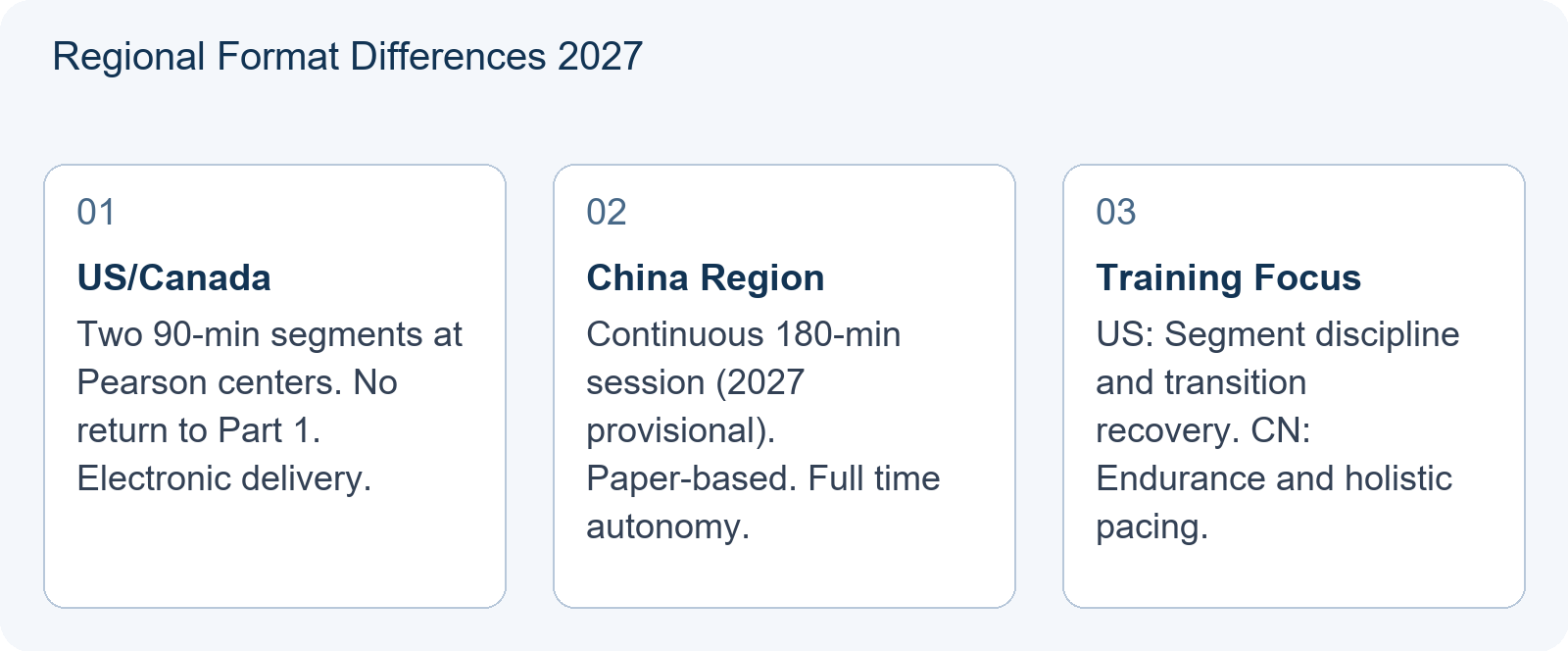
The change matters most for students who have heard that AIME I and AIME II are two chances. They are not, for 2027. The Hanlin WeChat article 'Note for Students Aiming for AIME: 2027 Qualification Thresholds Fixed, China Arrangements Clarified, AIME Test-Site Booking Opens!', published 10 October 2026, reports that China’s 2027 AIME remains 15 questions in one 180-minute continuous session, while US/Canada uses two 90-minute segments. Both regions face a single-exam risk, but the risk appears at different points in the clock. The preparation question is no longer 'How do I use the first AIME to prepare for the second?' It is 'What must be reliable before the only sitting?'

What Changed for AIME 2027?

The older AIME I/II structure encouraged a two-sitting mental model: one sitting could act as a warm-up or diagnostic, and the other could be treated as the real attempt. That model should be retired. The table below contrasts assumptions families may still carry with the 2027 single-exam reality.

Assumption to check 2027 single-exam reality Planning consequence
'AIME I can be a warm-up; AIME II is the real attempt.' AIME I/II are discontinued; there is one window on 5–6 February 2027. Score every full timed set before review and treat it as the only sitting.
'A strong AMC score can cushion a weaker AIME.' For USAMO/USAJMO selection, AIME scores are primary; AMC scores no longer count. If the goal extends beyond qualification, AIME accuracy is not a secondary margin.
'I can repair a bad start later.' China: one 180-minute continuous session with self-directed time. US/Canada: 90 minutes for 8 questions, then 90 minutes for 7; no return to segment one. China rehearses return-to-blank decisions; US/Canada rehearses first-segment accuracy.

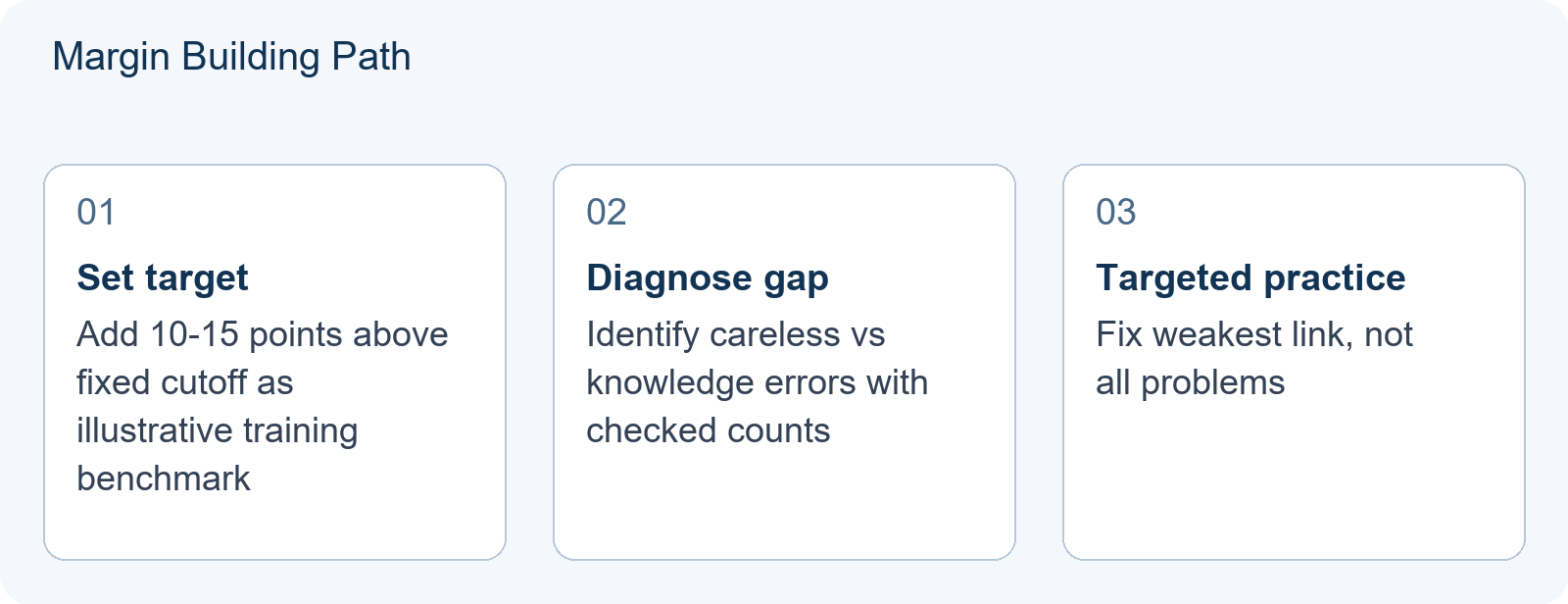
The fixed thresholds also change the qualification target. Instead of asking whether this year’s cutoff might move, a student can ask whether practice scores sit reliably above AMC 10 100 or AMC 12 85. The fixed line makes the target more legible. It does not create another AIME sitting. A margin-building view is useful alongside this planning question, but the core point remains the single attempt.

Why the Retake Assumption Is Risky

Under a two-sitting model, a student could tell themselves that the first AIME produced information and the second would apply it. For 2027, the first sitting is final. That is especially consequential for students aiming at USAMO or USAJMO, because the verified 2027 rules make AIME scores primary and retire the older AMC-plus-AIME index. A student cannot assume that a strong AMC result will offset a weaker AIME result.

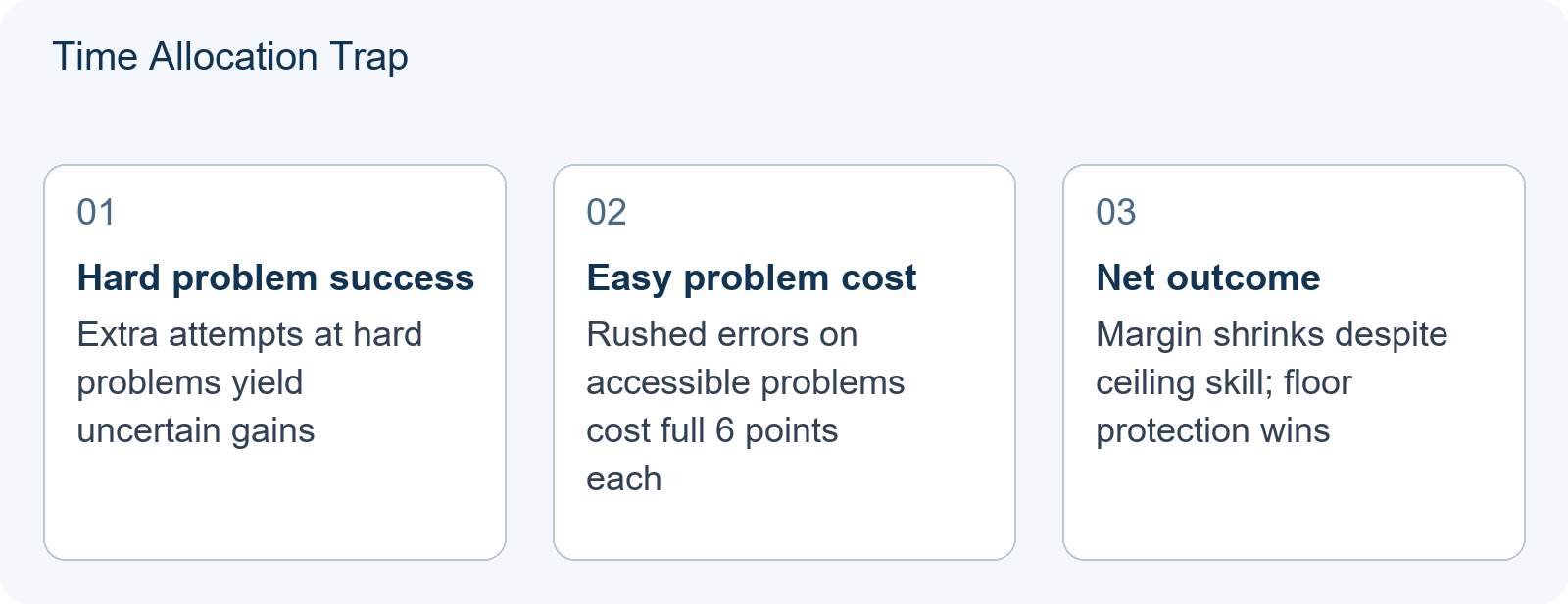
The risk is not only emotional. It changes how practice is designed. A practice set followed by unlimited review is a learning tool, but it is not a simulation of the single exam. If a student always allows a second attempt at the same set, they may never rehearse the decisions that matter most: when to leave a question blank, when to check an answer, and when to stop chasing a hard problem because the recoverable points are elsewhere. The single-exam plan should make those decisions boring and repeatable.
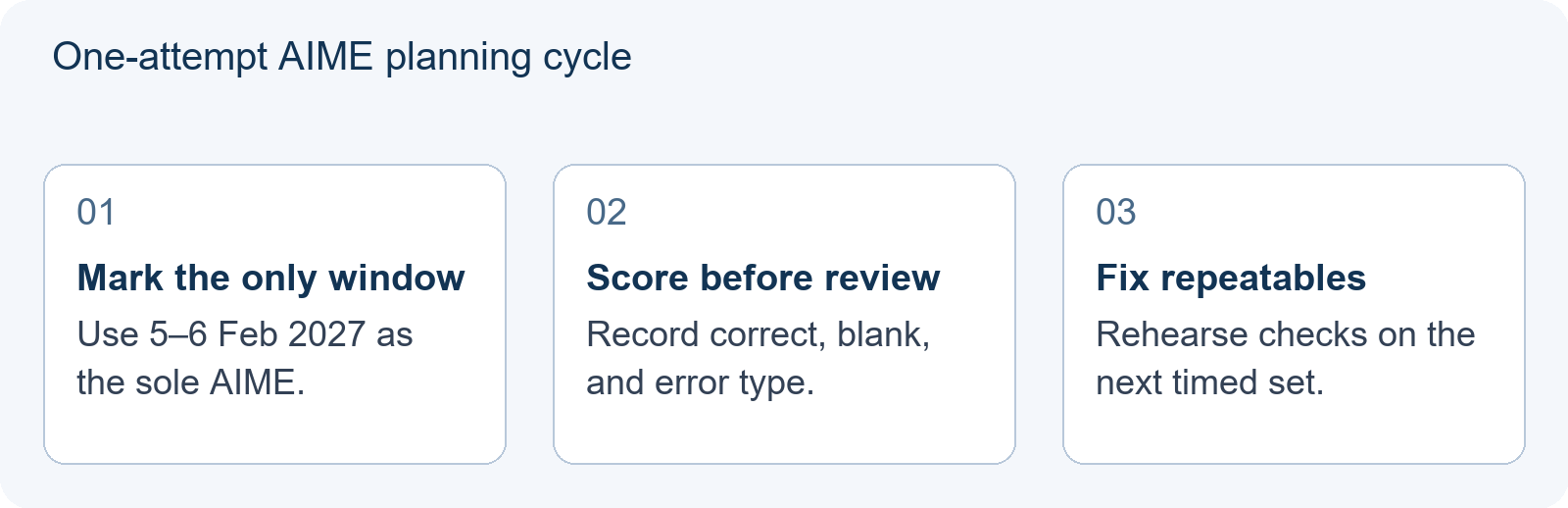
One-attempt AIME planning cycle

One-Attempt Preparation Priorities

A one-attempt plan does not require a completely different curriculum. It requires a different order of reliability. The following priorities are a suggested preparation framework, not a claim that every student needs the same schedule.

  • Front-load answer verification. For integer-answer questions, the final check should be a fixed step, not an optional habit. Domain conditions, sign errors, and 'solved for the wrong quantity' mistakes can turn a correct method into an incorrect entry.
  • Rehearse the full regional clock. China’s 180-minute continuous session rewards time allocation and return-to-blank decisions. US/Canada’s two 90-minute segments reward first-segment accuracy because the first eight answers cannot be revisited after the second segment begins. Use AIME Pacing Practice: Prepare for Your Region's 2027 Format to match practice to the correct format.
  • Classify errors by recoverability. A recoverable error uses a method the student already knows but loses to time pressure, a sign slip, or a missed check. A fragile method worked once but has not survived timed repeats. An out-of-scope item needs new theory and should not displace core accuracy too early.
  • Keep a blank log. For every skipped question, record whether the student recognized the method, ran out of time, or never had a viable entry point. Blank logs are more useful than a raw score because they show whether the next practice block should build speed, checking, or new content.
  • Use a no-retake practice rule. Finish a timed set, record the verified correct count, and only then review. The review can be generous; the first pass should not be.

Teaching Illustration: One Check Can Change the Recorded Answer

Teaching illustration, not an actual AIME problem or official scoring guidance. Solve sqrt(x + 6) = x. Because the right side equals a principal square root, x must be at least 0. Squaring both sides gives x + 6 = x^2, so x^2 − x − 6 = 0, or (x − 3)(x + 2) = 0. The candidates are 3 and −2. Checking x = 3 gives sqrt(9) = 3, which is valid. Checking x = −2 gives sqrt(4) = 2, while the right side is −2, so the candidate is rejected. The verified answer is 3.

This is a simple error, but it is exactly the kind that a single-exam plan must make non-repeatable. The student did not lack the algebra. They lacked a final verification step. In a one-attempt environment, a 20-second check is not extra caution; it is part of the answer.

Teaching Illustration: A 15-Question Score Audit

Teaching illustration using hypothetical counts, not a real student record. Suppose a student completes a 15-question timed set under one-attempt conditions and records the following audit.

Question band In-exam action Verified correct Review finding
1–6 Answered 6 No change
7–9 Left blank 0 Q7 and Q8 use known methods; Q9 needs a new idea
10–12 Answered 2 One sign error
13–15 Answered 0 No recoverable method found in review

The verified correct count is 8. If Q7, Q8, and the sign-error question are recoverable, the arithmetic ceiling is 11, because 6 + 2 + 2 + 1 = 11. That does not mean the student will score 11; it means the next practice block should not be aimed only at three harder topics. Two blanks were known-method questions, and one error was a checkable sign slip. A sensible next timed set might require the student to revisit Q7 and Q8 before spending time on Q13–15, then add a final sign check on Q10–12. The audit changes the practice target from 'more problems' to 'recoverable points under the clock.'

China and US/Canada: Same Single Exam, Different Failure Points

China’s 2027 AIME remains 15 questions in one 180-minute continuous session, according to the Hanlin Course article dated 10 October 2026. Students can allocate the whole block, skip a question, and return to it. The main single-exam risk is poor time allocation: a student may spend too long on a hard question and fail to return to a blank that was already within reach. Practice should therefore include an explicit return rule, such as 'after two minutes without a path, mark and move,' followed by a planned return window.

US/Canada uses two 90-minute segments: 8 questions, then 7. After entering the second segment, a student cannot return to modify the first eight answers. The main risk is first-segment accuracy and the handoff. A student who is slow to settle in the first eight questions has no late repair. Practice should simulate the handoff, not just the total 180 minutes. Readers outside China and North America should follow their International Group Leader’s instructions; the Pearson process should not be transferred to China. For China-specific age, format, and single-exam differences, see AIME China 2027: Age, Format, and Single-Exam Differences.

Preparing a Course-Fit or Resource Request

Before asking Hanlin for AIME preparation planning, build a one-page attempt profile. This is a preparation aid, not a promise that Hanlin offers a named checklist or a particular service. Include the date of each recent timed set, the regional format used, the verified correct count, the number of blanks, and a short error log separated into recoverable, fragile, and out-of-scope categories. Add the student’s target: qualification, a specific score band, or USAMO/USAJMO preparation. Do not include real student names if the log is shared.

A concrete profile makes the conversation more useful than a vague request for 'AIME preparation.' It also protects against the old retake assumption: if the practice record still contains second attempts at the same set, the profile will show it. The goal is to replace that habit with a single-attempt review cycle that matches the 2027 format. For a score-band perspective, the site’s AIME: 7 Points is the Watershed, 10 Points is the Stepping Stone can help frame target-setting without implying a guaranteed outcome.

The single-exam plan in one sentence: make the ordinary questions reliable, verify before recording, rehearse the region’s clock, and review every timed set as if there is no second sitting. That is the practical meaning of AIME 2027 without an AIME I/II retake.

General event background is available at Event background.
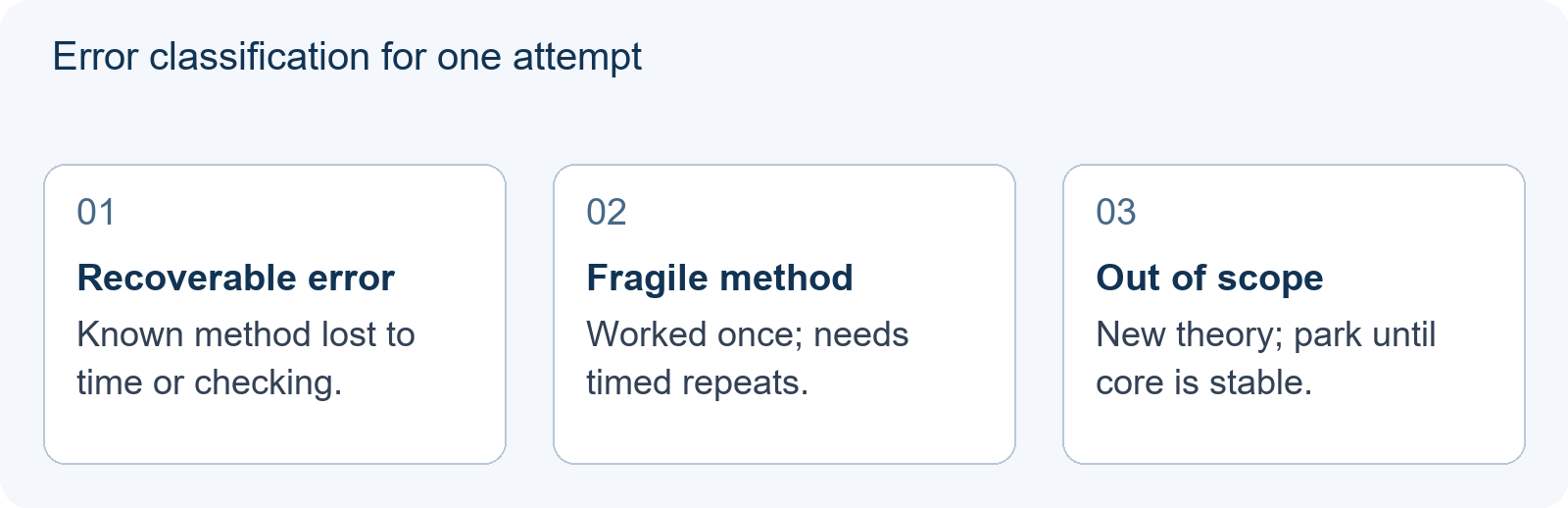
Error classification for one attempt

Frequently Asked Questions

Is there an AIME II in 2027?

No. The 2027 cycle replaces AIME I/II with one AIME window on 5–6 February 2027. Plan for one attempt.

Can a student choose between AIME I and AIME II in 2027?

No such choice exists for 2027 because AIME I/II are discontinued. The relevant choice is preparation quality and regional format, not an exam sitting.

Does a lower AIME score allow another attempt?

No. There is no second 2027 AIME sitting under the single-exam change; a lower score is not a retake trigger. Use practice sets to rehearse one-attempt decisions before the official window.
AIME 2027 USAMO/USAJMO Selection: Why AMC Scores No Longer Count

This AIME 2027 USAMO/USAJMO selection guide answers the practical question first: for 2027, a strong AMC 10 or AMC 12 score still can earn AIME qualification at the fixed thresholds — AMC 10 at least 100 and AMC 12 at least 85. It no longer does the second job many families assumed it did. MAA guidance verified for this report on 26 August 2026 says USAMO/USAJMO selection is based primarily on AIME scores; AMC scores no longer count because the AMC + 20 x AIME index is retired. The practical answer is therefore: qualify through AMC, then compete for USAMO/USAJMO through AIME performance. An AMC margin above the threshold is not protection inside the selection index.

What changed: qualification is not selection

AIME qualification and USAMO/USAJMO selection are separate gates. The first gate is now fixed for 2027: students on AMC 10 at or above 100, or AMC 12 at or above 85, meet the stated qualification threshold, subject to the applicable eligibility rules. That fixed line replaces the percentage-based cutoff logic many families remember. Qualification still matters, but it is a doorway, not the selection ranking.

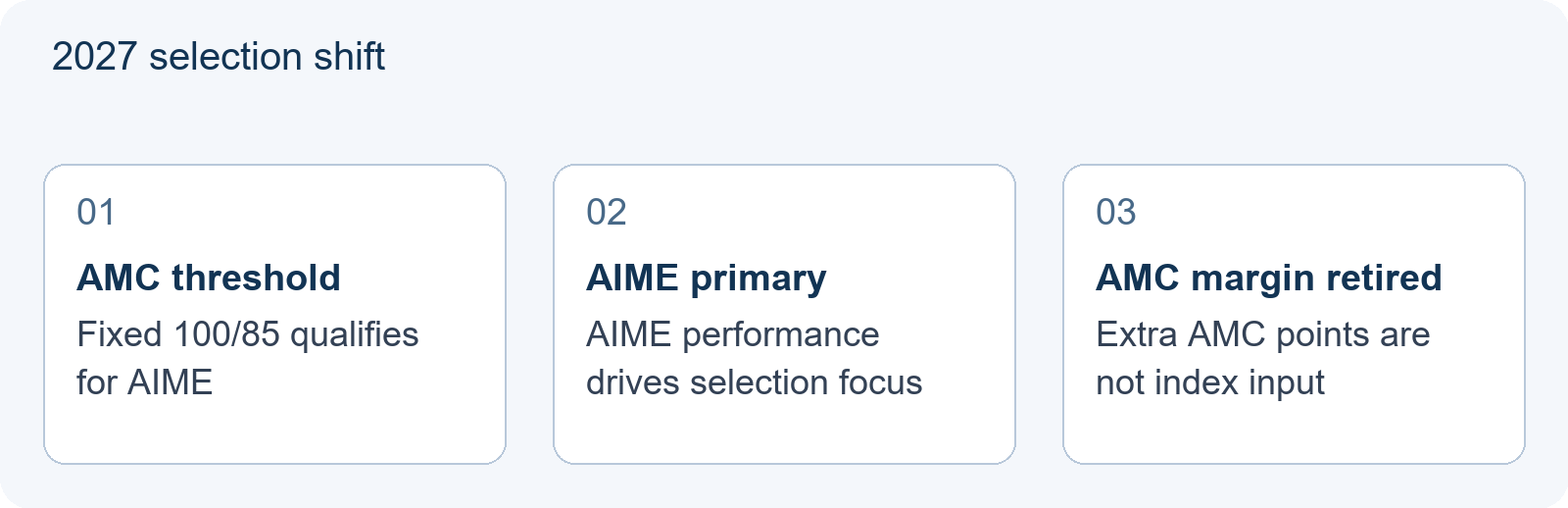
The second gate is the selection process that follows AIME. Under the retired index, a student's AMC score and AIME score were combined in a way that could let a high AMC score compensate for a lower AIME score. That arithmetic is gone. MAA guidance verified on 26 August 2026 states that USAMO/USAJMO selection is based primarily on AIME scores and that AMC scores no longer count. The AIME also becomes a single opportunity in 2027, with AIME I/II discontinued in favour of one 5-6 February 2027 window. One strong AIME performance now carries more planning weight than it did when families could think in terms of an AMC cushion.

A worked contrast: why a 20-point AMC margin stops protecting you

The following is a teaching illustration, not an actual contest result, an official cutoff, or a prediction of selection. It uses simple numbers to show why the old index changed the planning question.

Hypothetical student AMC 12 score AIME score Retired index arithmetic 2027 planning reading
Student A 120 5 120 + 20 x 5 = 220 The AIME score is the selection focus
Student B 100 8 100 + 20 x 8 = 260 The AIME score is the selection focus

Both hypothetical students clear the fixed AMC 12 threshold of at least 85. Under the retired index arithmetic, Student B's AIME advantage more than offsets Student A's 20-point AMC lead. Under the 2027 rule described by MAA, the AMC lead is not part of that selection index at all. Student B's AIME 8 does not guarantee selection, and Student A is not mathematically eliminated by this illustration. The point is narrower and more useful: the comparison no longer begins with Student A's AMC margin. It begins with AIME performance.

2027 selection shift

Who is affected — and who is not

The change matters most to students who have already qualified for AIME and are aiming at USAMO/USAJMO. Those students need to stop treating AMC preparation as a reserve score that can be spent later. Once the fixed threshold is cleared, additional AMC points may still be a personal achievement or a useful confidence signal, but they are not the selection currency described in the 2027 rule.

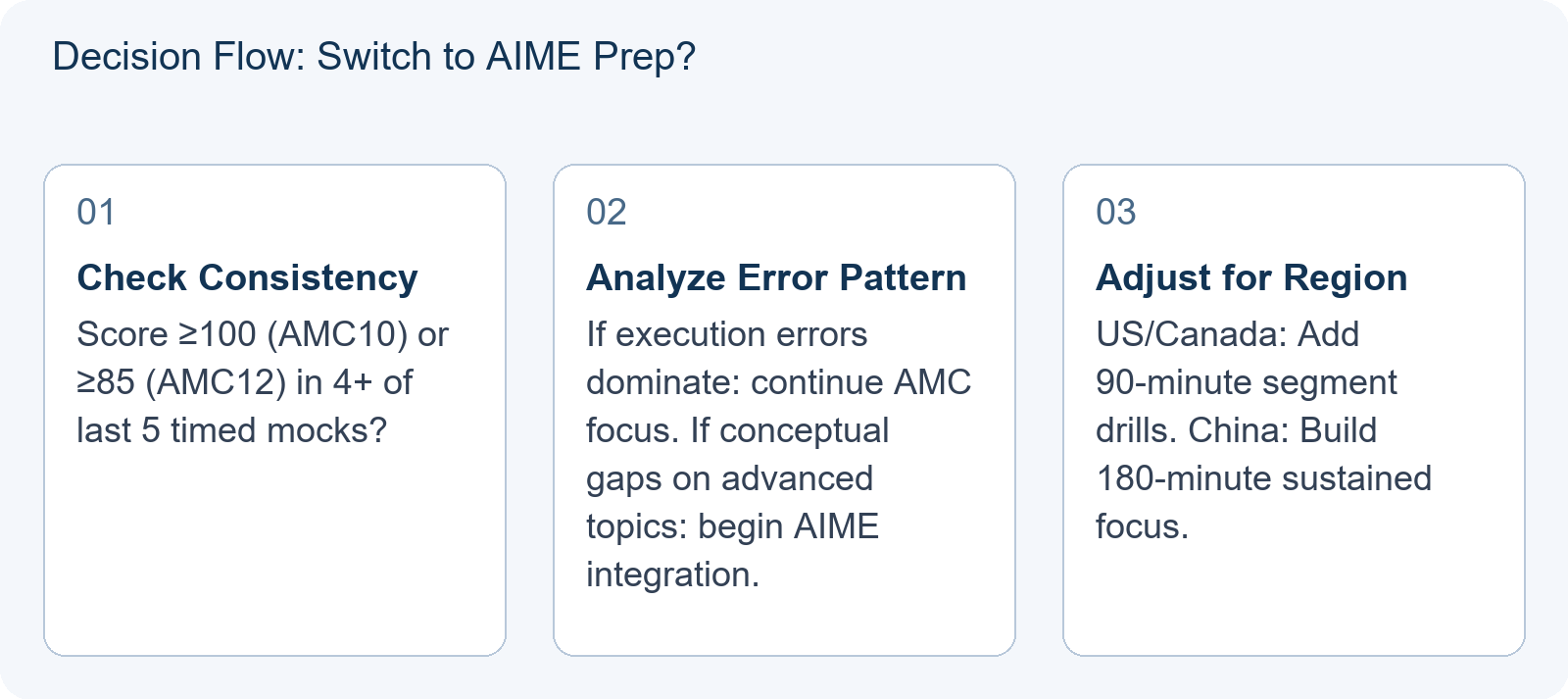
Students still below the fixed thresholds are in a different position. Their immediate task is qualification, not USAMO/USAJMO selection planning. A student who is not yet stable above AMC 10 100 or AMC 12 85 should not abandon AMC fundamentals for AIME material too early. The relevant decision aid is AIME Qualification Targets: Build a Reliable Margin Above the AMC Cutoff. For students who have cleared the line, the useful question becomes whether their AIME work is stable enough for a single-opportunity exam.

China and US/Canada candidates also need to separate qualification rules from administration rules. The AIME is a single opportunity in 2027, but the sitting format differs by region. Hanlin's 10 October 2026 report, translated as 'Attention, students preparing for AIME: 2027 qualification thresholds are fixed, China arrangements are clarified, and AIME test-site booking opens!', says China retains a 180-minute continuous session, while US/Canada candidates use two 90-minute segments of 8 and 7 questions. International entrants follow their International Group Leader; the Pearson self-scheduling process should not be applied to China. The China-specific format is summarised in AIME China 2027: Age, Format, and Single-Exam Differences.

Preparation priority: from cutoff margin to AIME stability

AMC and AIME reward different behaviours. AMC is a 25-question, 75-minute selection paper where speed, triage and clean short solutions matter. AIME is a 15-question integer-answer paper where a student must sustain reasoning across longer derivations. The 2027 selection change makes that difference strategic, not merely stylistic. A student who has qualified should move the centre of preparation from 'Can I push my AMC score higher?' to 'Can I produce reliable AIME accuracy under one sitting?'

That shift does not mean ignoring AMC entirely. It means changing what is optimised. Extra AMC speed drills may still help a student who is close to the qualification threshold. For a qualified USAMO/USAJMO aspirant, the higher-value work is multi-step derivation, checking whether an answer is an integer that satisfies every condition, and reviewing errors by cause rather than by topic label alone. The adjacent preparation question is covered in AIME Preparation After AMC: When to Switch From Speed to Sustained Reasoning. Score bands are a separate question; no score band should be read as a 2027 selection cutoff.

Decision table: audit your current plan

Old planning assumption 2027 planning question What to practise What to stop optimising
'My AMC margin protects my USAMO/USAJMO path.' Can I produce stable AIME accuracy in one opportunity? Longer derivations, integer-answer verification, timed recovery Chasing extra AMC points after the fixed threshold is secure
'AIME qualification is the finish line.' Have I separated qualification from selection? Full AIME sets under the correct regional format Treating qualification as if it were a selection ranking
'AIME I/II gives me a second chance.' How do I manage a single AIME sitting? Pacing, skip-and-return discipline, error checks Planning around a retake that no longer exists in 2027

The first row is the central change. A family may still be proud of a high AMC score, and a student may still benefit from AMC work as general training. But the selection index no longer uses AMC scores, so a plan that spends November and December trying to enlarge an already sufficient AMC margin is solving last season's problem. The second row guards against a different mistake: qualification is necessary but not the same as selection. The third row matters because the single AIME opportunity raises the cost of poor pacing and unreviewed errors, without creating a new official cutoff formula.

A practice design that matches the new selection logic

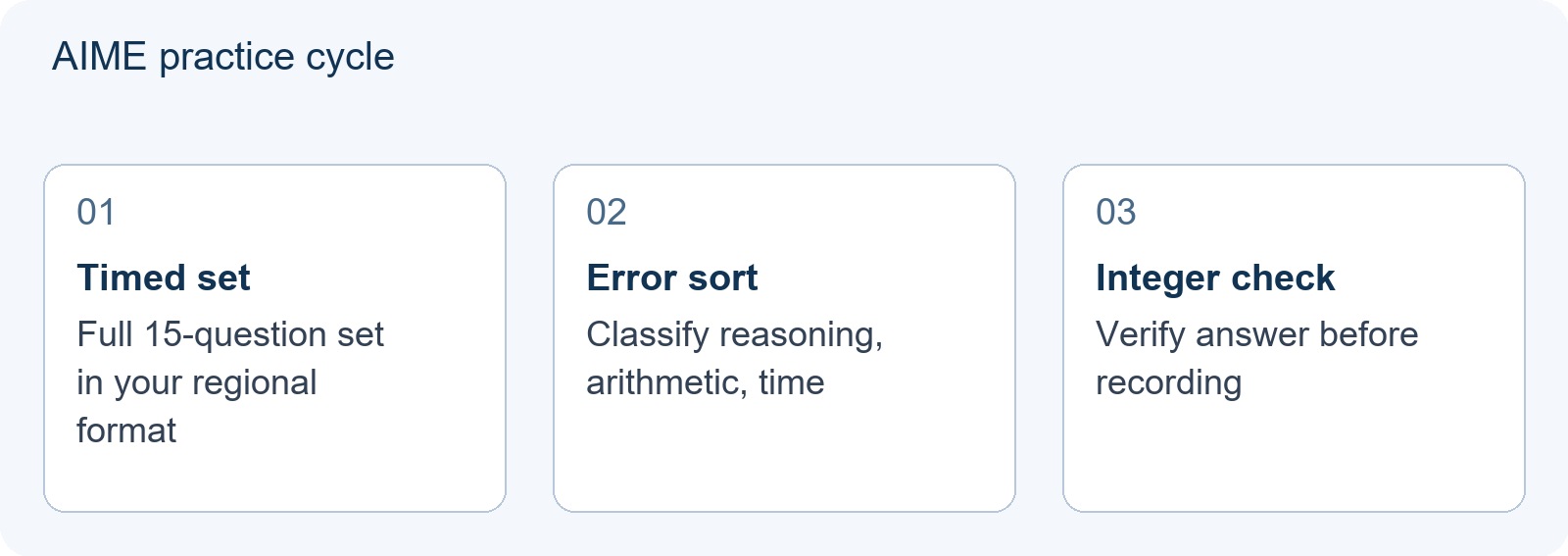
A practical weekly cycle has three parts. First, a timed AIME set using the student's actual regional format: 180 continuous minutes in China, or the two-segment 8 + 7 structure for US/Canada candidates. Second, an error sort into three boxes: reasoning gap, arithmetic or sign slip, and time or decision error. Third, an integer-answer verification pass in which the student checks the answer against the original conditions rather than only against the last line of algebra.

Teaching illustration only: suppose a practice equation produces candidates 12 and -3. The negative value cannot be the recorded integer answer, so the student must decide whether it is an extraneous root, a domain restriction, or a sign error in the derivation. The lesson is not the particular equation; it is the habit of verifying before recording. AIME preparation should build that habit under time pressure, because the 2027 selection logic rewards the student who can produce a correct integer answer repeatedly, not the student who merely recognises a familiar AMC shortcut.

Single-opportunity planning, without inventing a cutoff

The move to one AIME opportunity changes risk management. A student cannot assume that a bad first attempt will be followed by a second AIME I/II sitting. That makes full-run pacing, scratch-work discipline and recovery after a difficult problem more important. For US/Canada candidates, the two 90-minute segments also mean that segment-one choices cannot be revisited in segment two; students should practise that constraint rather than assuming a single continuous paper. For China candidates, the 180-minute continuous session allows self-directed time allocation, but it also removes the external break that might otherwise reset concentration.

What this article does not do is publish an unofficial USAMO/USAJMO cutoff formula. The verified 2027 rule says selection is based primarily on AIME scores and that AMC scores no longer count. It does not follow that every AIME score above some invented number guarantees selection, and it does not follow that every AIME score below some invented number eliminates a student. Families should reject any table that presents such numbers as official without a current MAA source. The safe planning conclusion is narrower: AMC gets the student to AIME; AIME performance is the primary selection input to prepare for.

How to prepare for a course-fit or resource review

A useful preparation conversation should start with evidence, not a sales promise. Bring a recent timed AIME set completed under the correct regional format, a short error log that separates reasoning from arithmetic and pacing, the student's current AMC threshold status, and a clear target: qualification, a stronger AIME score band, or USAMO/USAJMO selection preparation. Ask whether the review distinguishes those goals, because a student still chasing AMC 10 100 or AMC 12 85 needs different work from a qualified student who is already training for a single AIME sitting.

Ask also how integer-answer verification and full-paper pacing will be reviewed, and whether the plan uses the student's actual format rather than a generic 15-question set. A good review should be able to explain why a particular drill is assigned and what error pattern it addresses. It should not promise a selection outcome, invent a cutoff, or treat a high AMC score as a reserve that can be spent in the AIME index. The qualification and format articles linked above answer different questions; this article is specifically about the 2027 selection shift after AIME qualification.

General event background is available at Event background.

AIME practice cycle

Frequently Asked Questions

Does a high AMC score still help with USAMO/USAJMO selection in 2027?

A high AMC score can still help a student meet the fixed AIME qualification threshold: AMC 10 at least 100 or AMC 12 at least 85. It does not contribute to the USAMO/USAJMO selection index described for 2027, because AMC scores no longer count and the AMC + 20 x AIME index is retired. Selection is based primarily on AIME scores.

Does AIME qualification alone imply USAMO/USAJMO eligibility?

No. AIME qualification is a separate step from USAMO/USAJMO selection. A student must qualify for AIME, but selection is based primarily on AIME performance under the 2027 rule. This article does not publish an unofficial USAMO/USAJMO cutoff or imply that any particular AIME score guarantees selection.

How should China and US/Canada candidates prepare differently for the 2027 AIME?

Both should prepare for stable AIME accuracy under a single opportunity, but the sitting format differs. Hanlin's 10 October 2026 report says China retains a 180-minute continuous session, while US/Canada candidates use two 90-minute segments of 8 and 7 questions. International entrants should follow their International Group Leader, and the Pearson process should not be applied to China.

AIME Floor Function Bounds: Solving Inequalities with Integer Constraints

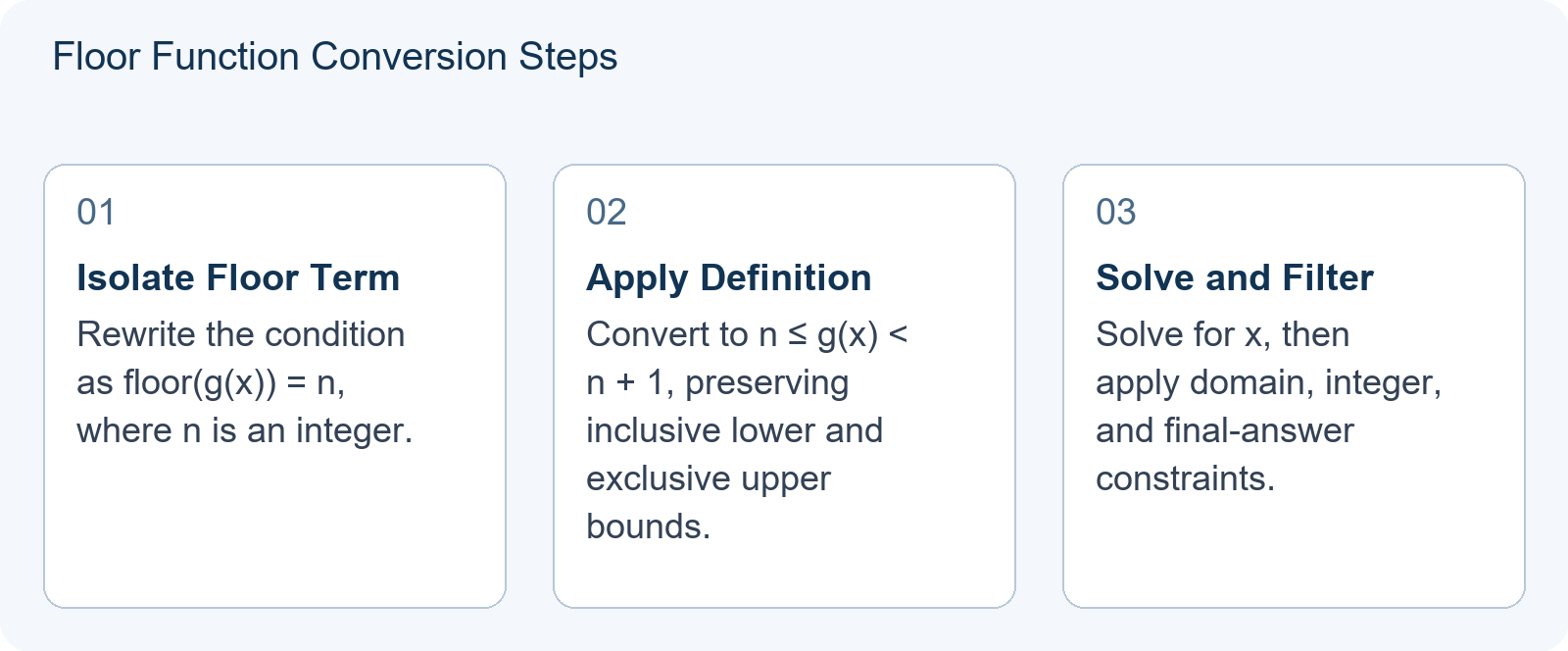
For students preparing for the 2027 AIME, AIME floor function bounds are a practical way to turn a discontinuous floor expression into a solvable inequality. The concise answer is: isolate the floor term, convert it using the definition k ≤ argument < k + 1, solve the resulting compound inequality, then apply the problem’s domain and integer restrictions. The official 0–999 AIME answer rule applies to the final submitted answer only, not automatically to every variable or intermediate value.

According to the MAA Invitational Competitions page checked on October 26, 2026, the 2027 AIME uses integer answers from 0 to 999. That is an answer-format constraint. It does not mean that x, an inner expression, or an intermediate count must lie between 0 and 999. A problem can involve negative values, large intermediate bounds, or non-integer variables while still producing a final answer inside the official range.

The examples below are teaching illustrations, not actual contest problems or official scoring guidance.

The Core Definition: Floor as a Compound Inequality

The entire technique rests on one definition. If n is an integer and floor(x) = n, then:

  • n ≤ x < n + 1

This conversion is the bridge from floor notation to ordinary algebra. It works because the floor function returns the greatest integer less than or equal to the input. The lower endpoint is included, while the upper endpoint is excluded.

For an equation such as floor(2x − 1) = 5, do not guess values. Write the compound inequality:

  • 5 ≤ 2x − 1 < 6

Add 1 to all three parts:

  • 6 ≤ 2x < 7

Divide by 2:

  • 3 ≤ x < 3.5

If the problem says x is an integer, then x = 3 is the only solution. If the problem asks for real x, the full interval [3, 3.5) is valid. The distinction matters, and the algebra itself gives the correct range.

Teaching Illustration 1: Counting Integer Solutions

Suppose a teaching exercise asks for the number of integer solutions to floor(x² / 10) = 3. This is not a past AIME problem; it is a skill drill.

Apply the definition directly to the inner expression x² / 10:

  • 3 ≤ x² / 10 < 4

Multiply by 10, which is positive, so the inequality signs do not change:

  • 30 ≤ x² < 40

Now identify integers whose squares lie in [30, 40). Check nearby perfect squares:

  • 5² = 25, too small
  • 6² = 36, valid because 30 ≤ 36 < 40
  • 7² = 49, too large

Because x can be negative, both x = 6 and x = −6 satisfy the condition. The number of integer solutions is 2. This example shows why bounding the inner expression is safer than trying to manipulate the floor symbol as if it were a multiplier.

Floor Function Conversion Steps

Handling Strict Versus Non-Strict Boundaries

The most common error in floor-function inequalities is mishandling the boundary. For floor(x) = n, the lower bound is inclusive and the upper bound is exclusive. A small table helps prevent slips:

Condition Integer meaning Variable range
floor(x) = n floor value is exactly n n ≤ x < n + 1
floor(x) > n floor value is at least n + 1 x ≥ n + 1
floor(x) < n floor value is at most n − 1 x < n

For example, floor(x) > 2 does not mean x > 2. It means the floor value is at least 3, so x ≥ 3. Similarly, floor(x) < 2 means the floor value is at most 1, so x < 2. Students often lose points by writing x ≥ 2 or x ≤ 1 in these cases.

Complex Arguments: Square Roots and Powers

When the argument inside the floor function is more complicated, the strategy stays the same: isolate the floor term and bound the argument. Domain restrictions become especially important.

Teaching illustration: solve for integer x in floor(√x) = 4. This is not a contest problem; it is a boundary drill.

By definition:

  • 4 ≤ √x < 5

Since all parts are non-negative, square all three parts:

  • 16 ≤ x < 25

The integer solutions are 16, 17, …, 24. There are 24 − 16 + 1 = 9 solutions. The value x = 25 is excluded because √25 = 5, and floor(5) = 5, not 4. Checking the upper boundary is essential.

AIME Final-Answer Constraint Without Over-Bounding Variables

The 2027 AIME final answer must be an integer from 0 to 999. That rule does not restrict the variables in the mathematical model. For example, x may be negative, the inner expression may be large, or a count may temporarily exceed 999. What matters is the quantity the problem asks you to submit.

If a problem asks for the sum of all valid integer solutions, then that sum is the final answer and must fit the 0–999 format. If the problem asks for a count, then the count is the final answer. Do not clip intermediate intervals at 999 unless the problem itself imposes that restriction.

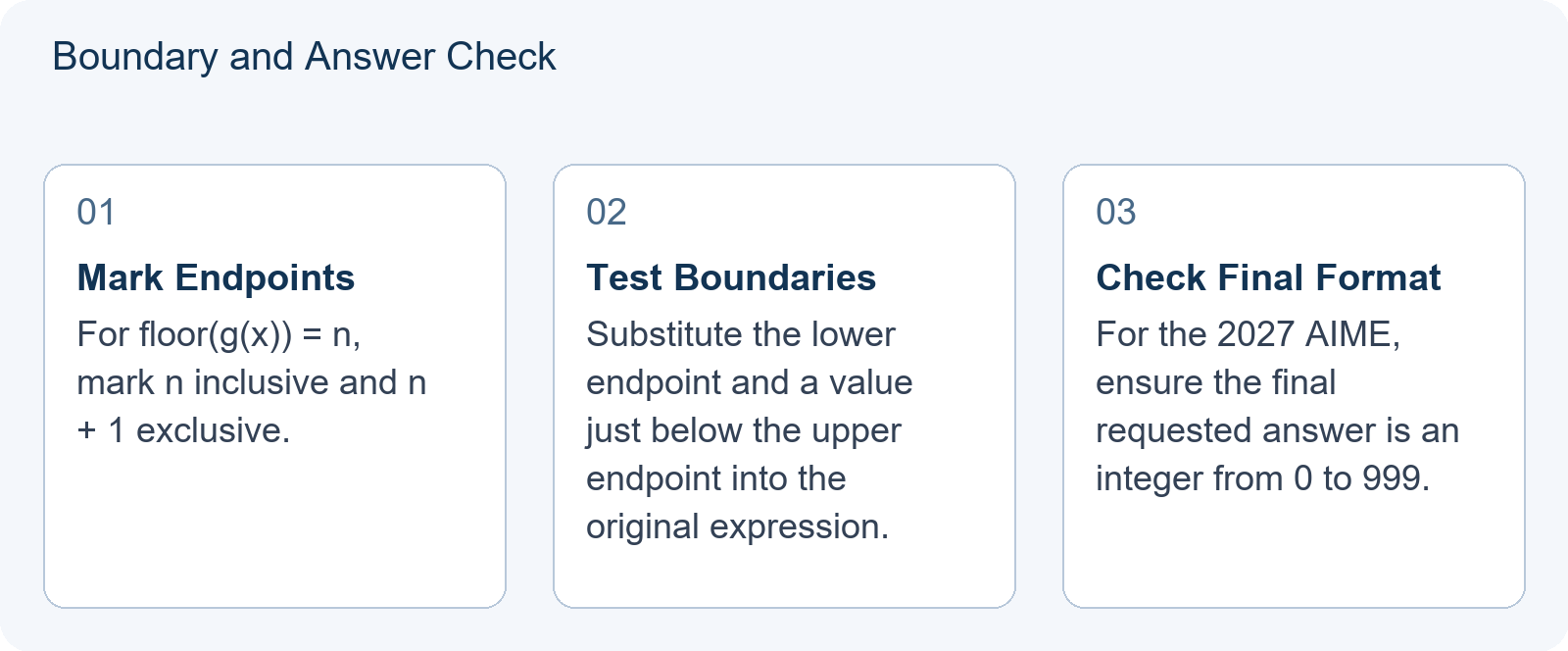
2026 Hanlin coaching notes titled Important Notice: Domestic AIME Math Exam Schedule Confirmed! advise a final integer-property, range, and substitution check to reduce calculation errors. A practical way to apply that advice is: after deriving a range such as 16 ≤ x < 25, substitute the lower endpoint and a value just below the upper endpoint into the original floor expression. Confirm that the floor value matches the target.

Diagnostic Strategy: Real Solutions Versus Integer Solutions

Before solving, clarify what the problem asks for:

  1. Real solutions: express the answer as an interval, such as [3, 3.5).
  2. Integer solutions: list the specific integer values or count them.
  3. Count of integers: compute the number of integers in the interval, adjusting for inclusive and exclusive endpoints.

For instance, if a teaching exercise asks for the number of real numbers x satisfying floor(x) = 5, the answer is infinite because the interval is [5, 6). If it asks for integers, the answer is 1. Misreading the requested type of solution produces a wrong answer even when the algebra is correct.

Common Pitfalls and Verification

Three major pitfalls occur in floor-function problems:

  • Ignoring the exclusive upper bound: treating floor(x) = n as x ≤ n + 1 instead of x < n + 1.
  • Misrounding negative numbers: remember that floor(−2.5) = −3, not −2. The floor function rounds down, not toward zero.
  • Forgetting domain restrictions: if the argument contains a square root or a denominator, the valid domain must be applied before counting solutions.

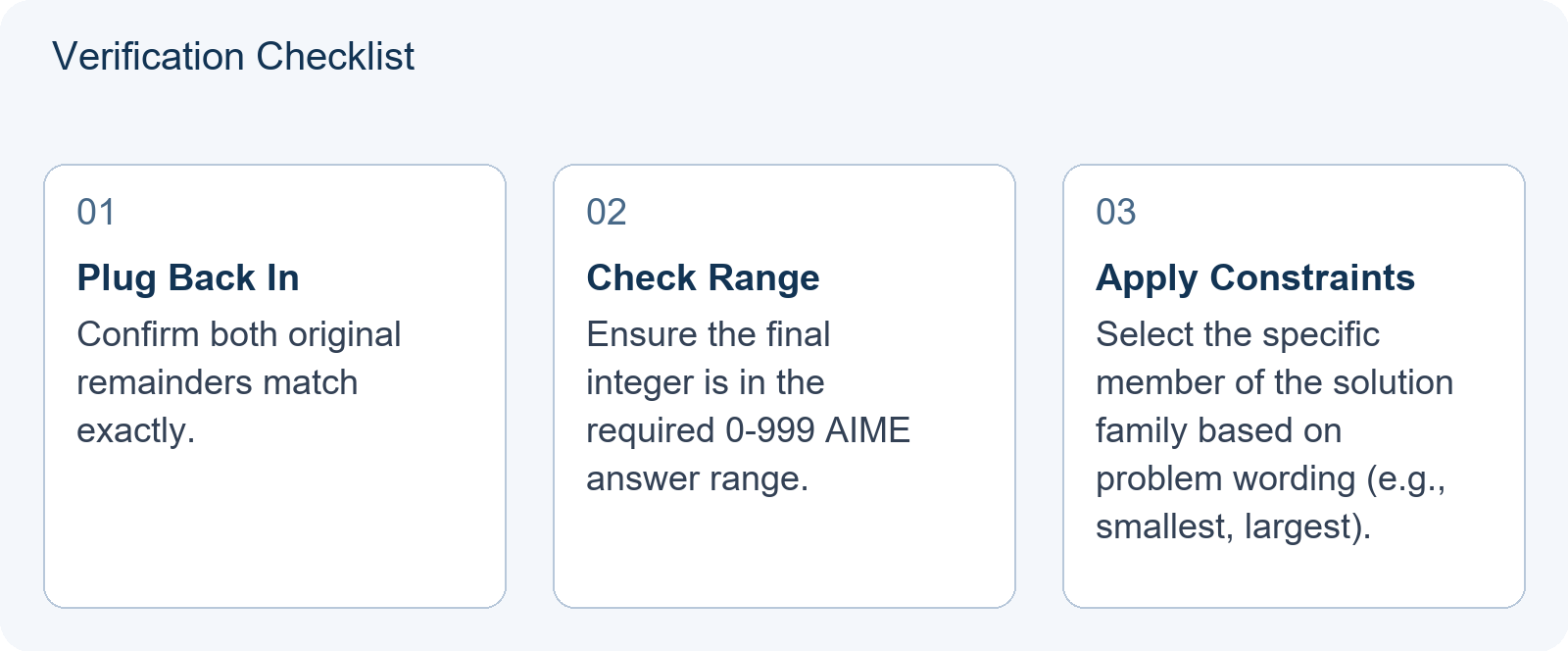
To verify, pick test points inside the derived interval. If you found 3 ≤ x < 3.5, test x = 3 and x = 3.4. Both should satisfy the original equation. Test x = 3.5; it should fail because floor(2·3.5 − 1) = floor(6) = 6, not 5. This substitution check aligns with the method discussed in AIME Answer Checking: Catching Extraneous Roots Before Recording an Integer.

Integrating Floor-Function Skills With AIME Preparation

Floor-function inequalities are part of the broader algebra toolkit needed for AIME. They reward precision with inequalities, integer awareness, and boundary checking. Students who practice the conversion n ≤ argument < n + 1 build habits that also help in piecewise functions, modular arithmetic, and counting problems.

For a wider view of qualification, scoring, and preparation, see the AIME Math Competition Guide: Qualification Rules, Scoring Changes & Prep Strategies. For another algebra skill, see AIME Vieta's Formulas: Find Symmetric Expressions Without Solving Every Root.

Diagnostic Drill: The Ceiling Function Trap

While the previous sections focused on the floor function, a common source of error in AIME preparation is confusing floor with ceiling. The ceiling function, denoted ⌈x⌉, returns the least integer greater than or equal to x. This distinction changes the inequality structure entirely. If ⌈x⌉ = n, then n − 1 < x ≤ n. Note that the lower bound is exclusive and the upper bound is inclusive—the exact opposite of the floor definition.

Teaching Illustration: Consider the equation ⌈2x + 1⌉ = 7 for real x. Applying the ceiling definition:

  • 6 < 2x + 1 ≤ 7

Subtract 1 from all parts:

  • 5 < 2x ≤ 6

Divide by 2:

  • 2.5 < x ≤ 3

The solution interval is (2.5, 3]. If the problem asked for integer solutions, only x = 3 would qualify. Testing boundaries is critical here. If x = 2.5, then 2(2.5) + 1 = 6, and ⌈6⌉ = 6, not 7. Thus, 2.5 is excluded. If x = 3, then 2(3) + 1 = 7, and ⌈7⌉ = 7. Thus, 3 is included. Students often mistakenly write [2.5, 3] or (2.5, 3), leading to incorrect counts or intervals.

Next Practice Task: To solidify this skill, solve for the number of integer values of k such that ⌈k/4⌉ = 5. Apply the definition: 4 < k/4 ≤ 5. Multiply by 4: 16 < k ≤ 20. The integers are 17, 18, 19, 20. There are 4 solutions. Verify by substitution: ⌈16/4⌉ = ⌈4⌉ = 4 (fail); ⌈17/4⌉ = ⌈4.25⌉ = 5 (pass); ⌈20/4⌉ = ⌈5⌉ = 5 (pass); ⌈21/4⌉ = ⌈5.25⌉ = 6 (fail). This drill reinforces the importance of checking both endpoints against the specific function definition.

Boundary and Answer Check

Frequently Asked Questions

Can I graph floor function inequalities?

Yes. Plotting y = floor(g(x)) helps visualize step boundaries. Identify horizontal segments at integer heights and note open or closed circles at endpoints to determine valid x-ranges.

Does the 0–999 rule apply to intermediate variables?

No. The 0–999 constraint applies only to the final answer submitted for the 2027 AIME. Intermediate variables and expressions can be negative, large, or non-integer if the problem’s logic allows them.

How do I handle negative numbers in floor functions?

Remember that floor rounds down to the next lower integer. For example, floor(−2.5) is −3, not −2. Always check the direction of rounding when working with negative arguments.

AIME Inclusion-Exclusion: Count Overlaps Without Overcounting

Direct answer. AIME inclusion-exclusion is the technique for counting objects that satisfy at least one of several conditions when the conditions overlap. Adding the individual counts is wrong because an object satisfying two conditions is counted twice, and one satisfying three is counted three times. For three conditions A, B and C, the corrected count is |A ∪ B ∪ C| = |A| + |B| + |C| − (|A ∩ B| + |A ∩ C| + |B ∩ C|) + |A ∩ B ∩ C|. On the standard illustration of integers 1 to 100 divisible by 2, 3 or 5, this gives 50 + 33 + 20 − 16 − 10 − 6 + 3 = 74. MAA's published 2027 AIME description lists 15 integer-answer questions with answers 0–999, and regional administrations differ in timing and delivery, so confirm the format through your own registration channel rather than assuming the US/Canada arrangement applies to you.

Why adding the individual counts fails

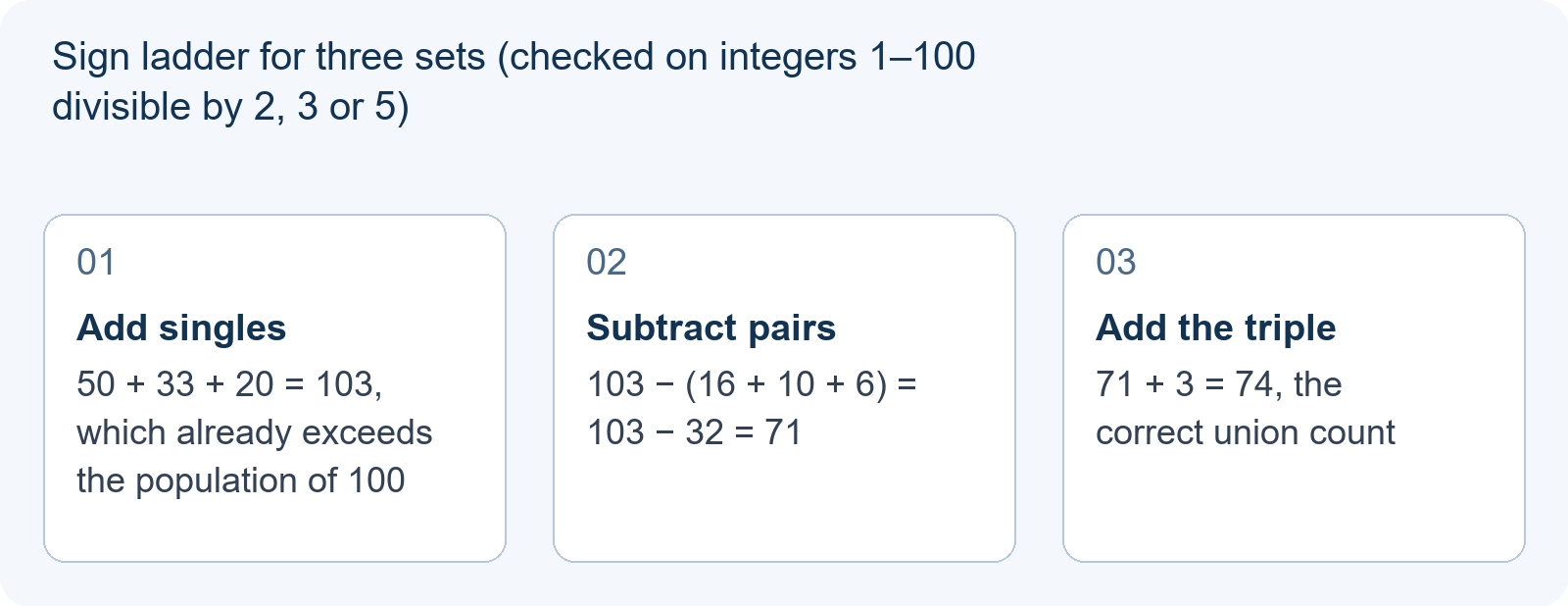
Suppose a student writes down three sets: A = multiples of 2 up to 100, B = multiples of 3, C = multiples of 5. The individual counts are 50, 33 and 20. Adding them gives 103 — more than the 100 integers that exist in the range. A count larger than the population is always a defect, not a rounding issue. The cause is that 6 is in both A and B, so it was counted twice; 30 is in all three, so it was counted three times.

On a timed AIME this kind of error is expensive because it does not look wrong in the middle of a solution. The sum 103 looks like a plausible three-digit entry, and it only collapses when it is checked against the range. Building the check into the method, rather than saving it for the end, is what makes the technique reliable.

The sign ladder: add singles, subtract pairs, add the triple

The reason the formula has its particular shape is easy to verify region by region.

  • If an object satisfies exactly one condition, it is counted once in the singles, never in a pair, never in the triple: net contribution 1.
  • If it satisfies exactly two conditions, it is counted twice in the singles and once in a pair: net contribution 2 − 1 = 1.
  • If it satisfies all three, it is counted three times in the singles, three times across the pairs, and once in the triple: net contribution 3 − 3 + 1 = 1.

Every element therefore contributes exactly 1 to the expression, which is exactly what a union count requires. The same reasoning extends to four or more sets, where the signs alternate +, −, +, − at successive overlap levels.

Sign ladder for three sets (checked on integers 1–100 divisible by 2, 3 or 5)

Step-by-step teaching illustration (a teaching example, not an official contest problem)

Count the integers from 1 to 100 inclusive that are divisible by at least one of 2, 3 or 5. This is a deliberately transparent illustration of the mechanics; it is not a released AIME problem.

Step 1 — single counts. |A| = floor(100/2) = 50; |B| = floor(100/3) = 33; |C| = floor(100/5) = 20.

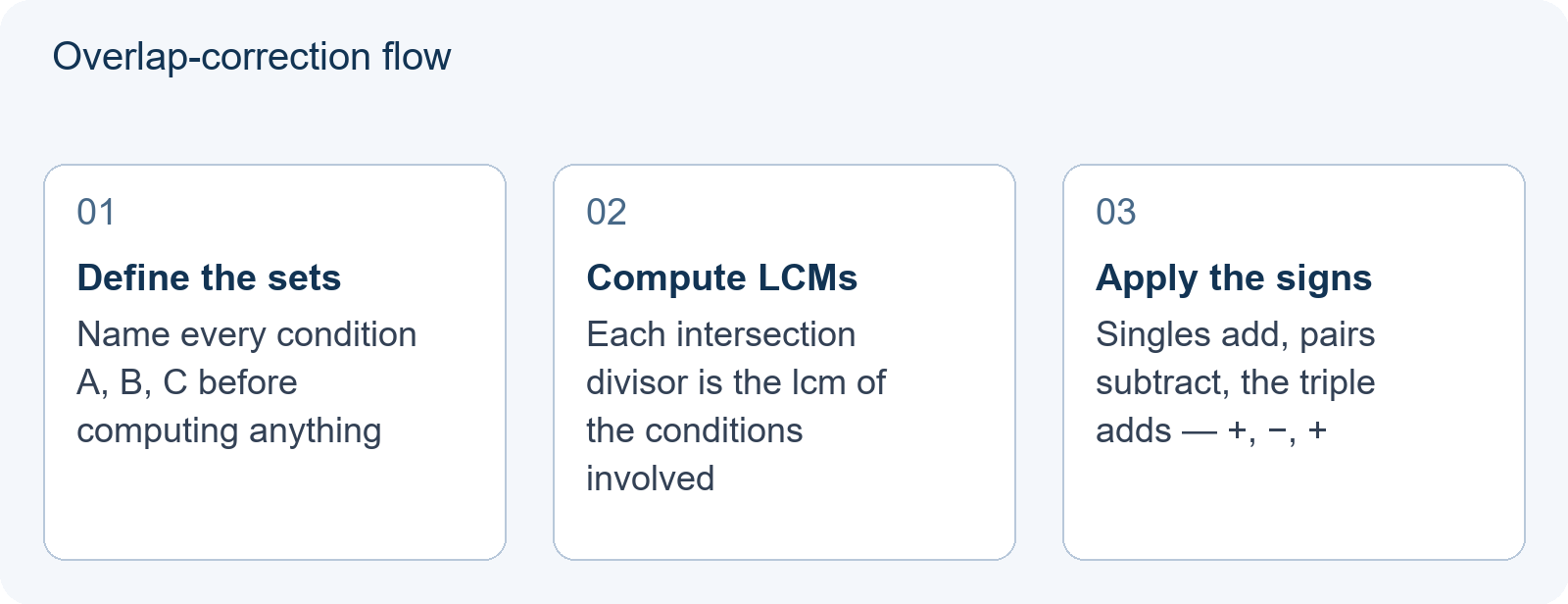
Step 2 — pairwise intersections. An integer lies in A ∩ B when it is divisible by both 2 and 3, that is, by lcm(2,3) = 6. So |A ∩ B| = floor(100/6) = 16. Similarly |A ∩ C| = floor(100/10) = 10 and |B ∩ C| = floor(100/15) = 6.

Step 3 — triple intersection. Divisibility by all three means divisibility by lcm(2,3,5) = 30, so |A ∩ B ∩ C| = floor(100/30) = 3.

Step 4 — apply the ladder.

Term Value How it was obtained
Singles 50 + 33 + 20 = 103 floor(100/2), floor(100/3), floor(100/5)
Pairs (subtracted) 16 + 10 + 6 = 32 floor(100/6), floor(100/10), floor(100/15)
Triple (added) 3 floor(100/30)
Union 103 − 32 + 3 = 74 Add singles, subtract pairs, add triple

The answer is 74. Notice that the intermediate 103 was never the answer; it was a staging value that the later subtractions corrected.

Reading the same diagram three ways

The same setup answers several different questions, which makes overlap structures a productive practice target.

  • At least one condition: 74, as computed above.
  • Exactly one condition: compute each exclusive region. Multiples of 2 only = 50 − 16 − 10 + 3 = 27; multiples of 3 only = 33 − 16 − 6 + 3 = 14; multiples of 5 only = 20 − 10 − 6 + 3 = 7. Total 27 + 14 + 7 = 48. The shortcut expression 103 − 2(32) + 3(3) = 103 − 64 + 9 = 48 confirms it.
  • At least two conditions: the pairwise sum 32 counts an element of exactly two conditions once and an element of all three conditions three times, so subtract two copies of the triple: 32 − 2(3) = 26. Note that this group of 26 includes the 3 elements that satisfy all three conditions. Therefore, the number of elements satisfying exactly two conditions is 26 − 3 = 23.
  • None of the conditions: 100 − 74 = 26.

These regions give a free correctness test. Using disjoint categories (exactly one, exactly two, all three, none): 48 + 23 + 3 + 26 = 100, covering every integer in the range exactly once.

A second illustration where the LCM choice decides the answer

Now count integers from 1 to 120 divisible by 4, 6 or 10. Singles: floor(120/4) = 30, floor(120/6) = 20, floor(120/10) = 12. Pairs use the least common multiples: lcm(4,6) = 12 gives 10; lcm(4,10) = 20 gives 6; lcm(6,10) = 30 gives 4. The triple uses lcm(4,6,10) = 60, giving 2. So the union is 30 + 20 + 12 − (10 + 6 + 4) + 2 = 62 − 20 + 2 = 44.

The instructive part is the pair lcm(4,6) = 12. Substituting 24, a common product rather than the least common multiple, would give floor(120/24) = 5 instead of 10. Because this term is subtracted, underestimating the intersection size leads to subtracting too little. The incorrect calculation would be 62 − (5 + 6 + 4) + 2 = 62 − 15 + 2 = 49. Thus, the error causes the final count to increase from 44 to 49. LCM errors do not announce themselves; they simply shift the result. Writing the lcm beside each intersection before doing any arithmetic is the cheapest defence.

'At least one' versus 'exactly one': the comparison that prevents lost points

Phrase in the question What it counts Correct treatment
At least one The union |A ∪ B ∪ C| Add singles, subtract pairs, add the triple (74 in the first illustration)
Exactly one Elements in one set and no other Build each exclusive region |A| − |A ∩ B| − |A ∩ C| + |A ∩ B ∩ C| and sum them (48 in the first illustration)
At least two Elements in two or three sets Add the pairwise intersections, then subtract twice the triple intersection (26 in the first illustration)

A common point of confusion arises when students compute the union correctly but submit it for an 'exactly one' question, or vice versa. The two numbers are different, and the gap between 74 and 48 is exactly the set of integers that satisfy two or three of the conditions. Distinguishing whether the question asks for the total coverage (union) or specific exclusive zones is critical for accuracy.

Venn diagrams as a twenty-second check

You will rarely have time to fill in every Venn region during the exam, but a rough three-circle sketch still pays. Label the pairwise and triple regions first, since those are where the sign errors occur, and leave the exclusive regions blank. If the question says 'exactly one', you should see immediately that three separate blank regions are being requested, not the whole outline.

Overcounting has other disguises as well. Rotational arrangements, for example, are overcounted by a symmetry factor rather than by an overlap level, and the correction is not the inclusion-exclusion ladder; that distinct trap is treated in our note on AIME Counting With Symmetry: When Dividing by the Number of Rotations Fails. Being able to name which kind of overcounting you face is half the diagnosis.

Diagnostic routine after you reach an answer

  • Population test: is the count no larger than the number of objects in the stated range? 74 out of 100 passes; 103 does not.
  • Sign test: did you add the triple back after subtracting the pairs? The pattern is +, −, +, never +, −, −.
  • Region-sum test: do the exclusive, exactly-two, triple and none regions add to the population? 48 + 23 + 3 + 26 = 100 leaves no integer unaccounted for.
  • Divisor test: is every intersection divisor a genuine least common multiple? Pair intersections use lcm of the two divisors; the triple uses lcm of all three.

Each check takes seconds and each one catches a different error class. Overlap counting rewards a student who finishes with two independent routes to the same integer, not one confident route.

Wording that signals overlap counting

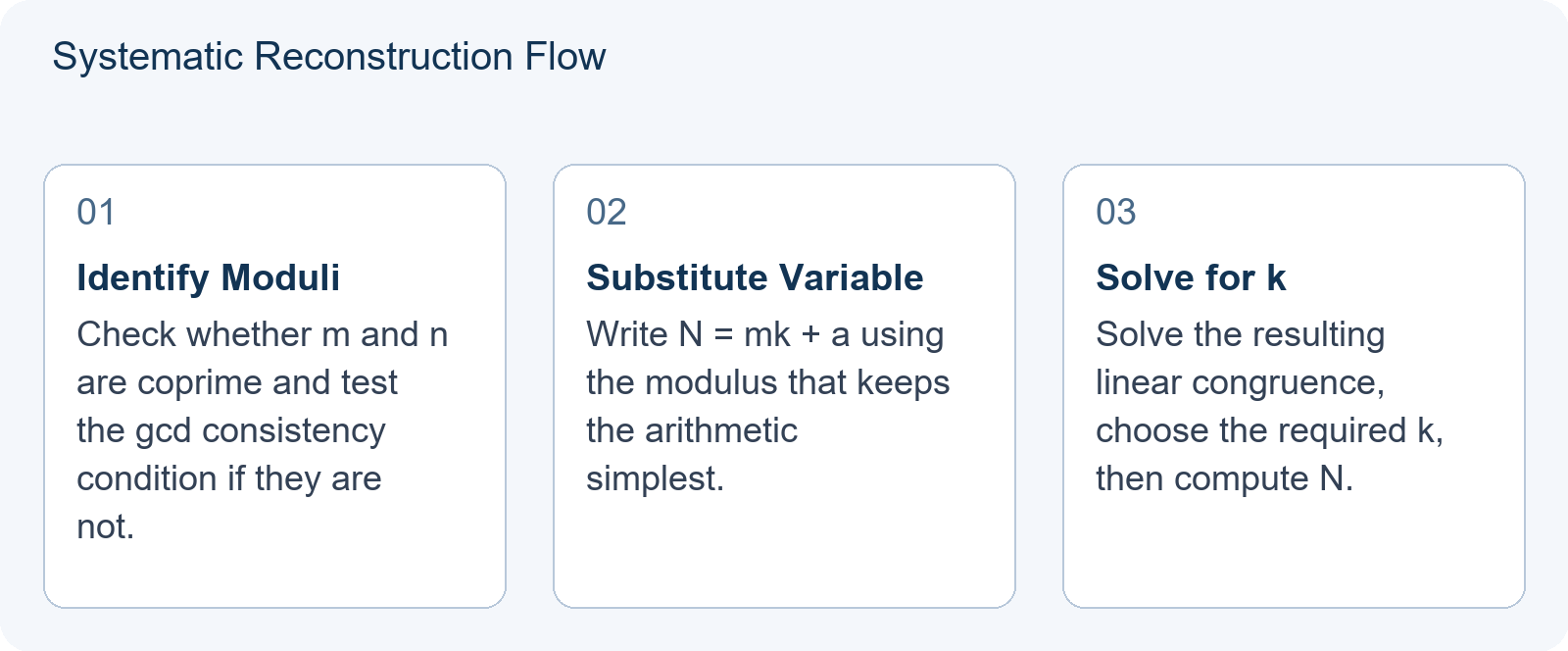
Certain phrases should trigger the ladder almost automatically: 'divisible by', 'is a multiple of', 'contains at least one of', 'satisfies either … or …', and any request phrased as 'how many … have at least one property'. The complementary phrases 'exactly one' and 'none' should trigger the region-building variant instead. When overlap counting appears alongside residue conditions, it is worth reviewing the residue technique separately; our note on AIME Modular Arithmetic: Recover an Integer From Two Remainders covers the congruence side of such problems.

How to practise this before your sitting

Six to eight well-chosen overlap problems are worth more than forty undifferentiated counting exercises. Work in this order: two-set warm-ups until the subtraction is automatic; three-set divisibility problems until the triple term is never forgotten; then 'exactly one' and 'at least two' variants of the same setup, so that the different target phrases are felt as different questions. Time a small set at exam pace, and keep a written record of which region you miscounted, not just which problem you missed.

Hanlin's own course note for 2027 AIME preparation, 'Important Notice: Domestic AIME Arrangements Confirmed' (Hanlin Courses WeChat account, retrieved 26 October 2026), treats number theory and combinatorics as the usual weak modules for Chinese students targeting 8–10 points. That is a coaching judgment drawn from teaching experience, not an official MAA rule or a published statistic, and it should be read as a study-priority suggestion rather than a prediction about any individual. Students who want to close that gap tend to benefit from bringing one or two worked overlap attempts, including the wrong version, to any consultation so the error can be located at the region level.

For the wider context around structure, difficulty spread and preparation sequencing, see our AIME Competition Guide: Scoring Changes, Difficulty Breakdown, and Prep Strategies.

General event background is available at Event background.

Overlap-correction flow

Frequently Asked Questions

Is inclusion-exclusion always necessary for small ranges?

No. If the whole population is small enough that you can list every element and mark the conditions by hand, direct enumeration is often safer, because the listing itself is the check. The ladder becomes the better choice once the range or the number of conditions makes complete listing impractical, which is the normal situation on the AIME. Either way, keep the population test: any count above the size of the range is wrong.

How do I handle 'exactly one' conditions?

Do not submit the union count. Build each exclusive region separately using |A| − |A ∩ B| − |A ∩ C| + |A ∩ B ∩ C| and add the three regions; in the 1-to-100 illustration that is 27 + 14 + 7 = 48. The equivalent shortcut is 103 − 2(32) + 3(3) = 48. Use whichever form you can reproduce under time pressure.

Which errors should I guard against in these problems?

Two errors to guard against are an incorrect least common multiple for an intersection, such as using 24 instead of 12 for lcm(4,6), and forgetting to add the triple intersection back after subtracting the pairwise intersections. Check each intersection divisor explicitly, and treat the region-sum test as a consistency check only when the regions are built from the actual set memberships rather than from the same mistaken intersection figures.

AIME China 2027: Age, Format, and Single-Exam Differences

Direct Answer: What Applies to AIME China 2027?

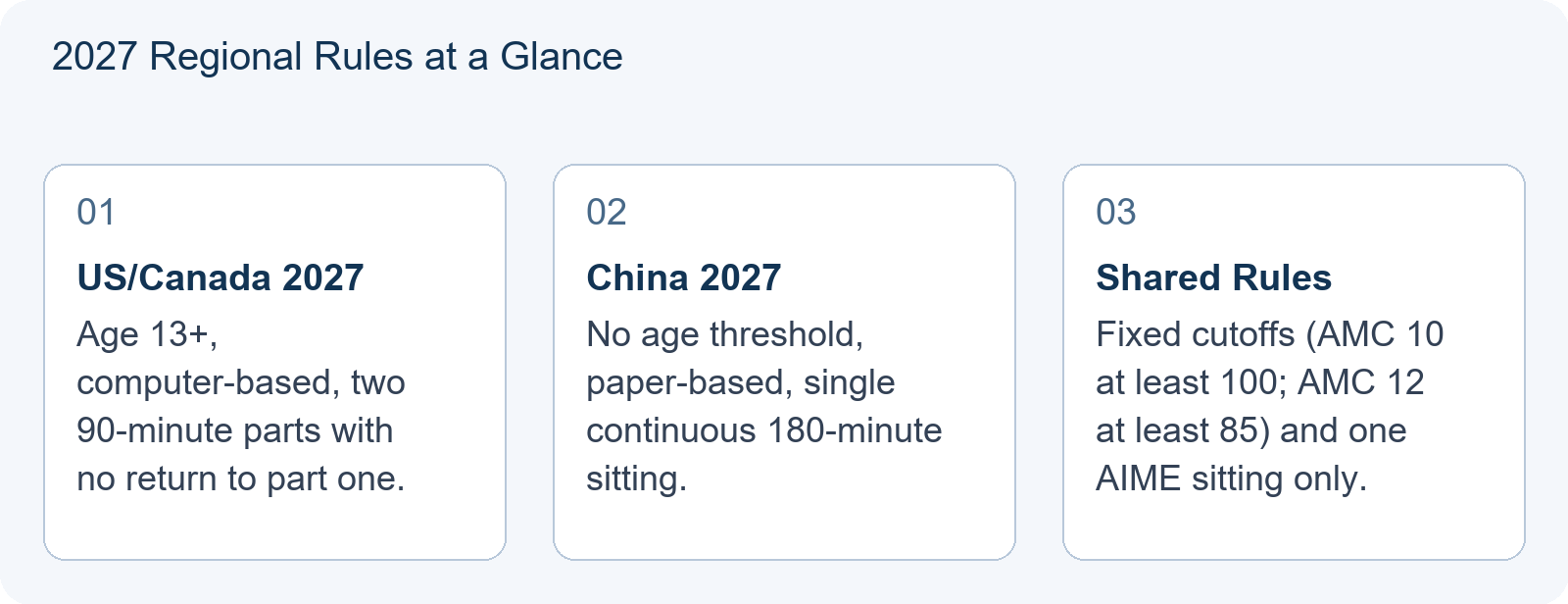
If your search question is "does the new AIME age rule or computer format apply to China in 2027?", the short answer is no on both counts. According to Hanlin's operator report Important Notice: Domestic AIME Math Exam Arrangements Confirmed! (WeChat public account "Hanlin Curriculum", published October 2026), the China region maintains its original rules with no minimum age threshold and continues to use a 180-minute continuous paper-based exam. The US/Canada region, by contrast, introduces a minimum age of 13 and moves to a two-part computer-based administration.

This distinction matters because reform headlines travel faster than regional policy. The MAA Invitational Competitions page, checked 26 October 2026, states that international AMC participants follow their country's IGL (International Governing Body) policy. That language is exactly why a US/Canada administrative change is not automatically a China change, and why younger Chinese students should not assume ineligibility before checking their region's rules.

Why the Confusion? What the US/Canada Region Actually Changed

The 2026-2027 season brought structural changes to the AMC and AIME series in the US/Canada region. The MAA page checked 26 October 2026 lists the following:

  • Minimum age of 13. In the US/Canada region, students under 13 are ineligible for AIME even if they meet the AMC score cutoff.
  • Computer-based administration at Pearson centers, with the English test delivered February 5-6, 2027.
  • Two-part structure. First 90-minute part contains 8 questions; after a short break, the second 90-minute part contains the remaining 7. Once a student moves to part two, they cannot return to edit part one.
  • Unified fixed cutoffs. AMC 10 at least 100, or AMC 12 at least 85, with other eligibility requirements.

Those details are US/Canada administration facts. Because international AMC participants follow their own country's IGL policy, treating them as global AIME rules would mislead China-region families. For comparison, the same MAA update notes that USAMO/USAJMO selection in 2027 is primarily AIME-based, with the AMC score no longer counted and the old AMC-plus-AIME index abolished.

2027 Regional Rules at a Glance

AIME China 2027 vs. US/Canada: Comparison Table

The table below summarizes the differences reported for 2027, using the Hanlin October 2026 operator report for China-region facts and the MAA page checked 26 October 2026 for US/Canada facts.

Feature US/Canada 2027 China 2027
Age eligibility Minimum age 13 required. No age threshold; original rules maintained.
Delivery mode Computer-based at Pearson centers. Offline paper exam.
Duration and structure Two 90-minute parts: 8 questions, break, 7 questions. No back-tracking to part one. One continuous 180-minute sitting; entire paper available for review in the same window.
Question count and answer form 15 integer-answer questions, answers 0-999. 15 integer-answer questions, answers 0-999.
AMC qualification cutoffs AMC 10 at least 100, or AMC 12 at least 85 (with other eligibility requirements). AMC 10 at least 100, or AMC 12 at least 85, matching the US figure as a fixed line rather than a percentage.
Number of AIME sittings Single AIME only. AIME I / AIME II split and the makeup path are removed for the 2027 season.

Read this table as a decision aid, not as a summary of everything in the AIME rulebook. It shows that for a Chinese student, the operational variables actually under their control in 2027 are paper-format endurance, single-sitting accuracy, and AMC score margin above the fixed cutoff — not the Pearson interface or the age-13 line.

Younger Chinese Students: Eligibility Without the US/Canada Age Cap

Parents of Grade 6 or Grade 7 students often ask whether the US/Canada age-13 rule blocks their child. Per the Hanlin October 2026 report, the China region keeps its original rules and has no age threshold, so a qualified AMC 10 or AMC 12 performer is not disqualified by age in the China stream for 2027.

Eligibility is not the same as readiness, however. The China-region format asks the candidate to hold focus across 180 continuous minutes, handwrite the entire solution path, and verify integer answers without a computer interface to catch input mistakes. If you are the parent of a young qualifier, the useful planning question is not "is my child old enough?" but "can my child sustain 180 minutes of focused reasoning after a full school day?" That is a practice question, and it is answered by timed paper mocks, not by age documents.

Single-Exam Reality: Planning for One AIME Sitting

A second change is not regional at all: 2027 ends the AIME I / AIME II split and the associated makeup path. Per the Hanlin October 2026 report, qualifying candidates receive one AIME opportunity in the season, with no second sitting to absorb an off day.

The practical implication is narrower than it first appears. What disappears is optional recovery, not optional strategy. A student who prepared to use AIME I as a low-stakes rehearsal and AIME II as the real attempt loses that sequence. In 2027, the same student needs a single plan that is calibrated for the paper they will actually see on 7 February 2027 (China region, 13:00-16:00, per the Hanlin report).

For China-region papers, that removal of a second sitting argues for tighter answer-checking inside the same 180 minutes. Because the entire paper stays accessible, the last 15-25 minutes can be reserved for verifying arithmetic and integer-range constraints (0-999) rather than racing through unattempted items. For a broader discussion of when study should shift from AMC speed to AIME sustained reasoning, see AIME Preparation After AMC: When to Switch From Speed to Sustained Reasoning.

Format Stability: Why 180-Minute Paper Practice Still Fits China

A common consequence of reading US/Canada reform coverage is that a Chinese student starts gaming, in training, for an artificial two-part structure. Per the Hanlin October 2026 report, the China region stays on the continuous 180-minute paper model for 2027; the note also indicates that from 2028 the China region is expected to align with the two-part offline computer-based style. That expectation does not change the 2027 simulation you should be running this season.

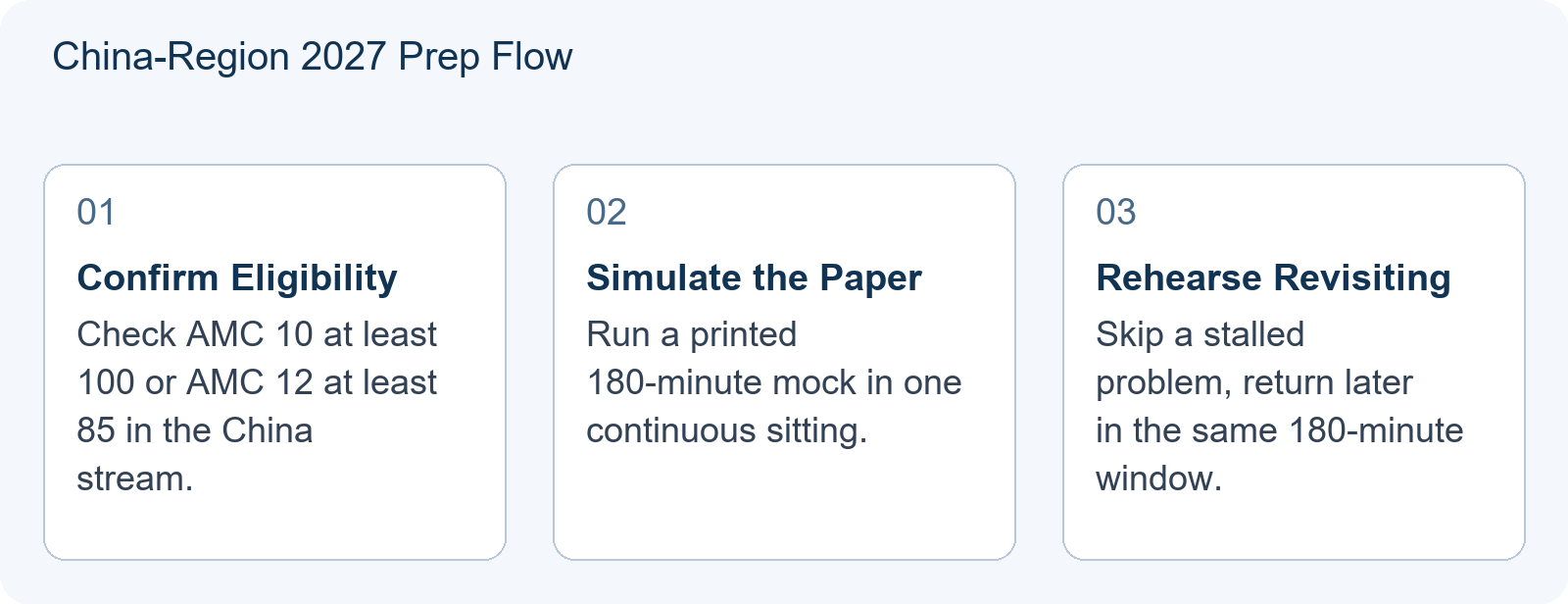
Coaching guidance for the 2027 China paper format typically includes:

  1. Full-length paper simulations. Run printed 180-minute mocks rather than short digital sessions, so timing instinct and scratch-paper habits are trained under the real constraint.
  2. Answer-verification habit. Build a routine of plugging results back into the original condition and checking that the integer lies within 0-999 before recording it.
  3. Revisit discipline. Practice skipping a stalled problem and returning to it later within the same 180-minute window, since the China paper does not lock a first-pass answer.

These are proposals for training, not claims about how any specific student performed. They follow directly from the format facts in the operator report.

Worked Teaching Illustration: A 180-Minute Time Frame

The following is an illustrative planning exercise, not a past contest problem and not a predicted AIME paper. Suppose a China-region candidate sets two goals for a 180-minute paper: attempt 12 of the 15 problems with full effort, and reserve 25 minutes at the end for verification of the answers already recorded.

  • Time for active solving: 180 - 25 = 155 minutes.
  • Average budget per attempted problem: 155 / 12 ≈ 12.9 minutes, so a working plan of roughly 12-13 minutes per attempted problem.
  • If the candidate wants a safety buffer of 30 minutes instead of 25: (180 - 30) / 12 = 150 / 12 = 12.5 minutes per attempted problem.

Notice that the average is not a per-problem rule; earlier problems in the paper are typically faster, so the real plan front-loads the clock and leaves more room for the attempted items near the back. If you are calibrating against AIME qualification scores instead of time, see AIME Qualification Targets: Build a Reliable Margin Above the AMC Cutoff.

USA(J)MO Pathway: Separate Eligibility Policy

Families aiming at USAMO or USAJMO should treat the pathway separately from AIME eligibility. The MAA page checked 26 October 2026 states that USAMO/USAJMO selection in 2027 is primarily based on AIME scores, with the AMC score no longer counted and the old AMC-plus-AIME index abolished.

USAMO/USAJMO participation is governed by separate eligibility policies, so readers interested in that pathway should consult the official MAA eligibility guidelines directly. This article's scope is the AIME China-region format comparison. For broader context on how regional formats shape preparation generally, see AIME Pacing Practice: Prepare for Your Region's 2027 Format.

Bringing Your Region Questions to an Authorized Test Center

If you plan to speak with an authorized AMC/AIME test center such as the one described in the Hanlin October 2026 report, come with questions that fit the 2027 rule picture rather than generic preparation questions. Useful items to have ready:

  • Your recent AMC 10 or AMC 12 score, so the center can assess margin above the fixed 100 / 85 line.
  • Confirmation that your registration is being handled in the China-region stream, not the US/Canada stream.
  • The format you will sit: continuous 180-minute paper exam, not a two-part computer test.
  • Which practice resources target paper-based endurance and integer-answer verification.
  • Your goal, whether that is AIME qualification, a high AIME score, or a longer mathematical progression.

The aim of these questions is to make sure a study plan matches the rules that apply to your confirmed region, rather than rules that appear in a global news summary.

General event background is available at Event background.

China-Region 2027 Prep Flow

Frequently Asked Questions

Is there an age limit for AIME China 2027?

No. The Hanlin October 2026 report describes the China region as keeping its original rules with no minimum age threshold, in contrast to the US/Canada region where a minimum age of 13 applies to AIME 2027.

Will Chinese students take the 2027 AIME on a computer?

For the 2027 season, no. The Hanlin report describes the China region remaining on a 180-minute continuous paper-based exam. The two-part computer-based administration is a US/Canada change. The same report indicates China may move to a comparable two-part offline computer format from 2028, which is planning context for later seasons rather than for 2027.

How does USAMO/USAJMO selection relate to AIME 2027?

USAMO/USAJMO selection in 2027 is primarily based on AIME scores, according to the MAA page checked 26 October 2026. USAMO/USAJMO participation is governed by separate eligibility policies, so students aiming for USAMO/USAJMO should consult the official MAA eligibility guidelines directly.

AIME Vieta's Formulas: Find Symmetric Expressions Without Solving Every Root

For students preparing for the American Invitational Mathematics Examination (AIME), algebraic fluency is not merely about the ability to solve equations. It is fundamentally about recognizing structure. A common trap in polynomial problems is the instinct to find every individual root explicitly. In many AIME-style questions, the roots are irrational, complex, or simply too cumbersome to calculate by hand. Attempting to do so wastes precious minutes and introduces significant risk of arithmetic error. The efficient path often lies in AIME Vieta's Formulas, which connect polynomial coefficients directly to symmetric expressions such as sums of squares, reciprocal sums, and sums of cubes.

The AIME consists of 15 questions where answers must be integers between 0 and 999 inclusive. This strict answer format rewards clean symbolic work. If a problem asks for a symmetric function of roots, you should almost never solve for the roots first. Instead, you must translate the question into the language of coefficients. This article explores how to manipulate these symmetric expressions using only the sums and products derived from Vieta's formulas, emphasizing the efficiency crucial for the AIME's tight time limits.

The Core Principle: Coefficients Encode Root Relationships

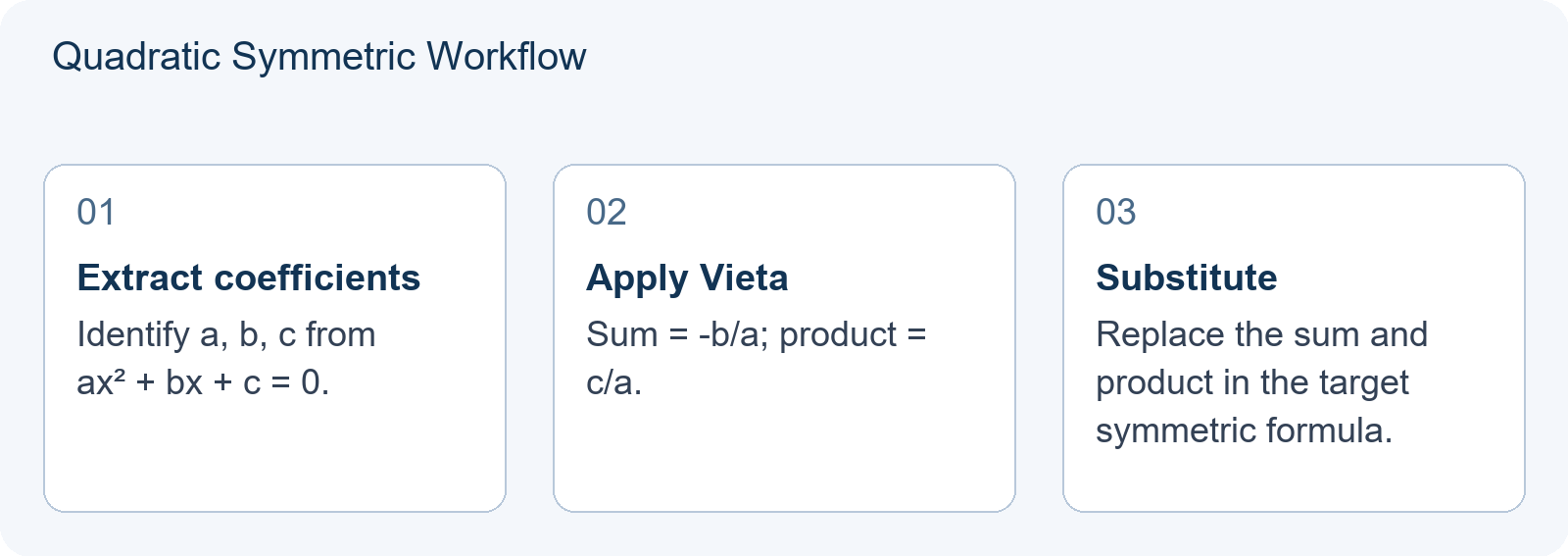
Vieta's formulas establish a direct link between the coefficients of a polynomial and the elementary symmetric sums of its roots. For a quadratic equation ax2+bx+c=0 with roots r1 and r2, the relationships are:

  • r1+r2=−ba
  • r1r2=ca

For a cubic equation ax3+bx2+cx+d=0 with roots r1,r2,r3, the pattern extends to three elementary symmetric polynomials:

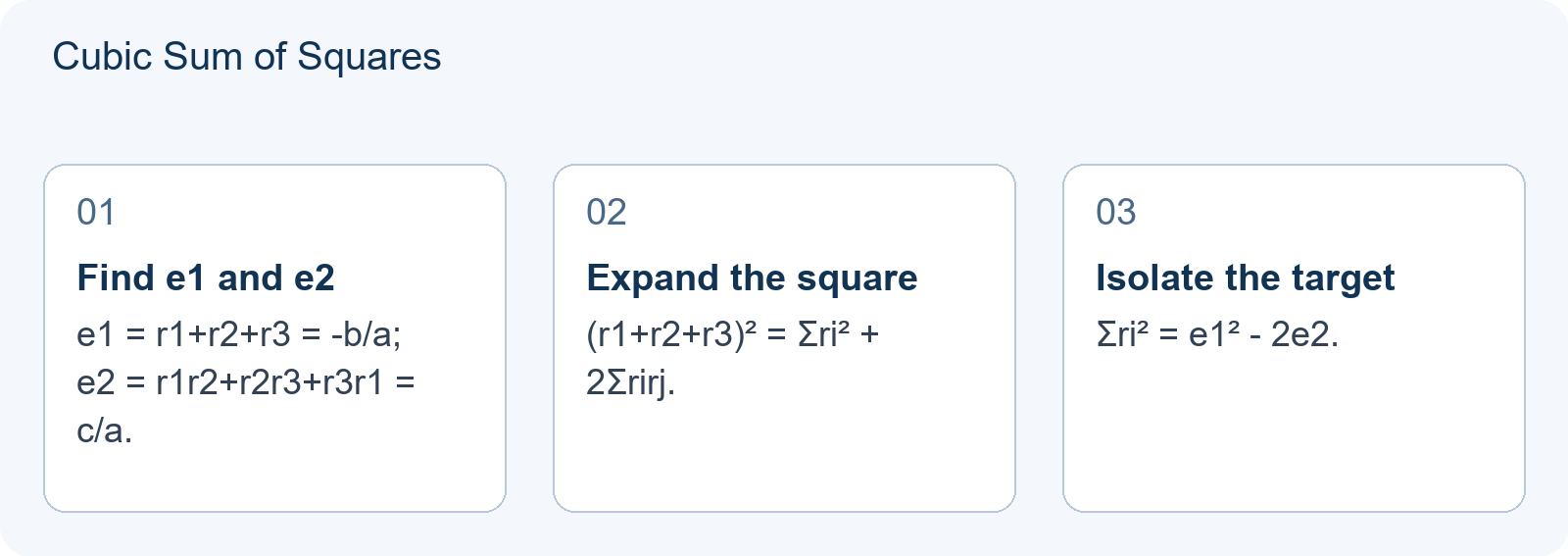
  • e1=r1+r2+r3=−ba
  • e2=r1r2+r2r3+r3r1=ca
  • e3=r1r2r3=−da

For a general polynomial P(x)=anxn+an−1xn−1+⋯+a0, the sum of the roots is −an−1an, and the product of the roots is (−1)na0an. These identities hold whether the roots are real or complex. That universality is exactly why they are useful in AIME preparation: a polynomial may not factor over the integers, but its coefficients still encode the symmetric information you need. Understanding this distinction allows you to bypass the messy radical calculations entirely.

Identifying Symmetric Expressions

An expression is symmetric if swapping any two roots does not change its value. Examples include r12+r22, 1/r1+1/r2, and r13+r23. Because these expressions depend only on elementary symmetric sums, they can be rewritten in terms of coefficients. This is the key insight: if the target quantity is symmetric, it is determined solely by the coefficients.

By contrast, an expression such as r1−r2 is not symmetric. Swapping r1 and r2 changes the sign of the result. Vieta's formulas alone cannot determine the value of non-symmetric quantities without additional information, such as the discriminant or specific ordering constraints. This distinction matters significantly in test-taking strategy: if a problem asks for a non-symmetric quantity, you may need a different tool like the quadratic formula or geometric interpretation. If it asks for a symmetric quantity, Vieta's formulas should be your immediate first check.

Quadratic Symmetric Workflow

Technique 1: Squaring the Sum

A productive application in AIME algebra is finding the sum of squared roots. Students often solve for r1 and r2 individually, then square them. This is inefficient. Instead, expand the square of the sum:

(r1+r2)2=r12+2r1r2+r22

Rearranging gives the identity:

r12+r22=(r1+r2)2−2r1r2

Teaching illustration, not an official contest problem: For the quadratic x2−5x+1=0, Vieta gives r1+r2=5 and r1r2=1. Therefore r12+r22=52−2(1)=25−2=23. The roots are rac5±212, which are irrational, but you never need to write them. The coefficient calculation is immediate and exact.

For three roots, the same idea becomes:

r12+r22+r32=(r1+r2+r3)2−2(r1r2+r2r3+r3r1)

In terms of elementary symmetric polynomials, this is e12−2e2. This is a useful Vieta identity for AIME algebra problems because it converts a root question into two simple coefficient lookups.

Technique 2: Reciprocal Sums

Problems asking for 1/r1+1/r2 require combining fractions. The common denominator is the product of the roots:

1r1+1r2=r2+r1r1r2=e1e2

For a cubic, two related identities are particularly useful:

  • 1r1+1r2+1r3=r1r2+r2r3+r3r1r1r2r3=e2e3
  • 1r1r2+1r2r3+1r3r1=r1+r2+r3r1r2r3=e1e3

These are especially useful when the roots are messy but the elementary symmetric sums are simple integers. A reciprocal sum may be a fraction as an intermediate value. That is acceptable. The final AIME answer must be an integer from 0 to 999, but the symmetric expression inside a problem can be fractional before a later step combines it with other terms.

Technique 3: Sum of Cubes and Newton's Sums

For two roots, the sum of cubes follows from the identity:

r13+r23=(r1+r2)3−3r1r2(r1+r2)=e13−3e1e2

For three roots, the corresponding identity is:

r13+r23+r33=e13−3e1e2+3e3

While memorizing these specific expansions is helpful, a more powerful general tool is Newton's Sums. Let Sk=r1k+r2k+…+rnk. For a monic polynomial xn+c1xn−1+c2xn−2+…+cn=0, the recurrence relation for 1≤k≤n is:

Sk+c1Sk−1+c2Sk−2+…+ck−1S1+kck=0.

For k>n:

Sk+c1Sk−1+…+cnSk−n=0.

This systematic approach allows you to compute S4,S5, etc., without memorizing complex multinomial expansions. A useful preparation benchmark is to know the pattern up to S3; the recursive structure then extends to higher powers if a problem requires it.

Worked Example: Cubic Sum of Squares

Teaching illustration, not an official contest problem: Suppose the roots of P(x)=x3−4x2+6x−4 are r1,r2,r3. Find r12+r22+r32.

Step 1: Identify coefficients. Here a=1, b=−4, c=6, d=−4.

Step 2: Apply Vieta's formulas to find elementary symmetric sums.

  • e1=r1+r2+r3=−(−4)/1=4
  • e2=r1r2+r2r3+r3r1=6/1=6
  • e3=r1r2r3=−(−4)/1=4

Step 3: Use the square-of-sum identity.

(r1+r2+r3)2=r12+r22+r32+2(r1r2+r2r3+r3r1)

e12=S2+2e2

42=S2+2(6)

16=S2+12

S2=4

The answer is 4, which is an integer in the AIME answer range. You can verify this by factoring: P(2)=8−16+12−4=0, so (x−2) is a factor. Division gives x2−2x+2, whose roots are 1+i and 1−i. Their squares are (1+i)2=2i and (1−i)2=−2i. The total sum of squares is 22+2i−2i=4. The coefficient method avoids all complex arithmetic.

Avoiding the 'Solve First' Trap

The primary advantage of mastering AIME Vieta's Formulas is time management. AIME problems often reward the shortest valid path, not the most explicit one. Spending several minutes calculating irrational or complex roots when a short substitution exists is a strategic error. Manual root calculation also increases the risk of sign errors, especially with negative coefficients or when dealing with conjugate pairs.

Before solving, ask: is the requested quantity symmetric in the roots? If yes, write it in terms of the sum and product. If the polynomial is cubic, write it in terms of the sum, pairwise sum, and product. If the expression is not symmetric, Vieta may still help as one part of a larger solution, but it will not determine the value alone. Recognizing this symmetry instantly saves cognitive load.

Final Check: Integer Constraints and Sign Errors

After deriving a symmetric expression, verify that the final requested result fits the AIME answer format: an integer from 0 to 999. If your calculation yields a fraction or a non-integer, re-examine the problem statement and your Vieta signs. Did you miss a leading coefficient? Did you forget the alternating sign in the product term?

Common errors include forgetting the negative sign in −b/a, misidentifying the constant term in a cubic, and mixing up the product formula for even and odd degree. For a quadratic ax2+bx+c, the product is c/a. For a cubic ax3+bx2+cx+d, the product is −d/a. The alternating sign is not optional. Always double-check the parity of the degree when calculating the product of roots.

For a complementary check on recording integer answers and avoiding extraneous results, see the related guide on AIME Answer Checking: Catching Extraneous Roots Before Recording an Integer.

Related Coefficient Methods

Vieta's formulas are not the only coefficient-shortcut in AIME algebra. Remainder problems also often become manageable when you avoid expanding every term. If you want to strengthen the same coefficient-focused instinct, review the method in AIME Polynomial Remainders: Solving Without Expanding Every Term. Both techniques rely on treating the polynomial as a black box defined by its coefficients rather than its roots.

Integrating Algebra into Broader Preparation

Polynomial manipulation is rarely isolated. It intersects with number theory, geometry, and combinatorics. For example, integer-root questions may require checking divisors of the constant term, while symmetric sums help analyze root distributions. The practical goal is not to memorize every identity but to build a reflex: when a problem mentions roots, scan for elementary symmetric sums.

For students moving from AMC-style speed rounds into AIME-style sustained reasoning, pacing changes matter. A useful companion article is AIME Preparation After AMC: When to Switch From Speed to Sustained Reasoning. Vieta practice fits that transition because it reduces computation while increasing the amount of structure you must recognize. Similarly, understanding qualification targets helps prioritize which algebraic skills yield the highest return on investment, as discussed in AIME Qualification Targets: Build a Reliable Margin Above the AMC Cutoff.

A Short Practice Plan

To make Vieta's formulas automatic, practice with a deliberate sequence.

  1. Start with quadratics. For random coefficients, compute r1+r2, r1r2, r12+r22, and 1/r1+1/r2.
  2. Move to cubics. Compute e1, e2, e3, then evaluate r12+r22+r32 and r13+r23+r33.
  3. Read past AIME polynomial problems and identify which ones ask for symmetric expressions before attempting any root calculation.
  4. Practice Newton's Sums for S4 on a cubic to understand the recursive pattern.

This kind of practice is more useful than simply reading solved examples. The skill is recognizing the pattern under time pressure, not just agreeing with a solution after it is shown.

Final Takeaway

When an AIME polynomial problem asks for a symmetric expression of roots, do not solve for the roots first. Use Vieta's formulas to translate the expression into coefficients. For quadratics, use sum and product. For cubics, use sum, pairwise sum, and product. Verify the final integer range and watch the alternating signs. With enough practice, AIME Vieta's Formulas become a fast, reliable tool rather than a formula to look up, giving you a decisive edge in both accuracy and speed.

Cubic Sum of Squares

Frequently Asked Questions

Can Vieta's formulas be used if the roots are complex?

Yes. Vieta's formulas apply to all roots of a polynomial, including complex numbers. When the coefficients are real, symmetric expressions of conjugate pairs produce real values, and the AIME integer answer format means the final expression must resolve to an integer.

What if the leading coefficient is not 1?

You can still use the general rules directly. For a quadratic, the sum is -b/a and the product is c/a. For a cubic, the product is -d/a. For a general degree-n polynomial, the product of roots is (-1)^n times the constant term divided by the leading coefficient. Do not ignore the leading coefficient.

How does this help with AIME time management?

It replaces lengthy radical or complex-root calculations with simple coefficient arithmetic. That saves time and reduces arithmetic errors, allowing you to spend more attention on harder combinatorial or geometric problems later in the exam.

AIME Geometry Ratios: Choose an Auxiliary Line Before Chasing Lengths

For many students preparing for the American Invitational Mathematics Examination, geometry problems create a predictable trap: the urge to calculate every unknown length with the Pythagorean theorem, coordinates, or trigonometric laws. This approach is mathematically valid, but under AIME timing it is often computational overkill. The stronger habit is to prioritize AIME Geometry Ratios. If you can establish a proportional relationship, you can often skip the messy length calculations entirely and move straight toward the integer answer.

That shift is also part of the broader move from AMC speed to AIME reasoning. A useful companion discussion is AIME Preparation After AMC: When to Switch From Speed to Sustained Reasoning, but this article focuses on one concrete geometry decision: choosing an auxiliary line before you start chasing lengths.

The Trap of Length Chasing

Imagine a triangle with several cevians meeting at an interior point. A student using length chasing may assign coordinates, write equations for each line, solve for intersection points, and then compute distances. Each step can be correct, yet the method is fragile. One sign error, one inverted fraction, or one mislabeled intersection ruins the final answer. AIME problems often have clean final answers from 0 to 999, but intermediate coordinate calculations can involve radicals, fractions, and large expressions.

The deeper issue is structural. When you focus only on absolute lengths, you ignore the relative relationships in the figure. Ratio methods ask a different question: what is preserved or proportional? If two triangles are similar, corresponding lengths share the same scale factor. If two triangles share a height, their areas are proportional to their bases. These relationships are often easier to verify than a long coordinate computation.

Ratio Sources That Actually Pay Off

In AIME-style geometry, most useful ratios come from a small set of sources.

Similar triangles. If two triangles have two equal angles, or if an angle is shared and the adjacent sides are proportional, the triangles are similar. Once similarity is established, every corresponding linear measurement scales by the same factor. This includes sides, altitudes, medians, and perimeters. You do not need the actual lengths to know their ratio.

Parallel lines. A line drawn parallel to one side of a triangle can create similar triangles or invoke the Basic Proportionality Theorem. This is especially useful when a transversal cuts across two sides and you need to relate segments on different sides.

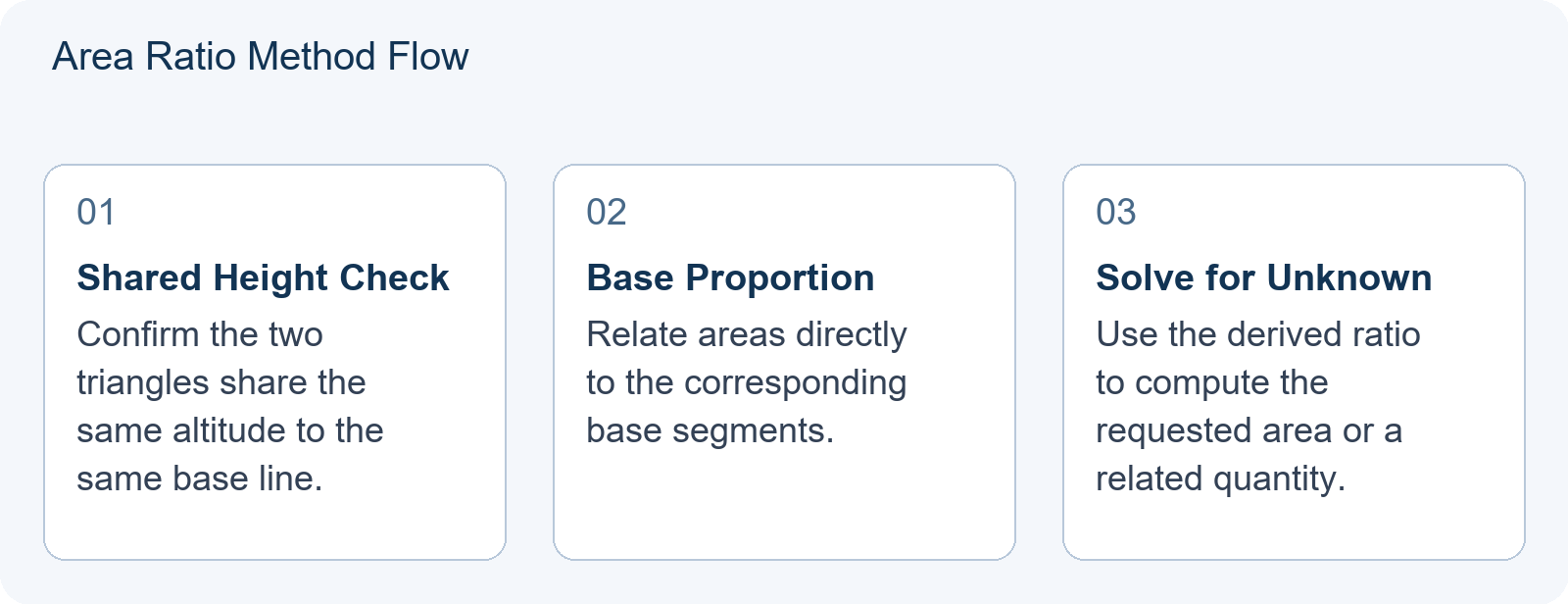
Area ratios. Triangles with the same height have areas proportional to their bases. This is the workhorse for cevian problems. If a cevian from vertex A meets side BC at D, then [ABD] : [ACD] = BD : DC. The shape of the triangle and the angle of the cevian do not change that relationship, because both smaller triangles share the same altitude from A to line BC.

Angle bisector ratios. The Angle Bisector Theorem says that an angle bisector in a triangle divides the opposite side in the ratio of the adjacent sides. If you know or can create those adjacent-side ratios, you can transfer them directly to the opposite side.

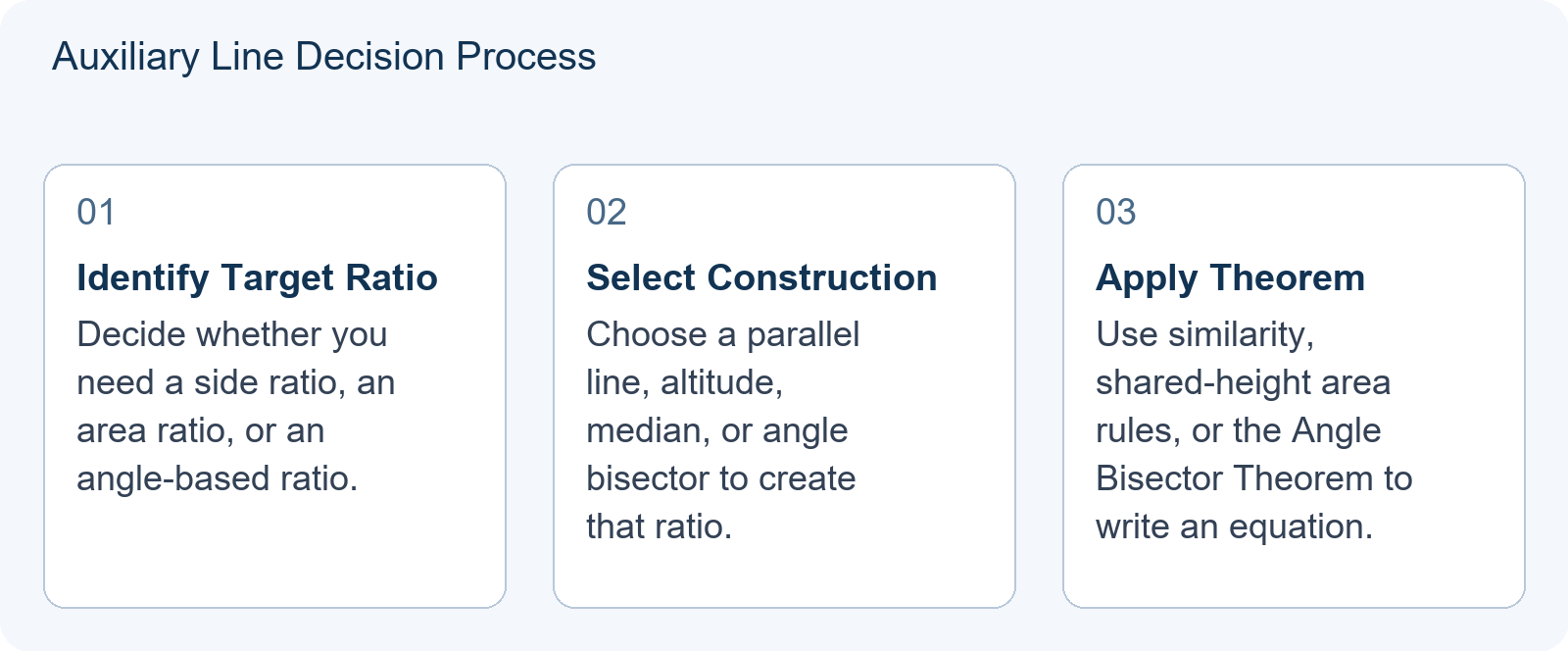
Auxiliary Line Decision Process

Decision Tree: When to Draw Which Auxiliary Line

The key skill is not drawing many auxiliary lines. It is drawing the right one. Use the ratio you want as your starting point.

  • Parallel line: Draw a line parallel to a side when you want similar triangles or direct segment proportions. This is the first choice when a problem involves a cevian crossing a triangle and you need to compare segments on two different sides.
  • Altitude: Drop an altitude when you need shared-height area ratios or a right triangle. Altitudes are also useful when the problem hints at cyclic quadrilaterals or trigonometric relationships inside a sub-triangle.
  • Median: Connect a vertex to the midpoint of the opposite side when you want equal-area splitting or centroid properties. A median divides a triangle into two equal-area triangles, which can anchor a ratio chain.
  • Angle bisector: Draw an angle bisector when adjacent side lengths or their ratios are known or easy to express. This directly links an angle condition to a split on the opposite side.

If a construction does not create a similarity, an area ratio, or a known theorem, it is probably not the line you need. Stop and reconsider the target ratio before adding more ink.

Worked Example: Area Ratios Without Length Chasing

This is a hypothetical teaching illustration, not an official contest problem.

Let triangle ABC have point D on side BC such that BD = 3 and DC = 5. Let point E lie on AD such that AE = 2ED. Find the ratio of the area of triangle ABE to the area of triangle CDE.

Length-chasing temptation: You could place B(0,0), C(8,0), D(3,0), then introduce variables for A and E. That creates unnecessary algebra. The ratio structure is already visible.

Ratio solution: Triangles ABD and ACD share the same altitude from A to line BC. Therefore, their areas are proportional to their bases:

[ABD] : [ACD] = BD : DC = 3 : 5.

Let [ABD] = 3k and [ACD] = 5k.

Now focus on triangle ABD. Since AE = 2ED, we have AE : ED = 2 : 1, so AE : AD = 2 : 3. Triangles ABE and ABD share the same altitude from B to line AD. Their areas are proportional to their bases AE and AD:

[ABE] = (2/3)[ABD] = (2/3)(3k) = 2k.

Next, focus on triangle ACD. Triangles CDE and ACD share the same altitude from C to line AD. Their bases are ED and AD. Since ED = (1/3)AD,

[CDE] = (1/3)[ACD] = (1/3)(5k) = 5k/3.

Therefore,

[ABE] : [CDE] = 2k : 5k/3 = 6 : 5.

No coordinates, no radicals, and no length chasing were needed. The construction was conceptual: recognize shared heights and compare bases.

Common Failure Modes and How to Catch Them

The first failure mode is drawing an auxiliary line that creates a new unknown instead of a ratio. For example, dropping an altitude in a triangle where no area or right-triangle relationship is needed may simply add variables. Before drawing, name the relationship you hope to create: similar triangles, equal heights, or angle bisector division.

The second failure mode is mixing up which triangles share a height. In the worked example, [ABE] and [ABD] share the height from B to line AD, not from A to BC. If you compare the wrong pair, the ratio becomes meaningless. Label the common vertex and the common base line before writing an equation.

The third failure mode is forgetting that area ratios must be multiplied along a chain. If [ABD] is 3k and [ABE] is 2/3 of that, the result is 2k. If another ratio is needed, multiply it in the correct order. A quick dimensional check helps: area ratios are unitless, so the k should cancel in the final comparison.

Finally, after obtaining a ratio, translate it back to the requested integer answer. If the problem asks for a sum, product, or difference of two quantities, express both in terms of the same variable before substituting. This is also where robust AIME Answer Checking: Catching Extraneous Roots Before Recording an Integer matter: confirm that the final quantity is an integer in the required range and that no hidden condition was ignored.

Note-Taking Strategy on Laminated Graph Paper

Under the MAA-announced 2027 AIME format for the MAA-administered exam, students cannot bring compasses or rulers. Test centers provide laminated graph paper booklets and fine-tip pens, with additional booklets available on request. This changes how you should use diagrams during practice.

You cannot measure lengths to guess ratios. Instead, sketch clearly enough to show topology and labels. Use the grid to keep parallel lines visually parallel and to estimate slopes, but do not treat estimates as exact unless the problem specifies lattice coordinates. Mark equal segments with matching tick marks, parallel lines with arrowheads, and right angles with small squares. Draw auxiliary lines with dashed strokes so you can distinguish your construction from the given figure.

Because you will be writing on laminated pages with fine-tip pens, plan the construction mentally before writing. A useful habit is to write the target ratio in the margin first, such as [ABE] : [CDE], then draw only the lines that help you express those areas. This prevents accidental clutter and keeps your diagram aligned with the algebra.

Connecting Ratios to the Integer Answer

AIME answers are integers from 0 to 999. Ratio results often appear as fractions, so the final step is usually to express the requested quantity in terms of a common scale factor. For example, if a side ratio is 3 : 4 and the problem asks for 100a + b where a : b = 3 : 4, write a = 3k and b = 4k, so the expression becomes 300k + 4k = 304k. If k is not determined by the given conditions, look for another ratio in the figure.

Do not assume the integer answer appears automatically. The integer requirement often serves as a check: if your ratio chain forces a non-integer for a quantity that must be an integer, revisit your auxiliary line. Did you use the correct shared height? Did you invert a base ratio? Is there a symmetry or midpoint condition you overlooked?

Drill Recommendation: Identify Ratios Before Solving

To build this skill, practice past AIME geometry problems in a deliberately incomplete way. Spend five minutes on a problem without solving it. Ask: which auxiliary line would create similar triangles? Which two triangles share a height? Which cevian divides an area proportionally? Then compare your proposed construction with a full solution.

This drill trains recognition. It also keeps you from defaulting to coordinates. Over time, you will notice that many AIME-style geometry problems are designed so that one well-chosen line turns a length calculation into a short ratio equation. The goal is not to avoid algebra; it is to use the smallest amount of algebra that reliably reaches the answer.

Resource Fit

If auxiliary-line choices are your bottleneck, focus your review on construction choices rather than longer computations. Hanlin is an authorized AMC-China test center, and Hanlin teaching resources include competition-oriented course materials. For general AIME context, see the AIME Math Competition Guide: Qualification Rules, Scoring Changes & Prep Strategies.

Keep the focus practical: bring a small set of attempted AIME geometry problems, mark where you chose an auxiliary line, and identify whether the line created a ratio or merely added calculation. That diagnosis is often more useful than another hour of unfocused length chasing.

Area Ratio Method Flow

Frequently Asked Questions

Can I use rulers or compasses in the 2027 AIME?

Under the MAA-announced 2027 AIME format for the MAA-administered exam, no. Students cannot bring any materials, including compasses or rulers. Laminated graph paper booklets and fine-tip pens are provided, with additional booklets available on request. China-region logistics are separate and should be checked against official China-region notices.

Why are ratios often faster than coordinates in AIME geometry?

Ratio methods reduce the number of algebraic steps and avoid many messy intermediate radicals or fractions. Coordinates are still useful, but when a problem gives segment ratios, midpoints, parallel lines, or cevians, a ratio approach often reaches the final integer more reliably.

Does the two-part 2027 AIME format change how I should practice ratios?

The MAA-announced format uses two 90-minute parts with a short break; the first part covers questions 1-8 and the second covers 9-15, and students cannot return to the first part. Practice ratio recognition in timed 90-minute blocks and rehearse clear diagram labeling, since efficient constructions conserve time for the later questions.

AIME Modular Arithmetic: Recover an Integer From Two Remainders

In AIME number theory, many problems hide a single integer behind two or more remainder clues. You might know that N leaves remainder 2 when divided by 5 and remainder 3 when divided by 7, but under exam time pressure the wrong move is to list numbers until one fits. The right move is to reconstruct N by substitution, then verify against the allowed answer range. This article focuses on the recovery step: how to turn two remainders into one integer efficiently, how to handle non-coprime moduli, and how to avoid off-by-one range errors. AIME answers are recorded as integers from 0 through 999. The mathematical reconstruction method below focuses only on the modular step.

Why AIME Modular Arithmetic Rewards Reconstruction

AIME problems often do not ask for the solution to a congruence system in abstract language. They ask for a number: the smallest positive integer, the number of objects, the missing digit, or the value that fits a range. Because the final answer must be an integer 0-999, you need both a correct congruence family and the specific representative selected by the problem's wording. Reconstruction is faster than brute force because it uses the structure of division.

Suppose N is congruent to a modulo m and N is congruent to b modulo n. The first statement says N = mk + a for some integer k. That single substitution turns the second congruence into a one-variable linear congruence. If m and n are coprime, there is one solution modulo mn. If they are not coprime, consistency requires a congruent to b modulo gcd(m,n). Many AIME-style traps are built around this consistency condition.

The Core Equation: From Two Remainders to One Variable

Start with the congruence with the larger modulus if you want fewer steps. Let N = mk + a. Substitute into the second congruence:

mk + a is congruent to b modulo n.

Rearrange:

mk is congruent to b - a modulo n.

If gcd(m,n)=1, multiply by the inverse of m modulo n. If gcd(m,n)=d is greater than 1, first check that d divides b-a. If it does not, no solution exists. If it does, divide the entire congruence by d to reduce to a coprime case. Then solve for k modulo n/d. Finally compute N = mk + a. Note that this gives you a base solution N0. The general solution is N = N0 + t * lcm(m,n).

This is the entire engine. The Chinese Remainder Theorem guarantees existence and uniqueness under coprime moduli, but you rarely need to quote the theorem in an AIME solution. You need the substitution.

Systematic Reconstruction Flow

Step-by-Step Method Using the Least Common Multiple

Use this checklist:

  1. Identify m, n, a, and b. Check gcd(m,n). If gcd is greater than 1, test whether b-a is divisible by gcd(m,n).
  2. Write N = mk + a, choosing the modulus that makes the arithmetic simplest, often the larger one.
  3. Solve the resulting linear congruence for k, choose the smallest nonnegative k, then compute N0.
  4. Determine the period L = lcm(m,n). The solutions are N0, N0+L, N0-L, etc.

The lcm tells you how often solutions repeat. If m=5 and n=7, every solution repeats by 35. If the problem asks for the smallest positive N, choose the smallest nonnegative k that gives N greater than 0. If the problem asks for a number between 1 and 999, you must find the specific member of the family N0 + tL that satisfies the additional constraints given in the text.

Teaching Illustration: Two Coprime Remainders

Teaching illustration, not an actual contest problem. Find the smallest positive integer N such that N is congruent to 2 modulo 5 and N is congruent to 3 modulo 7. Here m=5 and n=7 are coprime, and lcm=35.

Use the larger modulus 7. Let N = 7k + 3. Substitute into the first congruence:

7k + 3 is congruent to 2 modulo 5.

Since 7 is congruent to 2 modulo 5, this becomes 2k + 3 is congruent to 2 modulo 5. Subtract 3: 2k is congruent to -1, which is congruent to 4 modulo 5. Multiply by the inverse of 2 modulo 5, which is 3: k is congruent to 12, which is congruent to 2 modulo 5. The smallest nonnegative k is 2. Then N = 7(2)+3 = 17.

Check: 17 divided by 5 leaves remainder 2; 17 divided by 7 leaves remainder 3. The answer 17 is in the 0-999 range. The full solution set is 17 + 35t for integers t.

Notice what did not happen. We did not list numbers ending in 2 until one also had remainder 3 mod 7. We solved one linear congruence for k. That is the efficiency gain.

Teaching Illustration: Non-Coprime Remainders

Teaching illustration, not an actual contest problem. Find the smallest positive integer N such that N is congruent to 1 modulo 4 and N is congruent to 5 modulo 6. Here gcd(4,6)=2. The difference b-a = 5-1 = 4 is divisible by 2, so a solution exists.

Let N = 4k + 1. Substitute into the second congruence: 4k + 1 is congruent to 5 modulo 6, so 4k is congruent to 4 modulo 6. Divide the congruence by 2: 2k is congruent to 2 modulo 3. Since 2 is invertible modulo 3, k is congruent to 1 modulo 3. The smallest nonnegative k is 1, so N = 4(1)+1 = 5. Check: 5 mod 4 = 1 and 5 mod 6 = 5. The solution repeats modulo lcm(4,6)=12, so the solutions are 5 + 12t.

This example shows why the gcd check is not optional. If the original remainders had been N is congruent to 1 modulo 4 and N is congruent to 2 modulo 6, then b-a = 1, not divisible by gcd(4,6)=2, so no integer could satisfy both congruences. Recognizing that in one line saves minutes.

Verification Trick for AIME Answers

After computing N, plug it back into both original remainder statements. This catches arithmetic errors in the substitution. Then perform a second, independent check: confirm the answer is an integer from 0 through 999 and that it satisfies the problem's selection condition.

Do not stop at "it satisfies the congruences." AIME answers are not expressions like 17 + 35t. They are single integers. However, simply being in the 0-999 range is not enough to identify the correct answer if multiple members of the family fall within that range. You must re-read the problem for specific selection criteria, such as "smallest," "largest," or "divisible by X."

Common Pitfalls in AIME Modular Arithmetic

1. Forgetting the gcd consistency condition. If gcd(m,n) is greater than 1, the remainders must agree modulo that gcd. If they do not, no solution exists. If they do, reduce the problem carefully.

2. Dividing a congruence without checking divisibility. You can divide a congruence ax is congruent to b modulo n by d only when d divides a, b, and n. The safer route is to use the gcd condition and reduce the modulus correctly.

3. Using the product instead of the lcm. The solution repeats modulo lcm(m,n), not always mn. For coprime moduli they are equal; for non-coprime moduli they are not.

4. Confusing the answer range with a selection rule. AIME integer answers have a fixed range, but that range does not by itself select a unique member of a congruence family. Re-read the problem for constraints such as "smallest," "largest," or "divisible by X."

5. Reversing the substitution. If you write N = nk + b instead of N = mk + a, you must substitute into the other congruence. Mixing labels is the most common source of sign errors.

Choosing the Larger Modulus: A Small Heuristic

When you write N = mk + a, the modulus m multiplies k. If m is large, the final multiplication may be slightly larger, but the number of possible k values before reaching the target range is smaller. More importantly, choosing the larger modulus often makes the resulting congruence simpler because the variable k is being solved modulo the smaller modulus. For example, with moduli 5 and 7, use N = 7k + 3 and solve modulo 5. This keeps the linear congruence modulo 5. If you choose N = 5k + 2, you solve modulo 7, which is also fine, but arithmetic with 7 can be slightly less immediate. There is no universal rule; choose the representation that makes the inverse easy.

Range Selection: The Critical Step for Uniqueness

AIME answers are integers 0-999. This means after finding the full solution family N = N0 + L t, where L = lcm(m,n), you need the representative requested by the problem. It is crucial to understand that the answer format (0-999) does not automatically make the solution unique. Many families have multiple members in this range.

For the teaching illustration N is congruent to 2 modulo 5 and N is congruent to 3 modulo 7, N0 = 17 and L = 35. The solutions are 17, 52, 87, 122, 157, ... up to 997. All are valid integers in the 0-999 range.

  • If the problem asked for the smallest positive integer, the answer is 17.
  • If the problem asked for the largest solution below 100, the answer would be 87.
  • If the problem asked for the smallest solution above 100, the answer would be 122.
  • If the problem asked for a three-digit solution divisible by 11, you would impose that extra condition: 17+35t ≡ 0 (mod 11). Since 17 ≡ 6 and 35 ≡ 2 modulo 11, this gives 6+2t ≡ 0, so 2t ≡ 5 and t ≡ 8 modulo 11. Thus N=17+35(8)=297, which is divisible by 11.

The modular reconstruction gives the family; the wording selects the member. If the problem asks for a specific property, find the t that satisfies it rather than assuming the 0-999 range is enough.

Practice Strategy: Build Speed with Small Numbers

Before practicing full AIME problems, drill two-remainder reconstructions with small moduli. Use pairs such as mod 3 and mod 4, mod 5 and mod 7, and mod 4 and mod 6. For each pair, write the substitution, solve for k, compute N, and verify. Then identify the smallest positive member of the family N0 + tL. Doing ten of these mentally builds the pattern recognition that AIME speed requires.

When small examples feel automatic, increase the size of the remainders or moduli. The method does not change. The only additional work is arithmetic. This is also a good transition from AMC speed tactics to AIME sustained reasoning, as discussed in AIME Preparation After AMC: When to Switch From Speed to Sustained Reasoning. The goal is not to memorize cases but to trust a repeatable algorithm.

How Modular Reconstruction Connects to Other AIME Topics

Modular reconstruction often appears alongside polynomial remainders. A polynomial remainder problem may ask for a coefficient or constant that satisfies a congruence condition, and the same substitution logic applies. The linked article AIME Polynomial Remainders: Solving Without Expanding Every Term covers the polynomial side; use this article for the integer-recovery side. You can also combine modular thinking with counting problems, where the final count must be reported modulo a small number or placed in a specific residue class.

Answer checking is another natural companion. After finding N, verify that it satisfies both original statements and that it is the correct representative in the AIME range. A focused checklist for that final step appears in AIME Answer Checking: Catching Extraneous Roots Before Recording an Integer. Modular arithmetic rarely rewards rushing; it rewards a short, verifiable chain of arithmetic.

How to Avoid Arithmetic Errors Under Time Pressure

Write the substitution line clearly. Many errors come from skipping the intermediate congruence. If you go straight to a final N, you cannot debug. A three-line habit works well: first, N = mk + a; second, mk + a is congruent to b modulo n; third, mk is congruent to b - a modulo n. Then solve. Keep the original remainders visible. After computing N, check both remainders with division, not with mental modulo shortcuts. Finally, check the range and the specific selection criterion (smallest, largest, etc.).

If the problem gives more than two remainders, pair them one at a time. Solve the first two to get a combined congruence N is congruent to N0 modulo L. Then combine that with the third remainder. The method is identical, and the modulus becomes the lcm of the first two moduli. This is how AIME problems sometimes disguise a multi-step CRT problem as a word problem.

Verification Checklist

Frequently Asked Questions

Do I need to memorize the Chinese Remainder Theorem formula?

No. For AIME modular arithmetic, the constructive substitution method is usually faster and less prone to memory errors than recalling a general formula.

What if the moduli are not coprime?

First check whether the remainders agree modulo the gcd of the moduli. If they do not, no solution exists. If they do, reduce the congruence correctly and solve the remaining linear congruence.

Does the 0-999 answer range make the solution unique?

No. The range only limits which representatives can be recorded. You still need the problem's own selection condition, such as "smallest positive" or "divisible by 11," to choose the unique member of the congruence family. Then verify that the chosen integer satisfies both original remainder conditions.

AIME Preparation After AMC: When to Switch From Speed to Sustained Reasoning

The question of when to switch from speed to sustained reasoning in AIME preparation after AMC is no longer a matter of guessing cutoff percentages. For the 2027 season, the Mathematical Association of America (MAA) has established fixed qualification thresholds: a score of at least100 on AMC 10 or85 on AMC 12 meets the score requirement, provided other criteria are met. This structural change simplifies the goal but complicates the strategy. Students often ask whether they should begin AIME-specific training immediately upon hitting these scores or wait until after the November AMC exams. The answer depends less on the calendar date and more on the student's consistency in achieving these fixed benchmarks under timed conditions.

The New Fixed Thresholds and Their Strategic Implications

Previously, AIME qualification relied on percentile rankings, which fluctuated based on the strength of the applicant pool each year. This created uncertainty: a student might score well but fail to qualify due to high competition, or vice versa. According to MAA official rules verified in October 2026, the shift to absolute scores (100/85) removes this ambiguity. However, it introduces a new challenge: stability. A student who occasionally clears100 on AMC 10 practice tests may not consistently achieve this result under exam pressure. Analysis of preparation patterns suggests that the primary risk for students near the threshold is variance, not lack of knowledge. Therefore, the decision to switch to AIME-style sustained reasoning should be triggered by demonstrated consistency, not just a single passing score.

Distinguishing US/Canada Format Changes from China Region Rules

A critical distinction exists between the US/Canada and international regions regarding the 2027 AIME format. In the US and Canada, the exam will be administered electronically at Pearson Professional Centers, split into two 90-minute segments with no return to the first half. For China region participants in 2027, the format has not yet adopted the 90+90 minute structure; according to the October 10 operator report, the current arrangement follows a continuous session with full autonomy over time allocation. This difference fundamentally alters the "switch" moment. US/Canada students must train for segmented focus and strict time-boxing earlier, as the inability to revisit questions changes the cognitive load. Chinese students, however, can continue practicing holistic time management and strategic skipping, meaning their transition to deep reasoning can be more gradual, focusing on problem-solving depth rather than rigid segment adherence. Note that the China format is provisional for 2027 and subject to future policy updates.

Decision Flow: Switch to AIME Prep?

Teaching Illustration: The Consistency Diagnostic

[Teaching illustration: invented example for pedagogical purposes]

To determine if a student is ready to switch to AIME preparation, consider this diagnostic framework. Suppose a student takes five recent AMC 10 past papers under timed conditions and scores: 96, 102, 97.5, 105, and 99. The sum is 499.5, giving a mean of 99.9. Exactly two scores meet or exceed 100 (102 and 105), while three fall below (96, 97.5, and 99). Despite averaging close to 100, this student fails three out of five attempts to reach the fixed threshold. The errors are primarily calculation slips in the middle range (questions 11-20). In this scenario, switching to AIME problems is premature. The bottleneck is not conceptual depth but execution reliability. AIME problems require sustained attention; if a student cannot maintain accuracy over 75 minutes on AMC, they will likely struggle with the endurance required for AIME. The correct next step is targeted error analysis on AMC mid-range questions, not advanced AIME topics.

Contrasting Case: When Depth Becomes the Priority

[Teaching illustration: invented example for pedagogical purposes]

Contrast this with a student whose scores are consistently 115+ on AMC 10. They have mastered speed and basic accuracy. If this student continues only doing AMC drills, they face diminishing returns. Their errors now occur on questions 21-25, which involve complex combinatorics or number theory—topics that overlap significantly with early AIME problems. Here, the switch is overdue. This student should begin integrating AIME-style problems that require multi-step logical chains. Unlike AMC, where elimination strategies often work, AIME requires deriving an integer answer from scratch. Students who delay this switch often hit a "wall" in February, realizing too late that their AMC speed does not translate to AIME derivation skills.

The Role of Endurance Training in the Transition

Sustained reasoning differs from speed solving in cognitive stamina. AMC 10/12 allows for rapid pattern recognition and heuristic shortcuts. AIME demands rigorous proof-like thinking, even though formal proofs are not written. For students preparing for the China region's current 180-minute continuous exam, building this endurance is crucial. Many students burn out mentally before the final hour. The transition phase should include "long-form" practice sessions where students solve 3-4 difficult problems without time pressure, focusing entirely on clarity of logic and checking steps. This contrasts with the US/Canada segmented model, where endurance is tested within tighter 90-minute windows. Regardless of region, the ability to hold complex variables in working memory for extended periods is the key skill developed during this switch.

Diagnostic Application: Analyzing Error Types

Families can use a simple error-type analysis to decide the timing of the switch. Categorize mistakes from recent AMC mock tests into three buckets: 1) Knowledge Gaps (didn't know the theorem), 2) Execution Errors (calculation/slip), and 3) Strategy Errors (spent too long on easy questions). If Bucket 2 dominates, stay in AMC mode. If Bucket 1 involves advanced topics like modular arithmetic or complex geometry, switch to AIME prep. If Bucket 3 is high, work on pacing. This diagnostic prevents the common mistake of jumping to hard problems while still making basic errors. It ensures that the "switch" is data-driven, aligning with the fixed threshold reality where marginal gains come from eliminating specific weaknesses.

Practical Next Steps and Regional Considerations

When consulting with educators about AIME preparation, bring concrete data. Instead of asking "Is my child good enough?", present consistency diagnostic results. Ask specifically about regional format differences: "How do we adjust our study plan for the continuous session format versus the segmented US format?" Request feedback on whether current practice materials reflect the difficulty jump from AMC Q20 to AIME Q1. Understanding that AIME answers are integers from 0-999 helps frame the need for precise calculation skills. This approach moves the conversation from vague anxiety to targeted strategy, leveraging the new fixed-score environment to create a clear roadmap for success.

For students in China, the current format preserves flexibility in time allocation, so training should emphasize sustained concentration rather than segment-specific pacing. For US/Canada students, early adaptation to the 90-minute segment boundary is essential. Both groups should note that the fixed thresholds mean qualification is now a transparent target—but reaching it consistently remains the prerequisite for productive AIME preparation.

Related reading: For a deeper look at polynomial techniques common in early AIME problems, see AIME Polynomial Remainders: Solving Without Expanding Every Term. Students transitioning from AMC should also review AMC Math Competition: A Guide to AIME Qualification and Preparation for qualification mechanics, and AIME: 7 Points is the Watershed, 10 Points is the Stepping Stone for score-targeted strategy.

Applying the Consistency Diagnostic to Real-World Preparation Timelines

The teaching illustration above demonstrates that a mean score of 99.9 on AMC 10 practice tests does not guarantee qualification, as only two out of five attempts met the fixed threshold of 100. This discrepancy highlights a critical gap in student preparation: the failure to distinguish between average performance and reliable execution under pressure. For students aiming for AIME, this distinction dictates the immediate next steps in their study plan.

[Teaching illustration: invented example for pedagogical purposes]

Consider a hypothetical student who has completed three full AMC 10 mock exams in October 2026 with scores of 96, 102, and 97.5. The sum is 295.5, yielding a mean of 98.5. Here, one score exceeds the threshold, but two fall below it. If this student begins solving AIME problems immediately, they risk reinforcing bad habits. AIME questions require multi-step derivations where a single arithmetic error invalidates the entire solution. If the student’s primary weakness is calculation slips in the mid-range (questions 11–20), attempting AIME problems will likely result in frustration rather than skill acquisition. The correct strategic move is to pause advanced topic study and focus exclusively on error analysis from these three mocks. Identify whether the losses were due to knowledge gaps or execution errors. If execution dominates, drill timed accuracy on AMC-style problems until at least four out of five consecutive attempts exceed 100.

Conversely, examine a student with scores of112.5,118.5,and115.5. The mean is115.5, and all three attempts comfortably clear the 100-point bar. This consistency indicates mastery of speed and basic accuracy. Continuing to drill AMC papers offers diminishing returns. Their errors now likely occur on questions 21–25, involving complex combinatorics or number theory—topics that overlap significantly with early AIME problems. For this student, switching to sustained reasoning is overdue. They should begin integrating AIME-style problems that require deriving an integer answer from scratch without multiple-choice elimination strategies. Delaying this switch often leads to a "wall" in February, when students realize their AMC speed does not translate to AIME derivation skills.

This diagnostic approach prevents the common mistake of jumping to hard problems while still making basic errors. It ensures that the transition to AIME preparation is data-driven, aligning with the new fixed-score environment where marginal gains come from eliminating specific weaknesses. Students near the threshold must prioritize stability over novelty. Only when consistency is demonstrated should the focus shift to depth. This methodical progression respects the cognitive demands of both competitions and maximizes the probability of qualifying for AIME in the 2027 season.

Regional Format Differences 2027

Frequently Asked Questions

Does the fixed AIME cutoff mean I can stop worrying about percentile rankings?

Yes, for qualification purposes. You only need to meet the absolute score (100 for AMC 10, 85 for AMC 12). However, strong AMC performance builds the foundational skills that translate to higher AIME scores, which are now the primary factor for USAMO/USA(J)MO selection starting in 2027. Aiming above the minimum remains advisable for skill development, not for direct selection advantage.

What is the minimum age for AIME participation in my region?

For the US/Canada region, MAA rules state that participants must be aged 13 or older for 2027. International participants follow their respective country's policies through their International Group Leader. China region participants should verify current age requirements with their local organizer, as regional policies may differ from the US/Canada standard. Do not generalize the US/Canada minimum age 13 to China.

Should I buy AIME prep books before taking the AMC exam?

It depends on your current level. If you consistently exceed the AMC qualification thresholds, starting AIME prep early is beneficial. If you are borderline, focus on mastering AMC content first to ensure qualification, then switch to AIME materials after the November exam. Coaching judgment, not rigid rules, should guide this decision.

AIME Qualification Targets: Build a Reliable Margin Above the AMC Cutoff

Starting with the 2026–27 competition cycle, AIME qualification no longer depends on fluctuating percentage cutoffs. The MAA has set fixed thresholds: 100 points on AMC10 and 85 points on AMC12 (MAA AIME official rules, checked October 12 2026). For students and families researching preparation strategy, this change removes uncertainty about "where the line will fall"—but it replaces that uncertainty with a different question: how much above the fixed cutoff should you aim to score in practice, so that the official result feels secure rather than lucky?

Important distinction: these are official qualification thresholds, not guarantees. Meeting the score requirement is necessary but not sufficient; eligibility also depends on age and other criteria. For US/Canada test takers at Pearson centers, students must be 13 years or older as of the 2027 AIME date, with no exceptions (MAA AIME official rules, checked October 12 2026). International participants, including China-region students, follow their regional International Group Leader policies; the age condition and other eligibility rules may differ. This article focuses on building practice margin above the cutoff score, which is separate from verifying full eligibility.

Why a "Reliable Margin" Matters More Than the Minimum

A score at or above the relevant threshold meets the score component of eligibility. However, competition conditions differ from practice. Time pressure, problem-order effects, and the occasional misread can each cost points. A practice score at the threshold leaves no numerical margin for variation on a later paper. The goal should be to reach a level where the official cutoff feels like a floor, not a ceiling.

The fixed cutoff also changes the preparation dynamic. Under the old percentage system, a student might hope for an easy test that affects the cutoff. With a fixed score, the number is known in advance, which makes preparation more transparent. Under a percentile-based system, an easier paper can raise the score needed to reach the same percentile. That is different from the fixed threshold used in this cycle. The only variable left is your own performance.

Worked Teaching Case: Building an Illustrative Training Target

Let us examine a concrete scenario with checked arithmetic. Suppose a student is preparing for AMC10 and wants to qualify for AIME. The fixed cutoff is 100. The student sets an illustrative training target of 115 points in practice conditions—this is a personal benchmark, not an official safe margin or guarantee.

Step 1: Understand the scoring reality. AMC10 awards 6 points for a correct answer, 1.5 points for a blank, and 0 for an incorrect answer. With 25 questions in 75 minutes, the maximum is 150 points.

Step 2: Establish a baseline with verified counts. Consider a student who attempts 20 problems, leaving 5 blank, with 17 correct and 3 wrong. The score is: 17 × 6 + 5 × 1.5 + 3 × 0 = 102 + 7.5 = 109.5. This clears the 100 cutoff but illustrates how a student can be above minimum yet still short of a comfortable margin.

Step 3: Show improvement path with same attempt count. Suppose this student improves accuracy without increasing attempts: 19 correct, 1 wrong, 5 blank (still 20 attempted, 5 blank). The score becomes: 19 × 6 + 5 × 1.5 + 1 × 0 = 114 + 7.5 = 121.5. The gain is 121.5 − 109.5 = 12 points—from fixing just two errors. The problem counts verify: 19 + 1 + 5 = 25.

This case illustrates a general principle: for students near the cutoff, accuracy on accessible problems often yields more margin than attempts at harder problems.

Margin Building Path

Contrasting Case: Where Chasing Hard Problems Fails

Consider a different student with the same 115 illustrative target but a different profile: strong theoretical knowledge but slow execution. This student can solve problems 20–25 correctly when given unlimited time but rushes through early problems.

In practice, this student attempts 22 problems: 17 correct, 5 wrong, 3 blank. Using the checked calculation: 17 × 6 + 3 × 1.5 + 5 × 0 = 102 + 4.5 = 106.5 (not 105 as rough estimation might suggest). This clears the cutoff with only 6.5 points of margin—insufficient comfort for test-day variation.

The superficially similar approach of "attempt many problems" fails here because the student's time allocation is inverted. The two additional attempts beyond our first case came at the cost of two more errors. If those two problems had been left blank instead, the student would have earned 2 × 1.5 = 3 points; by getting them wrong, they earned 0. The hard-problem success did not compensate for this loss.

This contrast highlights that margin-building is not primarily about ceiling performance. It is about floor protection: ensuring that the problems you know how to do become points you actually earn.

Diagnostic: Where Is Your Margin Right Now?

To apply this framework, use a recent timed AMC practice test under realistic conditions. Record:

  • Problems correct, blank, and incorrect
  • Which problems were "careless errors" versus "did not know how to solve"
  • Time spent on each problem (estimate if not tracked)

Calculate your score and categorize your errors. Then ask:

If I eliminated all careless errors while keeping everything else constant, what would my score be? This is your "clean execution" ceiling. If this exceeds your illustrative target (e.g., 115 for AMC10), your priority is process discipline, not new content.

If I had unlimited time, what would my score be? This measures knowledge versus execution. A large gap between unlimited-time and actual score indicates speed or time-management issues. A small gap indicates knowledge gaps.

How many problems did I attempt in the first 30 minutes versus the final 45? Front-loading attempts often leads to rushed errors. A more even pace, with time reserved for checking, typically improves accuracy.

Complete answers to these three questions give you a specific preparation direction. Generic advice like "do more practice tests" is less useful than targeted work on your identified gap.

What the Diagnostic Means for Next Steps

Suppose your diagnostic reveals a gap between your clean-execution ceiling and your illustrative target. The specific feedback that addresses this depends on the error pattern:

Pattern: Careless errors concentrated in problems 1–15. Feedback needed: structured checking protocol, not harder problems. One approach is the "two-pass" method: first pass completes problems with confidence; second pass reviews flagged items. Another is explicit estimation—does the answer make sense?—before finalizing.

Pattern: Time runs out with unattempted problems you could solve. Feedback needed: timed practice with strict problem-allocation budgets. For AMC10, a rough guide is 2 minutes per problem for 1–10, 3 minutes for 11–20, and remaining time for 21–25. Adjust based on your personal speed.

Pattern: Knowledge gaps in specific content areas. Feedback needed: targeted topic review, not more full tests. Common AMC10/12 topics include counting and probability, number theory, and geometric configurations. Identifying which topics cost you points allows efficient study.

Use the final practice period to address the errors your own records reveal. Students who have built reliable margin through consistent practice perform more predictably than those who peak on occasional strong showings.

China-Specific Preparation Context

For students in China, the 2026–27 season has additional considerations. The AMC10/12 A and B exams remain available, with dates of November 6 and November 14, 2026; Hanlin's October 24, 2026 report gives the B registration deadline as November 3. China-region students take the exam offline at authorized test centers, not online. The AIME itself, if qualified, is also administered offline in China with a continuous 180-minute format—unlike the US/Canada split-session structure (Hanlin operator report, October 10, 2026).

This matters for margin-building because the test-day environment differs. Students should practice under conditions that match their actual administration: paper test, continuous time, and the specific materials allowed. The US/Canada AIME format of split 90-minute sessions with no return to earlier problems does not apply to China-region test takers, so preparation should not emphasize that constraint.

Students in China register through the International Group Leader system; MAA lists distinct public-school and private-school IGLs for China (MAA International 2026–27 participation). The private-school listing connects to ASDAN China. This registration pathway is separate from US/Canada direct registration and should be planned in advance.

Connecting to Broader Preparation Resources

For students seeking to understand the full progression from AMC to AIME and beyond, several related articles provide complementary coverage. The AMC10 to AIME Qualification Guide: Cutoff Scores, Exam Dates & Prep Strategies offers overview information on cutoff scores, exam dates, and general preparation strategies. For students earlier in their competition journey, the From AMC8 to AIME: The Ultimate Math Competition Progression Path describes how foundational competition experience builds toward qualification. Those interested in how AIME performance specifically influences advanced opportunities can consult AIME Competition Score Weight Adjustment: How to Prepare for 2026.

These resources address adjacent questions; this article's specific contribution is the worked methodology for building and verifying a reliable margin above the fixed cutoff.

Preparing for Consultation: What to Bring

If you are considering structured preparation support, having the following information ready makes consultation more productive:

  • Your most recent timed AMC practice score, with problem-level breakdown if available
  • Your target competition date (A or B exam, or both)
  • Your current grade level and math coursework, to assess foundational readiness
  • Specific topics or problem types where you consistently lose points

This preparation allows a focused discussion about whether your gap is primarily knowledge-based, execution-based, or strategic—and what specific practice structure would address it.

Time Allocation Trap

Frequently Asked Questions

Is 100 on AMC10 or 85 on AMC12 enough to guarantee AIME qualification?

These are the fixed minimum qualifying scores set by MAA for the 2026-27 cycle. However, 'guarantee' depends on meeting all eligibility criteria. For US/Canada test takers, this includes a minimum age of 13; international participants follow regional IGL policies with potentially different requirements. For test-day security, you should aim to consistently score above these thresholds in practice to account for performance variation. Practice targets are illustrative benchmarks, not official safe margins.

How does the China-region AIME format differ from US/Canada?

China-region AIME remains a continuous 180-minute offline exam according to the October 10, 2026 operator report. The US/Canada format splits into two 90-minute sessions with no return to earlier problems. China students should practice continuous-time conditions, not the split-session structure. International participants follow their regional International Group Leader policies.

Should I focus on solving harder problems or reducing errors on easier ones?

For building margin above the cutoff, reducing errors on problems you already know how to solve typically yields more reliable point gains than attempting harder problems. The worked case in this article shows how improving two wrong answers to correct ones—keeping the same attempt count—gains 12 points without requiring new knowledge or additional attempts.

Online Consultation
Online Consultation