AIME Pacing Practice: Prepare for Your Region's 2027 Format

Preparing for the American Invitational Mathematics Examination (AIME) requires more than just solving difficult problems; it demands precise time management matched to your region's specific format. As we look toward the 2027 competition cycle, a critical distinction emerges between the United States/Canada region and China. The US/Canada region adopts a new split-block format, while China retains its continuous 180-minute structure according to operator reports dated October 10, 2026. This article clarifies the specific format changes, explains why the pacing strategies diverge, and provides concrete practice methods for each region.

US/Canada 2027: Two 90-Minute Blocks With Comparable Difficulty

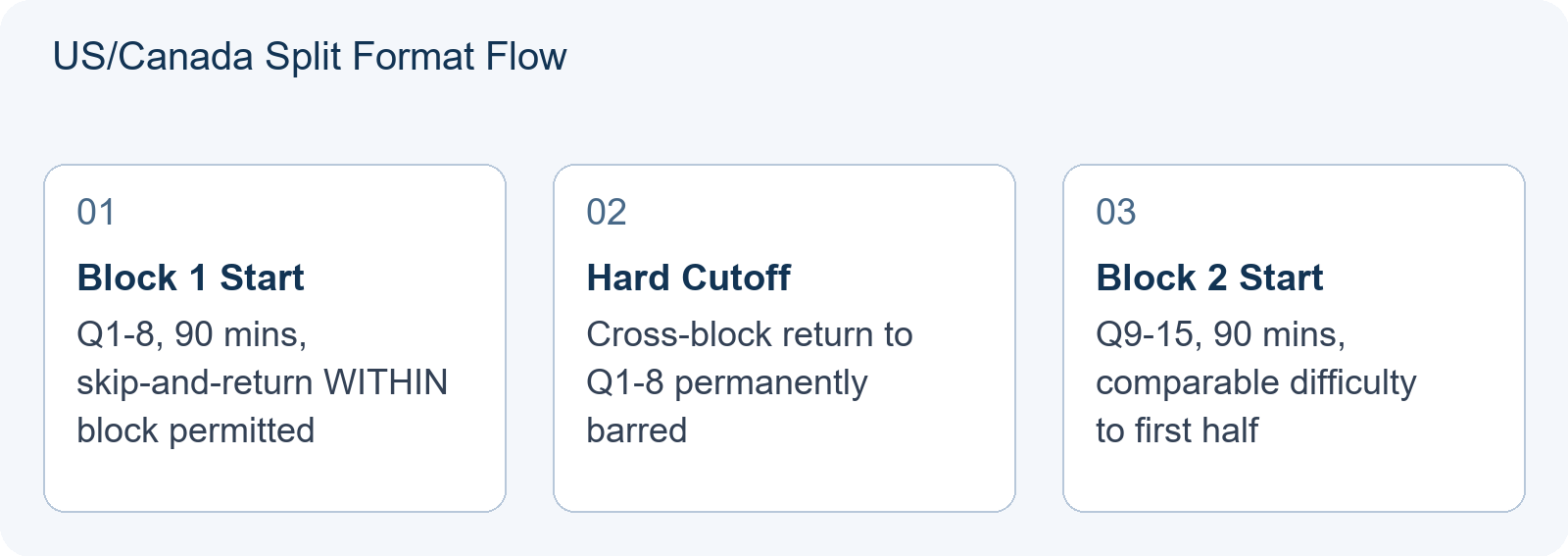
For students competing in the United States and Canada, the 2027 AIME introduces a structural overhaul verified by MAA official rules checked October 12, 2026. The exam is administered at Pearson Professional Centers in two distinct 90-minute parts with a short break between them. The first part contains questions 1–8; the second part contains questions 9–15. The critical constraint: once the second 90-minute block begins, students cannot return to questions 1–8. However, students MAY skip questions and return to them within the same 90-minute half. This within-half flexibility is essential to proper pacing strategy.

Importantly, MAA confirms the two halves have comparable difficulty—not the traditional pattern of early easy and late hard. This means students should not assume questions 1–8 are uniformly simple or that questions 9–15 are uniformly harder. The comparable-difficulty design rewards consistent performance across both blocks rather than front-loaded security.

Why the Split Format Changes Strategic Decisions

In the historical continuous format, a student stuck on question 4 could abandon it, progress through questions 5–10, and return to question 4 later with fresh perspective. The new US/Canada format preserves this flexibility WITHIN each 90-minute block but removes it ACROSS blocks. Time spent on questions 1–8 is permanently subtracted from questions 9–15, but time spent on question 3 can still be reallocated to question 7 if both fall within the same block.

The arithmetic bears examination: 90 minutes divided by 7 questions (second block) yields approximately 12.86 minutes per question, which is LARGER—not smaller—than the 12 minutes per question available across the full 180 minutes for 15 questions. The second block offers more time per question than the average, not less, though this must be weighed against the comparable difficulty of the problems.

Worked Teaching Illustration: Within-Half Return Strategy

Consider a student working through Block 1 (questions 1–8) with the following time expenditures: Q1 takes 10 minutes, Q2 takes 15 minutes, Q3 takes 10 minutes, Q4 takes 12 minutes, Q5 takes 15 minutes, Q6 takes 20 minutes. The cumulative time is 82 minutes. The student has 8 minutes remaining in Block 1 and CAN use this time to retry Q4, which had been skipped after initial difficulty. This within-half return is explicitly permitted and strategically valuable.

Contrast this with the same student in Block 2: if she spends 82 minutes on questions 9–13, the remaining 8 minutes cannot be redirected to Q4 from Block 1. The cross-block barrier is absolute.

China 2027: Continuous 180 Minutes, Full Self-Allocation

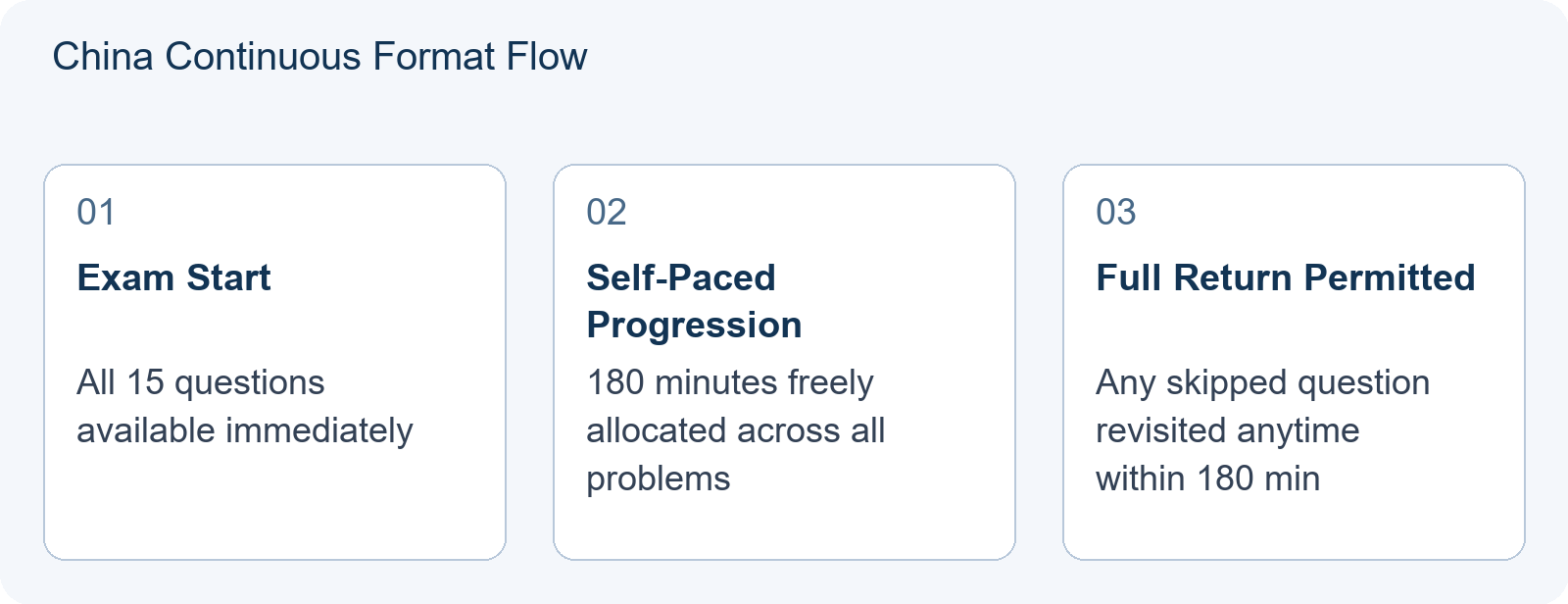
China's AIME implementation follows a different structure. According to operator reports dated October 10, 2026, Chinese candidates continue with a continuous 180-minute session for all 15 questions. Students retain full autonomy to allocate time across the entire exam and may return to skipped questions at any point. This is the confirmed format for the Chinese region, though it is not a MAA global guarantee—other regions may have different arrangements.

Implications for China Preparation

China students should not train for the 90+90 split. The relevant skills are three-hour stamina, strategic skipping with planned returns across the full exam, and dynamic time reallocation. A student who masters the US/Canada split-block drill would be underprepared for China's format, having trained to treat questions 1–8 as a closed chapter. Conversely, a China-trained student attempting the US/Canada format without adjustment would face difficulty at the 90-minute hard cutoff between blocks.
US/Canada Split Format Flow

Teaching Illustration: Same Student, Different Formats

Consider a student with typical per-question times on a past AIME: Q1–3 at 5 minutes each; Q4–6 at 10 minutes each; Q7–8 at 15 minutes each; Q9–10 at 20 minutes each; Q11–15 attempted only if time permits.

Scenario A: China Continuous Format

The student spends 15 minutes on Q1–3, then 30 minutes on Q4–6 (total 45 minutes). Q7 takes 15 minutes (60 minutes elapsed). Q8 takes 15 minutes (75 minutes). She has completed Q1–8 in 75 minutes, leaving 105 minutes for Q9–15. She attempts Q9 (20 minutes, 95 total), skips Q10 after 10 minutes of no progress, proceeds to Q11 (20 minutes, 125 total), returns to Q10 with 55 minutes remaining, and solves it with 25 minutes of additional work. She then attempts Q12 with 30 minutes left. Total completed: Q1–11. The cross-exam return to Q10 was decisive.

Scenario B: US/Canada Split Format (Same Student)

Block 1: Q1–3 (15 minutes), Q4–6 (30 minutes, total 45), Q7 (15 minutes, 60), Q8 (15 minutes, 75). She has 15 minutes remaining in Block 1. She uses 10 minutes to verify Q5, catches a calculation error, and corrects it. With 5 minutes left, she cannot productively start another problem, so she briefly reviews Q6. Block 1 ends with Q1–8 completed and verified.

Block 2: Q9 (20 minutes), Q10 (abandoned after 15 minutes of no progress), Q11 (20 minutes, 55 total), leaving 35 minutes for Q12–15. She attempts Q12 but makes no progress in 20 minutes, abandons it, and spends remaining time on Q13 with partial success. Total completed: Q1–9, Q11, partial Q13. The Q10 abandonment was correct given the block constraint; the Q12 attempt consumed time that could not be redirected to earlier questions.

Key Difference

In Scenario A, the return to Q10 added a completed problem. In Scenario B, the block boundary prevented this, and the student instead made progress on Q13. The continuous format rewarded persistence across the full exam; the split format rewarded securing early points and accepting strategic abandonment within each block. The optimal strategy is not merely "go faster"—it is "decide earlier within each bounded window."

Contrasting Case: When Old Paper Splits Mislead Preparation

A student preparing for US/Canada 2027 finds a 2015 AIME and splits it Q1–8 versus Q9–15 as a mock Block 1 and Block 2. However, older AIME papers may not reflect the new comparable-difficulty design. The 2015 paper might have genuinely easier problems in positions 1–8, leading the student to expect Block 1 to be comfortable. On the actual 2027 exam, with comparable difficulty across halves, Block 1 problems 6–8 may require Block 2-level effort. The student, unprepared for this, exhausts 90 minutes on only six problems and enters Block 2 with depleted confidence. The teaching illustration: do not assume old paper position numbers predict 2027 half difficulty. Use full timed blocks without pre-splitting by difficulty.

Diagnostic Application: Identify Your Regional Pacing Profile

Perform this timed diagnostic using any past AIME paper. For US/Canada candidates: set a hard 90-minute timer for Q1–8. You MAY skip and return within this window. Stop at 90 minutes. Reset for Q9–15. Record: (a) questions attempted per block, (b) questions completed per block, (c) time of first abandonment decision, (d) whether within-half returns were productive. For China candidates: run a continuous 180-minute session. Record cumulative time at each question's completion, note all skips and returns, and identify whether returns were productive.

Interpreting Your Results

If you are US/Canada-bound and your first abandonment occurs after minute 80 of Block 1, you are deciding too late. Target: abandon any problem consuming more than 12 minutes without clear progress, preserving time for within-half returns. If you are China-bound and your cumulative time on Q1–8 exceeds 90 minutes, you are front-loading and risking a rushed endgame. Target: complete Q1–8 in 75–85 minutes to preserve flexibility for returns across the full exam.

Next Steps: Region-Specific Practice Adjustments

For US/Canada students, incorporate "hard-stop" drills weekly: solve 8 questions from varied positions in a past paper in 90 minutes with within-half skip-and-return permitted, practicing early abandonment and return. For China students, take full 3-hour continuous tests biweekly, deliberately practicing skip-and-return sequences across the entire exam. Both groups should track accuracy rates separately for questions 1–5, 6–10, and 11–15 to identify where time investment yields the highest marginal return.

For further technique development, see our guides on AIME Polynomial Remainders: Solving Without Expanding Every Term and AIME Counting With Symmetry: When Dividing by the Number of Rotations Fails. For qualification context, refer to AMC Math Competition: A Guide to AIME Qualification and Preparation.

Practical Drill: The "Two-Pass" Block Strategy for US/Canada Candidates

The most common pacing failure in the new 90-minute split format is not running out of time, but spending it inefficiently on problems that yield no partial credit. AIME answers are integers from 0 to 999; there is no partial credit for work shown. Therefore, a student who spends 15 minutes attempting a problem and fails to produce an integer answer has gained zero points, whereas a student who spends 3 minutes verifying a solved problem secures those points. To address this, we introduce a structured "Two-Pass" drill specifically designed for the US/Canada 2027 format.

Step 1: The Rapid Scan (Minutes 0–15)

In your next practice session for Block 1 (Questions 1–8), do not start solving Question 1 immediately. Instead, spend the first 15 minutes reading all eight questions. Your goal is not to solve them, but to categorize each as "Confident," "Possible," or "Unknown." Mark these categories mentally or on your scratch paper. This initial investment prevents the trap of getting stuck on a difficult early question while easier later questions remain untouched. For example, if you identify Q6 as "Confident" but Q2 as "Unknown," you can prioritize Q6 after finishing Q1, ensuring you secure points from solvable problems before tackling harder ones.

Step 2: The Confident Pass (Minutes 15–45)

Solve only the questions marked "Confident." Aim to complete these within 30 minutes. If you finish early, use the remaining time to review your answers for calculation errors. This phase builds momentum and secures a baseline score. In a typical scenario, a strong student might find 4–5 questions in Block 1 to be "Confident." Completing these quickly frees up significant mental bandwidth for the more challenging "Possible" questions.

Step 3: The Strategic Return (Minutes 45–90)

Now, tackle the "Possible" questions. You have 45 minutes left. If you get stuck on one for more than 10 minutes without progress, abandon it and move to the next. Crucially, remember that you can return to skipped questions within this same block. Use the final 10 minutes to make a second attempt at any abandoned "Possible" questions with fresh perspective. This structured approach ensures that time is allocated based on expected point yield rather than question number order.

Diagnostic Check

After completing this drill, analyze your timing log. Did you spend more than 15 minutes on any single question during the "Confident Pass"? If so, your self-assessment was inaccurate—practice identifying true confidence levels. Did you leave any "Confident" questions unsolved? If yes, your scan phase was too rushed. Adjust your next drill by extending the scan to 20 minutes if necessary. This iterative refinement helps calibrate your internal clock to the 90-minute constraint, transforming abstract time management into concrete, measurable habits.

Conclusion

The 2027 AIME presents divergent pacing challenges. US/Canada candidates face a split format with comparable-difficulty halves that demands rapid decision-making, strategic within-half returns, and early security without assuming front-loaded ease. China candidates retain continuous 180-minute flexibility but must build three-hour stamina and disciplined self-regulation. Neither format is inherently easier—the challenge is alignment between preparation and reality. Verify your regional format with your local organizing body, then train specifically for that structure. Generic AIME practice without regional format awareness risks preventable timing errors.
China Continuous Format Flow

Frequently Asked Questions

Does the 90+90 minute split apply to China AIME 2027?

No. The 90+90 split is confirmed for US/Canada Pearson centers only. According to operator reports dated October 10, 2026, China's 2027 AIME uses a continuous 180-minute format with full time self-allocation. This is not a MAA global guarantee for all regions.

Can I return to questions from the first half during the second half in US/Canada format?

No. The cross-block return is permanently barred once Block 2 begins. However, within each 90-minute half, you MAY skip questions and return to them. For example, if you spend 82 minutes on questions 1-6, you have 8 minutes remaining to retry question 4 within Block 1.

What is the fixed AIME qualifying threshold for 2027?

MAA lists minimum AMC10/AMC12 thresholds of100/85 for this cycle, subject to all other applicable eligibility conditions. The minimum age13 requirement is specified for US/Canada Pearson administration; international participants should confirm their regional IGL requirements.
AIME Polynomial Remainders: Solving Without Expanding Every Term

For many students preparing for the American Invitational Mathematics Examination (AIME), polynomial remainders present a specific cognitive trap. The instinct is often to perform long division or expand terms fully, which consumes valuable time and increases the likelihood of arithmetic errors. However, the core skill required is not computational endurance but strategic simplification using the Remainder Theorem and modular arithmetic concepts. This article develops a systematic approach to solving polynomial remainder problems without expanding every term, providing concrete teaching illustrations and diagnostic guidance.

The Core Principle: Why Expansion Fails

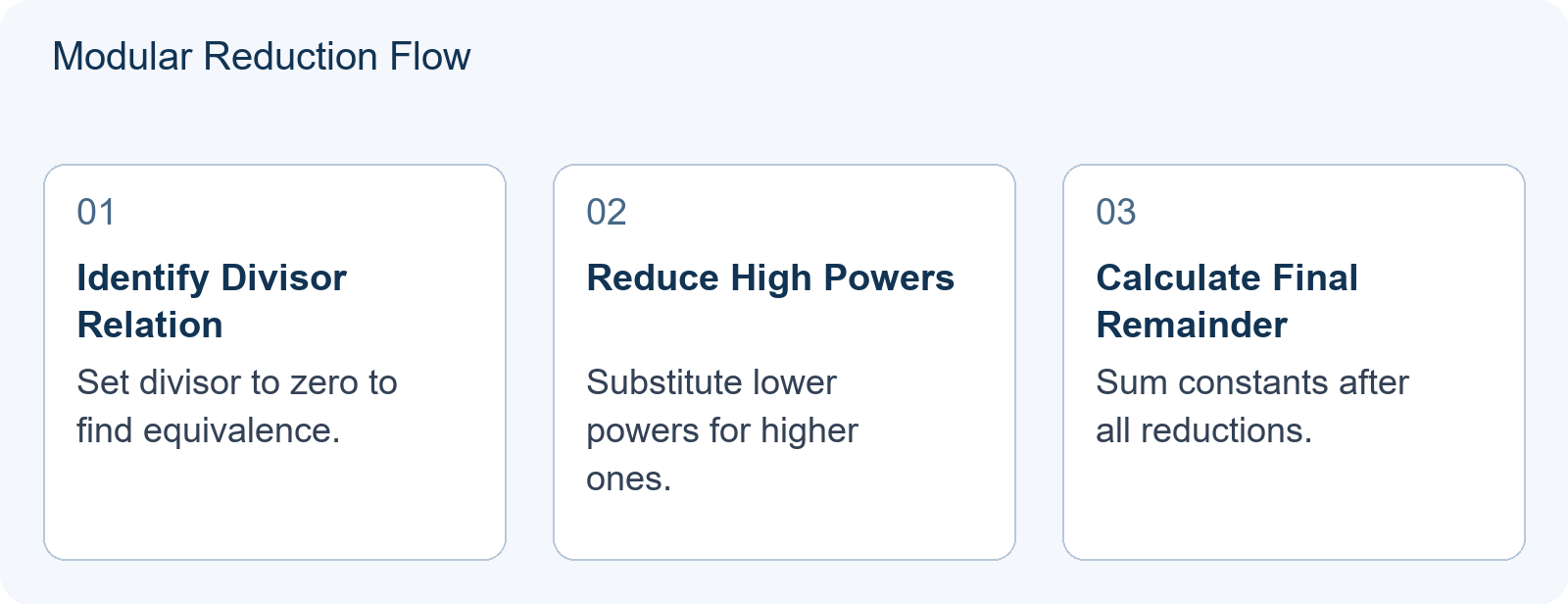
The Remainder Theorem states that if a polynomial P(x) is divided by (x - c), the remainder is P(c). When the divisor is more complex, such as (ax² + bx + c), direct application requires finding roots or using undetermined coefficients. In AIME contexts, divisors are often chosen so that their roots are irrational or complex, making direct substitution messy. The key insight is to treat the polynomial equation modulo the divisor. If we know that x² ≡ k (mod x² - k), we can reduce high powers of x systematically without expanding the entire expression.

This modular perspective transforms a division problem into a substitution problem. Rather than asking "what is the quotient?" we ask "what is x equivalent to?" The answer allows us to collapse exponents rapidly. This method is particularly powerful because AIME problems frequently feature polynomials of degree 8 or higher divided by simple quadratics—precisely the structure where brute-force long division would waste five to ten minutes.

Teaching Illustration 1: Strategic Reduction

Consider a teaching illustration where you need the remainder when P(x) = x¹⁰ + 5x⁸ + 2 is divided by Q(x) = x² - 3. Instead of dividing term by term, observe that x² ≡ 3 (mod x² - 3). Therefore, x¹⁰ = (x²)⁵ ≡ 3⁵ = 243. Similarly, x⁸ = (x²)⁴ ≡ 3⁴ = 81. Substituting these back into P(x), the remainder is 243 + 5(81) + 2 = 243 + 405 + 2 = 650. This method takes seconds compared to minutes spent on long division.

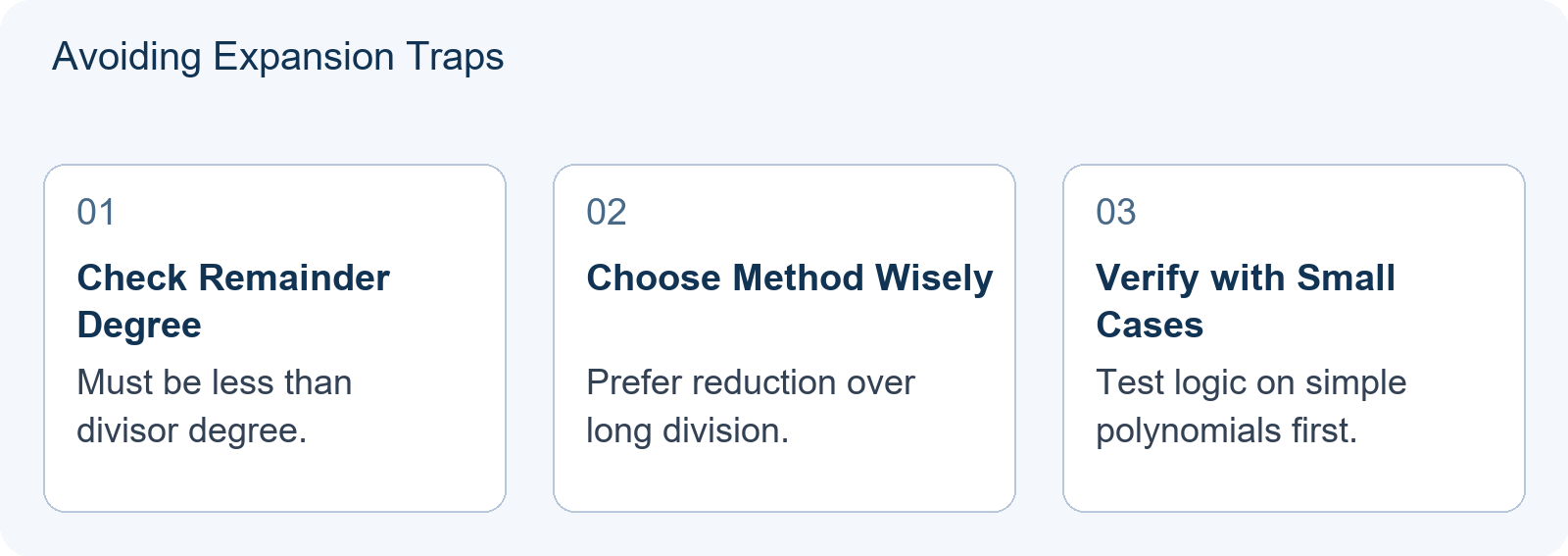
The critical verification step is confirming that the remainder's degree is less than the divisor's degree. Here, the remainder 650 is a constant (degree 0), which is less than degree 2, so the answer is complete. Students who attempt long division would arrive at the same constant but through far more error-prone arithmetic.

Teaching Illustration 2: Where Assumptions Fail

A common mistake occurs when students assume they can simply plug in values without verifying the degree of the remainder. Suppose P(x) is divided by D(x) = x² + x + 1. The remainder must be linear, say R(x) = ax + b. Students might try to find a and b by evaluating P(ω) where ω is a complex root. While valid, this requires handling complex numbers carefully. A safer, purely algebraic approach involves reducing powers of x using x² ≡ -x - 1. For example, x³ = x·x² ≡ x(-x-1) = -x² - x ≡ -(-x-1) - x = 1. Recognizing that x³ ≡ 1 allows rapid reduction of any power xⁿ based on n mod 3.

If a student fails to identify this cyclic pattern, they may attempt unnecessary complex substitutions, leading to calculation errors. The modular approach here reveals structure: since x³ ≡ 1, the powers of x cycle with period 3. For any polynomial, we can reduce exponents modulo 3, then express the result as a linear combination of 1 and x, which gives the remainder directly.

Diagnostic Table: Common Errors vs. Efficient Methods

Error Type Description Correct Approach
Brute Force Division Performing full polynomial long division. Use modular reduction (xᵏ ≡ r).
Ignoring Remainder Degree Assuming remainder is constant for quadratic divisors. Remainder degree < Divisor degree (linear for quadratic).
Complex Root Misuse Making arithmetic errors with i or ω. Stick to real-coefficient reduction rules.

Modular Reduction Flow

Building Systematic Skill: A Targeted Practice Sequence

To build this skill, start with divisors of the form x² - k, where the reduction is immediate: x² ≡ k. Practice reducing xⁿ for n up to 12. Then move to x² + x + 1 or x² - x + 1 where cyclic patterns emerge—here, x³ ≡ 1 or similar identities appear. Finally, tackle general quadratics requiring systems of equations for coefficients a and b. This progression mirrors the difficulty curve seen in competition contexts.

Each stage demands verification: after finding a remainder, multiply the quotient (if known) by the divisor and add the remainder—check that you recover the original polynomial. This sanity check catches sign errors and coefficient mistakes instantly.

For broader context on eligibility and preparation strategies, refer to our AIME: 7 Points is the Watershed, 10 Points is the Stepping Stone. Understanding the structural changes in the exam format, such as the shift to computer-based testing, helps contextualize why speed and accuracy in algebraic manipulation are critical. Additional background on qualification pathways appears in AMC Math Competition: A Guide to AIME Qualification and Preparation.

Demonstrating Competence

A learner should be able to take any polynomial up to degree 10 and divide it by a monic quadratic within two minutes, showing clear steps of power reduction rather than division algorithms. This aligns with the emphasis on foundational algebra skills highlighted in our From AMC8 to AIME: The Ultimate Math Competition Progression Path. Mastery means recognizing the divisor's structure instantly and selecting the appropriate reduction path without hesitation.

Avoiding Expansion Traps

Frequently Asked Questions

Can I always use the Remainder Theorem directly?

Only for linear divisors like (x-c). For quadratics, you must use modular reduction or set up a system for the linear remainder ax+b.

Is complex number substitution faster?

It can be, but it risks arithmetic errors. Algebraic reduction using x² relations is often safer and quicker for integer coefficients.

How does this apply to the new AIME format?

The new format emphasizes speed and accuracy. Mastering reduction techniques saves time compared to manual long division.

AIME Counting With Symmetry: When Dividing by the Number of Rotations Fails

Many AIME preparation students encounter counting problems where symmetry seems to invite a quick shortcut: identify rotational symmetry, then divide the total count by the number of rotations. This article addresses the specific failure mode in the title—when and why this division fails—through two original teaching illustrations. For broader context on AIME eligibility and the 2026-27 competition changes, see our AIME: 7 Points is the Watershed, 10 Points is the Stepping Stone.

The Tempting Shortcut and Its Limits

The intuition behind "divide by the number of rotations" comes from Burnside's lemma or basic orbit-counting: if a figure has n-fold rotational symmetry, one might expect each distinct configuration to appear n times in an unconstrained count. But this only holds under strict conditions that AIME problems often violate. The two cases below show a valid application and a common misapplication.

Case 1: Where Division Works (Teaching Illustration)

Setup: Count the number of distinct necklaces of 6 beads, using 2 red and 4 blue beads, where rotations are considered identical but reflections are distinguished.

Unconstrained count: Choose positions for the 2 red beads: C(6,2) = 15.

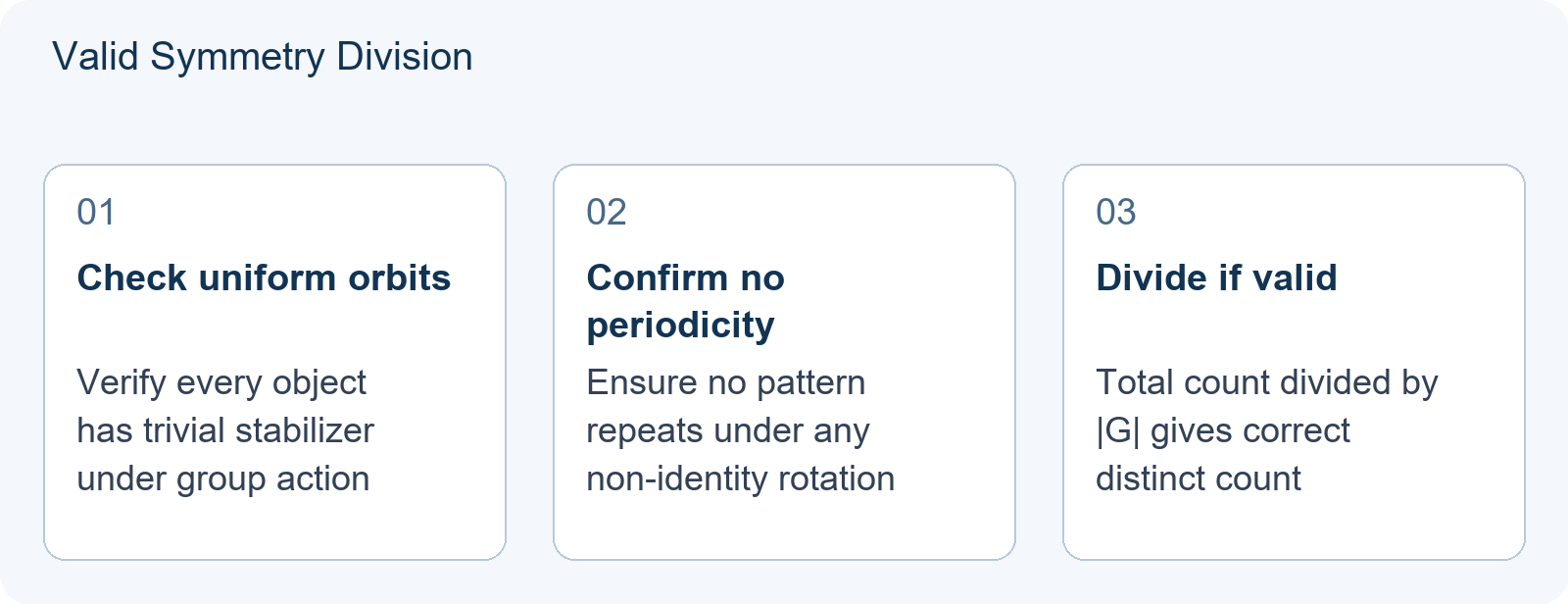
Symmetry analysis: The cyclic group C₆ acts on these 15 configurations. For a configuration to have stabilizer larger than the identity, the pattern must repeat with period dividing 6. With exactly 2 red beads, the only possible non-trivial stabilizer would require period 2 (3 copies of a 2-bead pattern) or period 3 (2 copies of a 3-bead pattern). Period 3 is impossible: it requires 3 red beads (one per block) or 0 red beads, not 2. Period 2 requires opposite beads to match, which is possible.

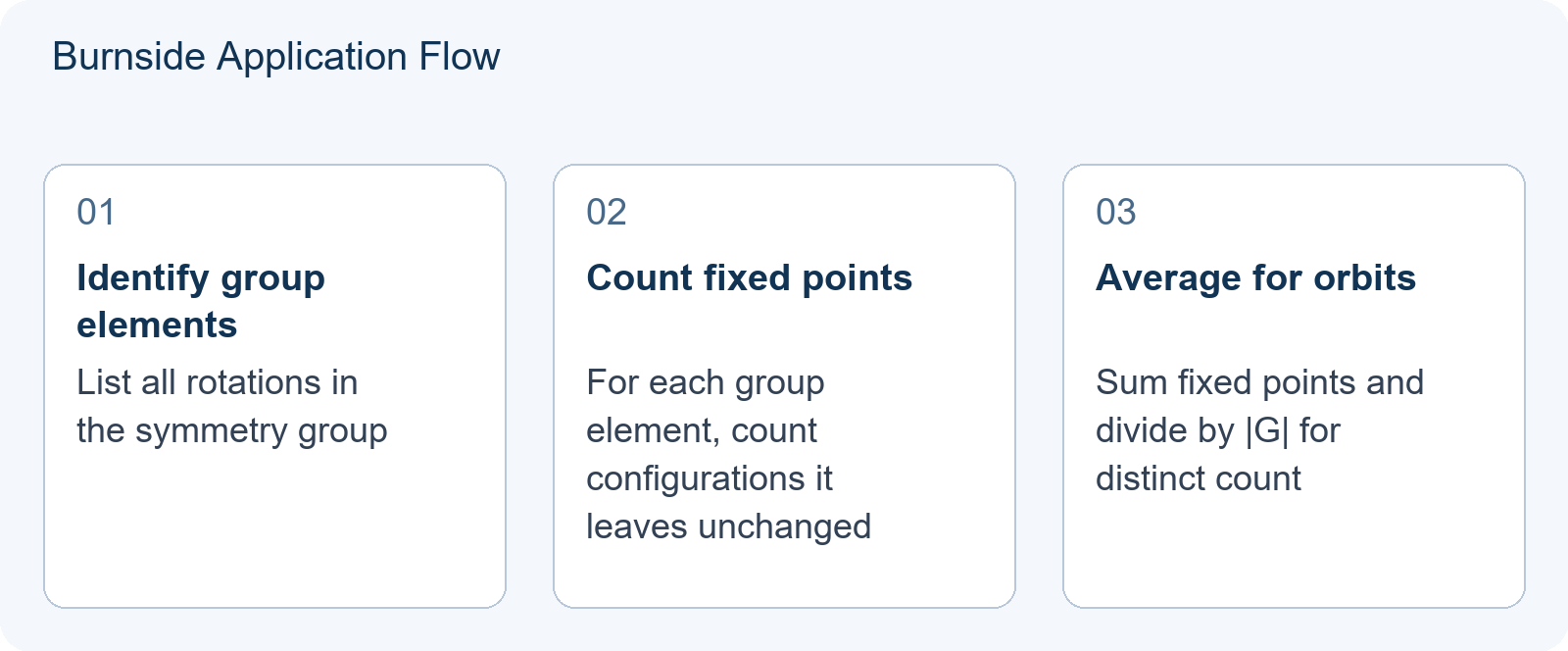
Correct approach (Burnside's lemma):

  • Identity (1 element): fixes all 15 configurations
  • Rotation by 60° and 300° (2 elements, order 6): fix only uniform colorings; impossible with 2 red, 4 blue. Fix 0 each.
  • Rotation by 120° and 240° (2 elements, order 3): require three matching positions; impossible with 2 red. Fix 0 each.
  • Rotation by 180° (1 element, order 2): requires opposite beads to match. With 2 red, 4 blue, choose which of the 3 opposite pairs is red-red: 3 configurations fixed.

Distinct necklaces = (15 + 0 + 0 + 0 + 0 + 3)/6 = 18/6 = 3.

Why naive division fails: 15/6 = 2.5 is not an integer, immediately signaling error. Even if it were integer, the correct answer 3 ≠ 2.5. The non-trivial stabilizer from the 180° rotation (3 configurations with opposite reds) makes uniform orbit size impossible.

Valid Symmetry Division

Case 2: Where Division Fails Disastrously (Teaching Illustration)

Setup: Count distinct colorings of a regular hexagon's vertices with 3 colors (R, G, B), where two colorings are equivalent if one rotates to the other.

Naive approach: Total colorings = 3⁶ = 729. Hexagon has 6 rotations. "Answer": 729/6 = 121.5—not even an integer, immediate red flag.

Why division fails: Different colorings have different stabilizer sizes. The monochromatic colorings (all R, all G, all B) have stabilizer size 6, not 1. Many patterns with repeating subpatterns (like RGRGRG) have stabilizer size 2 or 3. The orbits are not uniform in size.

Correct approach (Burnside):

  • Identity (1): fixes all 3⁶ = 729
  • Rotation by 60° and 300° (2 elements): fix colorings with all vertices same color, so 3 each
  • Rotation by 120° and 240° (2 elements): fix colorings with period 3, so 3² = 9 each
  • Rotation by 180° (1 element): fixes colorings with opposite vertices equal, so 3³ = 27

Distinct colorings = (729 + 2·3 + 2·9 + 27)/6 = (729 + 6 + 18 + 27)/6 = 780/6 = 130.

The naive 121.5 is wrong by nearly 7%; in other problems, the error can be larger.

Diagnostic: When Can You Divide?

Condition Safe to divide? Typical AIME context
All orbits have same size |G| Yes Rare; requires no non-identity symmetry in any configuration
Some orbits smaller (non-trivial stabilizers) No Most symmetry counting problems
Counting orbits of group action on labeled objects Use Burnside Necklaces, colorings, arrangements
"Up to rotation" with constraints on counts Use Burnside Bead colorings with fixed color frequencies

The Key Decision Rule

Before dividing by |G|, ask: Does every configuration I'm counting have trivial stabilizer? If any configuration could repeat under a non-identity rotation—same colors in a periodic pattern, identical objects arranged symmetrically, etc.—then division is invalid. Burnside's lemma is the reliable tool.

Building the Skill for AIME

AIME counting problems with symmetry typically appear in the 7-12 range, where careful case analysis separates correct from incorrect answers. The specific skill to demonstrate: given a symmetry condition, identify the group action, compute fixed points for each symmetry, and apply the orbit-counting formula.

For practice sequencing and broader preparation strategies, refer to our AMC Math Competition: A Guide to AIME Qualification and Preparation. Students ready for advanced topics may also consult From AMC8 to AIME: The Ultimate Math Competition Progression Path for additional challenge areas.

Preparing for Consultation

If you're working through symmetry counting and considering structured support, prepare these items for productive discussion:

  • Specific problems where your answer differed from the solution—note whether you used division or Burnside
  • Your current comfort with cycle notation and group actions
  • Whether you're targeting AIME qualification (AMC 10/12 performance) or AIME score improvement (USAJMO/USAMO trajectory)

Understanding the 2026-27 AIME format changes—including the two-part 90-minute structure and computer-based delivery—also informs how to time your practice sessions. The mathematical content, however, remains consistent with past years.

Burnside Application Flow

Frequently Asked Questions

Why does 729/6 not work for hexagon colorings?

Because different colorings have different stabilizer sizes. Monochromatic colorings are fixed by all 6 rotations, not just the identity. Burnside's lemma accounts for this by averaging fixed points across all group elements.

Can I every just divide by the number of rotations?

Only when every configuration has trivial stabilizer—meaning no configuration has any rotational symmetry. This is rare in competition problems; verify by checking if any periodic pattern is possible under the given constraints.

How does the 2026-27 AIME format affect symmetry problem preparation?

The mathematical content remains unchanged. The two-part timing structure means you should practice sustaining focus for 90-minute blocks, but the counting techniques—including Burnside's lemma—are the same as in prior years.

AIME Answer Checking: Catching Extraneous Roots Before Recording an Integer

The American Invitational Mathematics Examination (AIME) requires answers to be integers between 0 and 999. While many students focus on solving complex equations or combinatorial structures, a frequent source of lost points is failing to verify that the derived solution actually satisfies the original problem's constraints. This article addresses the specific preparation need of AIME Answer Checking, focusing on catching extraneous roots and domain violations before recording an integer.

Why Verification Matters in AIME

In standard multiple-choice competitions like AMC 10/12, incorrect intermediate steps might still lead to a plausible distractor. In AIME, however, there are no choices. If you solve an equation algebraically but fail to check for extraneous roots introduced by squaring both sides, or if you miss a geometric constraint that renders a solution impossible, you will record an invalid number. The recent reforms announced by MAA for the 2027 AIME emphasize rigorous testing conditions, including electronic entry and strict time limits. This makes efficient, reliable verification habits even more critical, as there is less opportunity for casual re-reading during the exam.

Teaching Illustration 1: The Squaring Trap

The following is an original teaching illustration, not an official past problem.

Consider a problem asking for the sum of all real values of x satisfying x+5=x−1. A common student approach is to square both sides immediately:

  • x+5=(x−1)2
  • x+5=x2−2x+1
  • x2−3x−4=0
  • (x−4)(x+1)=0

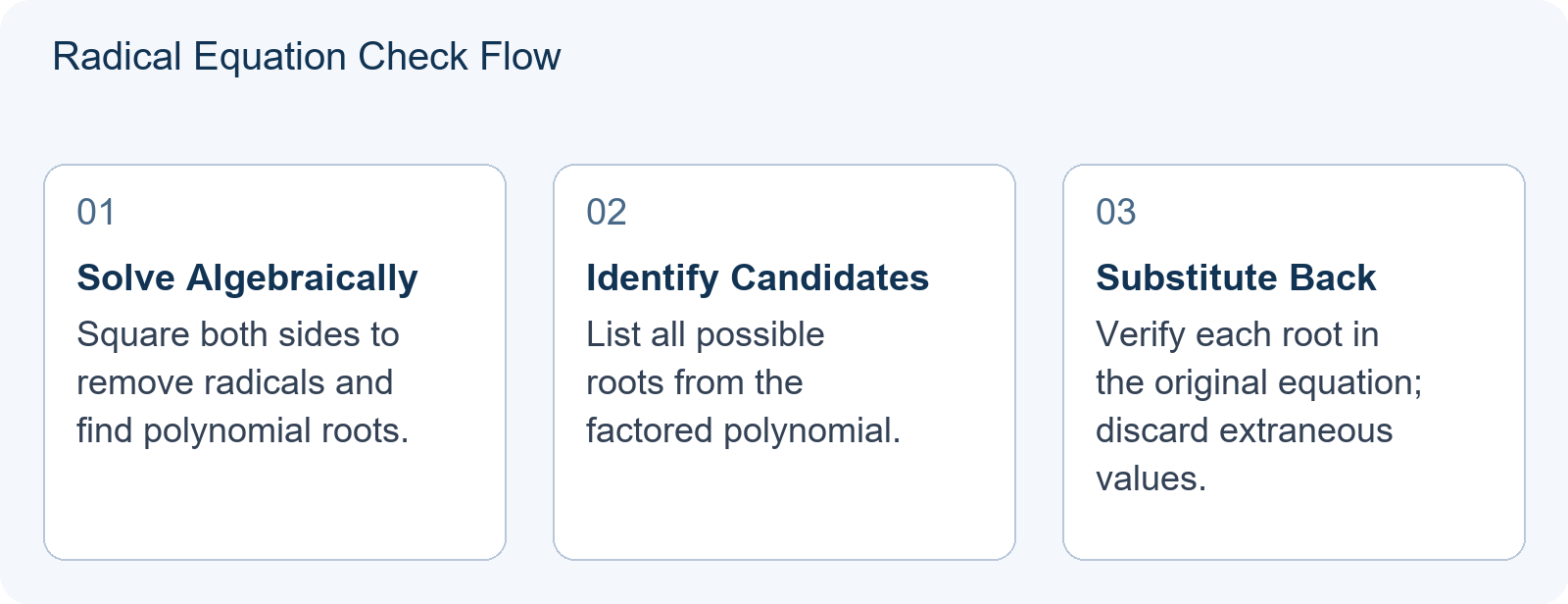
This yields potential solutions x=4 and x=−1. If the student simply sums these (4+(−1)=3), they arrive at an incorrect answer. Why? Because squaring can introduce extraneous roots. We must check each candidate against the original equation:

  • For x=4: 4+5=9=3, and 4−1=3. This works.
  • For x=−1: −1+5=4=2, but −1−1=−2. Since 2≠−2, this root is extraneous.

The correct sum is just 4. Without this verification step, the answer would be wrong. Notice also that the extraneous root x=−1 makes the right-hand side negative while the left-hand side (a square root) must be non-negative—a structural clue that could catch the error even faster.

Teaching Illustration 2: Geometry Constraints and the Acute Triangle

The following is an original teaching illustration, not an official past problem.

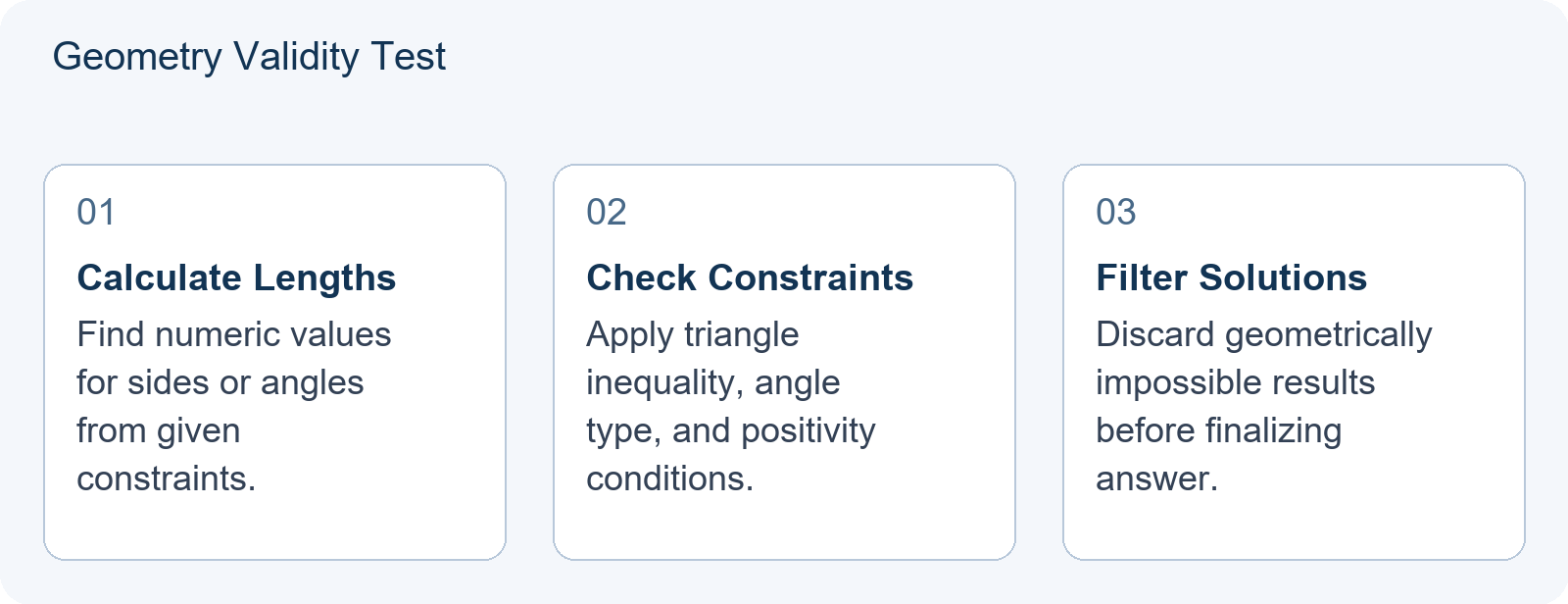
Imagine a problem involving a triangle with side lengths a=5, b=6, and variable side c, where the triangle must be acute. The question asks for the maximum integer value of c. Using the law of cosines, c2=a2+b2−2abcosC, a student might derive that for an acute triangle, all angles must be less than 90°. This requires three conditions:

  • a2+b2>c2 → 25+36=61>c2, so c<61≈7.81
  • a2+c2>b2 → 25+c2>36, so c2>11, meaning c>11≈3.32
  • b2+c2>a2 → 36+c2>25, automatically satisfied for positive c

A hurried student might approximate 61≈8 and incorrectly assume c can equal 8. However, checking the condition strictly: 82=64, which is not less than 61 (64>61), meaning the triangle would be obtuse, not acute. The valid maximum integer is c=7, since 72=49<61. This illustrates how rounding errors or loose bounds can lead to recording an invalid geometric configuration.

Diagnostic Table for Common Errors

Error Type Cause Verification Strategy
Extraneous Roots Squaring both sides of radical equations. Substitute back into original equation; check signs match.
Domain Violation Logarithms of non-positive numbers; division by zero. Check argument positivity and denominator non-zero status.
Geometric Impossibility Triangle inequality failure; negative lengths; wrong angle type. Verify all sides satisfy triangle inequalities and specific type constraints.
Integer Constraint Miss Answer is not an integer or outside 0-999. Re-examine derivation; round appropriately only if specified; ensure bounds.

Radical Equation Check Flow

Targeted Practice Sequence

To build this skill, do not just solve problems; practice the "stop-and-check" routine. For every AIME-style problem you attempt, explicitly write down the verification step before calculating the final integer. Start with simple radical equations, then move to systems of equations where substitution might introduce false solutions, and finally tackle geometry problems with multiple cases.

Begin with ten minutes daily on problems specifically designed to hide extraneous roots. When you find a candidate solution, pause and ask: "Does this make both sides of the original equation equal?" and "Does this violate any domain restriction I haven't checked?" This deliberate pause becomes automatic with repetition, and it prevents the costly error of recording an integer that algebra alone falsely suggested.

For broader context on qualification rules and scoring changes, refer to our How to Qualify for the AIME: AMC10 Cutoff Scores, Awards, and Difficulty. To understand how these skills fit into the new 2027 format, see AMC Math Competition: A Guide to AIME Qualification and Preparation. For specific resource recommendations, visit From AMC8 to AIME: The Ultimate Math Competition Progression Path.

Demonstrating Competence

A learner should be able to demonstrate this skill by consistently identifying why a particular algebraic solution is invalid due to domain restrictions or extraneous roots within 30 seconds of finding it. This speed is crucial when managing the two 90-minute segments of the upcoming computer-based AIME format, where efficient answer checking preserves time for harder problems.

Geometry Validity Test

Frequently Asked Questions

Does AIME allow partial credit for showing work?

No, AIME scores are based solely on the correctness of the final integer answer entered. Showing work does not earn points, so accurate verification is essential.

What happens if my calculated answer is not an integer?

You must re-evaluate your method. AIME answers are always integers between 0 and 999. Non-integers indicate a calculation error or misinterpretation of the question.

Are calculators allowed for checking answers?

No, calculators are not permitted in AIME. You must use mental arithmetic or scratch paper provided at the test center to verify solutions.

Online Consultation
Online Consultation